
Boiler Flues Explained: Everything You Need to Know
Quick Answer: A boiler flue is a pipe or duct that safely carries combustion gases — including carbon dioxide, water vapour, and carbon monoxide — from your boiler to the outside of your home. Every gas boiler installation requires a flue by law. Without one, harmful exhaust gases would accumulate inside your property, posing a serious health risk.
Introduction
A boiler flue is one of the most safety-critical components in any gas central heating system, yet most homeowners know very little about it. Your boiler flue removes combustion byproducts from your home every time your heating fires up, and without it, those gases — including carbon monoxide — would have nowhere to go. When it comes to maintaining your boiler, understanding the various components is crucial, especially during boiler timer troubleshooting steps. Identifying issues with your boiler’s timer can significantly affect efficiency and safety. Regularly checking the timer settings and ensuring proper function can help prevent larger, more costly problems down the line. In addition to the timer, it’s important to be aware of potential boiler water leak causes explained in your maintenance routine. Small leaks can lead to significant issues, including corrosion and increased energy costs. Being proactive about identifying and addressing these leaks can ensure your heating system runs efficiently and safely.
Boiler flues are required by law for all combi, system, and regular boiler installations. Gas Safe regulations govern where flues can be positioned, how they must be sealed, and the maximum distances they can travel. Whether you are replacing an old boiler, moving into a new property, or simply trying to better understand your heating system, knowing the basics of your boiler flue protects your household and helps you avoid costly mistakes. When considering boiler flue laws in New York, it’s crucial to stay informed about the latest regulations to ensure compliance and safety. Local authorities may have specific requirements regarding the installation and maintenance of boiler flues that differ from state-wide laws. Consulting with a licensed professional who understands these laws can help prevent legal issues and enhance the efficiency of your heating system.
This guide covers what a boiler flue is, the different types available, regulations you need to know, associated costs, and how to identify what type of flue your property has. Understanding zanussi boiler pricing options explained can help homeowners make more informed decisions. By comparing different models and their features, you can find a solution that fits your budget and heating needs. Additionally, considering any available warranties or service plans can further enhance the value of your investment. When selecting a heating solution, it’s also wise to consider the infrared heating panel benefits and costs, which can provide an energy-efficient alternative. These panels not only offer quicker heating times but also maintain a stable temperature, which can lead to lower energy bills over time. Homeowners should evaluate these options alongside traditional heating systems to make the best choice for their living spaces.

Understanding Boiler Flues: The Core Relationships
A boiler flue forms part of an interconnected system where every component has a defined role in safely managing combustion gases. Homeowners should explore various boiler financing options for homeowners to ensure they choose a system that fits their budget while maintaining efficiency. Understanding these options is crucial, as they can help offset the initial investment and promote long-term savings on energy costs. With the right financing, homeowners can upgrade to a more energy-efficient boiler, enhancing safety and performance in their heating system. When considering the best boiler models for three bedroom houses, it’s essential to evaluate factors such as energy efficiency ratings and reliability. Additionally, homeowners should read reviews and compare warranties to ensure they make a well-informed choice. Investing time in research can lead to significant savings and improved comfort in the long run.
- A boiler flue is a duct that carries exhaust gases from the boiler to the exterior of the building.
- A gas boiler produces combustion byproducts — including carbon dioxide, water vapour, nitrogen oxides, and carbon monoxide — during operation.
- A condensing boiler uses the flue to cool exhaust gases until water vapour condenses into liquid, improving overall efficiency.
- A boiler condensate pipe removes the liquid waste produced during this condensation process separately from the flue gases.
- A horizontal flue travels through the external wall directly behind the boiler and is the most common flue type in UK homes.
- A vertical flue rises through the roof and is used when the boiler is not positioned on an external wall.
- A round flue indicates a boiler installed within the last 15 years and uses regulation 22mm pipework.
- A square flue is associated with older installations that may still use 15mm pipework, which no longer meets current safety standards.
- A plume kit extends the flue outlet to redirect exhaust gases away from windows, doors, and air bricks when the boiler is positioned near an opening.
- Gas Safe registered engineers are the only professionals legally permitted to install, inspect, or repair boiler flues in the UK.
- Boiler flue regulations specify minimum clearance distances from boundaries, windows, and public footpaths to protect neighbouring properties.
- Annual boiler servicing includes a flue inspection to confirm that exhaust gases are venting correctly and that seals remain intact.
What Is a Boiler Flue?
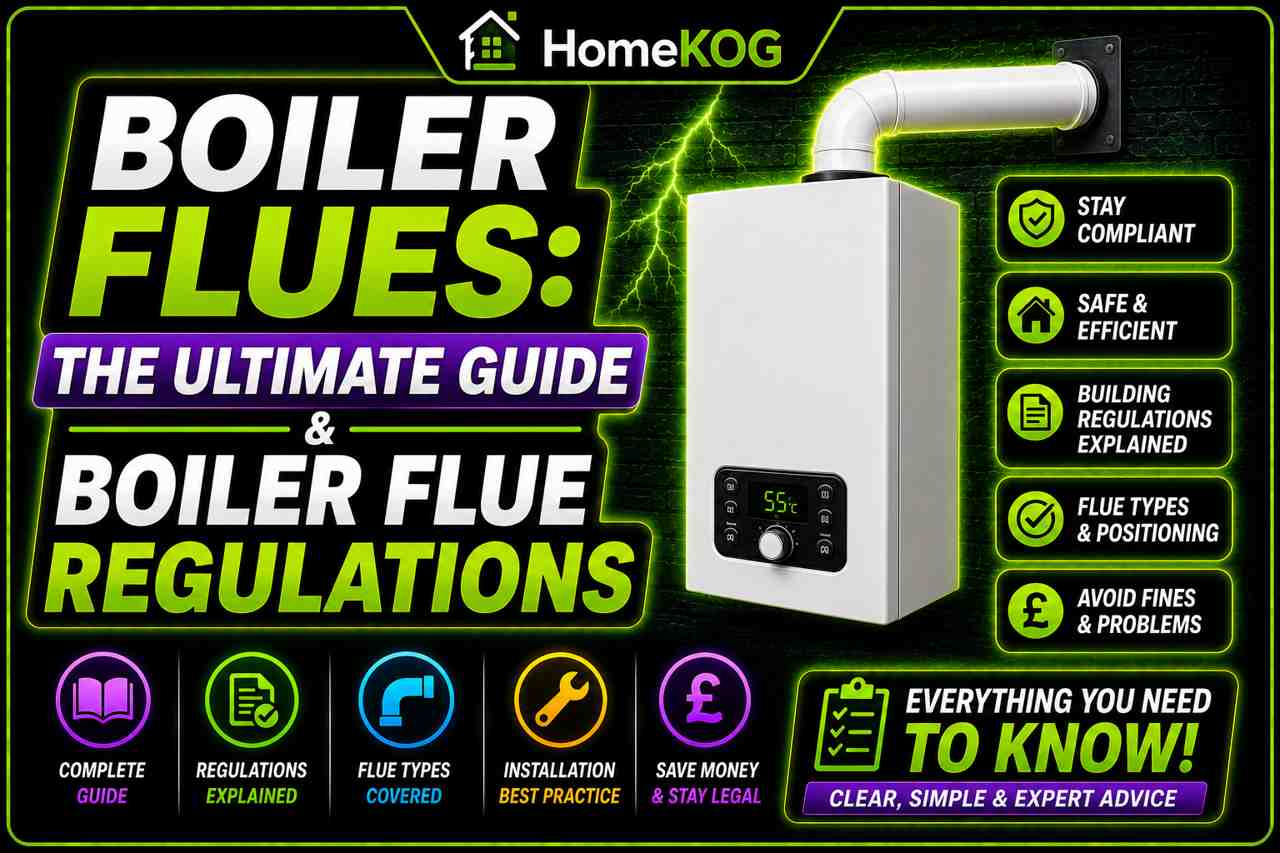
A boiler flue is a pipe or duct attached to a gas boiler that provides a sealed passageway for combustion gases to exit your home safely. The flue connects to the boiler unit and travels to an external wall or through the roof, terminating at a point where gases disperse safely into the open air.
Every time your boiler burns gas to heat water, it produces exhaust gases as a byproduct. These gases contain carbon dioxide, water vapour, and trace amounts of carbon monoxide and nitrogen oxides. The boiler flue ensures these byproducts exit the building without entering your living spaces. When considering your heating options, it’s essential to find the best swimming pool heaters for comfort to maintain an enjoyable swimming experience year-round. By investing in efficient heaters, you can not only enhance your comfort but also reduce energy consumption and costs. These heaters vary in type and technology, making it crucial to choose one that best suits your needs and preferences. Adjusting your set combi boiler flow temperature is another critical factor in maximizing efficiency and ensuring that your heating system operates at its best. A well-set flow temperature can lead to significant energy savings and improved comfort levels throughout your home. It’s advisable to consult with a heating professional to determine the optimal settings based on your specific system and usage patterns.
Without a boiler flue, combustion gases would accumulate indoors. Carbon monoxide — a colourless, odourless gas produced during incomplete combustion — is particularly dangerous and can be fatal at elevated concentrations. The flue eliminates this risk entirely by providing a dedicated, sealed exit route.
What Comes Out of a Boiler Flue?
The gases exiting a boiler flue depend on the type and efficiency of the appliance. In a condensing boiler — the standard type required in all new UK installations — the flue expels cooled combustion gases that have already had their water vapour condensed and removed as liquid waste.
You may notice white steam or vapour coming from a boiler flue on cold days. This is water vapour in the exhaust gases condensing as it meets cool outside air — it is entirely normal and not a sign of any fault.
A high-efficiency condensing boiler extracts more heat from the combustion process, which means exhaust gases leave the flue at a lower temperature than in older, non-condensing boilers. This is what produces the visible plume of steam on colder days.
Types of Boiler Flue
Boiler flues are categorised by their orientation and shape. Understanding which type your property has helps when arranging servicing, requesting quotes, or planning a boiler replacement.
Horizontal Flues
A horizontal flue is the most common type found in UK homes. The pipe travels directly through the external wall behind or beside the boiler, terminating on the outside of the building.
Horizontal flues are straightforward to install, less expensive than vertical alternatives, and easy to inspect visually from outside the property. If your boiler is mounted on an external wall, a horizontal flue is almost certainly what you have.
Vertical Flues
A vertical flue rises upward from the boiler and exits through the roof rather than through a side wall. This configuration is used when the boiler is positioned on an internal wall with no direct access to an external surface.
Vertical flues require more complex installation because the duct must be routed through the ceiling and roof structure. In many cases, scaffolding is needed to complete the roof penetration safely, and roof tiles must be removed and replaced around the flue terminal. These additional requirements make vertical flue installations significantly more expensive than horizontal equivalents.
The vertical flue terminal protrudes from the roof and resembles a small chimney. You may see steam rising from it on cold days when the heating is active.
Round vs Square Flues
Beyond orientation, flues are also distinguished by their cross-sectional shape, which indicates the age of the installation.
- Round flues are fitted to boilers installed within the last 15 years. They use 22mm pipework that meets current Gas Safe regulations and is compatible with all modern boiler models.
- Square flues are found on older installations and typically use 15mm pipework, which predates current regulatory standards. If your property has a square flue, it should be assessed to determine whether upgrading to 22mm pipework is required.
The easiest way to identify your flue shape is to walk outside and look at where the pipe exits the building. The terminal end will be clearly round or square and takes only a moment to identify.
Boiler Flue Regulations
Boiler flue installation is governed by strict regulations designed to protect occupants, neighbours, and the general public. All installation work must be carried out by a Gas Safe registered engineer who is familiar with current requirements. When selecting the best boilers for rental properties, it’s essential to consider energy efficiency, reliability, and compliance with local regulations. A well-chosen boiler not only enhances tenant comfort but also contributes to lower utility bills, making your property more attractive to potential renters. Additionally, investing in reputable brands known for their durability can lead to long-term cost savings and fewer maintenance issues. When issues arise, it’s crucial to understand the specific problems that can occur with these systems. Grant boiler fault code explanations can be invaluable for diagnosing issues quickly and accurately. This knowledge empowers landlords to address concerns efficiently, ensuring their properties remain safe and comfortable for tenants.
Flue Location Requirements
The position of a boiler flue terminal is regulated to prevent combustion gases from entering neighbouring properties or creating hazards in public areas.
Key location requirements include:
- The flue terminal must be at least 600mm from any boundary line between properties.
- The flue must not be positioned directly below, above, or adjacent to a window, door, or air brick without sufficient clearance.
- Flue terminals must not be located near public footpaths or walkways where exhaust gases could affect pedestrians.
- In terraced or semi-detached properties, the flue must be positioned so that gases do not discharge toward a neighbouring property’s openings.
- If the boiler is located near a window or other opening, a plume kit must be installed to redirect exhaust gases away from the aperture.
Flue Sealing and Fixing Requirements
Beyond location, the physical installation of the flue must meet specific standards:
- The duct must be sealed at both the internal and external wall penetration points using an appropriate sealant such as caulk or sand cement.
- The pipe must be angled correctly — typically a slight downward slope toward the outside — to prevent condensate from dripping back into the boiler.
- All sections of the flue, including any extensions, must be secured firmly using bolts and screws throughout the entire length.
- The overall length of the flue must be calculated to maintain sufficient draught for safe gas expulsion without reducing boiler efficiency.
Vertical Flue Regulations
Vertical flues are subject to manufacturer-specific distance limits that determine how far the duct can travel before losing the draught needed to expel gases safely. These limits vary by boiler model, so checking the specification for your exact unit is essential.
As a general rule, each 90-degree bend in a vertical flue reduces the maximum allowable travel distance by 1 metre. A boiler rated for a 6-metre flue run, for example, can accommodate 6 metres straight, 5 metres with one bend, or 4 metres with two bends.
Flue Extension Regulations
Flue extension lengths are determined by the boiler manufacturer rather than a universal standard. Some boiler models support flue extensions as short as 1 metre, while others can accommodate runs of up to 20 metres. The make and model of your boiler determines which flue extension options are available, and your Gas Safe engineer will specify the correct configuration during installation.
Boiler Flue Costs
The cost implications of your boiler flue depend primarily on its type and whether any additional work is required during installation. Understanding the Navien NCB 300 boiler features overview can help you make informed decisions about your heating needs. This model is known for its energy efficiency and advanced technology, which can lead to long-term savings. Additionally, its compact design allows for versatile installation options, making it suitable for various residential settings. reliable boilers from Worcester Bosch are also a great option to consider for homeowners looking for efficiency and durability. These models offer a range of features that cater to different heating requirements, ensuring that you find the perfect fit for your home. With their reputation for high-quality engineering, choosing a Worcester Bosch boiler can provide peace of mind and optimal performance year-round.
| Flue Type | Typical Cost Impact | Notes |
|---|---|---|
| Horizontal round flue | Included in standard installation | No additional cost in most cases |
| Horizontal square flue (upgrade required) | £50 – £150 additional | Pipework upgrade to 22mm standard |
| Vertical flue | £200 – £600 additional | Depends on roof access and complexity |
| Vertical flue with scaffolding | £400 – £1,000+ additional | Required when roof is not safely accessible |
| Plume kit | £50 – £150 | Required when boiler is near windows or openings |
| Flue extension | £30 – £100 per metre | Depends on boiler model and total run length |
If you already have a standard horizontal round flue and your new boiler uses the same exit point, there is typically no additional cost beyond the boiler installation itself. Any cost increases are always communicated clearly before work proceeds. When considering Liverpool gas boiler costs breakdown, it’s important to factor in potential extra expenses such as adjustments to existing flue systems or renovations to support modern units. Additionally, obtaining quotes from multiple installers can provide a clearer picture of the various pricing tiers available in your area. Always ensure that any estimates include a detailed explanation of costs to avoid unexpected charges later on. As you explore various options, be sure to check the ATAG boiler reviews for 2026 to gauge performance and customer satisfaction. Many users highlight the energy efficiency and reliability of ATAG models, which can significantly impact your long-term savings. Additionally, look for feedback on warranty and customer service experiences to ensure you make an informed decision.
Does a New Boiler Come With a Flue?
Yes — every new boiler installation includes a new boiler flue as a standard component. Fitting an old or existing flue to a new boiler is not compliant with Gas Safe regulations, as each flue must be matched to the specific boiler model it serves.
A Gas Safe registered engineer will assess your existing flue exit point, confirm whether the current position meets current regulations, and install the new flue as part of the overall installation. If the exit position requires modification or the flue type needs to change — for example, from square to round — this work will be included in the installation quote.
Common Boiler Flue Problems
Boiler flue issues can affect safety, efficiency, and boiler performance. Recognising the signs of a flue problem allows you to act quickly and avoid more serious damage. when dealing with a Warmflow boiler error code troubleshooting, it is essential to follow the manufacturer’s guidelines. Proper diagnostics can often lead to a swift resolution, ensuring your system operates safely and efficiently. Regular maintenance checks can help prevent such error codes from arising in the first place. In addition to troubleshooting error codes, winter boiler maintenance tips play a crucial role in ensuring optimal performance during the colder months. This includes checking the flue for blockages, inspecting the boiler for any signs of wear and tear, and ensuring that all components are functioning correctly. Taking these preventive measures can not only enhance efficiency but also extend the lifespan of your boiler system.
- Blocked flue terminal — birds, insects, or debris can obstruct the external flue terminal, preventing gases from escaping safely. Many modern boilers display a fault code when flue blockage is detected.
- Flue seal deterioration — seals around the wall penetration points degrade over time, allowing draught or moisture ingress that affects flue performance.
- Incorrect flue angle — a flue installed without the correct downward slope allows condensate to pool inside the duct and drip back into the boiler, causing internal corrosion.
- Flue separation — sections of a multi-piece flue can separate over time, particularly in vertical installations, allowing combustion gases to leak into ceiling voids or roof spaces.
- Visible corrosion — rust or staining around the external flue terminal indicates moisture ingress or corrosion within the duct that requires assessment.
If you suspect any of the above problems, do not attempt to inspect or repair the flue yourself. Contact a Gas Safe registered engineer to carry out a proper assessment.
Back Boilers and Flues
Back boilers — units fitted behind a fireplace and connected to the chimney rather than a dedicated flue — are the one exception to the standard flue requirement. If your property has a back boiler, combustion gases exit through the existing chimney structure rather than a purpose-built flue pipe.
Back boilers are significantly less energy-efficient than modern combi, system, and regular boilers. Replacing a back boiler with a modern condensing boiler reduces energy consumption, lowers gas bills, and brings the heating system up to current efficiency and safety standards. Any back boiler replacement includes installing a new purpose-built flue as part of the work. As homeowners prepare for the colder months, it is essential to consider the best condensing boilers for winter 2026 to ensure optimal warmth and efficiency. Investing in a high-quality condensing boiler not only enhances comfort but also contributes to long-term savings by minimizing energy waste. With various brands and models available, it’s important to compare features and reviews to find the ideal solution for your home heating needs.
Frequently Asked Questions
What is a boiler flue and why do I need one?
A boiler flue is a sealed pipe or duct that carries combustion gases — including carbon dioxide, water vapour, and carbon monoxide — from your boiler to the outside of your home. Every gas boiler installation legally requires a flue. Without one, harmful exhaust gases would accumulate inside your property. Carbon monoxide in particular poses a serious health risk, making the boiler flue a critical safety component in any central heating system.
Where is my boiler flue located?
Your boiler flue is typically visible on the outside wall of your property, positioned on the wall closest to where your boiler is installed internally. Look for a round or square pipe terminal protruding from the wall, usually at a low to mid-height position. On cold days, you may notice steam or white vapour coming from the terminal when your boiler is running. If your boiler is on an internal wall, the flue may exit through the roof as a vertical flue terminal.
What is the difference between a horizontal and vertical boiler flue?
A horizontal flue travels directly through the external wall behind the boiler and is the standard, more affordable installation. A vertical flue rises from the boiler upward through the roof and is required when the boiler is fitted on an internal wall with no external wall access. Vertical flues are more complex to install, often require scaffolding for roof access, and carry higher installation costs than horizontal alternatives.
How far can a boiler flue extend?
Maximum boiler flue extension length is determined by the specific boiler manufacturer rather than a universal standard. Some models support flue runs as short as 1 metre, while others can extend up to 20 metres. Each 90-degree bend reduces the maximum allowable distance by 1 metre. Your Gas Safe engineer will calculate the correct flue length for your specific boiler model and installation position during the survey.
Is steam coming from my boiler flue normal?
Yes — white steam or vapour visible from a boiler flue terminal is completely normal, particularly in cold weather. Condensing boilers — the standard type required in all new UK installations — produce cooled exhaust gases that contain water vapour. When this vapour meets cold outdoor air, it condenses into a visible white plume. This is not smoke and is not a sign of any fault. Persistent black smoke, unusual smells, or sooting around the terminal would indicate a problem requiring immediate attention.
Can I block or cover my boiler flue?
No — a boiler flue must never be blocked, covered, or obstructed in any way. The flue provides the only safe exit route for combustion gases, and any obstruction prevents these gases from venting correctly, creating a carbon monoxide risk inside your home. If your flue terminal has been accidentally blocked by debris, a bird nest, or building materials, contact a Gas Safe engineer to clear the obstruction safely before operating the boiler.
How often should a boiler flue be inspected?
A boiler flue should be visually inspected every year as part of your annual boiler service. A Gas Safe engineer checks the integrity of the flue seals, confirms the terminal is unobstructed, verifies that exhaust gases are venting correctly using combustion analysis equipment, and identifies any deterioration in the flue pipework. Between services, you can carry out a basic external check yourself to confirm the terminal is clear and that no visible corrosion or damage has developed.
What regulations govern boiler flue installation?
Boiler flue installation in the UK is governed by Gas Safe regulations, Building Regulations Part J, and manufacturer-specific requirements. Key rules include minimum clearance distances from boundaries (600mm), windows, doors, and public footpaths; sealing requirements at wall penetration points; correct pipe angle to allow condensate drainage; and maximum flue length limits that vary by boiler model. All installation work must be carried out by a Gas Safe registered engineer and a Building Regulations certificate issued on completion.
Conclusion: Your Boiler Flue Keeps Your Home Safe
A boiler flue is not an optional accessory — it is a legally required, safety-critical component of every gas boiler installation. Your boiler flue removes harmful combustion gases from your home every time your heating runs, and a faulty or non-compliant flue puts your household at risk.
Understanding the type of flue you have, its condition, and whether it meets current regulations gives you the information needed to make confident decisions when servicing or replacing your boiler. A Gas Safe registered engineer remains the only professional qualified to install, inspect, or repair a boiler flue safely and legally.
Book an annual boiler service to keep your flue in good condition, confirm your installation meets current regulations, and protect your home and everyone in it. If you are considering a new boiler, request a quote that clearly includes the flue installation — it should always be part of the package.