
Grant Boiler Error Codes: Faults, Causes and Troubleshooting Guide 2026
Quick Answer: Grant boiler fault codes fall into two categories — PP codes indicate sensor failures and PP6/PP7 indicate protection activations, while EE codes cover system faults including pump failure, low pressure, and PCB issues. EE2 (low pressure) can be resolved by the homeowner via the filling loop. Bleeding an air-locked oil pipe is also a DIY task. All other fault codes and the majority of Grant oil boiler faults require a qualified OFTEC-registered engineer.
Grant UK has built a strong reputation in the oil boiler market over several decades, with the Vortex and VortexBlue ranges regularly appearing in Which? Best Buy Awards. Like all boilers, Grant units use a fault code system to communicate problems on the control panel, and understanding what each code means helps homeowners act quickly and avoid unnecessary disruption to heating and hot water supply. Make a note of any code displayed before resetting the boiler, particularly if the boiler is still under warranty and a technician call-out may be needed. When considering new heating systems, homeowners should explore financing options for boiler installation to manage costs effectively. Various plans can make high-efficiency models more accessible, enabling families to enjoy the benefits of modern technology without overwhelming upfront expenses. Additionally, it’s wise to consult with local experts to find the best deals and options that suit specific needs.
Grant Boiler PP Fault Codes — Sensor Faults and Protection Activations
PP codes on Grant boilers indicate sensor failures or protection mechanisms that have activated. Most sensor faults require an OFTEC engineer to inspect and replace the affected component, but PP6 and PP7 are worth understanding in more detail as they indicate specific protection events rather than hardware failures.

PP1 — Inlet Sensor Failure
The PP1 code indicates that the inlet sensor, which measures the temperature of water entering the boiler, has failed or is reading outside its expected parameters. A faulty inlet sensor can cause the boiler to misread incoming water temperature and shut down unnecessarily, or in some cases prevent it from operating at all. Sensor replacement is a relatively straightforward and inexpensive repair for an OFTEC engineer.
Can you fix it yourself? No — an OFTEC engineer is required.
PP2 — Discharged Gas Sensor Failure
The PP2 code means the sensor responsible for measuring the temperature of discharged flue gases has failed. This sensor plays an important role in confirming that combustion gases are being expelled safely through the flue, and its failure will cause the boiler to shut down as a precaution. An OFTEC engineer should inspect and replace the sensor.
Can you fix it yourself? No — an OFTEC engineer is required.
PP3 — Temperature Sensor Coil Failure
The PP3 code indicates that the coil within one of the boiler’s temperature sensors has failed, breaking the electrical circuit the sensor needs to operate. This will typically cause an immediate boiler shutdown. Coil or sensor replacement must be carried out by an OFTEC engineer.
Can you fix it yourself? No — an OFTEC engineer is required.
PP4 — Return Gas Sensor Failure
The PP4 code indicates that the sensor measuring the temperature of return flue gases has failed. Similar in nature to the PP2, this sensor monitors the flue gas system on the return side and its failure prevents the boiler from operating safely. An OFTEC engineer should diagnose and replace the faulty sensor.
Can you fix it yourself? No — an OFTEC engineer is required.
PP5 — Ambient Temperature Sensor Failure
The PP5 code indicates a failure of the ambient temperature sensor, which measures the temperature of the air surrounding the boiler. This sensor is used by the control system to adjust boiler behaviour based on the local environment, and its failure can affect the boiler’s ability to operate correctly in certain conditions. Replacement by an OFTEC engineer is required.
Can you fix it yourself? No — an OFTEC engineer is required.
PP6 — Gas Overheat Protection Activated
The PP6 code means the boiler’s overheat protection system has activated in response to excessively high flue gas temperatures. This is a safety shutdown rather than a sensor failure. It can be triggered by a blockage in the flue, poor combustion, or a heat exchanger fault. The boiler should not be restarted until the cause of the overheat event has been identified and resolved by an OFTEC engineer.
Can you fix it yourself? No — an OFTEC engineer must establish the cause before the boiler is restarted.
PP7 — Anti-Freeze Protection Activated
The PP7 code indicates that the boiler’s anti-freeze protection has activated, which means the system has detected temperatures low enough to risk freezing in the pipework or boiler components. This is a protective function rather than a fault — the boiler may be operating normally in frost protection mode, or it may have shut down to prevent damage from freezing conditions.
Checking that the property is adequately heated and that any exposed pipework is lagged is the immediate first step. If the anti-freeze protection activates repeatedly without extremely cold conditions being present, a fault with the ambient temperature sensor (PP5) may be causing a false trigger and an OFTEC engineer should investigate.
Can you fix it yourself? Check for genuinely cold conditions and ensure exposed pipes are lagged. Call an OFTEC engineer if PP7 activates without an obvious cold weather cause.
Grant Boiler EE Fault Codes — System Faults
EE codes on Grant boilers cover a range of system-level faults including pump failures, low pressure, wiring issues, and communication errors. Most require an OFTEC engineer, but EE2 is an exception that homeowners can typically resolve themselves.
EE1 — Circulation Pump Failure or Airlock
The EE1 code indicates either that the circulation pump has failed or that the heating circuit has developed an airlock preventing water from circulating properly. The pump is responsible for moving heated water from the boiler around the radiator circuit and back, and if it fails or is blocked, the boiler will shut down to prevent overheating.
An airlock can sometimes be cleared by bleeding the radiators systematically from the top floor downwards, which releases trapped air from the circuit and restores circulation. If bleeding does not resolve the EE1, or if the pump itself is audibly seized or silent when the boiler calls for heat, an OFTEC engineer should inspect and replace the pump.
Can you fix it yourself? Try bleeding radiators to clear a possible airlock. Call an OFTEC engineer if the fault persists or the pump appears to have failed.
EE2 — Low System Pressure
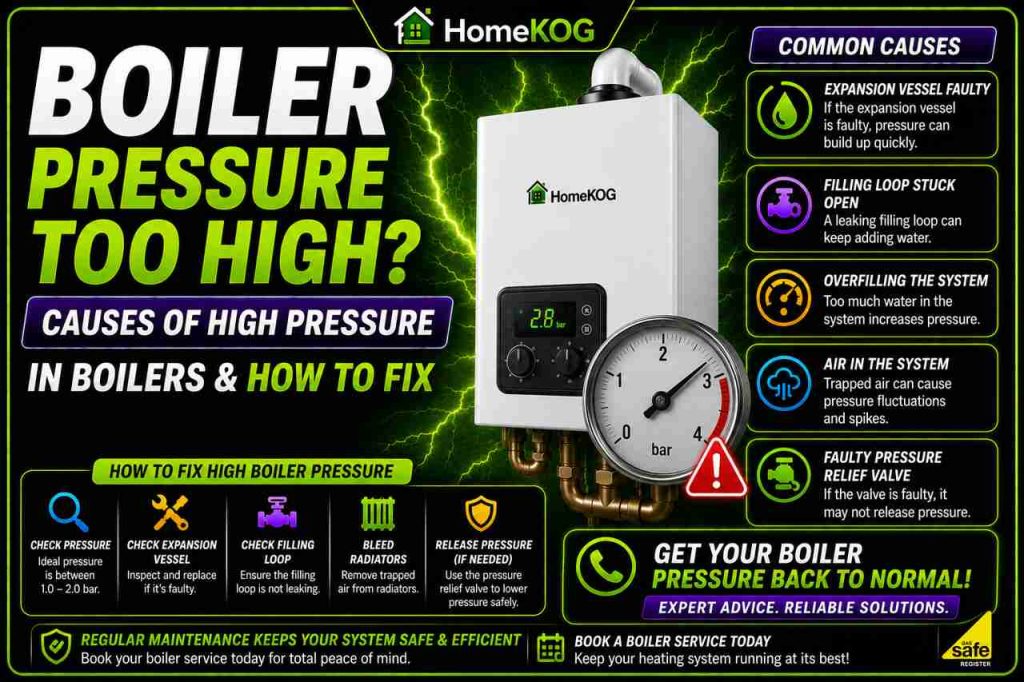
The EE2 code indicates that the water pressure in the central heating system has dropped below the minimum required for safe operation. This is the most straightforward Grant fault code to resolve and is one the homeowner can address without calling an engineer in most cases.
To restore pressure, locate the filling loop or lever on the boiler — the position varies between Grant models and the instruction manual confirms the exact location for each. Add water to the system slowly via the filling loop while watching the pressure gauge, stopping when the pressure reaches the level specified in the manual for the specific model. Close the filling loop fully once the target pressure is reached, then attempt to restart the boiler.
If pressure drops again within a short period of being restored, a slow leak is present somewhere in the system and an OFTEC engineer should locate and repair it rather than the homeowner continuing to top up the pressure as a temporary measure.
Can you fix it yourself? Yes — repressurise via the filling loop to the manufacturer’s specified pressure. Call an engineer if pressure drops repeatedly.
EE3 — Open Circuit Between PCB Terminals 23-24
The EE3 code indicates an open circuit in the wiring between terminals 23 and 24 on the boiler’s printed circuit board. This is an electrical fault that requires an OFTEC engineer to trace and repair the wiring fault or replace the affected component. Attempting to work on the PCB wiring without the appropriate qualifications is not advisable and could cause further damage to the control system.
Can you fix it yourself? No — an OFTEC engineer is required.
EE4 — Supply L and N Reversal
The EE4 code indicates that the live and neutral electrical supply connections to the boiler have been reversed. This is an installation error that can occur when a boiler is connected to the mains supply incorrectly or when a wiring modification has been made to the property’s electrical system. An electrician or OFTEC engineer should inspect and correct the wiring before the boiler is restarted.
Can you fix it yourself? No — a qualified electrician or OFTEC engineer is required.
EE8 — Communication Failure
The EE8 code indicates a communication failure within the boiler’s control system, typically between the main PCB and another connected component or control module. This can be caused by a wiring fault, a failed component, or a software issue within the control board. An OFTEC engineer should diagnose the source of the communication breakdown before any parts are replaced.
Can you fix it yourself? No — an OFTEC engineer is required.
Full Grant Boiler Error Code Reference Table
| Code | Fault | DIY Fix? |
|---|---|---|
| PP1 | Inlet sensor failure | No — OFTEC engineer required |
| PP2 | Discharged gas sensor failure | No — OFTEC engineer required |
| PP3 | Temperature sensor coil failure | No — OFTEC engineer required |
| PP4 | Return gas sensor failure | No — OFTEC engineer required |
| PP5 | Ambient temperature sensor failure | No — OFTEC engineer required |
| PP6 | Gas overheat protection activated | No — OFTEC engineer required |
| PP7 | Anti-freeze protection activated | Check cold conditions and lagging — engineer if no cold cause |
| EE1 | Circulation pump failure or airlock | Try bleeding radiators — engineer if pump faulty |
| EE2 | Low system pressure | Yes — repressurise via filling loop |
| EE3 | Open circuit PCB terminals 23-24 | No — OFTEC engineer required |
| EE4 | Supply L and N reversal | No — electrician or OFTEC engineer required |
| EE8 | Communication failure | No — OFTEC engineer required |
Grant Vortex Oil Boiler Fault Finding
How to Bleed a Grant Vortex Oil Boiler
If a Grant Vortex oil boiler fails to fire up, air trapped in the oil supply pipe is one of the most common causes — particularly if the oil tank has run dry and has since been refilled. The air must be purged from the pipe before oil can reach the burner and ignition can take place. Bleeding the oil pipe is one of the few oil boiler maintenance tasks that homeowners can carry out themselves and typically takes around five minutes.
What You Will Need
- A flat-head screwdriver
- A 4mm Allen key
- An old rag or cloth
Steps to Bleed a Grant Vortex Oil Boiler
Step 1 — Locate the burner. The burner has a red plastic cover and is typically found at the bottom of the boiler. Check whether the burner lockout button is showing a red light, which confirms the boiler is in lockout.
Step 2 — Remove the red cover. Use the flat-head screwdriver to undo the retaining screws and remove the red plastic casing to access the burner components.
Step 3 — Find the oil pump. The oil pump is located on the left-hand side of the burner. On the pump you should see a hexagonal stem approximately 3 inches long with a small threaded plug at the end.
Step 4 — Position the rag. Hold the rag beneath the threaded plug before proceeding, as a small amount of oil will escape during the bleeding process.
Step 5 — Open the bleed plug. Use the Allen key to turn the threaded plug up to half a turn — no more than 180 degrees. This opens the bleed point and allows trapped air to escape from the oil supply line.
Step 6 — Press the reset button. Press the burner reset button and listen for a buzzing sound, which indicates the pump is attempting to draw oil through the supply line and purge the air.
Step 7 — Retighten the plug. Once the buzzing sound is heard and oil begins to flow through the system, use the Allen key to retighten the threaded plug firmly. The boiler should then proceed through its normal start-up sequence.
If the boiler fails to fire after completing the bleeding process, or if the lockout returns shortly after restarting, a more significant fault with the burner, ignition system, or oil supply is likely and an OFTEC engineer should be called to investigate.
Grant Vortex Low Pressure
Low pressure on a Grant Vortex combi boiler is most commonly caused by a small water leak in the system or by a pressure drop following a recent radiator bleed. The EE2 code will typically appear on the control panel when pressure has fallen too low. Repressurising via the filling loop or lever to the pressure specified in the Grant manual for the specific model is the correct first step, and will resolve the fault in most straightforward cases.
Grant Oil Boiler Will Not Fire Up
If a Grant oil boiler fails to fire up and the issue is not an air-locked oil pipe, several other causes should be investigated by an OFTEC engineer. A faulty thermostat that is not calling for heat correctly, a broken combustion fan, a failed air pressure switch, or a faulty PCB are all potential causes that require professional diagnosis and component replacement. Low boiler pressure causing a lockout is the exception — that can be resolved by the homeowner via the filling loop before calling an engineer.
FAQ
What does the Grant boiler EE2 fault code mean?
The Grant boiler EE2 fault code indicates that the water pressure in the central heating system has dropped below the minimum level required for the boiler to operate safely. It is the most straightforward Grant fault code for homeowners to resolve — repressurising the system via the filling loop or lever to the pressure specified in the Grant manual will clear the code in most cases. If pressure drops again shortly after being restored, a leak in the system is the likely cause and an OFTEC engineer should locate and repair it.
Can I bleed a Grant Vortex oil boiler myself?
Yes, bleeding a Grant Vortex oil boiler to purge air from the oil supply pipe is one of the few oil boiler maintenance tasks that homeowners can carry out without an OFTEC engineer. The process requires a flat-head screwdriver, a 4mm Allen key, and an old rag, and takes approximately five minutes to complete. It is most commonly needed after the oil tank has run dry and been refilled. If the boiler fails to fire after bleeding or locks out again immediately, an OFTEC engineer should investigate the underlying cause.
What does the Grant PP6 fault code mean?
The Grant PP6 fault code means the boiler’s gas overheat protection has activated in response to excessively high flue gas temperatures. It is a safety shutdown rather than a sensor failure. The boiler should not be restarted until the cause of the overheat event has been established by an OFTEC engineer — possible causes include a blocked flue, poor combustion, or a developing heat exchanger fault. In addition to addressing the fault code, it is essential to ensure compliance with boiler flue installation requirements to maintain safe operation. Proper installation and ventilation can prevent dangerous build-ups of gas and ensure optimal performance. Regular maintenance checks are also crucial to identify any potential issues before they escalate.
Do I need an OFTEC engineer for Grant boiler repairs?
Yes, Grant’s main product range is oil-fired boilers, and all servicing, maintenance, and repairs on oil boilers must be carried out by an OFTEC-registered engineer. OFTEC is the registration body for oil heating technicians, equivalent to Gas Safe for gas appliances. Using an unregistered person to carry out oil boiler work is illegal, creates safety risks, and will invalidate the manufacturer’s warranty. OFTEC-registered engineers can be found using the OFTEC technician finder on the OFTEC website. When considering boiler installation for rental properties, it is crucial to ensure compliance with all relevant regulations and standards. Many landlords overlook the importance of scheduling regular inspections, which can lead to increased risks and potential liabilities. Engaging a qualified OFTEC-registered engineer not only guarantees adherence to safety protocols but also provides peace of mind for both landlords and tenants alike.
What should I do if there is no display on my Grant boiler control panel?
If the Grant boiler control panel shows no display but the rest of the property has power, the most likely cause is a fault with the boiler’s 12V transformer rather than a complete boiler failure. This is a component replacement job for an OFTEC engineer rather than a reason to consider a full boiler replacement. Checking that the boiler is receiving power from the mains — via the fuse spur or circuit breaker — is the first sensible check before calling an engineer, as a tripped breaker is a straightforward fix that does not require professional intervention.
How do I prevent Grant boiler faults?
Annual servicing by an OFTEC-registered engineer is the most effective way to prevent Grant boiler faults and keep the system operating efficiently. During a service the engineer will clean the burner nozzle, check the oil supply and pressure, inspect the flue, test all sensors and safety devices, and identify components approaching the end of their service life. Keeping the oil tank adequately filled at all times prevents air from entering the oil supply pipe — one of the most common causes of Grant Vortex lockouts — and monitoring the pressure gauge regularly allows low pressure issues to be caught and resolved before the EE2 code triggers a lockout.
When should I replace a Grant boiler rather than repair it?
A Grant boiler under 10 years old with a single straightforward fault is almost always worth repairing. For boilers over 10 to 12 years old with multiple sensor failures, recurring EE codes, or where a major component such as the PCB or heat exchanger requires replacement, the economics of repair versus replacement are worth reviewing honestly with an OFTEC engineer. A modern A-rated oil boiler replacement will be meaningfully more efficient than an older model, reducing running costs from the day of installation and potentially delivering significant savings over the following decade.
Conclusion
Grant boiler error codes provide a clear and structured starting point for diagnosing problems with Vortex and other Grant oil boiler models. PP codes point to sensor failures or protection activations, while EE codes cover system-level faults including low pressure, pump failures, and electrical issues. Of all the codes in this guide, EE2 is the only one that most homeowners can resolve themselves — by repressurising the system via the filling loop. Bleeding an air-locked oil supply pipe is also within the scope of a confident homeowner following the correct steps.
For all other faults, an OFTEC-registered engineer is the right call — both legally for an oil-fired appliance and practically, given the complexity of the components involved. Annual servicing by an OFTEC engineer remains the most effective way to keep a Grant boiler running reliably, prevent fault codes from appearing, and extend the operational lifespan of the system well beyond the average 10 to 15-year range.