
Boiler Pressure Too High? Here’s How to Reduce It Safely
Quick Answer: Boiler pressure that exceeds 2.5 bar is considered too high and can cause your boiler to lock out, develop leaks, or damage internal components. You can reduce high boiler pressure by bleeding your radiators to release excess water. If pressure continues to rise, a Gas Safe registered engineer should inspect your system immediately.
Introduction
High boiler pressure is one of the most common central heating complaints in the UK — and one of the most misunderstood. Your boiler pressure gauge reveals the balance of water and air inside your central heating system, and when that balance tips too far in either direction, your boiler cannot function efficiently.
Boiler pressure directly affects how effectively your system heats water and distributes it through your radiators and pipework. A combi boiler requires stable pressure between 1 and 1.5 bar to operate correctly. When that pressure climbs above 2.5 bar, your boiler enters a fault state that leads to lockouts, leaks, and — in worst-case scenarios — component failure.
This guide covers everything you need to know: what causes high boiler pressure, how to read your pressure gauge, how to safely reduce pressure at home, and when to call a Gas Safe engineer.
Understanding Boiler Pressure: The Core Relationships
Boiler pressure represents the force exerted by pressurised water as it circulates through your central heating system. Understanding how each component relates to pressure helps you diagnose and resolve problems quickly.
- A combi boiler maintains pressure through a filling loop connected directly to the cold mains water supply.
- The pressure gauge displays the current system pressure in bar units, typically on the boiler’s front panel.
- A pressure relief valve (PRV) releases excess pressure automatically when the system reaches a dangerous level.
- The filling loop regulates how much water enters the system and is the primary cause of overpressure when faulty.
- Radiators hold pressurised water and act as the primary release point when bleeding is required.
- The heat exchanger transfers heat from the gas burner to the water and is vulnerable to damage when pressure exceeds safe limits.
- A sealed central heating system contains a fixed volume of water that expands when heated, naturally causing temporary pressure increases.
- An expansion vessel absorbs this thermal expansion, preventing pressure spikes during normal operation.
- Boiler error codes signal pressure faults before physical symptoms like leaks become visible.
- A Gas Safe registered engineer is the only person legally qualified to carry out boiler repairs and pressure-related diagnostics.
- Annual boiler servicing reduces the likelihood of pressure faults by identifying component wear before it causes breakdowns.
- System sludge restricts water flow through pipework, causing localised pressure imbalances across the heating circuit.
What Is Boiler Pressure and Why Does It Matter?
Boiler pressure is the measure of water pressure inside your central heating system’s sealed circuit. This includes the boiler itself, the pipework, and all connected radiators throughout your home.
Your boiler heats cold water and pumps it through the system. That pump requires adequate pressure to move water efficiently — too little pressure and the water won’t circulate; too much pressure and the system becomes stressed, risking leaks and component failure. One essential part of maintaining your boiler system is to follow proper boiler pump troubleshooting steps when you notice any irregularities. Regular checks can help identify issues like blockages or worn-out components before they escalate into serious problems. By adhering to these steps, you can ensure the longevity and efficiency of your boiler system.
In modern combi boilers — units made by manufacturers including Worcester Bosch, Vaillant, Baxi, Ideal, and Viessmann — pressure is monitored continuously by internal sensors that trigger lockout codes if readings fall outside safe parameters.
What Should Boiler Pressure Be?
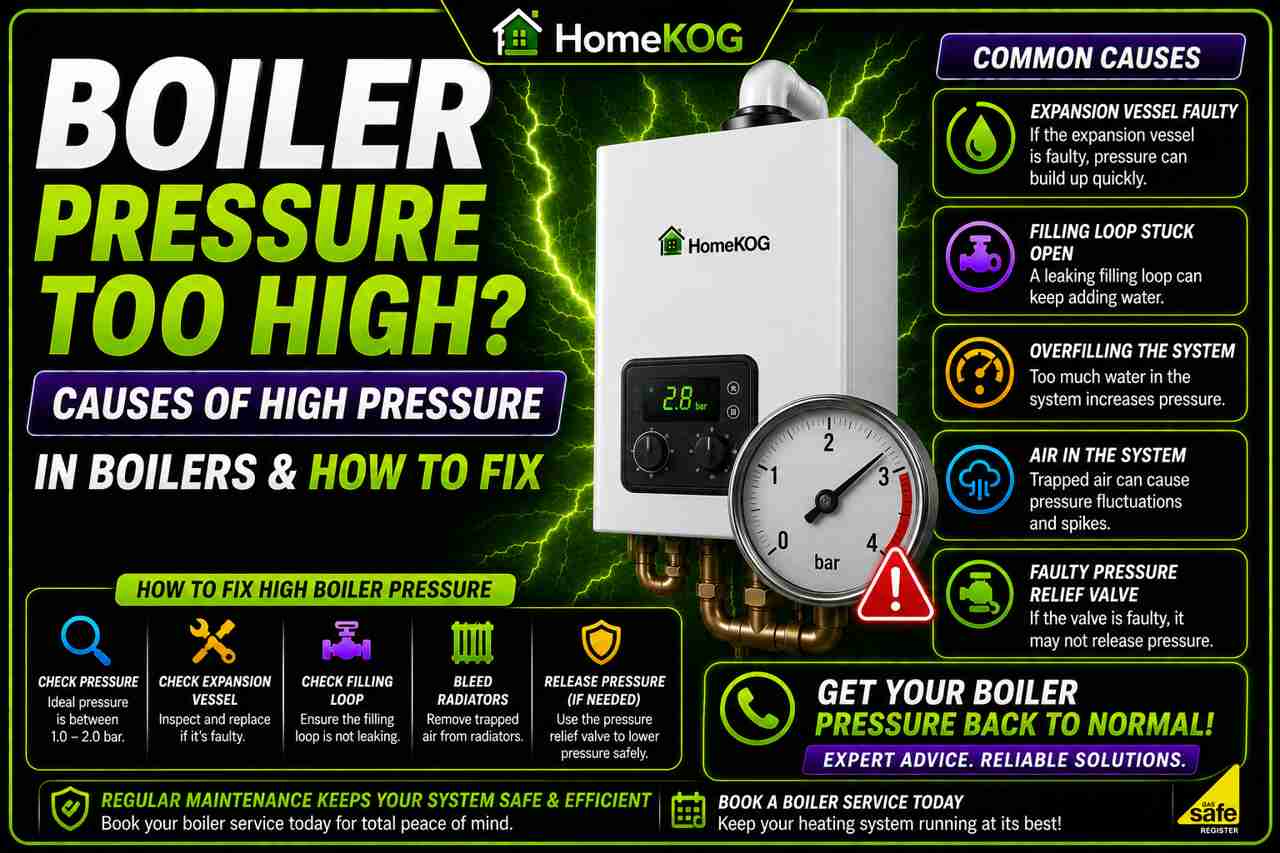
The ideal boiler pressure sits between 1 bar and 1.5 bar when the system is cold (not actively heating). This is the green zone on most analogue pressure gauges. Homeowners should regularly check their boiler pressure to ensure it remains within the recommended range, as this affects both efficiency and safety. Following the boiler pressure guidelines for homeowners can help prevent system malfunctions and prolong the lifespan of the boiler. Additionally, any significant fluctuations outside of the ideal range should prompt a consultation with a qualified technician to address potential issues.
When your boiler is actively running — heating water for radiators or domestic hot water — pressure will naturally rise slightly due to thermal expansion. A reading of up to 2 bar during operation is normal and not a cause for concern.
| Pressure Reading | Status | What It Means |
|---|---|---|
| Below 0.5 bar | Too Low | The boiler may shut down; the system needs repressurising |
| 0.5 – 1.0 bar | Low | System borderline; monitor closely |
| 1.0 – 1.5 bar | Ideal | Correct operating pressure |
| 1.5 – 2.0 bar | Acceptable | Normal during active heating |
| 2.0 – 2.5 bar | High | Monitor; bleed radiators if cold reading |
| Above 2.5 bar | Too High | Action required; boiler may lock out |
| Above 3.0 bar | Dangerous | Shut down boiler; contact Gas Safe engineer |
How to Read Your Boiler Pressure Gauge
Most boilers use either a circular analogue dial gauge or a digital pressure display built into the control panel. Here’s how to check it correctly:
- Locate the pressure gauge on the front panel of your boiler — on combi boilers, it is usually below the control display or behind a front cover panel.
- Identify the coloured zones — the green section indicates safe pressure, the red section indicates high pressure, and some gauges also show a low-pressure zone.
- Read the needle position — a needle pointing to the 10 o’clock position on most gauges corresponds to approximately 1.5 bar, which is ideal.
- Check the reading when cold — always check boiler pressure when the system has been off for at least an hour to get an accurate baseline reading.
- Compare against your boiler manual — different boiler models have slightly different pressure thresholds, so confirm the exact range for your unit.
Why Is My Boiler Pressure Too High?
High boiler pressure doesn’t appear without cause. Several distinct faults and conditions can push your system above safe operating limits. Identifying the correct cause determines the right fix. boiler malfunction causes explained, these issues can range from simple maintenance oversights to complex mechanical failures. Recognizing the signs early can prevent costly repairs and ensure your heating system operates efficiently. Regular inspections and prompt attention to problems are essential for sustaining optimal boiler performance.
1. A Faulty Filling Loop
The filling loop is a flexible braided hose that connects your boiler to the cold mains water supply. It allows you to manually top up pressure when it drops too low.
A filling loop that hasn’t been fully closed after repressurising, or one whose internal valve has failed, allows mains water to continuously feed the sealed system. Since mains pressure is typically 3 to 4 bar, even a partial leak in the filling loop can push the boiler pressure well above safe levels.
How to identify it: Close both valves on the filling loop fully. If pressure continues to rise over the next few hours with the boiler off, the filling loop valve is leaking internally and needs to be replaced.
2. A Faulty Pressure Relief Valve (PRV)
The pressure relief valve is a safety device that automatically opens to release water from the system if pressure exceeds its set threshold — usually around 3 bar. A PRV that is stuck open bleeds pressure constantly, while one that is stuck closed fails to release dangerous pressure buildups.
How to identify it: If you notice water dripping from the overflow pipe on the outside of your property, your PRV is likely discharging pressure — which means it is doing its job, but the underlying cause of high pressure needs to be resolved.
3. A Failed Expansion Vessel
The expansion vessel is a small sealed tank — usually mounted inside or near the boiler — that contains a rubber diaphragm. This diaphragm absorbs the expansion of water as it heats, preventing pressure from spiking during normal operation.
When the expansion vessel fails — through diaphragm rupture or loss of charge pressure — it can no longer absorb thermal expansion. Every heating cycle then causes a pressure increase that the system cannot safely accommodate.
How to identify it: Pressure rises noticeably each time the boiler fires up but then drops again as the system cools. This cycle suggests expansion vessel failure rather than a water ingress problem.
4. Too Much Water in the System
If your boiler was recently repressurised — either by yourself or an engineer — it is possible that too much water was added to the system. Overfilling raises baseline pressure above the ideal range even before any heating occurs.
How to identify it: Turn the boiler off completely and check the gauge. A cold reading above 1.5 bar suggests excess water is present. Bleeding your radiators will release the surplus.
5. Boiler Age and Component Wear
Boilers that are more than 10 years old experience wear across multiple pressure-related components simultaneously. Seals degrade, valve seats pit and corrode, and internal components no longer hold tolerances correctly.
In older boilers from manufacturers such as Worcester Bosch, Baxi, and Ideal, recurrent pressure problems often indicate that the boiler has reached end-of-life. Repeated repairs become more expensive than replacement over a 2–3 year period.
How to Reduce Boiler Pressure at Home
If your boiler pressure is mildly elevated — between 2 and 2.5 bar on a cold reading — you can often reduce it safely without calling an engineer by bleeding your radiators.
How to Bleed Your Radiators to Reduce Boiler Pressure
Bleeding a radiator releases trapped air and excess water from the system, reducing overall pressure. You need a radiator bleed key, which is available from any hardware or DIY store.
- Turn off your central heating and allow the radiators to cool completely before starting — hot water under pressure can cause scalding burns.
- Gather your equipment — you need a radiator bleed key and a small cloth or towel to catch drips.
- Start on the ground floor and work upwards systematically through every radiator in the property.
- Insert the bleed key into the bleed valve at the top corner of the radiator and turn it slowly anticlockwise — a quarter turn is usually sufficient.
- Listen for a hiss of air escaping from the valve — this is normal and indicates trapped air is being released from the circuit.
- Watch for water — once a steady trickle of water appears with no more hissing, the air has been purged; close the valve immediately by turning clockwise.
- Monitor the pressure gauge throughout the process — stop bleeding when the gauge needle returns to the green zone between 1 and 1.5 bar.
- Restart the boiler and observe whether pressure stabilises at the correct level over the next 24 hours.
Important: If your boiler pressure returns to a high reading within a day or two of bleeding, a fault is causing continuous overpressure. Contact a Gas Safe registered engineer — do not bleed the system repeatedly as a long-term fix.
Is High Boiler Pressure Dangerous?
This is the question most homeowners ask first, and the answer requires some nuance. High boiler pressure is unlikely to cause a catastrophic explosion — that outcome, while dramatic in films, is effectively prevented by modern safety systems.
However, sustained high pressure does cause real and costly damage. A pressure relief valve activates and discharges water through the overflow pipe, which can cause water damage to walls, ceilings, or external brickwork over time. Internal components — particularly the heat exchanger and pump — experience accelerated wear when operating above rated pressure. Pipe joints and boiler seals develop leaks that worsen progressively if pressure isn’t corrected.
The risk level depends on how high the pressure climbs and for how long it remains elevated:
- 2 to 2.5 bar — low risk; address within a few days by bleeding radiators
- 2.5 to 3 bar — moderate risk; boiler may lock out; resolve within 24 hours
- Above 3 bar — elevated risk; shut the boiler off and contact a Gas Safe engineer same day
- Above 4 bar — high risk; component failure likely; do not operate the boiler
Boiler Error Codes for High Pressure
Modern boilers from Worcester Bosch, Vaillant, Baxi, Ideal, and Viessmann display error codes on their control panels when internal sensors detect pressure outside safe thresholds. These codes allow early intervention before physical damage occurs.
Common high pressure fault codes by manufacturer:
| Manufacturer | Error Code | Meaning |
|---|---|---|
| Worcester Bosch | E9 | Overpressure fault — pressure above 2.65 bar |
| Vaillant | F22 / F75 | Low pressure / pressure sensor fault |
| Baxi | E110 | Overheat or overpressure lockout |
| Ideal | F1 | Low water pressure (also check for overpressure after resets) |
| Viessmann | F4 | Overpressure fault |
Keep your boiler’s instruction manual accessible. If you cannot locate it, most manufacturers publish digital copies on their websites. Identifying the correct error code before calling an engineer saves diagnostic time and reduces call-out costs.
When to Call a Gas Safe Engineer
Some boiler pressure issues are safely resolved by the homeowner — bleeding radiators, closing a filling loop valve, or checking for obvious leaks. Others require a qualified Gas Safe registered engineer.
You should contact a Gas Safe engineer when:
- Pressure rises repeatedly within 48 hours of bleeding radiators, indicating an ongoing fault rather than trapped air.
- The pressure relief valve is discharging water through the overflow pipe, meaning the PRV is doing its job but the underlying cause must be fixed.
- You suspect an expansion vessel failure, which requires a pressure test and possible replacement — not a DIY task.
- Pressure climbs above 3 bar and does not reduce after bleeding, as continued operation risks damage to the heat exchanger or pump.
- Your boiler displays a pressure-related error code that does not clear after standard troubleshooting.
- Your boiler is over 10 years old and is experiencing recurring pressure issues, as multiple components may need assessment simultaneously.
- You are unsure of any step — gas appliances and pressurised systems carry inherent risks, and Gas Safe registration exists for good reason.
A Gas Safe registered engineer carries an ID card with their registration number. You can verify any engineer’s credentials at the Gas Safe Register website at gassaferegister.co.uk.
How to Prevent High Boiler Pressure in the Future
Prevention is significantly cheaper than repair. The following measures reduce the likelihood of pressure problems developing in your central heating system.
- Book an annual boiler service with a Gas Safe engineer — a boiler service costs approximately £80 to £120 and identifies developing faults before they become expensive breakdowns.
- Check your pressure gauge monthly — a two-minute visual check each month catches early pressure changes before they reach problem levels.
- Do not over-pressurise when topping up — when using the filling loop to add pressure after bleeding, stop at 1.5 bar to leave headroom for thermal expansion.
- Flush the system periodically — magnetic system filters and power flushes remove iron oxide sludge that restricts water flow and creates localised pressure imbalances.
- Install a magnetic filter, such as a Magnaclean or Fernox TF1, to continuously remove magnetite sludge from the circulating water, protecting the pump and heat exchanger.
- Consider a boiler cover that includes annual servicing, giving you scheduled professional maintenance without the need to book each year separately.
Frequently Asked Questions
What should my boiler pressure be?
Boiler pressure should sit between 1 and 1.5 bar when your central heating system is cold and not actively running. During operation — when the boiler is heating water for radiators or hot taps — pressure can rise to around 2 bar without concern due to thermal expansion. A reading consistently above 2.5 bar when cold indicates a fault that requires attention.
Why does my boiler pressure keep rising?
Boiler pressure that rises repeatedly after being corrected indicates a persistent fault, most commonly a leaking filling loop valve that allows mains water to continuously enter the sealed system. A failed expansion vessel — which can no longer absorb thermal expansion — also causes pressure to climb with each heating cycle. Both faults require a Gas Safe engineer to diagnose and repair correctly.
Can I reduce boiler pressure myself?
Yes, in many cases you can safely reduce boiler pressure at home by bleeding your radiators. This releases trapped air and excess water from the system, lowering pressure back into the safe 1 to 1.5 bar range. If pressure remains high after bleeding, or returns to high levels within a day or two, a professional fault diagnosis is required — do not continue to bleed the system as a substitute for a proper repair.
Is a boiler pressure of 3 bar dangerous?
A boiler pressure of 3 bar exceeds the safe operating threshold for most residential boilers and indicates a fault condition. Most boilers automatically lock out at this level, preventing further operation until the pressure is reduced. If your boiler continues to operate above 3 bar — or if pressure climbs toward 4 bar — you should shut the boiler off and contact a Gas Safe engineer the same day, as the pressure relief valve and heat exchanger are at risk of damage.
How do I know if my pressure relief valve is faulty?
A pressure relief valve discharges water through the boiler’s overflow pipe, which exits the property through an external wall, typically near the boiler. If you notice water dripping or flowing from this pipe, your PRV is activating — either correctly in response to genuine overpressure, or incorrectly due to valve wear. In either case, the cause must be identified and resolved by a Gas Safe engineer.
Does bleeding radiators fix high boiler pressure?
Bleeding radiators reduces boiler pressure by releasing trapped air and excess water from the system. This fix is effective when excess water is the primary cause of high pressure — for example, if the system was recently over-topped using the filling loop. However, bleeding does not fix underlying faults such as a leaking filling loop, a failed expansion vessel, or a faulty PRV. If bleeding does not maintain correct pressure, a professional inspection is necessary.
How much does it cost to fix high boiler pressure?
The cost to fix high boiler pressure depends on the cause. Bleeding radiators is free and can be done by the homeowner. Replacing a filling loop costs approximately £50 to £150, including labour.
Replacing an expansion vessel typically costs £150 to £300. A full boiler service — which checks pressure components among other systems — costs approximately £80 to £120. If the boiler is beyond economic repair, a new combi boiler installation ranges from £1,500 to £3,500, depending on the model and installation complexity.
Can high boiler pressure cause a leak?
Yes, sustained high boiler pressure directly causes leaks. Excess pressure strains joints, seals, and pipe connections throughout the central heating circuit. Weaker points in the system — often at radiator valves, pipe joints behind walls, or internal boiler seals — develop drips that worsen progressively as pressure cycles continue.
A boiler that leaks water from its casing should be inspected by a Gas Safe engineer immediately, as internal leaks can damage electrical components and the heat exchanger.
Conclusion: Act Early, Stay Safe
High boiler pressure is a manageable problem when addressed promptly. Your boiler pressure gauge provides the earliest warning of a developing fault — checking it monthly costs nothing and can prevent expensive breakdowns.
A pressure reading between 1 and 1.5 bar indicates a correctly functioning system. A reading above 2.5 bar signals that action is required. Bleeding your radiators resolves minor overpressure quickly, while persistent or severe pressure faults require a Gas Safe registered engineer to diagnose and repair safely.
Your boiler represents a significant investment in your home’s comfort and efficiency. Annual servicing keeps pressure components working correctly, extends the boiler’s lifespan, and maintains energy efficiency — reducing gas bills and repair costs. Don’t wait for a lockout or a leak to take action: book your annual boiler service today and keep your central heating system performing at its best.