
Boiler Pump Not Working: Causes and How to Fix It 2026
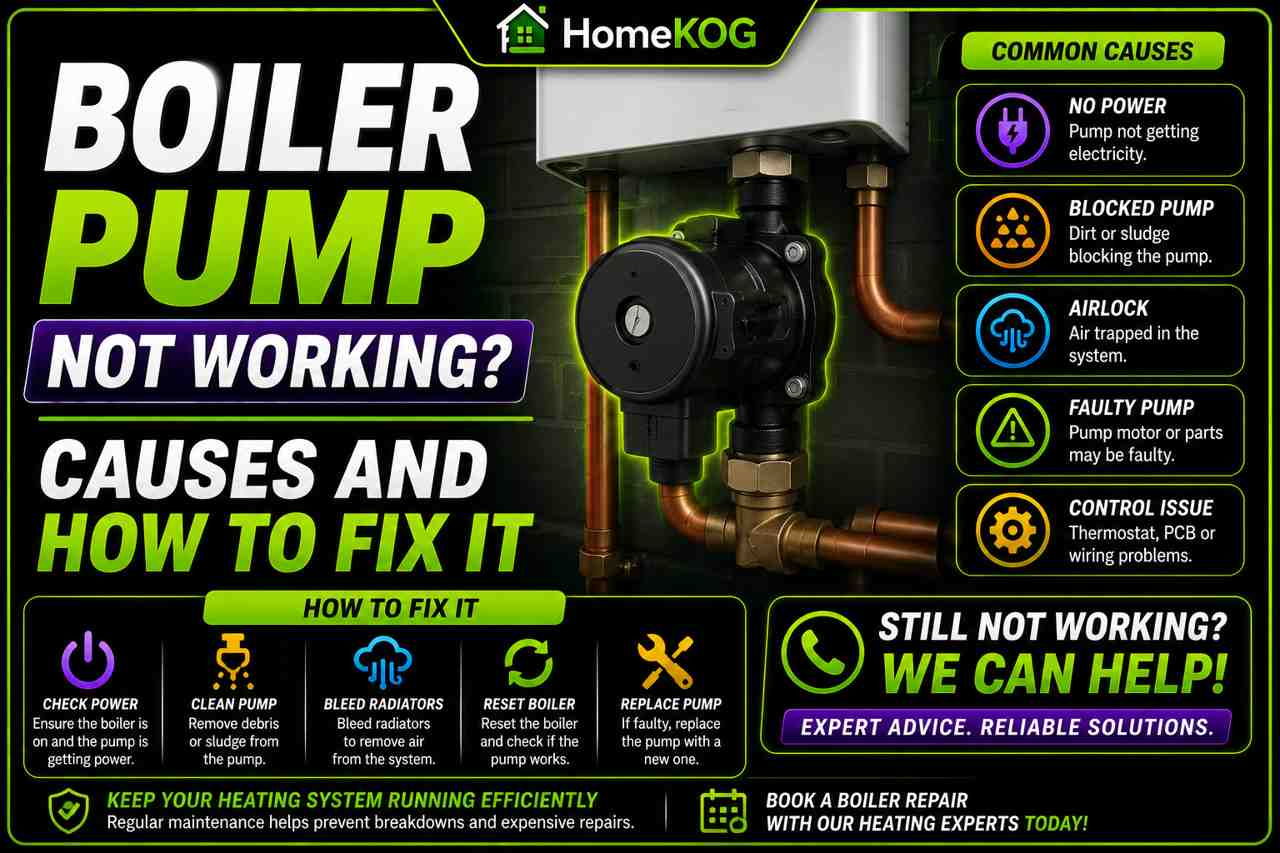
Quick Answer: A boiler pump that is not working correctly most commonly shows as cold radiators, no hot water, unusual pump noise, or water leaking from the pump body. The most common DIY fixes are tapping the pump body gently to free a jammed shaft, bleeding the pump bleed screw to release an airlock, and lubricating a sticking mid-position valve with WD-40. A seized shaft, broken impeller, corroded pump body, or PCB fault require a Gas Safe engineer. Pump replacement costs between £150 and £350 fully installed.
The central heating pump — sometimes called the circulator pump or boiler pump — is responsible for moving hot water from the boiler through the pipework to every radiator, tap, and shower in the property. When it stops working correctly, the effects spread across the whole heating system: radiators fail to heat, hot water becomes unavailable, or the boiler repeatedly faults. The good news is that many pump problems have straightforward causes and some can be resolved without calling an engineer. This guide covers every common boiler pump fault, how to identify which one applies, and what to do about it.
Where to Find the Boiler Pump
Before any diagnosis or troubleshooting, locate the pump. In combi boiler installations the pump is usually inside or immediately adjacent to the boiler casing. In system and regular boiler installations it is typically found in the airing cupboard alongside the hot water cylinder. Check the boiler manual if the pump is not immediately visible — on some installations it is mounted under the floorboards or in a utility space.

Signs That the Boiler Pump is Not Working
The following symptoms indicate a pump problem rather than a boiler fault. If the boiler itself is powering up, displaying no fault codes, and attempting to fire but heating is not reaching the radiators, the pump is the most likely cause. To address the issue effectively, it’s important to follow boiler pressure troubleshooting techniques. Start by checking the pressure gauge to ensure it is within the optimal range, typically between 1 and 1.5 bar. If the pressure is low, you may need to add water to the system to restore functionality. In addition to addressing the pressure, you should consider boiler thermostat troubleshooting techniques to ensure the heating system functions correctly. Checking the thermostat settings and verifying that it responds accurately to temperature changes can prevent unnecessary heating issues. If the thermostat is malfunctioning, replacing or recalibrating it may be necessary to restore optimal performance.
Radiators that are cold or taking significantly longer than usual to reach temperature suggest water is not circulating. A water flow pipe that feels cold to the touch while the pump is running confirms circulation has stopped. A pump casing that is unusually hot — too hot to hold the hand against — indicates overheating. Constant humming or unusual noise from the pump area suggests an airlock or loose bearing. Visible water pooling beneath the pump indicates a seal failure or corroded pump body. A pump that runs continuously without switching off points to a PCB or overrun stat fault. No vibration or warmth from the pump at all confirms a power or wiring problem.
Boiler Pump Troubleshooting Guide
Problem 1 — Water Not Circulating Despite Pump Running
How to identify it: The pump feels warm and vibrates normally when touched, confirming it has power, but radiators are cold and no hot water reaches the taps. The pump is on but water is not moving through the system.
What causes it: A jammed pump shaft or impeller, most commonly caused by debris or sludge that has accumulated inside the pump body and lodged against the rotating components.
How to fix it: Turn off the heating and allow the system to cool. Locate the flat slot at the end of the pump shaft — removing a panel may be needed to access it. Insert a flat-head screwdriver and attempt to turn the shaft. A shaft that turns freely is not seized. If the pump vibrates but water is still not circulating, a gentle tap on the pump body may free a partially jammed component. If neither approach restores circulation, a Gas Safe engineer should attend to dismantle and inspect the pump. Annual boiler servicing is the most effective preventative measure against debris accumulation.
Problem 2 — No Power to the Pump
How to identify it: Place a hand on the pump body. A functioning pump feels slightly warm and produces a low vibration. A pump with no power is completely cold and silent, even while the boiler is running.
What causes it: If the boiler has power but the pump does not, the most likely causes are a wiring fault between the PCB and the pump, or a blown fuse on the pump circuit. If neither the boiler nor the pump has power, the PCB itself is more likely the source of the fault. Inadequate pump performance can lead to pump overrun implications for boilers, causing overheating and potential damage to the system. Regular maintenance checks are essential to ensure that the pump is functioning correctly, as neglecting this can exacerbate existing issues. Additionally, monitoring the boiler’s operational parameters can help identify any irregularities before they lead to significant failures.
How to fix it: A Gas Safe engineer is required to inspect and test the pump wiring safely. The engineer may be able to replace the fuse or repair a wiring fault, or may recommend full pump replacement on an older unit where the wiring fault indicates broader deterioration.
Problem 3 — Noisy Pump (Airlock)
How to identify it: The pump is running and the system has power, but a persistent humming or gurgling noise is coming from the pump body. This is distinct from the low-level operational hum that is normal — an airlock produces a louder, more irregular sound.
What causes it: Air trapped inside the pump forms an airlock that prevents the impeller from moving water efficiently. The pump works harder trying to push against the trapped air, generating the noise.
How to fix it: This is one of the few pump problems with a safe and straightforward DIY resolution.
- Switch off the electrical supply to the pump at the fused spur or consumer unit.
- Locate the bleed screw on the front of the pump body — refer to the pump manual if it is not immediately visible.
- Place a cloth beneath the bleed screw to catch any water.
- Turn the bleed screw very slightly anticlockwise using a flat-head screwdriver — a small hiss of escaping air confirms an airlock is present.
- Close the bleed screw as soon as water begins to drip and tighten securely.
- Restore the electrical supply and check whether the noise has stopped.
If bleeding the pump does not resolve the noise and the humming continues, a loose pump bearing is the likely cause. A bearing cannot be replaced in isolation — the pump requires replacement.
Problem 4 — Blocked Pump
How to identify it: Radiators are cold or heating poorly and the pump has confirmed power and is running. Tapping the pump has not restored circulation. No rattling or clicking noise is present to suggest a broken impeller.
What causes it: Black iron oxide sludge — magnetite — that has accumulated in the pipework over years of use has entered the pump and is restricting the impeller’s ability to move water. A pump that has not had the system inhibitor maintained or where no magnetic filter is fitted is more vulnerable to sludge blockage.
How to fix it: A system cleanse or power flush carried out by a Gas Safe engineer is the appropriate solution. Once the system has been flushed and the pump cleaned or replaced, fitting a magnetic filter to the return pipework prevents sludge from re-entering the pump. The filter is cleaned at each annual service, permanently removing accumulated sludge from the system.
Problem 5 — Leaking Pump
How to identify it: Water is pooling beneath the pump or visibly dripping from the pump body or its pipe connections.
What causes it: Three possible causes in order of likelihood. The pump has become loose at its pipe connections over time, allowing water to escape at the joint. The pump seal has failed, allowing water to bypass the sealing face. The pump body has corroded — typically on older pumps or systems that have been left inactive for extended periods — causing the metal to develop pinhole leaks.
How to fix it: Begin by tightening all pipe connections at the pump. If the leak stops, the connections were loose. If leaking continues, inspect the pump body for signs of corrosion — brown staining, pitting, or visible rust on the casing suggests corrosion rather than a seal fault. A failed seal can sometimes be replaced in isolation by a Gas Safe engineer. A corroded pump body requires full pump replacement. Running the heating periodically during summer — even briefly — prevents the pump seal from drying out and reduces the risk of corrosion-related leaks developing over the inactive period.
Problem 6 — Incorrect Speed and Flow Rate Settings
How to identify it: Some radiators heat correctly while others are slow or cold, and all other pump faults have been ruled out. The pump has a speed selector switch with settings 1 to 3.
What causes it: A pump set to an inappropriately low speed for the system’s size and pipework layout will not generate enough flow to reach all radiators. Conversely, a pump set too high can cause excess noise, pressure surges, and premature wear.
How to fix it: The speed selector switch is located on the top of the pump body. If the pump is currently set to 1 and radiators are not heating fully, increasing to setting 2 may resolve the issue. Before adjusting the setting, consult a Gas Safe engineer — some pumps are deliberately set lower than maximum capacity because the system’s pipework cannot handle higher flow rates without causing pressure problems or boiler faults. Adjusting without professional advice risks damaging the boiler.
Problem 7 — Pump Incorrectly Installed
How to identify it: The pump has never worked correctly since the day it was installed. Heating has been absent or severely reduced from the first use of the system.
What causes it: Installation error — most commonly the pump being fitted in the wrong orientation or connected in reverse. A pump must be installed in a precise horizontal position with the bleed screw accessible on the side. Even a slight deviation from horizontal causes persistent airlocking and premature bearing wear.
How to fix it: Contact the engineer who carried out the installation — they are responsible for rectifying incorrect work at no additional charge. If the original installer cannot be reached, a Gas Safe engineer must remove and correctly refit the pump.
Problem 8 — Pump Running Continuously
How to identify it: The pump continues to run when the heating is off and no hot water demand is active. Checking during an extended period with no heating or hot water call confirms the pump is running when it should not be.
What causes it: Three common causes. A faulty PCB sending a constant run signal to the pump. A faulty pump overrun stat that cannot detect when the pump should stop. A mid-position valve that is stuck in an open position, making the system behave as if heating is continuously demanded.
How to fix it: If the mid-position valve is the cause, applying WD-40 to the valve actuator and manually working the valve through its full range of movement can free a stuck mechanism. For a faulty PCB or overrun stat, a Gas Safe engineer is required to test and replace the relevant component. Leaving a pump running continuously significantly shortens its lifespan and increases electricity consumption — this fault should be addressed promptly rather than left.
Problem 9 — Seized Pump Shaft
How to identify it: No heating or hot water is present and the pump body feels hot rather than slightly warm to the touch. Locate the slot at the end of the pump shaft, insert a flat-head screwdriver, and attempt to turn it — a seized shaft will not move at all.
What causes it: Extended inactivity is the most common cause, particularly at the start of the heating season after months without use. Foreign objects entering the pump body, or components rubbing together due to wear, also cause shaft seizure.
How to fix it: A seized shaft cannot be freed by DIY methods — the pump requires replacement. A Gas Safe engineer will confirm the seizure, remove the old pump, and fit a correctly specified replacement.
Problem 10 — Broken Impeller
How to identify it: A distinct rattling or clicking noise from inside the pump body — different from the humming of an airlock — indicates fragments of a broken impeller moving freely inside the pump casing.
What causes it: Impeller failure is caused by age and accumulated wear, excessive operational stress, or a foreign object entering the pump and striking the impeller blades.
How to fix it: The pump requires replacement. A broken impeller cannot be repaired — fragments circulating inside the pump body will cause further damage if the pump continues to operate.
Boiler Pump Replacement Costs 2026
| Cost Element | Typical Range |
|---|---|
| Replacement pump (parts only) | £90 – £160 |
| Labour for pump replacement | £60 – £190 |
| Total installed cost | £150 – £350 |
Before purchasing a replacement pump, check whether the existing pump is within its warranty period — pumps less than five years old are typically covered for free replacement under the manufacturer’s warranty. When specifying a replacement, note the speed settings, flow rate, and model number from the old pump to ensure the replacement is correctly matched to the system.
If pump faults are recurring — requiring replacement every few years rather than the expected 10 to 15-year lifespan — an underlying system issue such as persistent sludge contamination or chronic overheating is likely. A Gas Safe engineer should investigate the root cause before a further replacement is carried out.
FAQ
How do I know if my boiler pump has failed completely?
A completely failed pump is cold and silent — no vibration, no warmth — when the boiler is running and heating is demanded. This is distinct from a pump that is running but not circulating water, which will feel warm and vibrate normally. A cold, silent pump indicates a power or wiring fault rather than a mechanical failure of the pump itself, and requires a Gas Safe engineer to test the pump circuit.
Can I replace a boiler pump myself?
Replacing a boiler pump involves draining the relevant section of the heating system, disconnecting the pipe connections and electrical wiring, and refitting a new pump in the correct orientation. While this is technically possible for a competent DIYer on the hydraulic side, the electrical connections to the pump circuit constitute electrical work that must comply with Part P of the Building Regulations. Using a Gas Safe registered engineer who can carry out both the hydraulic and electrical work ensures the installation is correctly certified. Understanding system boiler installation costs breakdown is crucial for homeowners considering this upgrade. Factors such as the complexity of the installation, the type of boiler chosen, and additional fittings can significantly influence the final price. Hiring a professional not only guarantees a safe installation but can also provide insights into potential long-term savings on energy bills.
Why does my boiler pump keep failing?
A pump that requires repeated replacement within a few years of each replacement is typically suffering from an underlying system problem rather than pump quality issues. Persistent sludge contamination from an inadequately maintained system is the most common cause — magnetite particles entering the pump accelerate impeller and bearing wear. Fitting a magnetic filter and carrying out a system flush before the next pump installation removes the root cause. Chronic system overheating and incorrect pump specification are less common but also worth investigating with a Gas Safe engineer.
How long should a boiler pump last?
A well-maintained pump in a clean system should last between 10 and 15 years. Pumps in systems with high sludge levels, no magnetic filtration, or inadequate inhibitor maintenance typically fail sooner. Annual boiler servicing that includes inhibitor checks, magnetic filter cleaning, and visual pump inspection is the most effective way to maximise pump lifespan.
Is a noisy pump dangerous?
In most cases, no. A noisy pump indicates a maintenance issue — trapped air, worn bearings, sludge blockage — rather than a safety emergency. The exception is a pump that is hot enough to burn when touched, which indicates overheating that should be investigated promptly. All modern boilers include safety thermostats and pressure relief devices that activate before unsafe conditions develop — the boiler will lockout before pressure or temperature reach dangerous levels. If the boiler is also displaying fault codes alongside pump noise, call a Gas Safe engineer for same-day attendance.
Conclusion
Most boiler pump problems have identifiable causes and, in several cases, practical DIY first steps that resolve the issue without an engineer visit. Freeing a jammed shaft with a gentle tap, bleeding the pump bleed screw to clear an airlock, and lubricating a stuck mid-position valve with WD-40 are all safe and straightforward interventions that restore pump operation in many cases. One common issue that can lead to boiler pump malfunctions is the causes of boiler airlocks. These airlocks occur when air becomes trapped within the heating system, disrupting the flow of water and causing inefficiencies. Regular maintenance and bleeding of the radiators can help prevent this issue and maintain optimal performance.
Where the pump shaft is fully seized, the impeller is broken, the pump body is corroded, or a PCB fault is suspected, replacement or professional repair is the appropriate response. At £150 to £350 fully installed, pump replacement is substantially less costly than a full boiler replacement — and in most cases resolves the heating fault completely without the need to consider a new boiler at all.