

Broken Boiler? Signs, Causes, Quick Fixes & What to Do Next
Quick Answer
A broken boiler typically shows warning signs including no heat or hot water, strange noises, water leaks, low pressure, or a pilot light that keeps going out.
Before calling an engineer, check the power supply, adjust boiler pressure, inspect the thermostat, and look for any displayed error codes.
If you smell gas or suspect carbon monoxide, leave the property immediately and call the National Gas Emergency Service on 0800 111 999.
Introduction
A broken boiler is one of the most disruptive household emergencies, particularly in winter when the effects of losing heat or hot water are felt immediately.
The good news is that not every boiler fault needs an engineer visit, and not every boiler problem means a replacement.
A boiler that has stopped working, lost pressure, or is making unusual noises is telling you something is wrong. Understanding what those signals mean helps you decide whether it’s something you can resolve in minutes, or whether a Gas Safe engineer needs to be contacted promptly.
Ignoring warning signs carries real risks. A neglected boiler fault remains one of the leading causes of carbon monoxide incidents in UK homes.
This guide covers how to recognise a broken boiler, the most common causes of failure, what you can safely check yourself, when to call a professional, how to cope without heat or hot water in the short term, and how to stop the same faults recurring.

Understanding Broken Boilers: The Core Relationships
A boiler fault involves multiple interconnected components, and understanding how they relate to each other helps diagnose the problem correctly.
- A boiler pressure gauge monitors the water pressure inside the sealed central heating system. A needle in the green zone indicates correct pressure, around 1 bar.
- A pilot light ignites the gas burner inside the boiler and must stay lit for the boiler to produce heat. One that keeps going out points to a fault worth investigating.
- A thermostat controls the temperature at which the boiler fires and regulates heating output. Incorrect settings or a faulty thermostat stop the boiler responding to demand.
- A condensate pipe carries acidic waste water from a condensing boiler to the external drain. It’s the most common cause of boiler shutdown in freezing weather when it ices over.
- Carbon monoxide is a colourless, odourless gas produced by incomplete combustion inside a faulty boiler. It’s the most common cause of death by poisoning in the UK and needs immediate action if suspected.
- A Gas Safe registered engineer is the only professional legally qualified to inspect, service or repair a gas boiler. Using an unregistered engineer invalidates warranties and raises safety risk.
- Boiler error codes are fault identifiers on modern boiler control panels. They point the engineer or homeowner to the specific component that has caused the lockout.
- A pressure relief valve discharges water when internal pressure exceeds safe limits. Continuous discharge from the overflow pipe signals a persistent overpressure fault.
- Annual boiler servicing catches developing faults before they cause a complete breakdown, and is a condition of most manufacturer warranties.
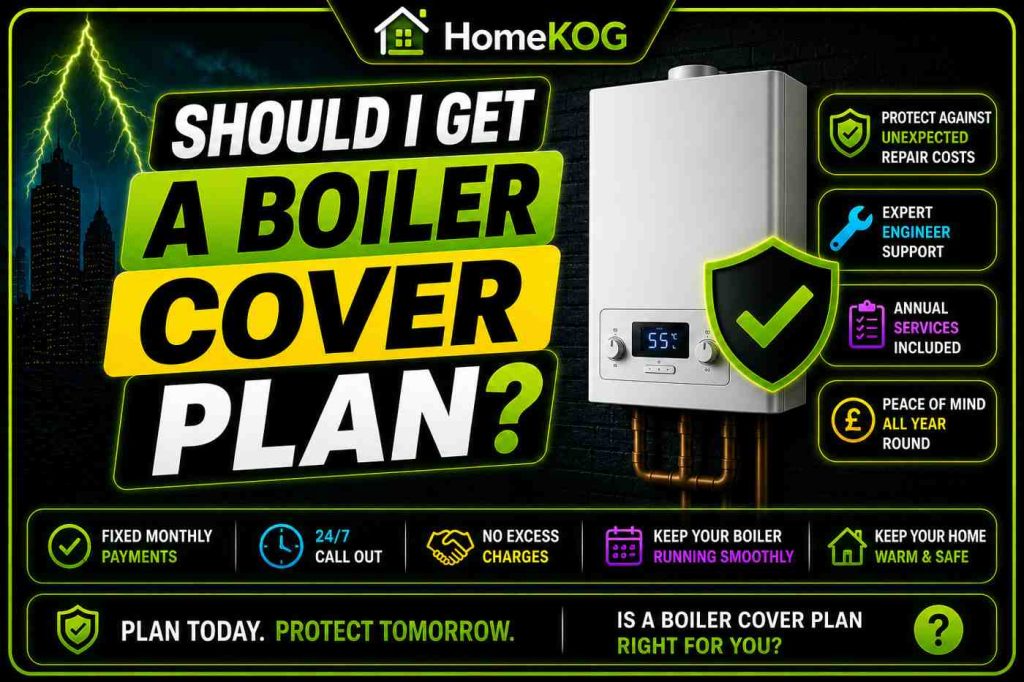
- Boiler cover insurance protects against unexpected repair costs by covering engineer call-out fees, labour and parts for qualifying faults.
- A smart thermostat cuts down on faults caused by incorrect temperature programming by learning occupancy patterns and adjusting schedules automatically.
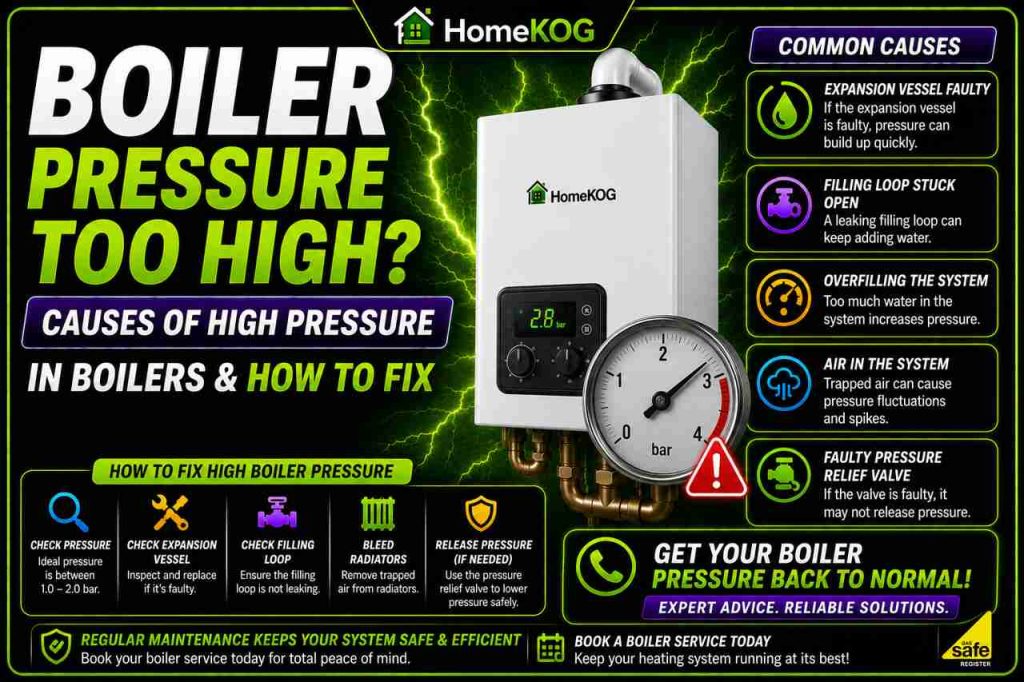
- Low boiler pressure is one of the most common causes of a boiler shutting down. It happens when water is lost from the sealed system through a leak, or after bleeding radiators without repressurising.
How to Tell If Your Boiler Is Broken
Boilers rarely fail without warning. Most faults are preceded by one or more symptoms that, if caught early, let you act before a complete breakdown happens.
No Heat or Hot Water
The most obvious sign of a broken boiler is its failure to provide heat to the radiators or hot water to the taps.
A boiler that fires up normally but produces neither heat nor hot water is likely locked out due to a fault. Check the control panel for an error code that identifies the cause.
Strange or Unusual Noises
Boilers that are functioning correctly run with a low, consistent hum. Unusual sounds, including banging, kettling, gurgling, whistling or vibrating, point to specific faults.
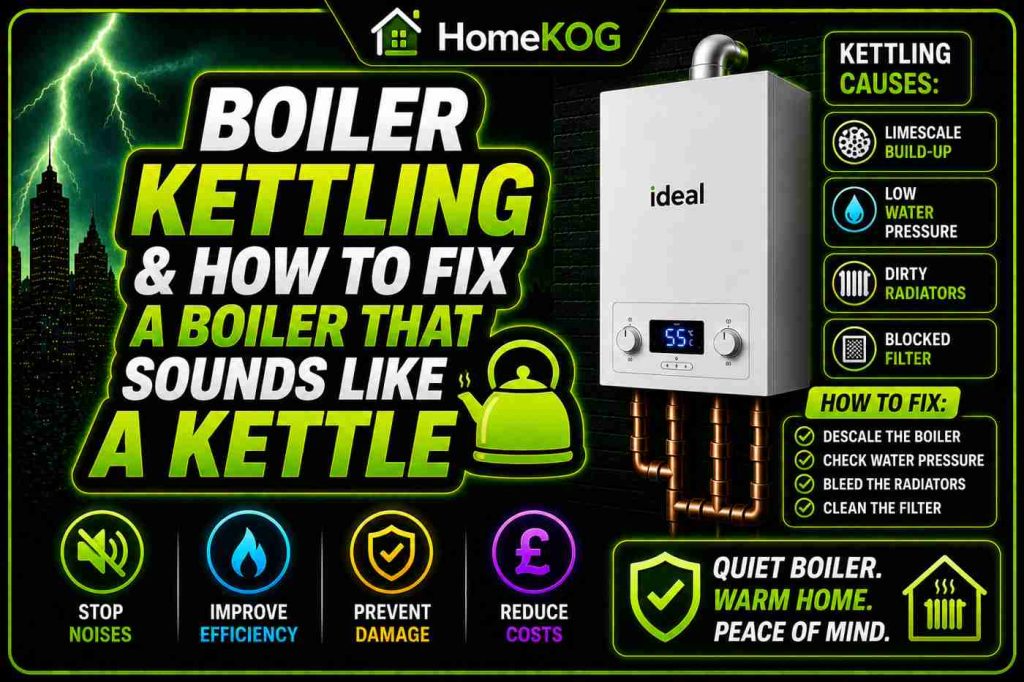
Kettling, which sounds similar to a kettle boiling, is typically caused by limescale build-up on the heat exchanger restricting water flow. Banging or clunking can indicate a failing pump or air trapped in the system. Gurgling often points to low water pressure or a blockage in the condensate pipe.
Water Leaks
Visible water beneath the boiler or around pipework is a clear sign of a fault. Leaks can come from a corroded or cracked heat exchanger, a failing pump seal, loose pipe connections, or a pressure relief valve discharging due to persistently high system pressure.
Any boiler that is actively leaking water should be inspected by a Gas Safe engineer promptly. Internal leaks can damage electrical components if left unaddressed.
Low Boiler Pressure
A pressure gauge reading below 0.5 bar means the sealed central heating system has lost water. This causes most modern boilers to lock out automatically as a safety measure.
Low pressure is one of the most common boiler faults and is often resolvable without an engineer, by repressurising the system through the filling loop.
Pilot Light Issues
A pilot light that repeatedly goes out, or a boiler that fails to ignite, points to a problem with the ignition system, the gas supply, or a fault triggering a safety shutdown.
Some causes of repeated pilot light failure, such as a faulty thermocouple or a blocked burner, need engineer attention.
Boiler Constantly Switching Off
A boiler that fires up and then shuts down repeatedly, known as short cycling, is responding to a fault detected by its internal sensors.
Common causes include low water pressure, a faulty thermistor, a blocked condensate pipe, or overheating triggered by restricted water flow through a dirty or scaled heat exchanger.
Unusual Smells
A smell of gas near the boiler or on the gas supply pipework is a serious safety emergency.
A sulphur or eggy smell means a gas leak. Do not attempt to identify or fix the source, do not use any electrical switches, and leave the property immediately. Call the National Gas Emergency Service on 0800 111 999 from outside the building.
A burning or metallic smell from the boiler, without any gas odour, may indicate an electrical fault within the unit and needs engineer assessment.
[boiler cta]
Common Causes of Boiler Failure
Understanding the most frequent causes of boiler breakdown helps you identify the most likely fault and take the right first steps.
Low or Lost Boiler Pressure
A sealed central heating system loses pressure over time through micro-leaks at joints, valve packing, or radiator connections. Pressure also drops after radiators are bled if the system isn’t repressurised afterwards.
Most boilers need a pressure between 1 and 1.5 bar. If the gauge reads below 0.5 bar, the boiler won’t fire.
Frozen Condensate Pipe
Condensing boilers, the standard type installed in all UK properties since 2005, produce acidic condensate water as a byproduct of high-efficiency combustion. This drains through the condensate pipe, which typically exits through an external wall.
In freezing temperatures, this pipe can ice over, blocking the drain and shutting the boiler down. It’s one of the most common causes of boiler failure during cold spells, and one of the few faults that can be resolved safely without an engineer.
Thermostat or Timer Fault
A boiler that receives no signal from the thermostat won’t fire, whatever the demand for heat. A blank display, incorrect programmed settings, or a dead battery in a wireless thermostat can all stop the boiler responding to demand.
Checking the thermostat before assuming the boiler itself is at fault saves time and unnecessary call-out costs.
Limescale and Sludge Build-Up
In hard water areas, limescale deposits build up on the heat exchanger over time, restricting water flow and reducing heat transfer. Iron oxide sludge, produced by corrosion inside the radiators and pipework, has the same effect.
Both cause the boiler to overheat internally, triggering a safety shutdown. A power flush removes sludge from the system, while a magnetic system filter, such as a Magnaclean, stops new sludge from building up.
Faulty Diverter Valve
In combi boilers, a diverter valve directs hot water either to the radiators or to the domestic hot water circuit, depending on demand.
A diverter valve that’s stuck or failing causes the boiler to provide heat to one function but not the other, for example hot radiators but no hot water from the taps, or vice versa.
Component Wear and Age
Boilers that are 10 or more years old are increasingly prone to component failure as parts reach the end of their service life. The pump, expansion vessel, pressure relief valve and heat exchanger are all subject to wear and may fail individually or together as a boiler ages.
Repeated repair costs on an older boiler typically exceed the cost of replacement within 2 to 3 years, making renewal the more economical long-term choice.
What You Can Check Yourself Before Calling an Engineer
Several common boiler faults can be identified and resolved without calling a Gas Safe engineer. The following checks are safe to perform and may restore normal operation immediately.
Step 1: Check the Power Supply
Confirm the boiler’s power switch is in the on position, and that no circuit breakers or fuses related to the boiler have tripped.
A power outage or tripped RCD can leave the boiler without power, and restoring the electrical supply resolves this immediately. If the display is blank, this is the first thing to check.
If the power supply is stable and the boiler still isn’t working, it’s worth investigating common issues such as airflow restrictions or pilot light problems. Our guide to boiler troubleshooting solutions for homeowners can help identify these more effectively.
Step 2: Check the Gas Supply
Confirm other gas appliances in the property, such as the hob, oven or gas fire, are working normally. If no gas appliances are working, contact your gas supplier, as there may be a supply interruption in your area.
If only the boiler is affected, the gas isolation valve serving the boiler may have been accidentally turned off.
Step 3: Check Boiler Pressure
Locate the pressure gauge on the boiler; most are visible on the front panel. A reading below 0.5 bar indicates low pressure.
Use the filling loop to repressurise the system to between 1 and 1.5 bar, following the instructions in your boiler manual. Close the filling loop valves fully once the correct pressure is reached and attempt to restart the boiler.
Step 4: Check the Thermostat
Confirm the thermostat is set above the current room temperature, typically above 21°C, to trigger the boiler to fire. A thermostat set at or below room temperature won’t call for heat.
Check the display is active, the battery isn’t flat in a wireless model, and the timer programme is set correctly.
Step 5: Look for Error Codes
Modern boilers display fault codes on their control panels when a safety sensor triggers a lockout. Note the code displayed and refer to your boiler manual or the manufacturer’s website to identify the cause.
Many fault codes can be cleared by pressing the reset button once the underlying cause has been resolved.
Step 6: Check the Condensate Pipe (Winter Only)
If the boiler has shut down during freezing temperatures, the condensate pipe is a likely cause. Locate the white plastic pipe that exits the boiler and runs to an external drain.
If it’s frozen, carefully apply warm, not boiling, water to the external section to melt the ice blockage, then reset the boiler. Insulating the external section stops the fault recurring.
Step 7: Reset the Boiler
Once any identifiable issue has been addressed, press the boiler’s reset button and let it complete its start-up cycle. A boiler that fires up successfully and stays running afterwards suggests the fault has been resolved.
A boiler that locks out again within a short period needs engineer investigation.
If the boiler keeps having issues, it may be worth following our boiler overheating troubleshooting steps to narrow down the cause. Common factors include a malfunctioning thermostat or an obstruction in the heat exchanger, both of which can lead to overheating.
When to Call a Gas Safe Engineer
Some boiler faults cannot and should not be addressed without a qualified professional. Call a Gas Safe registered engineer when:
- You smell gas anywhere in the property. Leave immediately and call 0800 111 999 before contacting an engineer.
- The boiler continues to lock out repeatedly after resetting, with no identifiable cause.
- There is visible water leaking from the boiler casing or internal components.
- The pilot light won’t stay lit after relighting attempts.
- Error codes on the display indicate component failures such as a faulty pump, heat exchanger or ignition fault.
- Pressure drops rapidly after repressurising, indicating an active leak in the system.
- The boiler is more than 10 years old and is experiencing recurring faults across multiple components.
Always verify that any engineer you contact is Gas Safe registered, by asking to see their Gas Safe ID card or checking their registration number at gassaferegister.co.uk.
Coping Without Heat and Hot Water
While waiting for an engineer, the following measures help maintain comfort and manage essential needs until the boiler is back in operation.
Keeping Warm
- Wear thermal layers and use extra blankets to reduce the heat your body needs from the environment.
- Fit draught excluders around doors and letterboxes to prevent cold air infiltration.
- Use heavy curtains or thermal blinds to retain heat inside rooms and cut heat loss through windows.
- Use plug-in electric panel heaters or oil-filled radiators to heat the rooms you’re using most.
- Infrared heating panels provide targeted, efficient warmth by heating objects and surfaces directly rather than the air.
Managing Without Hot Water
- Boil water in a kettle for washing, personal hygiene, and essential cleaning tasks.
- Use a large pot on the hob to heat enough water for a shallow bath if needed.
- Confirm cold water taps throughout the property are working, to make sure the mains supply is unaffected by the boiler fault.
Preventing Future Boiler Breakdowns
Annual Boiler Servicing
A Gas Safe registered engineer carrying out an annual boiler service checks all key components, cleans the heat exchanger, confirms combustion efficiency, and identifies developing faults before they cause a breakdown.
Most boiler manufacturer warranties require annual servicing to stay valid. Booking a summer service, when engineers are less in demand, tends to mean shorter waits than the peak winter period.
Install a Magnetic System Filter
A magnetic filter, such as a Magnaclean or Fernox TF1, fitted to the central heating circuit continuously removes iron oxide sludge from the circulating water.
Sludge is one of the most common causes of heat exchanger damage and pump failure. A filter stops build-up reaching critical components, extending the operational life of the boiler considerably.
Insulate the Condensate Pipe
Any section of the condensate pipe that runs externally or through an unheated space should be insulated with foam lagging to prevent freezing during cold weather.
It’s a five-minute, low-cost measure that prevents one of the most common winter boiler faults entirely.
Invest in a Smart Thermostat
A smart thermostat replaces a standard programmable timer and room thermostat with a system that learns the household’s occupancy patterns and adjusts the heating schedule automatically.
By stopping the boiler running unnecessarily and maintaining consistent temperature targets, a smart thermostat reduces the operational stress on the boiler and helps lower energy bills.
Consider Boiler Cover
Boiler cover provides insurance against unexpected repair costs by covering engineer call-out fees, labour and parts for qualifying faults.
Many boiler cover plans include annual servicing, giving both financial protection and regular maintenance in a single plan. Compare plans annually to make sure they still offer good value, and only use Gas Safe registered engineers for any work covered under the policy.
Frequently Asked Questions
What are the most common signs of a broken boiler?
The most common signs of a broken boiler include no heat or hot water, strange noises such as banging or kettling, visible water leaking from the boiler or pipework, low pressure on the gauge, a pilot light that keeps going out, and the boiler repeatedly switching itself off.
Modern boilers also display error codes on their control panels when a fault is detected, which can help identify the specific cause before an engineer is called.
What should I do first if my boiler stops working?
Start by checking the power supply, gas supply and boiler pressure before assuming a serious fault. Confirm the thermostat is set above room temperature and the timer programme is active.
Check the boiler display for any error codes and refer to your manual to identify the cause. If the boiler has shut down during freezing weather, check whether the condensate pipe is frozen, then attempt a boiler reset once any obvious issues have been addressed.
Is it safe to reset a boiler yourself?
Yes. Pressing the reset button on a boiler is safe and is a standard first response to a lockout. It clears the fault lockout and lets the boiler attempt a fresh start-up cycle.
If the boiler locks out again shortly after resetting, it’s detecting a persistent fault that needs engineer investigation. Don’t reset the boiler more than once or twice without identifying the underlying cause, as repeated unsuccessful resets can wear ignition components unnecessarily.
How do I fix low boiler pressure?
Low boiler pressure is resolved by repressurising the system through the filling loop, a flexible braided hose connected to the cold mains water supply, typically located beneath the boiler.
Open both valves on the filling loop slowly and watch the pressure gauge rise. Close both valves fully when the gauge reaches between 1 and 1.5 bar, then attempt to restart the boiler. If pressure drops back down within a day or two, an active leak is the likely cause and needs engineer investigation.
Can a frozen condensate pipe cause a boiler breakdown?
Yes. A frozen condensate pipe is one of the most common causes of boiler shutdown during cold weather in the UK. Condensing boilers produce acidic waste water that drains through the condensate pipe to an external drain.
When temperatures drop below zero, the external section of this pipe can freeze solid, blocking the drain and triggering a safety shutdown. The fix is to thaw the frozen section with warm water and reset the boiler. Insulating the external pipe stops the problem recurring.
When should I replace my boiler rather than repair it?
A boiler that’s more than 10 years old and experiencing recurring faults, particularly across multiple components, is approaching the end of its life.
When the cumulative cost of repairs over a 1 to 2 year period gets close to or exceeds the cost of a new boiler installation, replacement is the more economical long-term decision. Energy Saving Trust figures show that switching an old boiler for an A-rated replacement can save up to £840 a year in a detached home, according to Gas Safe Bristol’s breakdown of the data, though savings are smaller in flats and terraces, where the boiler was already heating less space.
What is the danger of ignoring a broken boiler?
Ignoring warning signs from a broken boiler carries serious safety risks. Carbon monoxide, a colourless, odourless gas produced by incomplete combustion, is the most significant hazard and remains the most common cause of death by poisoning in the UK.
A boiler with a cracked heat exchanger or compromised flue can release carbon monoxide into the property without any visible or noticeable warning. A carbon monoxide detector should be installed in every home with a gas boiler, and any boiler suspected of producing carbon monoxide should be shut down immediately and inspected by a Gas Safe engineer before being restarted.
How much does an emergency boiler callout cost in 2026?
A standard daytime callout from a Gas Safe engineer typically costs between £60 and £120, while an out-of-hours emergency callout, evenings, weekends or bank holidays, tends to run from £120 up to around £250 or more depending on your location.
Parts are usually charged separately on top of labour. Getting the basics checked yourself first, power, pressure, thermostat, and error codes, can sometimes avoid the callout altogether.
Is a boiler breakdown covered by my home insurance?
Standard buildings and contents insurance usually doesn’t cover boiler breakdowns caused by wear and tear, only sudden, accidental damage such as an escape of water from a burst pipe.
Routine boiler faults, old age and gradual component failure are what dedicated boiler cover or a home emergency policy is designed for instead. It’s worth checking your existing policy documents before assuming you’re covered either way.
Act on the Signs Early and Stay Safe
A broken boiler is rarely a complete surprise. The warning signs are there if you know what to look for. Pressure drops, unusual noises, error codes, and inconsistent heating performance all signal that something needs attention before a full breakdown occurs.
Checking the basics, power, pressure, thermostat and error codes, resolves a significant proportion of boiler faults without any engineer involvement.
When those checks don’t restore normal operation, a Gas Safe registered engineer should be contacted promptly. Ignoring boiler faults, particularly those involving unusual smells or repeated lockouts, carries real safety risks that no short-term cost saving justifies.
Annual servicing, a magnetic system filter, and boiler cover are the three most effective investments in preventing future breakdowns. A well-maintained boiler lasts longer, performs more efficiently, and costs significantly less to run than one that’s only attended to when it fails.