
Why Does My Boiler Keep Turning Itself Off? Causes and Fixes 2026
Quick Answer: The most common reasons a boiler keeps turning itself off are low boiler pressure (repressurise via the filling loop), a frozen condensate pipe (thaw with warm water and reset), a faulty or misreading thermostat (replace batteries or thermostat), and a closed valve preventing water circulation (check and open the valve). Short cycling — where the boiler fires briefly then cuts out — indicates the boiler is oversized for the property or has a pump or system design issue. Pump failure, heat exchanger faults, and fuel supply interruption also cause repeated shutdowns. Always check the boiler’s fault code display first — it identifies the cause directly.
A boiler that repeatedly turns itself off is one of the most disruptive heating problems a homeowner can face — particularly in cold weather where every shutdown means loss of heating and hot water until the boiler is restarted. The good news is that many causes have straightforward DIY solutions. The important first step is always checking whether a fault code is displayed — modern boilers communicate the reason for a shutdown through an alphanumeric code that identifies the problem far more specifically than any external symptom can. This guide covers every cause, from the simplest to check first to the faults that require a Gas Safe engineer.
First: Is It the Pre-Heat Function?
Before investigating a fault, rule out the preheat function. Combi boilers are designed to periodically fire for short periods to pre-heat the plate heat exchanger, ensuring hot water is available immediately when a tap is opened. This brief firing and shutting down cycle — often occurring every 30 to 60 minutes even when no heating or hot water is actively demanded — is normal operation and not a fault.
If the boiler fires briefly then shuts off at regular intervals and hot water is available when taps are opened, the preheat function is operating correctly. If the boiler fires, struggles to stay lit, then locks out with a fault code, or if heating performance is poor, one of the causes below applies.

Cause 1 — Low Boiler Pressure
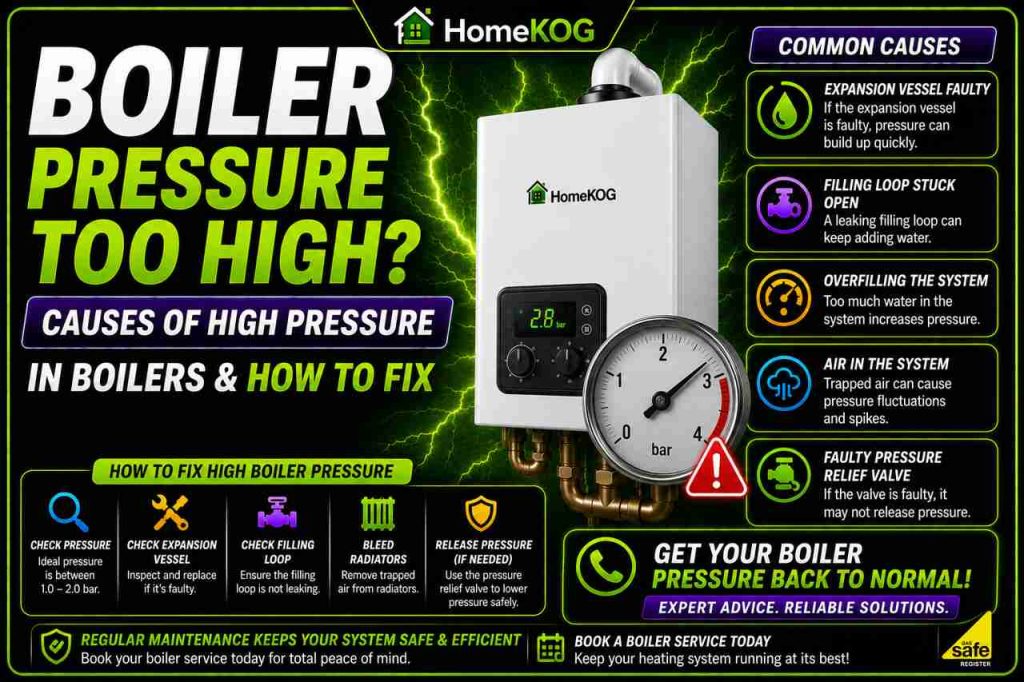
Low system pressure is the most common cause of a boiler shutting itself down. Most boilers automatically lock out when pressure drops below approximately 0.5 bar — the pump cannot effectively circulate water at such low pressure and the boiler’s safety controls shut it down to prevent damage.
Check the pressure gauge on the boiler front panel. A reading below 1.0 bar in the cold state indicates the system needs repressurising. Locate the filling loop — typically a braided hose with one or two valves beneath the boiler — and open it slowly. Watch the gauge and close the valves when the pressure reaches 1.5 bar. Reset the boiler and check whether it stays running.
If pressure drops back to a low level within hours or a few days of repressurising, a system leak is causing the pressure loss. Call a Gas Safe engineer to locate and repair the leak rather than continuing to top up repeatedly.
Cause 2 — Frozen Condensate Pipe
In cold weather, the external section of the condensate pipe can freeze and block. When condensate cannot drain, it backs up into the boiler and triggers a shutdown. The boiler will typically display a fault code — Worcester EA 227, Vaillant F28 or F29, Viessmann F2, Ideal L2 — and may produce a gurgling sound before shutting down.
Thaw the frozen pipe by pouring warm (not boiling) water from a jug along the external pipe section, focusing on joints and elbows where ice most commonly blocks. Once the condensate drain is clear, reset the boiler. Wrap the external pipe in foam pipe lagging after the thaw to prevent recurrence.
Cause 3 — Faulty or Miscalibrated Thermostat
A thermostat fault is one of the most common causes of repeated boiler shutdown. If the thermostat is reading an incorrectly high room temperature — due to a failing sensor, a thermostat positioned near a heat source, or low battery power — it will send a stop signal to the boiler as soon as it fires, believing the target temperature has already been reached. The boiler fires, the thermostat immediately cuts the demand, the boiler shuts down, and the cycle repeats.
Replace the thermostat batteries as the first diagnostic step on a wireless thermostat — low battery power causes erratic signalling that produces exactly this intermittent shutdown pattern. If the problem continues after battery replacement, check that the thermostat is not sited near a radiator, in direct sunlight, or in a draught that causes inaccurate readings. A thermostat that continues to malfunction after these checks requires replacement.
Cause 4 — Fuel Supply Interruption
A boiler cannot stay running without a continuous gas supply. Check other gas appliances in the property — the hob or cooker — to confirm gas is available. If other appliances are also not working, the supply to the property has been interrupted. Contact the gas supplier to confirm whether planned maintenance work is affecting supply in the area.
For properties on a prepaid gas meter, check the meter credit before doing anything else. A prepaid meter that has run out of credit cuts the gas supply immediately — topping up the meter and resetting the boiler resolves the problem instantly. This is one of the most easily overlooked causes precisely because it is so obvious once identified.
Cause 5 — Closed or Stuck Valves
Check the valves on the pipework beneath and around the boiler to confirm they are all open. A valve that has been accidentally closed — perhaps during maintenance or a plumbing job — stops water flowing through the system. Without water circulation, the boiler overheats rapidly and its safety thermostat shuts it down.
Manual and thermostatic radiator valves should be open throughout the property. If all visible external valves are confirmed open and the boiler continues to shut down, a motorised zone valve within the heating circuit may be stuck closed. This requires a Gas Safe engineer to inspect and replace.
Cause 6 — Short Cycling
Short cycling occurs when the boiler fires, reaches the set temperature very quickly, shuts down, and then repeats this cycle in rapid succession — often firing for only a few minutes before shutting off, then firing again 5 to 10 minutes later. This pattern wastes gas, stresses the heat exchanger and ignition system, and indicates that the boiler’s output is not well-matched to the system’s actual demand.
The most common cause of short cycling in an existing installation is that the boiler has been oversized — its maximum output far exceeds the property’s heating demand, causing it to satisfy the thermostat almost immediately after firing. A properly modulating boiler should be able to reduce its output to match low demand, but a boiler set to run at a fixed high output in a small system will short-cycle.
Short cycling can also be caused by a blocked or restricted pipework network that limits flow, a pump running at too high a speed for the system, or a poor heating system design. A Gas Safe engineer should assess short cycling — adding thermal mass to the system or adjusting the pump speed are relatively simple corrections, while redesigning the system is a more significant intervention.
Cause 7 — Water Pump Malfunction
The circulation pump moves water around the heating circuit — without it, hot water accumulates around the heat exchanger, causing the boiler to overheat and trigger its safety thermostat shutdown. A failed or seized pump produces a boiler that fires, overheats within a minute or two, and shuts down on the overheat safety.
A pump that is running but not circulating effectively — due to a seized impeller or a very high sludge level — produces the same symptom. Gentle tapping on the pump body with a rubber mallet can occasionally free a lightly seized impeller as a temporary measure. A seized or failed pump requires replacement by a Gas Safe engineer — pump replacement costs £150 to £350 fully installed.
Cause 8 — Heat Exchanger Fault
On boilers that are 7 to 10 years old or older, a cracked or heavily scaled heat exchanger can cause repeated shutdown. A cracked heat exchanger allows water to enter the combustion chamber, which the boiler detects and shuts down. Heavily scaled heat exchanger surfaces cause localised overheating — the boiler’s overheat thermostat activates and cuts out the boiler.
Heat exchanger replacement costs £300 to £600. On a boiler over 10 years old and outside warranty, comparing this repair cost against a new boiler installation is worthwhile — a new boiler typically costs £1,800 to £2,500 installed and comes with a 7 to 12-year warranty that covers the heat exchanger from day one.
Cause Summary
| Cause | DIY Fix | Action Required |
|---|---|---|
| Low boiler pressure | Yes | Repressurise to 1.5 bar |
| Frozen condensate pipe | Yes | Warm water thaw, reset boiler |
| Flat thermostat batteries | Yes | Replace batteries |
| Thermostat fault | Partial | Replace thermostat |
| Fuel supply / prepaid meter | Check meter | Top up or contact supplier |
| Closed valve | Check first | Open valve if visible |
| Short cycling | No | Gas Safe engineer — pump/system |
| Pump malfunction | Tap pump | Gas Safe engineer — replacement |
| Heat exchanger fault | No | Gas Safe engineer — assess vs replacement |
Preventing Repeated Boiler Shutdowns
Annual boiler servicing by a Gas Safe engineer is the most effective preventive measure — the engineer identifies the developing faults that cause repeated shutdowns before they cause a lockout. Monthly pressure checks allow the homeowner to identify a developing system leak before it causes a shutdown. Condensate pipe lagging prevents the freeze lockouts that are particularly disruptive in mid-winter cold snaps.
FAQ
Why does my boiler fire up then cut out immediately?
A boiler that fires and immediately cuts out is most commonly caused by a thermostat sending a stop signal almost immediately after the heat demand starts — indicating the thermostat is reading an incorrectly high temperature. Check the thermostat position, replace the batteries, and confirm the set temperature is above the current room temperature. A faulty thermostat temperature sensor produces the same symptom and requires thermostat replacement.
Why does my boiler turn off after 10 to 15 minutes?
A boiler that runs for 10 to 15 minutes then shuts off is often showing signs of low pressure — the pressure may be borderline at startup but drop below the cutoff threshold as the system heats and expands. Check the pressure gauge while the boiler is running as well as cold. Alternatively, the overheat thermostat may be triggering due to restricted flow from a stuck valve or failing pump.
Can a dirty boiler cause it to keep turning off?
Yes. A boiler that has not been serviced for several years accumulates combustion deposits on the burner and heat exchanger that reduce efficiency, cause localised overheating, and can trigger repeated safety cutouts. Annual servicing prevents this accumulation. A boiler with significant deposits will benefit from professional cleaning and combustion adjustment at a service visit.
Do I need a new boiler if it keeps turning off?
Not necessarily — most causes of repeated shutdown are repairable faults rather than end-of-life failure. The exception is a heat exchanger fault on a boiler over 10 years old outside warranty, where the repair cost approaches the cost of a new installation. A Gas Safe engineer can assess whether repair or replacement is the more cost-effective choice for the specific fault and boiler age.
Conclusion
A boiler that keeps turning itself off is almost always communicating a specific fault through its display panel — reading and looking up that fault code is always the most direct route to identifying the cause. Where no fault code is displayed, working through the causes in order of likelihood — pressure, condensate, thermostat, fuel, valves — identifies the majority of cases without any specialist knowledge or tools.
Annual servicing, condensate pipe lagging, and monthly pressure checks between services are the three preventive measures that address the most common causes of repeated shutdown before they cause a heating outage. Where the fault persists after the DIY checks have been exhausted, a Gas Safe engineer should diagnose and repair the remaining causes — all of which involve internal boiler components that cannot legally or safely be worked on without Gas Safe registration.