
Swimming Pool Boilers and Pool Heaters: Complete Guide 2026
Quick Answer: The best swimming pool heating system depends on pool size, usage frequency, and budget. Gas boilers are the most reliable option for large pools or infrequently used pools, heating water quickly regardless of outdoor temperature. Electric heat pumps are more cost-effective to run for smaller pools used regularly, but require outdoor air temperatures above 7°C to work effectively. Solar panels provide the lowest running costs for pools used in warm weather. A domestic gas boiler can also heat a pool via a specially fitted heat exchanger. All gas pool boiler installations must be carried out by a Gas Safe registered engineer.
A cold swimming pool is one of the few outdoor leisure facilities that actually becomes more work than pleasure. The right heating system makes the difference between a pool that is used regularly and one that sits unused for most of the year. With heating costs, environmental impact, and installation complexity all varying significantly between the available options, choosing the right pool heater requires more consideration than most homeowners expect. This guide covers every type of pool heating system, how each works, what it costs, and which is best suited to different pool sizes and usage patterns.
What Does a Swimming Pool Boiler Do?
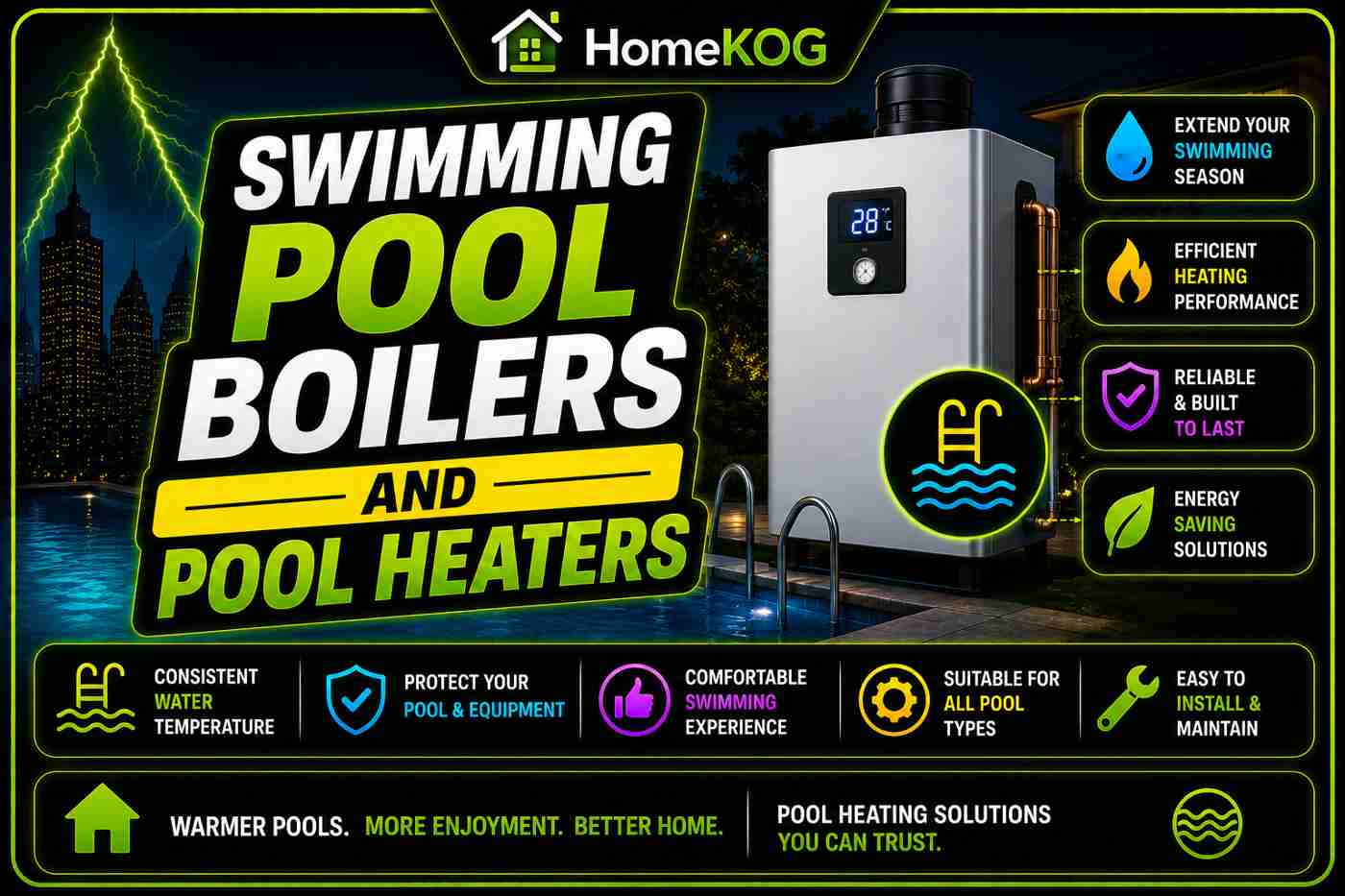
A swimming pool boiler heats water drawn from the pool through a combustion chamber or heat exchanger and returns it to the pool at the target temperature. The fundamental process mirrors a domestic hot water system — a heat source warms the water, and the heated water is returned to its source — but the volumes involved are significantly larger, requiring appropriately specified equipment for effective pool heating. SPlan heating system components explained are essential for optimizing the efficiency of pool heating. Understanding each part, from the pump to the heat exchanger, allows for better maintenance and performance. By ensuring that all components work harmoniously, pool owners can achieve consistent water temperatures while minimizing energy costs.
The choice of heat source — gas combustion, electrical resistance, heat pump, or solar — determines the boiler type, the running cost, and the environmental impact. Each has genuine advantages in specific contexts and limitations that make it less suitable in others. Homeowners also need to consider boiler finance options for homeowners when evaluating their choices. These options can make high-efficiency systems more affordable and accessible to a broader audience. By understanding the available financing, homeowners can invest in the technology that best meets their specific heating needs. boiler flue regulations explained clearly can help homeowners ensure their systems operate safely and efficiently. Compliance with these regulations not only enhances performance but also reduces the risk of hazardous emissions. By remaining informed about local codes and best practices, homeowners can maintain their installations and contribute to a healthier environment.
Types of Swimming Pool Boilers and Heaters
Gas Pool Boilers
Gas-powered pool boilers work on exactly the same principle as a domestic gas boiler — an internal combustion chamber burns gas to heat water drawn from the pool, which is then returned at the target temperature. Gas boilers can heat large volumes of water quickly and maintain a consistent pool temperature regardless of outdoor air temperature or weather conditions, making them the most reliable option for pools that need to be heated from cold on demand or maintained at temperature through variable weather.
The primary advantage of gas is heating speed and consistency. A gas boiler can bring a large pool from cold to swimming temperature in a matter of hours rather than the days an alternative system might take. For pools that are not kept permanently heated — used for occasional parties, seasonal use, or events — this rapid heating capability is a significant practical advantage that alternative systems cannot match.
The disadvantage is running cost. Gas prices per unit of energy are higher than electricity in some configurations and the combustion process produces carbon emissions, making it the least environmentally friendly option among the alternatives.
Best for: Large pools, pools used infrequently or heated on demand, all-weather reliability requirements.
Electric Pool Boilers and Heat Pumps
Electric pool heaters extract warm air from outside using a fan, pass it over an evaporator coil, and use the heat absorbed by a refrigerant in the coil to warm the pool water through a heat exchanger. This is the same fundamental process as an air source heat pump for domestic heating — and shares the same efficiency advantage. An electric heat pump for a pool can deliver 3 to 5 units of heat for every unit of electricity consumed, making it substantially more efficient per unit of energy than a direct combustion gas boiler.
The limitation is temperature dependency. Heat pumps require outdoor air temperatures above approximately 7 to 10°C to operate effectively. In cooler weather — early spring and late autumn in the UK — their efficiency drops and their ability to maintain pool temperature against heat losses reduces. For pools used primarily in warm weather, this limitation rarely matters. For year-round pool use in the UK climate, a heat pump may need a gas boiler backup during the coldest months. When considering options for efficient heating solutions, potential buyers often explore the best heat pump manufacturers in the UK. These manufacturers provide a range of models designed to optimize performance, even in less-than-ideal temperatures. Choosing a high-quality heat pump can make a significant difference in energy usage and overall cost over time.
Electric heat pumps have higher purchase costs than gas boilers but lower annual running costs due to the COP efficiency advantage. For a small to medium pool used regularly throughout the swimming season, the lower running cost typically justifies the higher initial investment within a few years.
Best for: Smaller pools, pools used frequently during the warmer months, environmentally-conscious installations with good access to outdoor air.
Ground Source Heat Pumps
Ground source heat pumps for pool heating follow the same principle as ground source domestic heating — pipes buried underground at 1 to 2 metres depth extract the stable ground temperature of approximately 10°C, which the heat pump upgrades through compression to heat the pool water. Ground source systems offer more consistent performance than air source because ground temperature does not vary with weather, but the installation cost — requiring extensive groundwork for the ground loop — is substantially higher.
For domestic swimming pool applications, ground source heat pumps are generally difficult to justify on cost grounds — the performance advantage over air source is modest for pool heating specifically, and the installation cost differential is significant. They are more commonly found in commercial pool facilities where the scale of heating demand makes the efficiency advantage more meaningful.
Best for: Commercial pools, properties where ground source infrastructure is already installed for domestic heating. When considering the best boilers for rental properties, it is essential to prioritize energy efficiency and maintenance costs. Many landlords find that investing in high-quality systems can lead to significant savings over time. Additionally, selecting a boiler with reliable customer support adds peace of mind for property management. For those managing properties with central heating needs, the best condensing boilers for efficient heating can provide a reliable solution that minimizes energy bills. These systems not only enhance comfort but also align with sustainability goals by reducing emissions. Therefore, landlords should carefully evaluate the options available to ensure they choose a model that combines performance and efficiency effectively.
Solar Pool Heaters
Solar pool heaters use roof or ground-mounted solar collectors to capture heat from sunlight and transfer it to pool water circulated through the collector panels. Running costs are effectively zero — no fuel, no electricity beyond the circulation pump — and the technology requires minimal maintenance with an expected lifespan of 15 to 20 years.
The limitations are consistency and capacity. Solar heating is dependent on sunlight availability — output varies significantly with cloud cover, season, and time of day. In the UK climate, solar heating alone can maintain a pool at comfortable swimming temperature during the summer months but cannot reliably maintain temperature on overcast days or outside the summer season. The heat input is gradual, and solar heating alone cannot rapidly bring a large pool from cold to temperature on demand.
Solar heating is most appropriate as a supplement to another heat source, or as the sole heating for pools used only in summer by homeowners willing to accept some variability in pool temperature.
Best for: Summer-only pools, reducing running costs alongside a primary heat source, environmentally conscious installations.
Using a Domestic Boiler to Heat a Swimming Pool
A standard domestic gas boiler can be configured to heat a swimming pool through the installation of a dedicated plate heat exchanger — a device that transfers heat from the domestic hot water circuit to the pool water without the two circuits mixing. This approach avoids the need for a dedicated pool boiler and can be cost-effective where the domestic boiler has sufficient spare capacity to meet both domestic and pool heating demands.
The practicality depends on the domestic boiler’s output and the pool’s size. A typical domestic combi or system boiler rated at 25 to 40kW may be adequate for heating a small or medium pool alongside normal domestic demand, but larger pools require dedicated pool boilers sized appropriately for the volume of water involved. A Gas Safe engineer and ideally a pool heating specialist should assess the existing boiler’s capacity before attempting to use it for pool heating.
Swimming Pool Boiler Costs 2026
| Cost Element | Gas Pool Boiler | Electric Heat Pump | Solar Heater |
|---|---|---|---|
| Unit cost | £500–£4,000 | £1,500–£5,000 | £1,500–£4,000 |
| Installation cost | £500–£1,000 | £500–£1,000 | £500–£1,000 |
| Total installed cost | £1,000–£5,000 | £2,000–£6,000 | £2,000–£5,000 |
| Annual running costs | Higher (gas) | Lower (electricity) | Near zero |
| Best payback scenario | Large pool, infrequent use | Small-medium pool, regular use | Summer pool, sunny climate |
The size of the pool has the single greatest influence on the correct boiler specification and therefore the cost. Larger pools require higher-output boilers, more significant installation infrastructure, and higher running costs regardless of the heat source chosen. Getting the sizing right — neither undersized (struggling to maintain temperature) nor oversized (wasting energy) — requires a professional assessment of the pool volume and expected heat loss.
Installation Process
All gas pool boiler installations must be carried out by a Gas Safe registered engineer. This is a legal requirement under the Gas Safety (Installation and Use) Regulations 1998, and the consequences of non-compliant gas installation — including carbon monoxide production and explosion risk from improperly connected pipework — make this non-negotiable. Verify Gas Safe registration at gassaferegister.co.uk before any work begins.
The installation involves positioning the boiler adjacent to the pool at the required clearance distances, connecting the pool water circuit to the boiler’s inlet and outlet connections, connecting gas supply pipework, installing the flue, and commissioning the system. For domestic boilers being adapted for pool heating, the heat exchanger installation requires additional specialist work.
Electric heat pump installation involves positioning the external unit with adequate airflow clearance, electrical connection, water circuit connection to the pool, and commissioning. An electrically qualified installer should handle the electrical connections.
Planning permission for pool heating equipment is not normally required for domestic installations where equipment is positioned at ground level, but properties in conservation areas or with listed building status should check with the local planning authority before installation.
How Often Should a Pool Boiler Be Serviced?
Annual servicing is the standard recommendation for gas pool boilers, consistent with domestic gas boiler requirements. Debris and scale accumulate in the combustion chamber and heat exchanger over time, reducing efficiency and potentially creating dangerous operating conditions. A Gas Safe engineer should inspect and clean the combustion chamber, check gas pressure and combustion quality, test safety devices, and verify flue integrity at each annual service.
Electric heat pumps benefit from annual or bi-annual maintenance — checking refrigerant levels, cleaning the evaporator coil and fan, inspecting electrical connections, and verifying heat exchanger performance. While not a legal requirement for electrical appliances as it is for gas, annual servicing maintains efficiency and identifies developing faults before they cause system failure.
Solar pool heating systems require the least maintenance — checking collector panel condition, verifying pipe connections, and ensuring the circulation pump is operating correctly. The simplicity of the technology means that a thorough annual inspection is typically sufficient.
FAQ
What size boiler do I need to heat a swimming pool?
The correct boiler size depends on the pool volume, the target temperature, the outdoor temperature during use, the pool’s insulation (including whether a cover is used when not in use), and how quickly the pool needs to reach temperature from cold. As a general guide, a small domestic pool of 20 to 30m³ may require 8 to 15kW of continuous heating capacity to maintain temperature, while a larger pool of 50m³ or more may require 30kW or above. A pool heating specialist should calculate the specific requirement for the pool before specifying equipment.
Is a gas boiler or heat pump better for a swimming pool?
Gas boilers heat pools faster, work in any weather, and are more appropriate for large pools or infrequently used pools that need to be brought from cold to temperature quickly. Electric heat pumps have lower running costs, are more environmentally friendly when using renewable electricity, and are better suited to smaller pools used regularly during the warm months. For year-round use in the UK climate, a gas boiler provides more reliable performance; for summer-season use, a heat pump is typically more cost-effective.
Can I use my domestic boiler to heat a swimming pool?
Yes, if the domestic boiler has sufficient spare capacity for the pool’s heating demand alongside normal domestic hot water and central heating use. A dedicated plate heat exchanger transfers heat from the domestic circuit to the pool without mixing the water circuits. This approach is most practical for small pools and requires professional installation including assessment of the existing boiler’s output capacity.
How much does a swimming pool boiler cost to run?
Annual running costs depend on the heat source, pool size, and usage pattern. Gas boilers have the highest per-unit fuel cost but the fastest heating capability. Electric heat pumps have lower per-unit heat cost due to their COP efficiency advantage. Solar heaters have near-zero running costs but require supplementary heating in cooler conditions. For a typical domestic pool used throughout the summer season, annual gas boiler running costs can range from £600 to £2,000 depending on pool size and usage, while heat pump running costs for the same pool are typically 50 to 70% lower.
Does a pool boiler need annual servicing?
Gas pool boilers must be serviced annually by a Gas Safe registered engineer — the same legal and safety requirements that apply to domestic gas boilers apply to gas pool heating equipment. Electric heat pumps benefit from annual maintenance to maintain efficiency and identify developing faults, though this is not a statutory requirement. Solar heating systems require periodic inspection but have the lowest maintenance requirement of any pool heating technology.
Conclusion
Choosing the right swimming pool heating system requires matching the technology to the pool’s specific size, usage pattern, and the homeowner’s priorities on running cost versus installation cost. Gas boilers deliver the most reliable and rapid heating for large or infrequently used pools but carry the highest running costs and environmental impact. Electric heat pumps offer the lowest running costs for smaller pools used regularly during the warmer months and can use renewable electricity to minimise carbon impact. Solar heating eliminates running costs entirely for summer-season pools at the cost of some temperature consistency. Another aspect to consider is insulating your hot water tank, which can significantly reduce energy costs while ensuring a consistent supply of warm water for your pool. Investing in proper insulation helps maintain the desired temperature and reduces the strain on your heating system. Ultimately, this will extend the lifespan of your equipment and enhance your overall pool experience.
Whatever system is chosen, professional installation is essential — Gas Safe registration for gas equipment, electrical qualification for heat pump electrical connections, and appropriate pool circuit engineering in all cases. Annual servicing maintains efficiency, ensures safety, and extends the operational lifespan of the investment, making it as important for pool heating equipment as it is for the domestic boiler that keeps the rest of the home warm through winter.