
How Does an S-Plan Heating System Work? Complete Guide 2026
Quick Answer: An S-Plan heating system uses two separate motorised zone valves — one controlling the central heating circuit and one controlling the hot water cylinder — allowing both to be operated independently. It is the most common heating system in modern UK homes and suits system and regular boilers with a hot water cylinder. S-Plan cannot be used with a combi boiler. Key advantages are independent zone control, consistent water flow, and the ability to extend to multiple heating zones in larger properties. Common faults include sticking microswitches and valve seizure caused by sludge accumulation.
Most UK homeowners are unaware of which type of heating control system their property uses until something goes wrong with it. The S-Plan and its alternative, the Y-Plan, between them account for the vast majority of domestic heating system configurations in UK properties. Understanding which system is in place, how it operates, and what its strengths and limitations are helps with informed decisions about new boiler installation, heating upgrades, and fault diagnosis. This guide explains everything about S-Plan heating systems in straightforward terms.
What is an S-Plan Heating System?
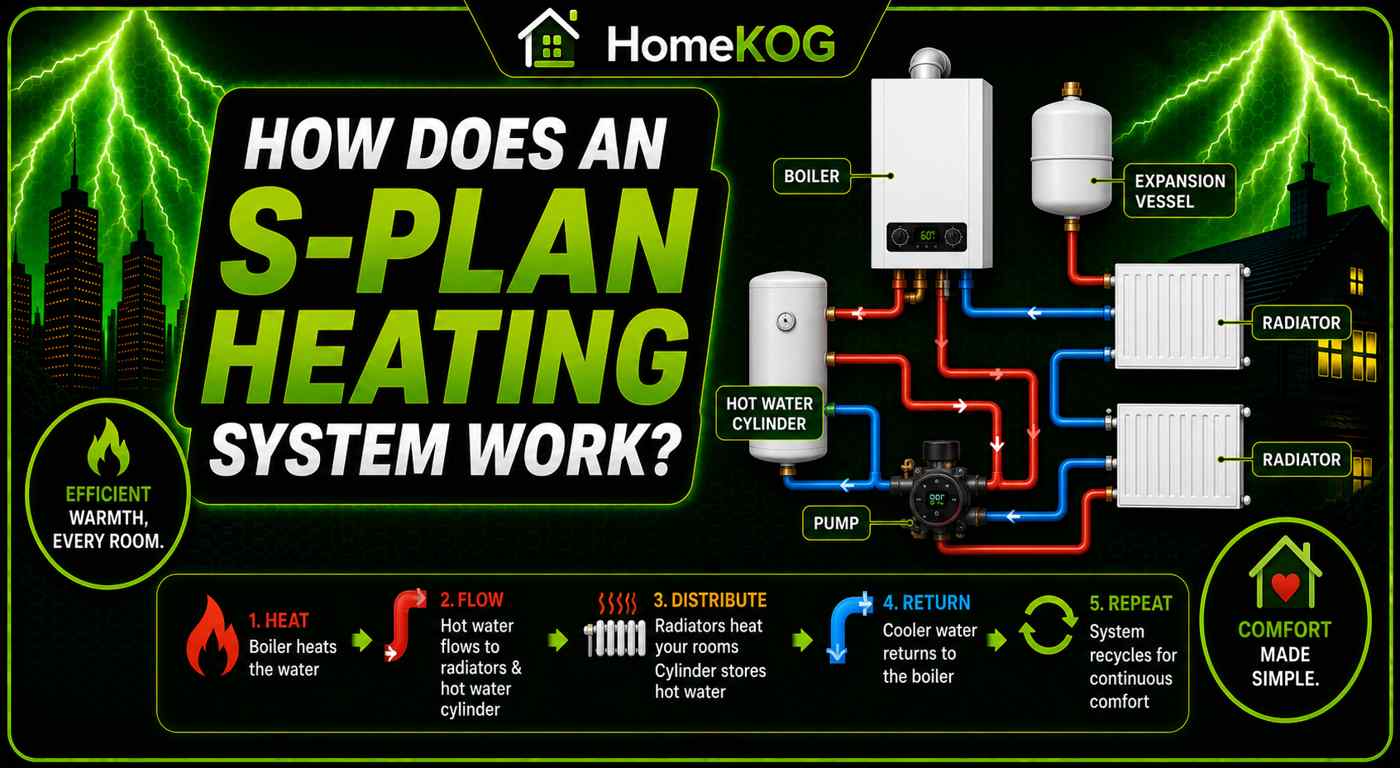
An S-Plan heating system is a two-zone heating control configuration that uses two separate motorised zone valves — also called two-port valves — to independently control the flow of hot water to two separate circuits: the central heating radiator circuit and the domestic hot water cylinder circuit.
The name comes from the schematic diagram of the system’s layout, which traces an S-shape when drawn. The S-Plan is the most widely installed heating system type in modern UK homes, having largely replaced older single-valve configurations in new builds and heating upgrades over the past two decades.
Because the S-Plan requires a hot water storage cylinder to manage the domestic hot water circuit, it is used exclusively with system boilers and regular (conventional) boilers. Combi boilers heat water directly from the mains on demand and have no requirement for a cylinder — an S-Plan system is not applicable to a combi boiler installation. When selecting a suitable system boiler for your needs, it’s essential to consider factors like pool heater efficiency ratings. Higher efficiency ratings can lead to significant savings on energy costs over time. Additionally, understanding how these ratings impact performance can help you make an informed decision for your home.

How Does an S-Plan Heating System Work?
The S-Plan system controls the distribution of hot water produced by the boiler to two separate destinations — the radiators and the hot water cylinder — using independent motorised valves for each. When upgrading your heating system, it’s essential to explore various boiler finance options for homeowners that best fit your budget and needs. Many providers offer tailored plans to help ease the financial burden of purchasing and installing a new boiler. Taking the time to compare these options can ensure you make a well-informed decision that maximizes efficiency and cost savings.
When the programmer calls for central heating, a 230V electrical signal is sent to the Motor Live terminal on the heating zone valve. This causes the valve’s motor to open the valve, allowing hot water from the boiler to flow into the radiator circuit. As the valve reaches its fully open position, it activates an internal microswitch. This microswitch sends a second 230V signal that starts the circulation pump and simultaneously fires the boiler.
The same process applies independently to the domestic hot water circuit. When the programmer calls for hot water — or the cylinder thermostat detects that the cylinder temperature has dropped below the set point — the hot water zone valve opens, the microswitch activates, and the boiler fires to heat water through the cylinder coil.
When the demand for either heating or hot water is satisfied — the room thermostat reaches its target temperature, the cylinder thermostat reaches its target temperature, or the programmer switches off the relevant circuit — the 230V supply to the Motor Live is cut. The zone valve springs shut under a return spring mechanism, stopping the flow of water to that circuit. The pump and boiler continue to run briefly after the valve closes to dissipate residual heat, then shut down.
Because the two zone valves operate independently, central heating and hot water can be active simultaneously, separately, or not at all — the programmer and thermostats for each circuit operate without affecting the other.
S-Plan System Components
A complete S-Plan installation includes the following components working together.
The system or regular boiler provides the heat source. Two motorised two-port zone valves — one on the heating flow pipe and one on the cylinder coil flow pipe — control water distribution. A circulation pump moves water around the circuits. A programmer or timer sets the active periods for heating and hot water independently. A room thermostat monitors air temperature in the main living area and cuts the heating call when the target temperature is reached. A cylinder thermostat monitors the hot water temperature and cuts the hot water call when the cylinder reaches the set temperature. A hot water storage cylinder stores the heated domestic hot water. A wiring centre brings all the electrical connections together and manages the switching logic between the components.
S-Plan vs Y-Plan: What is the Difference?
The Y-Plan is the other common domestic heating system configuration and uses a single mid-position three-port valve rather than two separate two-port valves. The three-port valve has three positions — heating only, hot water only, and mid-position (both simultaneously). The mid-position is the key distinction: a Y-Plan valve in mid-position diverts flow to both circuits concurrently.
| Feature | S-Plan | Y-Plan |
|---|---|---|
| Valve type | Two separate two-port valves | One three-port mid-position valve |
| Zone independence | Fully independent | Partially independent |
| Expandability | Easy — add more zone valves | Complex — valve replacement required |
| Fault diagnosis | Simpler — one valve per circuit | More complex — single valve controls both |
| Common fault | Sticking microswitch, valve seize | Mid-position valve fault |
| Cost | Slightly higher (two valves) | Slightly lower (one valve) |
The S-Plan’s use of independent valves for each circuit makes fault diagnosis more straightforward — a fault in one circuit does not affect the other, and the faulty valve can be identified and replaced without disrupting the functioning circuit. Expanding the system to additional zones is also more straightforward with S-Plan — a third zone valve and thermostat can be added for a conservatory, basement, or second property level without fundamental reconfiguration.
Benefits of an S-Plan Heating System
Independent control of heating and hot water is the primary practical benefit. Being able to have hot water available in summer without the central heating running — or vice versa — is something that single-valve systems manage less cleanly. This independence also allows timed schedules for each circuit that reflect actual household usage rather than forcing both circuits onto the same schedule.
Multiple zone control is straightforward to implement with S-Plan. Each additional zone requires only an additional two-port valve and thermostat — the wiring centre accommodates the additional zone without requiring fundamental system changes. This makes S-Plan the natural choice for larger properties where heating different areas of the house to different temperatures at different times delivers meaningful energy savings. Another innovative tool that enhances energy management is the Neomitis thermostat advanced features overview. With capabilities like remote access and smart scheduling, users can optimize their heating preferences conveniently. Additionally, integrating these advanced features can further streamline the efficiency of multi-zone systems, ensuring that every room maintains its desired temperature without unnecessary energy expenditure.
Consistent water flow through the heating circuit is maintained regardless of hot water demand, because the two circuits are hydraulically independent. In Y-Plan systems, simultaneous heating and hot water demand shares the boiler’s output between the two circuits, potentially reducing flow and temperature in each.
Drawbacks of an S-Plan Heating System
Sticking Microswitch
The microswitch inside the zone valve actuator — which activates the pump and boiler when the valve reaches the fully open position — can stick in the open position. When this occurs, the boiler and pump receive a continuous run signal and operate without interruption regardless of thermostat or programmer status. Continuous boiler operation wastes fuel, increases wear on the pump and heat exchanger, and can cause the boiler to overheat and lockout on safety devices. A sticking microswitch is identified by the boiler running when no heat demand is active and is resolved by replacing the valve actuator.
Valve Seizure from Sludge
Magnetite sludge — the black iron oxide deposit that accumulates in heating systems without adequate magnetic filtration and inhibitor maintenance — can affect the valve seat and spindle. The sludge deposits on the valve mechanism cause the spindle to stiffen progressively, eventually seizing and preventing the valve from opening or closing correctly. A seized valve produces either no heat (if stuck shut) or continuous running (if stuck open). Valve seizure is preventable through magnetic filter installation, correct inhibitor dosing, and annual servicing — the same maintenance measures that protect the boiler and radiators from sludge damage.
Valves that have been inactive for extended periods — particularly over summer when neither circuit operates for weeks at a time — are more vulnerable to seizure than those in continuous seasonal use. Running the heating briefly during summer every few weeks prevents static seizure in both the valve mechanism and the boiler pump.
Room Thermostat Faults
Room thermostats in S-Plan systems can occasionally fail to send the correct call signal, either through flat batteries on battery-powered models, a failed thermostat unit, or a wiring fault between the thermostat and wiring centre. A thermostat fault that prevents the heating call from being sent will cause the boiler not to fire for central heating even though the programmer is calling for heat. Battery replacement is the first diagnostic step on battery-powered thermostats. A thermostat that still fails to operate correctly after battery replacement requires replacement of the thermostat unit — a straightforward engineer task.
Setting Up an S-Plan Heating System
S-Plan wiring involves 230V electrical connections between the wiring centre, zone valves, pump, boiler, programmer, and thermostats — all of which constitute notifiable electrical work under Part P of the Building Regulations. A Gas Safe registered heating engineer with experience in S-Plan wiring should carry out the installation. Incorrect wiring of an S-Plan system is a common source of faults where one or both circuits fail to operate correctly despite the individual components being in good condition.
The correct installation sequence involves fitting and commissioning the boiler first, installing the zone valves and connecting the pipework, mounting and wiring the wiring centre, connecting all components to the wiring centre following the manufacturer’s wiring diagram, and testing each circuit independently before commissioning the complete system.
Best Boilers for S-Plan Systems
S-Plan systems require a system boiler or regular boiler — not a combi. The following are among the most recommended system boiler options for S-Plan installations in 2026.
| Boiler | Output Range | Key Feature |
|---|---|---|
| Viessmann Vitodens 100-W System | 4–35kW | Stainless steel HX, 94% efficiency |
| Worcester Bosch Greenstar 4000 System | 12–24kW | Built-in WiFi, 10yr warranty |
| Worcester Bosch Greenstar 8000 System | 15–50kW | 12yr warranty, stainless steel HX |
| Ideal Vogue Max System | 15–32kW | 12yr warranty, compact |
| Vaillant ecoTEC Plus System | 12–38kW | Quiet Mark, stainless steel HX |
S-Plan Heating System Costs
The total cost of an S-Plan heating system installation depends on whether the boiler is being replaced simultaneously, whether additional zones are being added, and the complexity of the existing pipework configuration.
| Cost Element | Typical Range |
|---|---|
| New system boiler installed | £1,800 – £3,000 |
| Two-port zone valve (parts only) | £15 – £40 each |
| Zone valve replacement (installed) | £80 – £150 each |
| Wiring centre replacement | £80 – £200 installed |
| Additional zone addition | £200 – £400 per zone |
| Full S-Plan system (boiler + controls) | £2,000 – £5,000 |
FAQ
What is the difference between an S-Plan and Y-Plan heating system?
An S-Plan uses two separate two-port motorised zone valves — one for heating and one for hot water — allowing both circuits to operate fully independently. A Y-Plan uses a single three-port mid-position valve that directs flow to heating, hot water, or both simultaneously. S-Plan is easier to expand with additional zones and simpler to diagnose when a fault develops in one circuit. Y-Plan uses fewer components and is slightly cheaper to install initially but less flexible for multi-zone configurations.
Can an S-Plan system be used with a combi boiler?
No. An S-Plan system requires a hot water storage cylinder to manage the domestic hot water circuit, and combi boilers heat water directly from the mains on demand with no cylinder. An S-Plan system is only appropriate for system boiler or regular boiler installations. For zone control with a combi boiler, smart thermostatic radiator valves combined with a smart thermostat provide independent room-by-room temperature control without requiring a zone valve system.
What causes an S-Plan zone valve to stick?
The two most common causes are a sticking microswitch within the valve actuator and sludge accumulation on the valve spindle and seat. A sticking microswitch causes the boiler to run continuously when it should not be. Sludge seizure prevents the valve from opening or closing correctly. Both are addressed by valve actuator or full valve replacement. Sludge seizure is preventable through magnetic filter installation and annual inhibitor maintenance.
How many zones can an S-Plan system support?
An S-Plan system can in principle support as many zones as required — each additional zone adds a two-port valve, a thermostat, and the corresponding wiring to the wiring centre. In practice, two-zone S-Plan (heating and hot water) is the standard domestic configuration. Three-zone installations — separating upstairs and downstairs heating, or adding a conservatory — are common in larger properties. Beyond three zones, the wiring centre complexity and the system’s pumping capacity become factors that a heating engineer should assess.
Conclusion
The S-Plan heating system’s combination of independent zone control, straightforward fault diagnosis, and easy expandability makes it the most practical and most widely installed domestic heating system configuration for system and regular boiler installations in the UK. Its independence of the heating and hot water circuits — each controlled by its own valve, thermostat, and timer schedule — provides more flexible and more efficient temperature management than the single-valve Y-Plan alternative, particularly in larger properties where zoning different areas of the house delivers meaningful energy savings.
The system’s common faults — sticking microswitches, sludge-seized valves, and thermostat battery failures — are all well understood and inexpensive to resolve when identified promptly. Annual boiler servicing that includes checking valve operation and inhibitor levels prevents the sludge accumulation that underlies the majority of valve faults, keeping the system running correctly throughout its operational life. boiler flue maintenance best practices are also essential to ensure optimal efficiency and safety. Regular inspections and cleanings can prevent dangerous blockages and enhance the overall performance of the system. By adhering to these best practices, homeowners can avoid costly repairs and extend the lifespan of their boilers.