
Boiler Flue Regulations: What You Need to Know in 2026
Quick Answer: Boiler flue regulations require that flues are positioned at least 30 to 60cm away from any opening (windows, doors, vents) to prevent expelled gases from re-entering the property. Flues facing public spaces such as pavements must be positioned at least 2.1 metres above ground level. Horizontal flues must be angled slightly upwards to prevent condensate dripping. All flue joints must be supported throughout their length, sealed with solvent cement per BS 6209, and visually accessible to Gas Safe engineers. Only a Gas Safe registered engineer can legally install, modify, or relocate a boiler flue in the UK.
The boiler flue is one of the most safety-critical components of any gas heating installation. Its purpose is to safely remove combustion waste gases — including carbon dioxide and potentially carbon monoxide — from the property and discharge them to the atmosphere at a position where they cannot re-enter the building or cause harm to people nearby. A flue that is incorrectly positioned, inadequately supported, or poorly sealed creates a real risk of toxic gas exposure to occupants, neighbours, and members of the public. The regulations governing flue installation exist precisely to prevent these outcomes.
What is a Boiler Flue?
A boiler flue is a duct or pipe that carries waste gases produced during the boiler’s combustion process from the boiler to the outside atmosphere. Modern condensing gas boilers produce flue gases containing carbon dioxide, water vapour, and trace combustion products. If the combustion process is imperfect — through a faulty burner, blocked flue, or poor air supply — carbon monoxide can also be present in the flue gases.
The flue on a modern condensing boiler is a balanced flue — a concentric pipe-within-a-pipe design that simultaneously draws combustion air from outside (through the outer pipe) and expels flue gases to outside (through the inner pipe). This balanced arrangement prevents combustion air from being drawn from inside the property, eliminating the risk of combustion products being drawn back into the room if there is negative pressure inside the building.
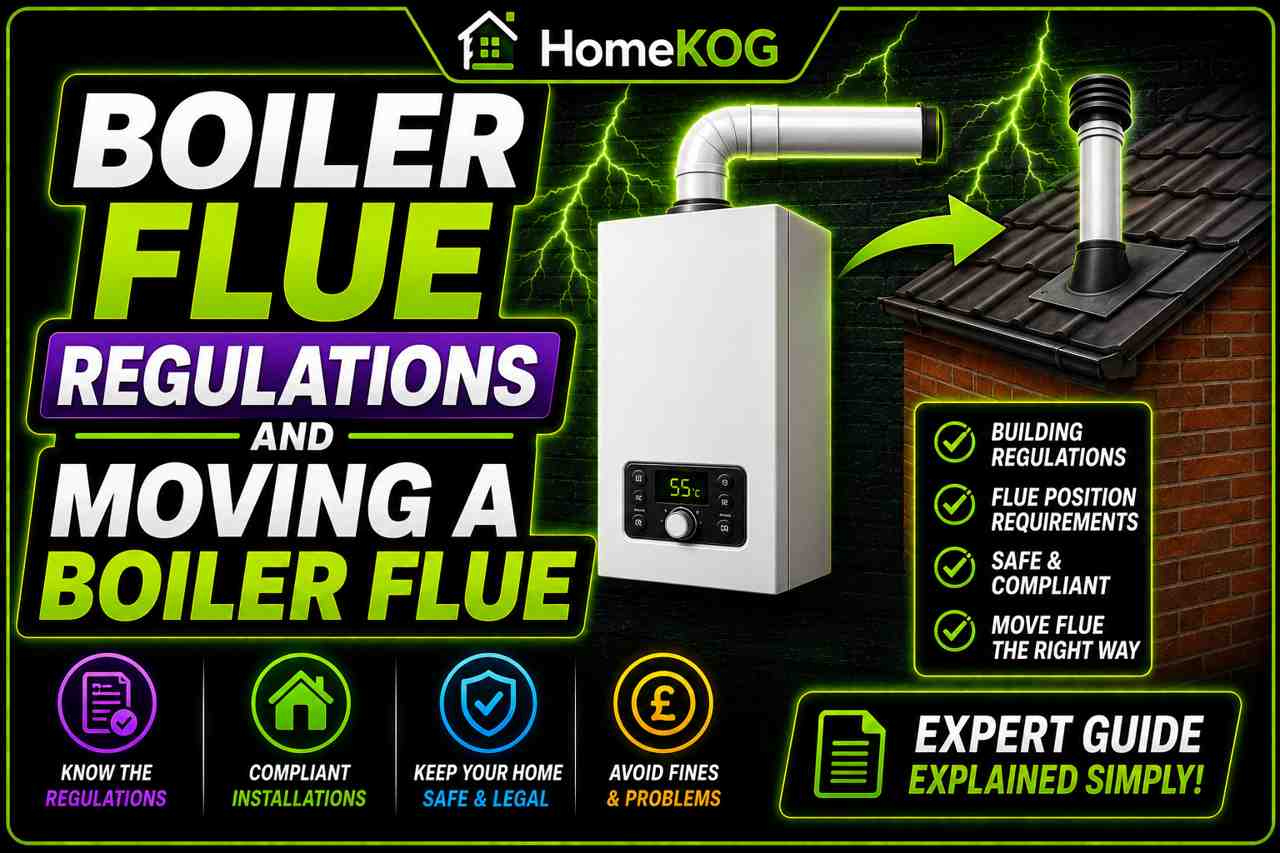
In most UK installations, the flue exits horizontally through an external wall as a short pipe with a terminal fitting. In properties where a horizontal exit is not practical — because the only available wall faces neighbour windows, or the boiler is located away from an external wall — a vertical flue through the roof is used instead.

Boiler Flue Regulations: Key Requirements
Boiler flue regulations form part of the Building Regulations, specifically Part J (Combustion Appliances and Fuel Storage Systems). All new boiler installations and any boiler relocations must comply with these regulations. The regulations do not automatically require existing non-compliant installations to be modified immediately, but any work on an existing installation — including boiler replacement or relocation — triggers the requirement for the new installation to fully comply.
Distance from Windows, Doors, and Openings
The most frequently misunderstood flue regulation concerns the minimum distance between the flue terminal and any opening in the building fabric — windows, doors, air vents, and other openings.
The minimum required distance varies depending on the specific configuration but the general requirement is that the flue terminal must not be within 30 to 60cm below, above, or to the sides of any opening. The precise minimum for a specific installation depends on the boiler’s output, the flue terminal type, and the building’s configuration — the Gas Safe engineer installing the boiler will confirm the applicable distances.
This distance requirement exists because flue gases, while partly dispersed by the terminal’s design, can still be drawn back into the property through a nearby open window or door if the clearance is insufficient. The condensate vapour plume from a condensing boiler is particularly visible in cold weather and can cause nuisance or health concerns if directed toward an opening.
Distance from Heat-Sensitive Materials
Flue gases exit the terminal at significantly elevated temperatures — the terminal and the immediate vicinity remain hot during boiler operation. The regulations require that the flue terminal is positioned at least 7.5cm away from any material that could be damaged by heat. Plastic guttering, fascias, and soffits are the most common materials requiring clearance, as the sustained heat from the flue terminal can cause deformation or melting over time.
The flue must also be positioned at least 15cm to the side of any soil or drain pipes to prevent heat damage to the plastic pipe material.
Flues Facing Public Spaces
Where the flue terminal exits a wall that faces a public area — a pavement, public path, pedestrian precinct, or any area regularly used by members of the public — the terminal must be positioned at a minimum height of 2.1 metres above ground level. This ensures that flue gases and condensate discharge are above head height and cannot directly affect passing members of the public.
Where the 2.1-metre height cannot be achieved on the available wall — because the boiler is located in a ground-floor room with limited wall height — a vertical flue through the roof is the appropriate solution.
Flue Orientation and Angle
Horizontal flues must be installed at a slight upward angle — typically 1 to 3 degrees — along their entire length from the boiler to the terminal. This ensures that any condensate water vapour that condenses within the flue pipe drains back toward the boiler’s condensate trap rather than dripping out of the terminal onto the external wall or passing people below.
A flue installed level or with a downward angle will allow condensate to accumulate within the pipe, potentially causing corrosion of the flue components and dripping of acidic condensate from the terminal.
Condensate Plume Considerations
The visible white vapour plume from a condensing boiler’s flue terminal is water vapour condensing as it meets cold outdoor air. The regulations require that this plume must not cause a nuisance to neighbouring properties, must not cross public routes at a height that creates problems for pedestrians, and must not obscure security cameras or trigger infrared motion sensors.
In some installations — particularly where the flue terminal is in a confined space, a passageway, or close to security equipment — a plume management kit can redirect the plume direction to comply with these requirements.
Vertical Flue Regulations
Vertical flues that exit through the roof require access points at regular intervals along their concealed length. Any section of a vertical flue that is enclosed within the building structure — passing through floor voids, ceiling spaces, or duct shafts — must have inspection hatches that allow a Gas Safe engineer to visually inspect the flue joints for signs of leakage or damage. A flue that cannot be inspected because it is fully concealed without access points will cause the boiler to be classified as “At Risk” — meaning the engineer cannot certify its safety.
This regulation is particularly relevant for vertical flue installations in apartments and multi-storey buildings where the flue must pass through multiple floor levels before exiting at the roof.
Flue Support Regulations
The entire length of the flue installation must be supported at appropriate intervals to prevent sagging or movement. Unsupported sections of flue can develop sags where condensate accumulates, restricting gas flow and potentially causing the boiler to lock out on fan pressure faults.
The flue must be secured to the surrounding structure using clamps or brackets, with all joints firmly connected. Per BS 6209, solvent cement must be applied to all joints on the flue to ensure a gas-tight seal. A joint that is not properly sealed allows flue gas to escape within the building structure — a potentially serious safety issue where the gases can accumulate in concealed spaces.
Do Flue Regulations Apply to Old Boiler Installations?
The current flue regulations apply in full to all new boiler installations and to any boiler relocation or flue modification. They do not automatically require existing non-compliant installations to be brought up to current standards unless the installation is being modified or the boiler is being replaced.
However, if a boiler replacement triggers a change from a non-condensing to a condensing boiler, the condensing boiler’s flue terminal location and orientation requirements may differ from the original non-condensing flue — requiring repositioning or extension of the flue to comply with current regulations. The Gas Safe engineer carrying out the replacement will identify any required flue changes as part of the installation planning process.
Commercial Boiler Flue Regulations
Commercial properties using boilers above 70kW output — common in larger commercial premises, schools, and apartment blocks — must comply with the same Part J Building Regulations as domestic installations, with additional requirements reflecting the larger scale and potential for greater impact.
Commercial flues must be installed in a straight configuration where possible, must be pressure-tested to confirm there are no leaks, and must be positioned clear of heat-sensitive materials with adequate clearances. Access hatches for inspection are typically required at more frequent intervals than domestic installations. All commercial flue components must carry CE certification confirming they meet the relevant safety and performance standards.
What to Do If Your Flue Doesn’t Meet Regulations
If an existing flue installation is found not to comply with current regulations — either through a Gas Safe inspection, a boiler service, or a self-check — the appropriate response depends on whether the non-compliance is in an existing unchanged installation or arises from recent work.
For existing installations where no recent work has been done, a Gas Safe engineer should assess whether the non-compliance presents an immediate safety risk. If the engineer identifies the flue as presenting an “Immediately Dangerous” risk — where flue gases could enter the property — the engineer is required to advise disconnection of the appliance. If classified as “At Risk” — where the installation has a potential to become dangerous — the engineer will issue an At Risk notice and advise remedial action.
Remedial action may involve flue terminal repositioning, extension of the flue to achieve required clearances, installation of access points for concealed sections, or flue replacement where components are damaged. All remedial work must be carried out by a Gas Safe registered engineer.
FAQ
How far should a boiler flue be from a window?
The minimum distance between a flue terminal and any opening — including windows, doors, and air vents — is typically 30 to 60cm depending on the specific configuration. The precise minimum depends on the boiler output, terminal type, and installation configuration. A Gas Safe engineer will confirm the specific minimum required for the installation and ensure compliance.
Can a boiler flue go through a neighbour’s wall?
No. A boiler flue cannot be routed through a neighbouring property’s walls or structure. Where a flue needs to pass through a communal area — a shared roof space or duct in an apartment building — access for inspection must always be maintained. Any routing through shared areas requires agreement and must be designed to allow Gas Safe engineers to inspect joints.
Can I move my boiler flue myself?
No. Moving or modifying a boiler flue constitutes work on a gas installation and must be carried out by a Gas Safe registered engineer. Working on gas appliances without Gas Safe registration is illegal under the Gas Safety (Installation and Use) Regulations 1998, voids the boiler’s warranty, and invalidates home insurance coverage for any related damage.
What happens if my flue is too close to a window?
A flue terminal positioned too close to a window creates a risk of expelled combustion gases — including carbon monoxide — being drawn back into the property when the window is open. It also creates condensate nuisance issues. A Gas Safe engineer should assess the risk level and advise on the remedial action required, which may involve extending or repositioning the flue terminal.
Do I need planning permission to install a boiler flue?
In most cases, no — installing or replacing a boiler flue is permitted development that does not require planning permission, as long as it meets the Building Regulations and is carried out by a Gas Safe registered engineer. Properties in conservation areas, listed buildings, or those subject to Article 4 Directions may have additional restrictions — checking with the local planning authority before any external wall penetration is advisable in these cases.
Conclusion
Boiler flue regulations exist to protect occupants, neighbours, and members of the public from the combustion gases produced by gas boilers. The core requirements — minimum distances from openings, clearances from heat-sensitive materials, height requirements over public spaces, correct horizontal angle, supported joints sealed with solvent cement, and access for inspection — are all directed at ensuring that flue gases are safely discharged to the atmosphere without creating a route back into any occupied space.
Compliance is not optional — the regulations form part of the Building Regulations and must be met by all new installations. A Gas Safe registered engineer carrying out a boiler installation will ensure flue compliance as a standard part of the work, and should be the only person installing, modifying, or relocating any flue installation regardless of the perceived simplicity of the task.