
No hot water or heating is one of the most disruptive problems a home can face — and a boiler ignition fault is one of the most common causes. The good news is that many ignition faults have straightforward causes that can be identified and sometimes resolved without calling an engineer.
This guide walks through every common cause of a boiler not firing up, from immediate checks to specific fault diagnosis, so you can work through the problem systematically before deciding whether professional help is needed. When it comes to boiler troubleshooting tips for homeowners, it’s essential to understand the basics, such as checking the thermostat settings and ensuring there is no air trapped in the radiators. Regular maintenance can also prevent issues from arising, saving both time and money in the long run. By following these guidelines, homeowners can take more control over their heating systems and potentially resolve minor problems on their own. boiler issues during winter months can often escalate if not addressed promptly. Homeowners should be particularly vigilant, as colder temperatures can exacerbate existing problems. By staying proactive and aware of common symptoms, such as unusual noises or inconsistent heating, they can mitigate the risk of more severe malfunctions.
Checks When Your Boiler Won’t Fire Up
Before investigating specific fault causes, run through these basics first. The majority of boiler ignition faults are resolved at this stage:
-
Power supply — check the boiler is receiving power and no fuse has blown or circuit breaker tripped at the consumer unit
-
Gas supply — test other gas appliances (hob, gas fire) to confirm gas is reaching the property
-
Thermostat settings — confirm the thermostat is set above the current room temperature and the programmer isn’t in a scheduled off period
-
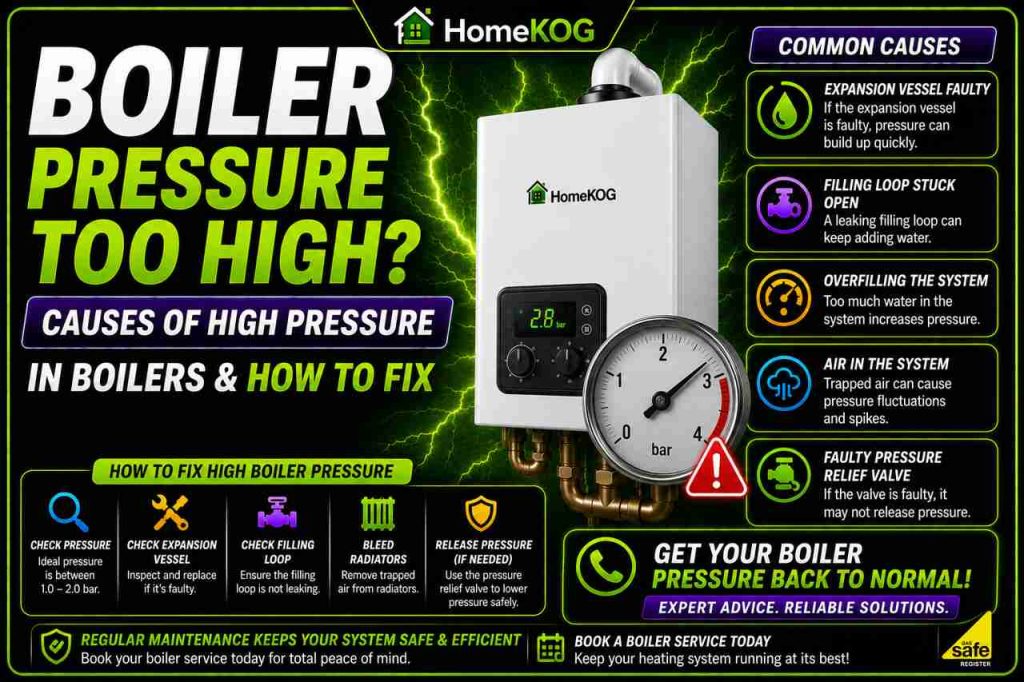
System pressure — check the pressure gauge reads between 1 and 1.5 bar when cold
-
Fault codes — check the boiler display for any error codes and look these up in your boiler manual before doing anything else boiler overheating troubleshooting steps are essential to ensure the safety and efficiency of your heating system. Start by inspecting the pressure levels and checking for any leaks around the boiler. If these initial steps do not resolve the issue, it may be necessary to consult a professional technician for further diagnosis.
If all of these check out and the boiler still won’t ignite, work through the sections below.
How Modern Boiler Ignition Works
Most boilers installed in UK homes over the last 25 to 30 years use electronic ignition rather than a standing pilot light. When heating or hot water is called for, a spark igniter fires automatically to light the burner. There is no pilot light to manually relight on these systems.
Older boilers — typically those over 25 to 30 years old — may have a standing pilot light. If you have an older system and suspect the pilot light is out, refer to your specific boiler manual for relighting instructions. If in any doubt, call a Gas Safe registered engineer rather than attempting it yourself.
Gas Supply Issues
If the boiler attempts to ignite — you can hear clicking — but fails to fire, a disrupted gas supply is one of the most common causes of boiler ignition failure.
Check Other Gas Appliances
Turn on a gas hob or check another gas appliance. If it works normally, gas is reaching the property and the fault is likely specific to the boiler. If nothing gas-powered is working, check whether a prepayment meter needs topping up. If the meter is fine and there’s still no gas, contact your supplier.
Smell of Gas
If you can smell gas anywhere near the boiler or meter, stop immediately. Do not attempt any further checks, do not operate any switches, and do not use your phone inside the property. Leave the building, leave doors open as you go, and call the National Gas Emergency Service on 0800 111 999 from outside.
Low Boiler Pressure
Low system pressure is one of the most frequent causes of boiler lockout and ignition failure. Most boilers will refuse to fire when pressure drops below 1 bar, displaying a low pressure fault code. To address this issue effectively, it’s essential to have a clear understanding of boiler lockout troubleshooting tips that can guide you through the process. Inspecting the pressure relief valve and ensuring it is functioning properly is a good starting point. Additionally, checking for leaks in the system can help maintain the necessary pressure for optimal boiler operation.
The pressure gauge should read between 1 and 1.5 bar when the system is cold. To repressurise, locate the filling loop — usually a braided silver hose with valves at each end beneath the boiler — and slowly open both valves until the gauge reaches 1.5 bar, then close both valves firmly. Reset the boiler afterwards.
If pressure drops repeatedly over days or weeks, a leak somewhere in the system is the likely cause. A Gas Safe engineer should locate and repair the leak before further repressurisation.
Important: System pressure should not exceed 3 bar when hot. If the pressure relief valve — a safety device that prevents dangerous overpressure — is discharging water externally, this indicates an overpressure condition requiring professional inspection.
Electronic Ignition Failure
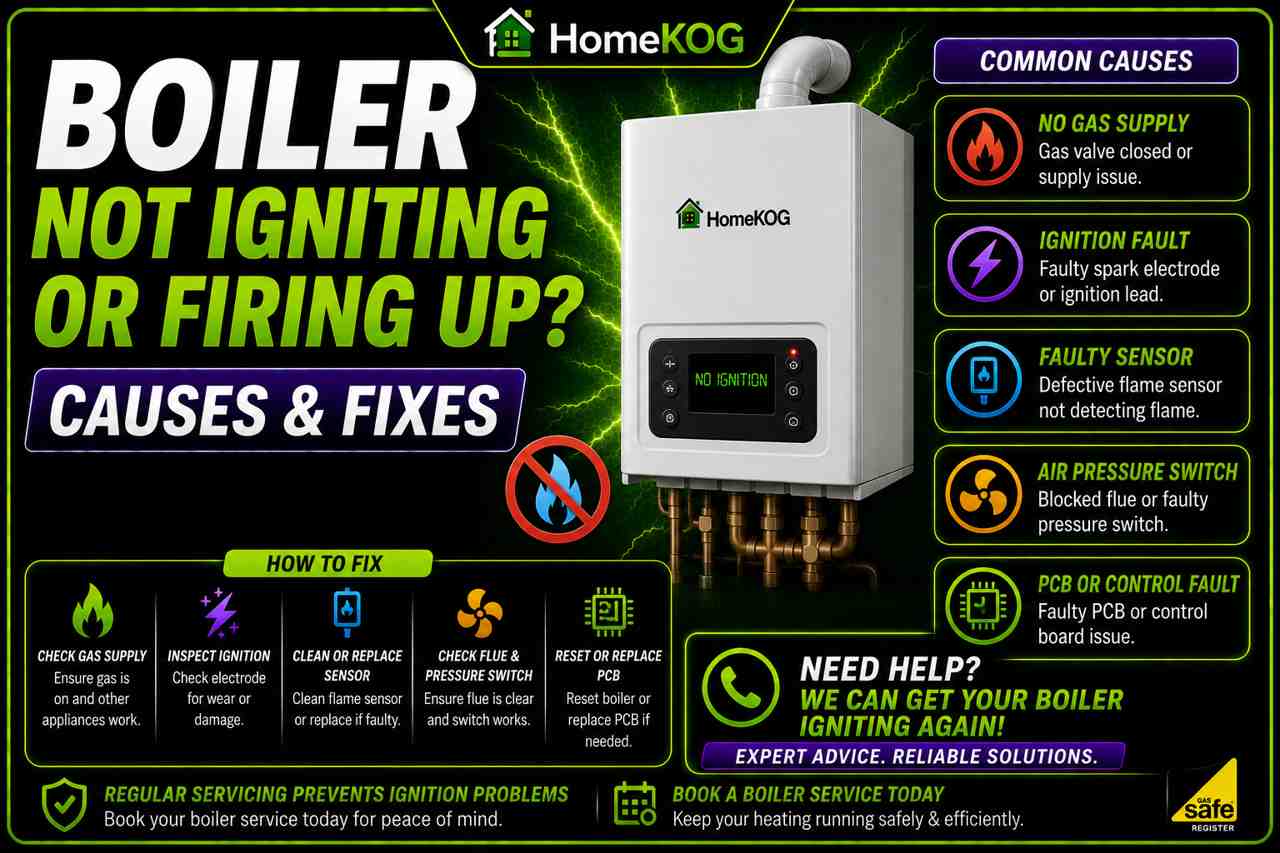
A boiler that clicks repeatedly but produces no flame almost always points to an ignition fault. On modern boilers, the spark igniter generates the initial spark, while a separate flame detection electrode (also called a flame sensor) confirms the burner has lit. A fault in either component can cause ignition failure.
Common causes include:
-
Dirty or corroded ignition electrode — carbon deposits prevent a clean spark from forming
-
Faulty flame detection electrode — the sensor fails to confirm ignition even when the burner lights, causing the boiler to shut down as a safety measure
-
Damaged ignition lead — cracks or breaks in the lead interrupt the electrical circuit
-
Faulty PCB (printed circuit board) — the PCB controls the entire ignition sequence; a failing PCB can prevent the spark from firing, misread flame sensor signals, or cause intermittent ignition faults that appear and disappear without obvious pattern
-
Gas valve not opening — the spark igniter may be working correctly but the gas valve isn’t releasing gas to the burner
None of these are user-serviceable. A Gas Safe registered engineer must diagnose and repair internal ignition components.
Faulty Gas Valve
The gas valve controls the flow of gas to the burner. A faulty valve — whether blocked, seized, or with damaged wiring connections — prevents gas from reaching the burner even when the spark igniter fires correctly. The result is a boiler that clicks but produces no flame and locks out after multiple failed ignition attempts.
Gas valve faults are not user-repairable. Do not attempt to inspect, adjust, or bypass the gas valve yourself. A Gas Safe registered engineer must carry out this work.
Frozen or Blocked Condensate Pipe
During cold weather, the condensate pipe — the plastic pipe that carries acidic wastewater from the boiler to an external drain — can freeze solid and cause the boiler to lock out. Most boilers display a specific fault code when this happens.
To thaw a frozen condensate pipe, pour warm water — not boiling, which can crack the plastic pipework — along the length of the external section until the blockage clears. Reset the boiler once thawed. Insulate the external pipe section before the next cold spell to reduce the risk of recurrence.
Boiler Keeps Locking Out
A boiler that fires successfully but repeatedly locks out shortly afterwards is a distinct problem from one that won’t ignite at all. Repeated lockout — where the boiler lights, runs briefly, then shuts down — usually points to one of the following:
-
Faulty flame detection electrode — the sensor loses the flame signal during operation, triggering a safety shutdown even though the burner is lit
-
Intermittent ignition fault — an inconsistent spark caused by a degrading ignition electrode or damaged lead causes the boiler to lose and regain ignition unpredictably
-
Boiler short cycling — the boiler fires, reaches temperature rapidly, and shuts off in quick succession due to oversizing, incorrect flow temperature settings, or a system circulation problem boiler overheating common causes can include low water levels, faulty thermostats, or mineral buildup within the heat exchanger. These issues can lead to inefficient operation and, in some cases, significant damage if not addressed promptly. Regular maintenance and monitoring are essential to prevent these problems from escalating and to ensure safe boiler function.
-
Central heating pump fault — a failing or seized pump prevents proper water circulation, causing the boiler to overheat and trigger a safety lockout
-
PCB fault — intermittent PCB failure can cause unpredictable lockouts with no consistent pattern or fault code
Important: Some boilers — Worcester Bosch models in particular — have a built-in lockout counter that triggers a hard lockout requiring an engineer reset after a set number of consecutive failed ignition attempts. If your boiler has locked out hard and won’t respond to the standard reset button, this may be the cause.
If the boiler keeps locking out despite basic troubleshooting, book a Gas Safe engineer inspection rather than continuing to reset. Identifying the root cause early prevents further component damage.
Boiler Fault Codes for Ignition Problems
Modern boilers display fault codes that identify specific faults — these are more useful than any visible symptom alone. Common ignition-related fault codes by brand:
Always cross-reference codes with your specific boiler manual — codes can vary between product ranges within the same brand.
Can an Airlock in Pipes Prevent My Boiler from Igniting or Firing Up?
A key issue for homeowners is the impact of boiler airlock problems and solutions on heating efficiency. An airlock in pipes can hinder water flow, preventing the boiler from igniting or firing up. Identifying and resolving these airlocks is crucial for ensuring your heating system operates smoothly and reliably.
How to Reset Your Boiler After an Ignition Fault
After addressing the underlying cause — repressurising, thawing a condensate pipe, restoring gas supply — the boiler will need a manual reset to clear the lockout.
On most modern boilers, press and hold the reset button (marked with a flame or reset symbol) for approximately 3 seconds. Allow a full restart cycle before assessing whether the fault has cleared.
If the boiler locks out again immediately, or fails to ignite after two reset attempts, stop resetting. Repeated unsuccessful resets can stress the ignition electrode and PCB. At this point the fault requires a Gas Safe engineer to diagnose properly.
When to Call a Gas Safe Engineer
Stop troubleshooting and call a Gas Safe registered engineer if:
-
You can smell gas anywhere near the boiler or meter
-
The boiler locks out repeatedly despite addressing obvious causes
-
A fault code is displayed that isn’t resolved by basic troubleshooting
-
The boiler keeps locking out shortly after firing — intermittent ignition fault
-
The boiler has entered a hard lockout and won’t respond to the reset button
-
The boiler is making unusual sounds — banging, whistling, or grinding — alongside ignition failure
-
You’re unsure about any step in this process
For anything involving internal boiler components, gas connections, or the flue system, Gas Safe registration is a legal requirement. These are not DIY repairs.
Is It Time for a New Boiler?
A single ignition fault doesn’t mean the boiler needs replacing. But repeated ignition faults, frequent lockouts, and an ageing system are worth evaluating honestly.
Key factors to consider:
-
Age — boilers over 10 to 12 years old become progressively less efficient and spare parts become harder to source
-
Repair frequency — if engineer callouts are happening more than once a year, cumulative repair costs can approach replacement cost quickly
-
Energy efficiency — a modern A-rated condensing boiler uses significantly less gas than an ageing system, reducing bills year-round
-
Warranty cover — a new boiler comes with manufacturer warranty, removing repair cost risk for the warranty period
Annual Servicing Prevents Ignition Faults
Most boiler ignition problems develop gradually rather than appearing without warning. A dirty ignition electrode, degrading flame sensor, or scaling on the heat exchanger are all detectable during a service — long before they cause a breakdown.
During an annual service, a Gas Safe registered engineer carries out:
-
Visual inspection of all internal components
-
Ignition electrode and flame detection electrode inspection and cleaning
-
Flue integrity check and combustion analysis
-
System pressure check and filling loop inspection
-
Cleaning of main boiler components
-
Full safety and operation checks
Annual servicing is a condition of most manufacturer warranties. Missing a single service can void cover entirely.
FAQs
Why is my boiler clicking but not igniting?
Clicking without ignition means the spark igniter is firing but gas isn’t reaching the burner, or the flame detection electrode isn’t confirming a flame. Common causes include a gas supply interruption, faulty gas valve, low system pressure lockout, or a failed ignition electrode. Check gas supply and system pressure first, then look for a fault code on the display.
What should I do first when my boiler won’t fire up?
Check power supply, gas supply to other appliances, thermostat settings, system pressure, and the boiler display for fault codes. These five checks resolve the majority of boiler ignition faults without needing an engineer.
What is the difference between an ignition electrode and a flame detection electrode?
The ignition electrode generates the spark that lights the burner. The flame detection electrode (flame sensor) confirms the burner has successfully lit and signals the boiler to continue running. Both can cause ignition failure if faulty — the ignition electrode prevents the burner lighting, the flame sensor causes the boiler to shut down even when it has.
Can I relight the pilot light on my boiler?
Most boilers installed in the last 25 to 30 years use electronic ignition and have no pilot light. If your boiler is older and has a standing pilot light, refer to your specific boiler manual for relighting instructions. If in any doubt, call a Gas Safe engineer.
What pressure should my boiler be at?
Between 1 and 1.5 bar when the system is cold. Below 1 bar, most boilers lock out and refuse to fire. Repressurise using the filling loop and reset the boiler. If pressure drops repeatedly, have a Gas Safe engineer check for a system leak.
Why does my boiler keep locking out?
Repeated lockout after firing usually points to a faulty flame detection electrode, intermittent ignition fault, boiler short cycling, circulation pump fault, or a PCB issue. If basic troubleshooting doesn’t resolve it, a Gas Safe engineer inspection is needed to identify the root cause.
How do I reset my boiler after an ignition fault?
Press and hold the reset button — marked with a flame or reset symbol — for approximately 3 seconds. Allow a full restart cycle before assessing the result. If the boiler locks out again immediately or fails to fire after two attempts, stop resetting and book an engineer.
When should I replace rather than repair my boiler?
If the boiler is over 10 to 12 years old, requires frequent engineer callouts, or has persistent ignition faults despite professional repair, replacement is often more economical long-term. A Gas Safe engineer can give an honest assessment of repair versus replacement value for your specific situation.