
How Do Ground Source Heat Pumps Work? Complete Guide 2026
Quick Answer: A ground source heat pump extracts heat stored in the earth at approximately 10°C year-round and uses a refrigerant compression cycle to upgrade it to a usable temperature for radiators, underfloor heating, and hot water. A network of pipes buried 1 to 2 metres deep (horizontal loop) or in a deep borehole (vertical loop) carries an antifreeze-water mixture that absorbs ground heat, which is then compressed and transferred to the home’s heating circuit. Ground source heat pumps are 300 to 400% efficient — producing 3 to 4 units of heat for every 1 unit of electricity consumed. Installation costs £15,000 to £25,000 but running costs are 30 to 70% lower than a gas boiler, and the Boiler Upgrade Scheme provides a £7,500 government grant towards installation.
As energy costs continue to rise and the UK’s 2035 deadline for phasing out new gas boiler installations approaches, ground source heat pumps represent one of the most efficient and environmentally sound heating alternatives available to UK homeowners. They are not the right solution for every property — the space requirement, installation complexity, and upfront cost rule them out for many — but for properties where the conditions are right, a ground source heat pump delivers lower running costs, significantly reduced carbon emissions, and an operational lifespan roughly twice that of a conventional gas boiler.
What Does a Ground Source Heat Pump Do?
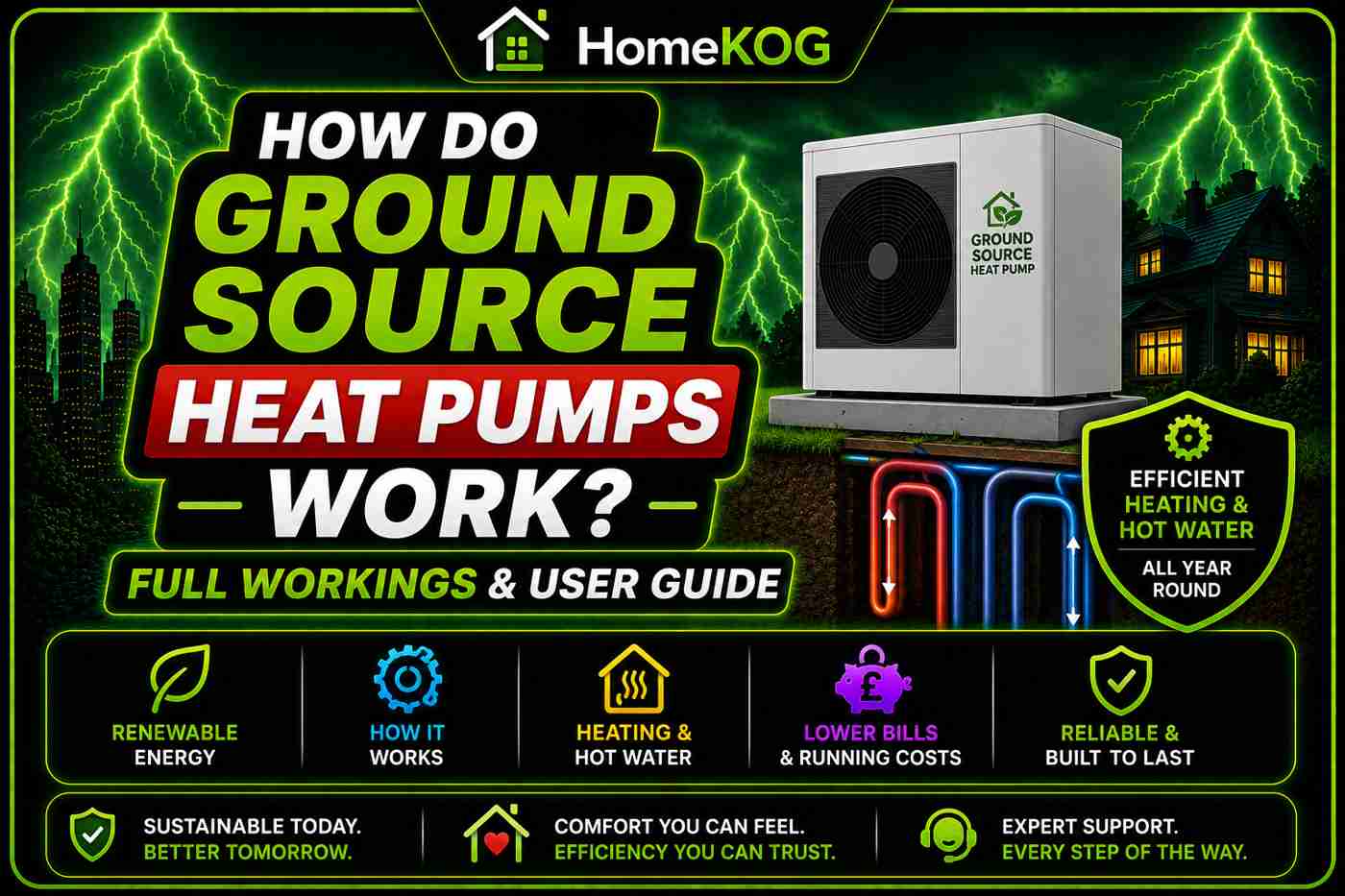
A ground source heat pump extracts solar energy that has been absorbed and stored in the earth beneath the ground surface. Even during the coldest UK winters, the ground at a depth of 1 to 2 metres maintains a relatively stable temperature of approximately 10°C — the accumulated effect of solar radiation absorbed through the ground surface throughout the year.
The heat pump harnesses this stored energy and uses a compression cycle — the same thermodynamic process used in a domestic refrigerator, but in reverse — to upgrade the low-temperature ground heat to a temperature suitable for space heating and hot water. The result is a system that produces significantly more heat energy than the electrical energy it consumes to operate the compressor, making it substantially more efficient than any direct electric or gas heating system.
It is important to distinguish a ground source heat pump from an air source heat pump. Both use the same refrigerant compression principle, but a ground source system extracts heat from the earth through buried pipework, while an air source system extracts heat from ambient outdoor air through an external fan unit. Ground source systems are generally more efficient because ground temperature is more stable year-round than air temperature — air source efficiency drops in the coldest winter weather precisely when heating demand is highest, while ground source efficiency remains relatively consistent. Air source heat pump benefits include lower installation costs and easier retrofitting into existing homes compared to ground source systems. Additionally, they can provide both heating and cooling, making them versatile options for climates with varying seasonal demands. Homeowners may also appreciate the potential for reduced carbon footprints and energy bills, particularly when paired with renewable energy sources.

How Does a Ground Source Heat Pump Work?
The operating cycle of a ground source heat pump has four stages, working continuously to extract ground heat and transfer it to the home.
In the first stage, an antifreeze-water mixture is pumped through the buried ground loop pipework. As this mixture circulates through the ground, it absorbs heat from the surrounding soil, warming from its entering temperature to approximately 10°C at the exit of the loop — even when the air temperature above ground is well below freezing.
In the second stage, the warmed antifreeze-water mixture passes through a heat exchanger within the heat pump unit. Here, it transfers its absorbed heat to a refrigerant fluid that has a very low boiling point. The refrigerant absorbs the heat and evaporates into a gas even at these low temperatures.
In the third stage, an electrically powered compressor compresses the refrigerant gas. Compressing a gas raises its temperature significantly — this is the fundamental thermodynamic process that allows the heat pump to upgrade low-temperature ground heat to a usable higher temperature, typically 35 to 55°C depending on the system and demand.
In the fourth stage, the hot compressed refrigerant passes through a second heat exchanger, where it transfers its heat to the home’s heating circuit water — flowing to underfloor heating pipes, radiators, or a hot water cylinder. The refrigerant cools, condenses back to a liquid, and the cycle begins again.
The efficiency of this process is expressed as the Coefficient of Performance (COP) — the ratio of heat output to electrical energy input. A well-installed ground source heat pump in an appropriate property achieves a COP of 3 to 4, meaning 3 to 4 units of heat are delivered for every 1 unit of electricity consumed. This compares to a maximum COP of 1.0 for a direct electric heater and approximately 0.95 for a 95% efficient gas boiler. Understanding combi boiler operation principles is crucial for assessing their effectiveness and efficiency in managing household heating and hot water. Unlike traditional systems, combi boilers heat water on demand, eliminating the need for a separate hot water tank and thereby maximizing energy utilization. This innovation can lead to substantial savings on energy bills while providing a reliable heating solution.
What Equipment Does a Ground Source Heat Pump System Include?
A complete ground source heat pump installation comprises four main components working together. The ground loop is the network of buried pipes carrying the antifreeze-water mixture — either laid horizontally in trenches or dropped vertically into boreholes. The heat pump unit houses the heat exchanger, compressor, and refrigerant circuit and is installed inside or adjacent to the property. The heat distribution system — underfloor heating pipework or radiators — distributes the heat around the property. The hot water cylinder stores heated domestic hot water for taps, showers, and baths.
Types of Ground Source Heat Pump Systems
Horizontal Ground Loops
Horizontal systems bury the ground loop pipework in trenches at a depth of 1 to 2 metres. The loop is laid across the trench floor and the trench is backfilled, leaving no permanent surface disruption once the ground has settled and re-grassed.
The space requirement is significant. A typical 3 bedroom property of 120m² floor area requires trenches totalling 60 to 80 metres in length — typically laid as two parallel trenches of 30 to 40 metres each. The total ground area disturbed during installation is considerable, and the garden must be free of established trees, large shrubs, and underground services such as drainage pipes in the area to be excavated.
Horizontal systems are less expensive to install than vertical systems because standard excavation equipment rather than specialist drilling equipment is used. They are the appropriate choice where adequate garden space is available without significant obstacles.
Vertical Ground Loops (Borehole Systems)
Vertical systems drill one or more boreholes straight down to depths of 15 to 120 metres and insert the ground loop pipework vertically. A single borehole requires only a small surface footprint — a fraction of the garden area needed for a horizontal system — making vertical systems viable in properties with limited outdoor space.
The depth of the boreholes improves efficiency because ground temperature and thermal stability increase with depth. Vertical systems also access the geothermal heat that originates from the earth’s core rather than relying solely on solar energy stored near the surface, providing a more consistent heat source.
The limitation is cost — specialist drilling equipment is significantly more expensive to mobilise than standard excavators, and the drilling contractor must navigate underground utilities, drainage systems, and geological conditions. Vertical systems typically cost £3,000 to £5,000 more to install than an equivalent horizontal system.
Home Heating Applications
Underfloor Heating
Ground source heat pumps are ideally matched to underfloor heating systems. The low flow temperatures that heat pumps produce — typically 35 to 45°C, compared to 65 to 80°C for a conventional gas boiler — are exactly what underfloor heating is designed to operate at. Underfloor heating distributes heat evenly across the entire floor surface, providing comfortable, consistent warmth throughout the room at a lower flow temperature than is possible with standard radiators. For new builds or properties undergoing full renovation where underfloor heating can be installed throughout, a ground source heat pump and underfloor heating together represent the most efficient combination available.
Radiators
Ground source heat pumps can be used with radiators, but standard-sized radiators designed for high-temperature gas boiler systems will underperform when supplied with the lower flow temperatures a heat pump produces. To compensate, larger radiators — typically oversized by 50 to 100% compared to standard sizing for a gas boiler system — are needed to deliver the same heat output at the lower flow temperature. Properties converting from a gas boiler system to a ground source heat pump almost always need new, larger radiators throughout — a significant additional cost that should be factored into the installation budget.
Hot Water
A hot water cylinder sized for the household’s demand stores heated domestic hot water produced by the heat pump. The cylinder is typically heated once or twice daily and maintains the stored water at 55°C or above to prevent Legionella bacteria growth. The heat pump’s heating cycle and hot water heating cycle are managed by the control system to balance demand and maintain comfort throughout the day. In addition, combi boiler functionalities for instant heating offer a convenient alternative by eliminating the need for a hot water cylinder. These systems can provide immediate hot water on demand, making them ideal for smaller households or apartments. Furthermore, they help optimize energy usage by only heating water as needed, ensuring greater efficiency and lower utility bills.
Benefits of Ground Source Heat Pumps
Lower running costs are the most significant ongoing benefit. A ground source heat pump’s running costs are typically 30 to 70% lower than an equivalent gas boiler system, depending on the property’s insulation standard and the local electricity-to-gas price ratio. The system produces 3 to 4 units of heat for every unit of electricity consumed, compared to a gas boiler which produces approximately 0.9 to 0.95 units of heat for every unit of gas consumed.
Carbon emissions are substantially lower than gas heating even accounting for the electricity used to power the compressor. As the UK electricity grid continues to decarbonise through renewable generation, the carbon intensity of ground source heat pump operation decreases over time without any change to the system itself.
The operational lifespan of a ground source heat pump significantly exceeds that of a gas boiler. The ground loop pipework has an expected lifespan of 50 years or more. The heat pump unit itself lasts approximately 20 to 25 years — roughly twice the 10 to 15-year lifespan of a conventional gas boiler. The buried ground loop, representing a substantial proportion of the installation cost, requires no maintenance and will outlast several heat pump unit replacements.
Low maintenance requirements after installation compare favourably with gas boilers. An annual service by a qualified engineer is recommended to check refrigerant levels, inspect the heat pump unit’s components, and verify system performance. The buried ground loop requires no routine maintenance.
Some heat pump models support a cooling mode — reversing the cycle to transfer heat from the home to the ground during summer. This passive cooling capability requires no separate air conditioning installation and is increasingly valued as UK summers become warmer.
Is a Ground Source Heat Pump Right for Your Property?
Ground source heat pumps perform best in properties that meet certain conditions. Adequate garden space for horizontal trenches or access for vertical borehole drilling is the primary requirement — without sufficient outdoor space, installation is not feasible. Good insulation throughout the property is critical — heat pumps heat at lower temperatures over longer periods than gas boilers, and a poorly insulated property loses heat too rapidly for this approach to maintain comfortable temperatures efficiently. Well-insulated walls, loft, floors, and double or triple glazing are important prerequisites.
Properties with existing or planned underfloor heating receive the greatest efficiency benefit. Properties requiring complete radiator replacement to accommodate lower flow temperatures should factor this cost into the total installation budget. Rural properties off the gas grid where the alternative is oil or LPG heating show the strongest financial case for ground source heat pump installation — the running cost savings compared to oil or LPG are larger than the savings compared to natural gas.
Installation Process
A ground source heat pump installation follows a structured process. An installer surveys the property to assess garden space, geology, existing heating infrastructure, insulation standard, and heating demand. This survey produces a system design specification including the ground loop type and size, heat pump output, cylinder specification, and any distribution system modifications needed.
Groundworks take one to two days for horizontal systems — excavators dig the required trenches, the loop pipework is laid and connected, and the trenches are backfilled. Vertical borehole drilling takes one to two days per borehole depending on depth and geological conditions, with each borehole requiring only a small surface footprint.
The heat pump unit is then installed inside the property, connected to the ground loop and the home’s heating circuit. Controls, the hot water cylinder, and any distribution system modifications are completed. The system is commissioned, refrigerant levels are set, and the controls are programmed for the household’s heating schedule.
Costs and Financial Support
| Cost Element | Typical Range |
|---|---|
| Heat pump unit and ground loop (horizontal) | £2,000 – £10,000 |
| Heat pump unit and ground loop (vertical borehole) | £5,000 – £15,000 |
| Total installed cost (horizontal) | £15,000 – £20,000 |
| Total installed cost (vertical) | £18,000 – £25,000 |
| Boiler Upgrade Scheme grant (2026) | £7,500 |
| Effective installed cost after grant | £7,500 – £17,500 |
| Annual running costs | £540 – £700 |
| Payback period | 8 – 10 years |
The UK government’s Boiler Upgrade Scheme provides a £7,500 grant for eligible homeowners replacing a fossil fuel heating system with a ground source heat pump. Applications are made through the installing MCS-certified contractor. The grant is paid directly to the installer and deducted from the homeowner’s invoice, reducing the upfront cost significantly.
FAQ
How long does a ground source heat pump last?
The ground loop pipework has an expected lifespan of over 50 years and requires no maintenance during this period. The heat pump unit itself lasts approximately 20 to 25 years with annual servicing — roughly twice the 10 to 15-year lifespan of a conventional gas boiler. The extended operational lifespan is a significant long-term financial advantage despite the higher upfront installation cost.
Will a ground source heat pump pay for itself?
A ground source heat pump typically pays back its installation cost within 8 to 10 years through reduced energy bills, depending on the system specification, the property’s insulation standard, and whether renewable heat incentives have been utilised. Properties replacing oil or LPG heating achieve payback faster than those replacing mains gas due to the larger per-unit cost difference between electricity and oil compared to electricity and gas.
What types of properties suit ground source heat pumps?
Properties with adequate garden space for horizontal trenches or borehole access, good levels of insulation throughout, and existing or planned underfloor heating achieve the best performance and financial returns. New builds incorporating the system during construction benefit from lower installation costs and optimal integration with the building design. Older properties are viable with appropriate insulation upgrades and radiator replacement if required.
Do ground source heat pumps work in cold weather?
Yes. Because ground temperature at 1 to 2 metres depth remains approximately 10°C year-round regardless of surface air temperature, ground source heat pumps maintain consistent efficiency throughout winter. This is a key advantage over air source heat pumps, whose efficiency decreases as outdoor air temperature falls in the coldest winter months when heating demand is highest.
Can a ground source heat pump provide hot water?
Yes. A hot water cylinder connected to the heat pump system stores domestic hot water at the required temperature. The heat pump heats the cylinder content once or twice daily depending on demand. The cylinder should be maintained at a minimum of 55°C to prevent Legionella growth and can be boosted to 60°C periodically as a hygiene measure.
Conclusion
Ground source heat pumps are among the most efficient and lowest-carbon heating systems available to UK homeowners — producing 3 to 4 units of heat for every unit of electricity consumed, maintaining consistent efficiency year-round, and operating for 20 to 25 years with minimal maintenance. The barriers are the significant upfront cost, the space requirement for ground loop installation, and the insulation standard needed to realise the system’s efficiency in practice.
For properties that meet the conditions — adequate garden space, good insulation, suitable distribution system — and particularly for properties off the gas grid where the running cost savings are most pronounced, a ground source heat pump represents a compelling long-term investment. The £7,500 Boiler Upgrade Scheme grant reduces the financial barrier meaningfully, and the combination of lower running costs, reduced carbon emissions, and an operational lifespan twice that of a gas boiler provides a strong total cost of ownership case when evaluated over the full system lifetime.