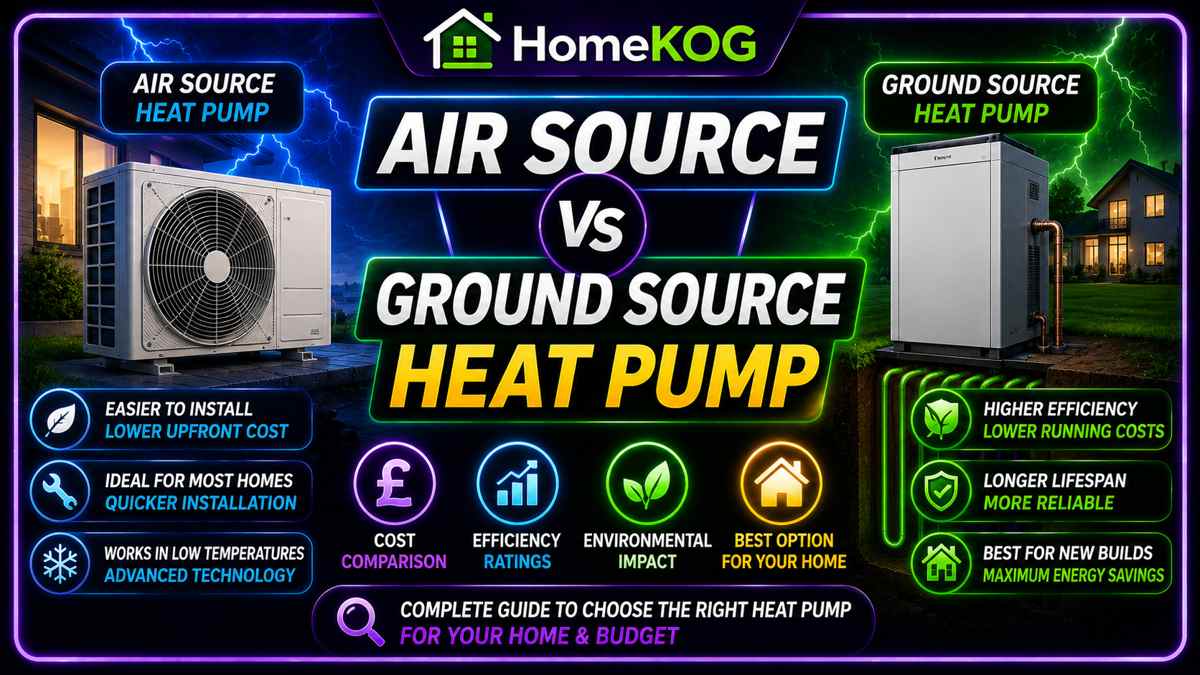

Air Source vs Ground Source Heat Pump: Which is Best for Your Home? 2026
Quick Answer
Ground source heat pumps are more efficient, more consistent year-round, and cheaper to run in the long term, but cost roughly £15,000 to £35,000 to install and need significant garden space for the ground loop.
Air source heat pumps cost around £8,000 to £14,000 installed, need no excavation, and are faster and simpler to fit, but lose some efficiency in cold weather when heating demand is highest.
For properties with adequate outdoor space and a long-term perspective, ground source offers better running economics. For properties with limited space or a tighter installation budget, air source is the more practical choice.
Both attract the £7,500 Boiler Upgrade Scheme grant in 2026, and homes currently on oil or LPG heating can get an enhanced £9,000 for either type until 31 March 2027. Our air source heat pump grants guide covers the current eligibility rules in full.

The choice between an air source and ground source heat pump is one of the more significant heating decisions a UK homeowner can make, involving real differences in upfront cost, installation complexity, long-term efficiency, and suitability for different property types.
Both systems use the same fundamental refrigerant compression technology to move heat from the environment into the home, but where they source that heat, and how consistently they can access it, creates practical differences that affect daily running costs throughout the system’s operational life.
This guide compares both technologies across every relevant dimension to help identify which is the right choice for the specific property and circumstances.
How Each System Works
Both heat pump types use a refrigerant compression cycle, the same thermodynamic process as a domestic refrigerator running in reverse, to extract low-grade environmental heat and upgrade it to a temperature useful for space heating and domestic hot water. The fundamental difference is the heat source the energy is extracted from.
An air source heat pump extracts heat from outdoor air using a fan-driven heat exchanger mounted on the outside of the property. As outdoor air passes across the heat exchanger, a refrigerant with a low boiling point absorbs the heat and evaporates. The refrigerant vapour is then compressed, raising its temperature significantly, and the heat is transferred to the home’s heating circuit. The cooled refrigerant expands and the cycle repeats.
A ground source heat pump extracts heat from the earth through a network of pipes buried either horizontally in trenches at 1 to 2 metres depth, or vertically in boreholes of 15 to 120 metres. An antifreeze-water mixture circulates through these pipes, absorbing the stable ground temperature of around 10°C, and passes through a heat exchanger where the heat transfers to the refrigerant circuit. The same compression cycle then upgrades this heat to a usable temperature for the home.
Both systems can also run in reverse as cooling systems, extracting heat from inside the home and moving it to the outdoor air or ground, providing passive cooling in summer without a separate air conditioning installation.
Key Differences: Direct Comparison
|
Factor |
Air Source |
Ground Source |
|---|---|---|
|
Heat source |
Outdoor air |
Earth (ground temperature) |
|
Winter efficiency |
Reduces in cold weather |
Consistent year-round |
|
Typical COP |
2.5–3.5 |
3.5–4.5 |
|
Installation cost |
£8,000–£14,000 |
£15,000–£35,000 |
|
Boiler Upgrade Scheme grant |
£7,500 (£9,000 for oil/LPG homes) |
£7,500 (£9,000 for oil/LPG homes) |
|
Net cost after standard grant |
£500–£6,500 |
£7,500–£27,500 |
|
Space requirement |
External wall space only |
Large garden or borehole access |
|
Installation disruption |
Low, around 1–2 days |
Higher, 2–5 days |
|
Planning permission |
Sometimes required |
Generally not required |
|
Noise |
Fan noise from external unit |
Silent during operation |
|
Operational lifespan |
15–20 years |
20–25 years (ground loop 50–100 years) |
|
Annual running costs |
Higher in cold winters |
Consistent, lower overall |
Efficiency Comparison
Efficiency is measured by the Coefficient of Performance (COP), units of heat output per unit of electricity consumed. A higher COP means more heat for the same electricity cost.
Air source heat pump COP varies with outdoor temperature. At 7°C outdoor temperature, the standard test condition, a modern air source heat pump achieves a COP of roughly 3.0 to 3.5. As outdoor temperature falls below this in winter, COP drops, at -5°C it may fall to 2.0 to 2.5, meaning the system consumes significantly more electricity to produce the same heat output precisely when demand and electricity prices are at their highest. Modern units continue extracting heat down to -15°C or below, but at reduced efficiency throughout that range.
Ground source heat pump COP is more consistent because ground temperature at depth varies only slightly between seasons, roughly 8°C to 12°C year-round in the UK. This stable inlet temperature means the compressor works at a consistent load throughout the year, maintaining a COP of 3.5 to 4.5 regardless of whether it’s a mild autumn evening or the coldest February night. This consistency is the ground source system’s main efficiency advantage, reliable, low-cost heating precisely when air source systems are least efficient.
On the coldest days in the UK, ground source systems can be operating at an inlet temperature 15°C warmer than the air available to an equivalent air source installation, a meaningful efficiency advantage at exactly the time of year that matters most for comfort and running costs.
Running Costs
Both systems have lower running costs than gas or oil boilers when correctly sized and installed in a well-insulated property. The difference between the two heat pump types is less dramatic than their installation cost difference suggests, but it’s genuine over a full year.
For a typical 3 to 4 bedroom UK property, annual running costs are roughly £540 to £700 for a ground source heat pump and £700 to £1,000 for an air source heat pump. The gap comes from the air source system’s lower winter COP needing more electricity to produce the same heat output during the months of highest demand.
Time-of-use electricity tariffs, which offer cheaper rates at off-peak overnight hours, benefit ground source heat pumps more than air source. Ground source systems can run overnight at off-peak rates without an efficiency penalty, because ground temperature doesn’t vary with time of day. Air source systems face their worst efficiency conditions in the early morning, the coldest part of the day, which coincides with the cheapest off-peak tariff periods, reducing the value of overnight tariff optimisation.
Installation Costs and Process
Air Source Heat Pump Installation
Air source heat pump installation is significantly less disruptive and less expensive than ground source. The external unit is mounted on a wall or a ground-level plinth outside the property, connected to the home’s heating circuit through an external wall penetration. Electrical connection and internal pipework modification complete the installation. Most installations finish in one to two days with minimal disruption to the property.
Planning permission is sometimes required for the external unit, particularly in conservation areas, listed buildings, or properties with aesthetic restrictions on external alterations. Noise from the external fan, typically 40 to 60dB depending on the model and load, is worth considering in relation to neighbouring properties and garden use areas.
Ground Source Heat Pump Installation
Ground source heat pump installation is more complex, more expensive, and more disruptive during the installation period. Horizontal loop systems require excavating trenches across a substantial garden area, a 120m² property typically needs 60 to 80 metres of trenching, which is backfilled and reinstated after the pipe is laid. Excavation and reinstatement typically takes two to five days depending on system size and ground conditions. Vertical borehole systems avoid the extensive surface disruption but need specialist drilling equipment, adding cost while reducing the required garden area.
Ground source heat pump installations generally don’t need planning permission, since the groundworks happen at depth without permanent visible external changes to the property. The heat pump unit inside the property is roughly the size of a small fridge and fits in a kitchen, utility room, or cupboard.
Space Requirements
Air source heat pumps need a suitable external wall or ground-level location with clear airflow around the unit, typically 0.5 to 1 metre clearance on all sides. The unit is roughly the size of a large air conditioning condenser. No garden land is needed beyond the mounting position.
Ground source heat pumps with horizontal loop systems need substantial usable garden area. The garden must be free of established trees, large shrubs, and underground services in the excavation area, and must stay accessible to excavation equipment. Properties with small urban gardens, basement levels below garden level, or heavily planted gardens are often not viable for horizontal systems. Vertical borehole systems need access for drilling equipment but only a small surface footprint once drilling is complete.
Lifespan
Air source heat pump external units typically last 15 to 20 years. Constant exposure to the elements, wind, rain, frost, and in coastal locations, salt-laden air, degrades external components more quickly than the sheltered environment of a ground source system. Properties within a kilometre of the coast should specifically discuss saltwater exposure with the installer before choosing an air source unit, as accelerated corrosion can significantly shorten component life in these locations.
Ground source heat pump units last 20 to 25 years. The buried ground loop pipework has an expected lifespan of 50 to 100 years and will outlast multiple heat pump unit replacements. The combination of a long-lasting heat pump unit and a virtually permanent ground loop means the total infrastructure investment in a ground source system depreciates more slowly than an air source installation. Whichever type you choose, it’s worth budgeting for the average heat pump servicing costs over that lifespan, since annual servicing plays a real part in hitting those upper lifespan figures.
Who Should Choose an Air Source Heat Pump?
Air source heat pumps are the sensible choice for properties with limited garden space that can’t accommodate ground loop excavation or borehole drilling. They’re also right where installation budget is a limiting factor, the net cost after the standard £7,500 Boiler Upgrade Scheme grant typically runs from around £500 to £6,500 for an air source installation, compared to £7,500 to £27,500 for ground source.
Properties in milder climates, the south and south-west of England, for example, see less winter efficiency reduction than properties in the north of England and Scotland.
Urban and suburban properties with modest gardens, flats with outdoor unit mounting options, and properties where the installation timeline matters are all better served by the simpler, faster air source installation. For first-time heat pump adopters wanting to try heat pump operation with a lower financial commitment, air source provides a practical, cost-effective entry point.
Who Should Choose a Ground Source Heat Pump?
Ground source heat pumps are the sensible choice for properties with adequate garden space for horizontal trenching, or with accessible ground for vertical borehole drilling. Rural properties with larger plots are natural candidates.
Properties replacing oil or LPG heating, where the running cost saving relative to the fuel replaced is larger than for mains gas, see the strongest financial case for ground source. That case is stronger still now, with the temporary £9,000 Boiler Upgrade Scheme grant available for oil and LPG homes switching to either heat pump type until 31 March 2027.
Properties where heating consistency matters, where the occupants can’t tolerate the mild reduction in winter efficiency that air source systems experience, benefit from ground source’s year-round consistency. New builds where ground loop installation can be integrated into the construction programme at lower disruption cost than a retrofit represent an ideal opportunity for ground source.
Properties planning long-term occupation are better placed to realise the ground source system’s superior long-term economics. The combination of lower annual running costs and a longer system lifespan eventually recovers the higher upfront investment, typically within 8 to 12 years of operation.
FAQ
Is a ground source heat pump worth the extra cost?
For properties with adequate space and a long-term ownership perspective, yes. The higher installation cost of a ground source system, typically several thousand pounds more than an air source installation at equivalent output after the Boiler Upgrade Scheme grant, is offset over time by lower annual running costs, consistent year-round efficiency, and a longer operational lifespan.
The payback period for the additional investment compared to air source is typically 8 to 12 years, depending on the specific property and heating patterns.
Do air source heat pumps work in winter in the UK?
Yes, but with reduced efficiency. Modern air source heat pumps continue to extract useful heat from outdoor air down to -15°C or below, but their COP, and therefore the heat produced per unit of electricity, decreases as outdoor temperature falls.
At typical UK winter temperatures of -5°C to 5°C, air source systems continue operating effectively but with higher electricity consumption than during milder weather. In the coldest spells, the efficiency gap between air and ground source systems is at its widest.
Which heat pump is better for a large house?
A large house with high heating demand benefits more from ground source than air source. The consistent, high-output performance of a ground source system suits large properties where demand is significant and consistent.
An 8kW ground source unit heats a 200m² property more efficiently than the 10kW air source unit needed for the same job, with lower electricity consumption and no drop in performance during cold weather. The ground source unit also avoids the visual and noise impact of a large external air source unit on a prominent property.
Can both heat pump types be used for hot water?
Yes. Both air source and ground source heat pumps can be integrated with a hot water cylinder to provide domestic hot water as well as space heating. The cylinder is heated by the heat pump and stores hot water at the required temperature for taps, showers, and baths.
The heat pump’s control system manages the balance between space heating and hot water heating demand according to the programmed schedule and current temperatures.
What grants are available for both heat pump types in 2026?
Both air source and ground source heat pumps attract the same £7,500 standard Boiler Upgrade Scheme grant for eligible homeowners in England and Wales, rising to £9,000 for households currently on oil or LPG heating until 31 March 2027. Rule changes in April 2026 also removed the requirement for a valid EPC to apply. Our full air source heat pump grants guide covers eligibility for both types in detail.
In Scotland, Warmer Homes Scotland may cover the cost of either type for qualifying low-income households. In Wales, Nest Wales provides free installations including heat pumps for qualifying households. Both national schemes are available regardless of which heat pump type is installed, subject to each scheme’s own eligibility criteria.
Does it matter which installer I use for either heat pump type?
Yes. Whichever type you choose, the installation needs to be carried out by an MCS-certified installer to qualify for the Boiler Upgrade Scheme grant, and MCS certification is a reasonable proxy for installer quality more generally, since it requires demonstrated competency in heat pump design and installation.
Getting quotes from at least two or three MCS-certified installers is worth the time, particularly for a ground source system, where design decisions around the ground loop have a big effect on both cost and long-term performance.
Conclusion
Air source and ground source heat pumps represent the two most practical renewable heating options for UK homeowners in 2026, and the choice between them is mostly determined by available space, budget, and time horizon, rather than any absolute technical superiority of one over the other.
Ground source heat pumps win on efficiency, consistency, running costs, and lifespan, but need substantial space, higher upfront investment, and a longer payback period. Air source heat pumps win on installation simplicity, lower upfront cost, and accessibility for urban and suburban properties with limited garden space, but accept a degree of winter efficiency reduction that ground source avoids.
For most UK homeowners weighing up the options, the £7,500 Boiler Upgrade Scheme grant makes air source heat pump installation genuinely affordable, with net costs potentially under £1,000 on the smallest, most budget-conscious installations. For homeowners with the space, budget, and long-term planning horizon to justify the ground source investment, the superior year-round efficiency and operational longevity make it the stronger long-term choice.
Either decision represents a meaningful step towards lower carbon emissions and less dependence on fossil fuel heating.