
How Does Central Heating Work? A Complete Guide to Every System Type
Quick Answer: Central heating works by generating heat from a fuel source — most commonly gas — and distributing it throughout the home via hot water circulated through a network of pipes and radiators. A boiler heats the water, an electric pump pushes it through the system, radiators release the heat into each room, and a thermostat controls when the boiler fires. Approximately 85% of UK homes use wet central heating as their primary heat source.
Get boiler cover with a free annual service >
Introduction
Central heating is the most important system in most UK homes — yet most people know very little about how it actually works. Understanding what type of central heating you have, how the components connect, and what controls the process gives you the foundation to use it more efficiently, identify faults earlier, and make better decisions when the time comes to replace or upgrade the system.
The UK’s varied housing stock means several different types of central heating are in use today — from the wet gas boiler systems that dominate modern homes to electric storage heaters, warm air systems, and district heating in older properties. Each works on different principles and suits different property types, fuel connections, and household needs.
This guide explains what central heating is, how the most common wet system works in detail, the main types available in the UK, how to identify which system you have, and how to control it efficiently.

Understanding Central Heating: The Core Relationships
Central heating involves a network of interconnected components — understanding what each one does and how they relate to each other clarifies how the whole system functions.
- A central heating system is the combination of a heat source, distribution network, heat emitters, and controls that together maintain the temperature of a home and its hot water supply.
- A gas boiler is the heat source in approximately 85% of UK homes — it burns natural gas to generate heat, which is transferred to water circulating through the system.
- A heat exchanger inside the boiler transfers heat from the gas combustion process to the water passing through copper pipes, raising the water temperature before it enters the central heating circuit.
- An electric pump circulates the heated water from the boiler through the sealed pipework circuit to the radiators throughout the home and back again — without the pump, heated water would not move through the system.
- A radiator is a heat emitter — hot water from the boiler enters one side, transfers its heat to the metal surface and the surrounding air through convection and radiation, and exits cooler on the other side.
- A thermostat monitors room temperature and sends a signal to the boiler to fire when the temperature drops below the set level and to stop when the target is reached — it is the primary energy-efficiency control in the system.
- A boiler flue is the pipe through which combustion waste gases exit the boiler to the outside — in a condensing boiler, a secondary heat exchanger recovers heat from these gases before they are vented.
- A sealed central heating system keeps the circulating water permanently enclosed within the pipework circuit — the same water circulates continuously and is only removed during maintenance or system draining.
- A thermostatic radiator valve (TRV) fitted to individual radiators controls the flow of hot water through that radiator based on the room temperature, allowing different rooms to be maintained at different temperatures.
- An air-source heat pump extracts heat from outdoor air and transfers it into the central heating circuit, providing an alternative to a gas boiler that produces zero direct combustion emissions.
- Underfloor heating distributes heat through pipes or electric cables installed beneath the floor surface, providing radiant heat from below rather than convective heat from wall-mounted radiators.
- A smart thermostat learns household occupancy patterns, connects to a smartphone app, and adjusts the heating schedule automatically — reducing energy consumption by ensuring the boiler fires only when and where heat is genuinely needed.
What Is Central Heating?
Central heating is the system by which a home and its water supply are kept warm from a single centralised heat source. Rather than heating individual rooms with separate fires or heaters, a central heating system generates heat in one location — the boiler — and distributes it throughout the property via a network of insulated pipework. benefits of central heating cover extend beyond mere comfort. They often include protection against unexpected boiler breakdowns, which can lead to significant repair costs and inconvenience during colder months. Additionally, having comprehensive coverage can provide peace of mind knowing that your heating system is well-maintained and any issues will be addressed swiftly.
In the UK, this most commonly means a gas boiler heating water that is pumped to radiators in every room. The radiators release heat into the room through a combination of convection — warming the air in contact with the radiator surface — and radiation — emitting infrared heat directly from the metal surface.
The efficiency of a central heating system depends on three interconnected factors: the efficiency of the heat source (the boiler), the quality of the heat distribution (the pipework and radiators), and the intelligence of the controls (the thermostat and TRVs). Improving any one of these three areas reduces running costs and improves comfort.
Types of Central Heating Systems in the UK
1. Wet Central Heating
Wet central heating is the most common heating system in UK homes, present in approximately 85% of properties according to research by the Climate Change Committee. It uses a boiler to heat water, which is then pumped through insulated pipes to radiators in each room. The radiators release heat and the cooled water returns to the boiler for reheating in a continuous closed loop.
Wet central heating systems are most commonly powered by gas boilers — combi, system, or conventional — but the same wet distribution circuit is also used with oil, LPG, hydrogen-ready, and heat pump boilers. The distribution network is the same regardless of the heat source; only the boiler itself changes when switching fuel type.
2. Electric Storage Heaters
Electric storage heaters use electricity — typically cheap off-peak Economy 7 tariff electricity during overnight periods — to heat ceramic or stone bricks within the unit. The stored heat is then gradually released throughout the day as the property requires warmth.
Electric storage heaters are common in flats and properties without a gas connection. They are independent units rather than a centralised system — each heater operates individually, making them distinct from a wet central heating system. Running costs are higher than gas where a gas connection is available, but advances in smart storage heaters have improved the controllability and efficiency of modern units compared to older models.
3. Warm Air Systems
Warm air central heating systems were installed in a significant number of UK homes built in the 1960s and 1970s. They work by drawing cold air from outside into a boiler where it is heated, then distributing the warmed air through ducts to vents in each room.
Warm air systems are no longer commonly installed in new UK homes and are becoming increasingly difficult to service as parts become scarce. Homeowners with warm air systems are typically advised to consider converting to a wet gas central heating system when their warm air system approaches end of life.
4. District Heating
District heating distributes heat from a centralised energy source — typically a large boiler plant or combined heat and power facility — to multiple properties through insulated underground pipes. Individual properties receive hot water from the central source and return cooled water, without any boiler in the home itself.
District heating is more common in social housing and high-density residential developments than in private homes. It produces no direct carbon emissions at the point of use, and its efficiency depends on the energy source powering the central plant. It is considered a low-carbon heating option when the central source uses renewable energy.
5. Underfloor Heating
Underfloor heating distributes heat from beneath the floor surface rather than from wall-mounted radiators, providing radiant warmth that heats the room from the ground up. There are two types:
- Wet underfloor heating passes warm water through a network of pipes installed beneath the floor covering — the same water heated by the boiler. It is compatible with all wet central heating heat sources, including gas boilers and heat pumps, and works particularly well with heat pumps due to the lower flow temperatures required.
- Dry underfloor heating passes electricity through heating cables installed beneath tiles or laminate flooring. It is simpler to install in existing properties but more expensive to run than wet underfloor heating connected to a gas or heat pump.
Underfloor heating delivers a more even distribution of heat than radiators and eliminates the visual presence of radiators on walls, but is more expensive to install and less responsive to rapid temperature changes than conventional radiators.
What Type of Central Heating Do I Have?
Identifying your central heating type is straightforward in most cases:
- If you have a boiler (in a kitchen cupboard, airing cupboard, utility room, or loft) and radiators throughout the home, you have a wet central heating system. This is by far the most common type.
- If you have individual wall-mounted heater units that feel warm to the touch but have no visible radiator water connections, they are electric storage heaters.
- If you have floor-level vents or grilles rather than wall-mounted radiators, you may have a warm air system.
- If your home has no boiler at all and you pay for heating through a service charge or communal system, you may be on district heating.
If you are unsure, a Gas Safe registered engineer can identify the system type during a boiler service or heating inspection.
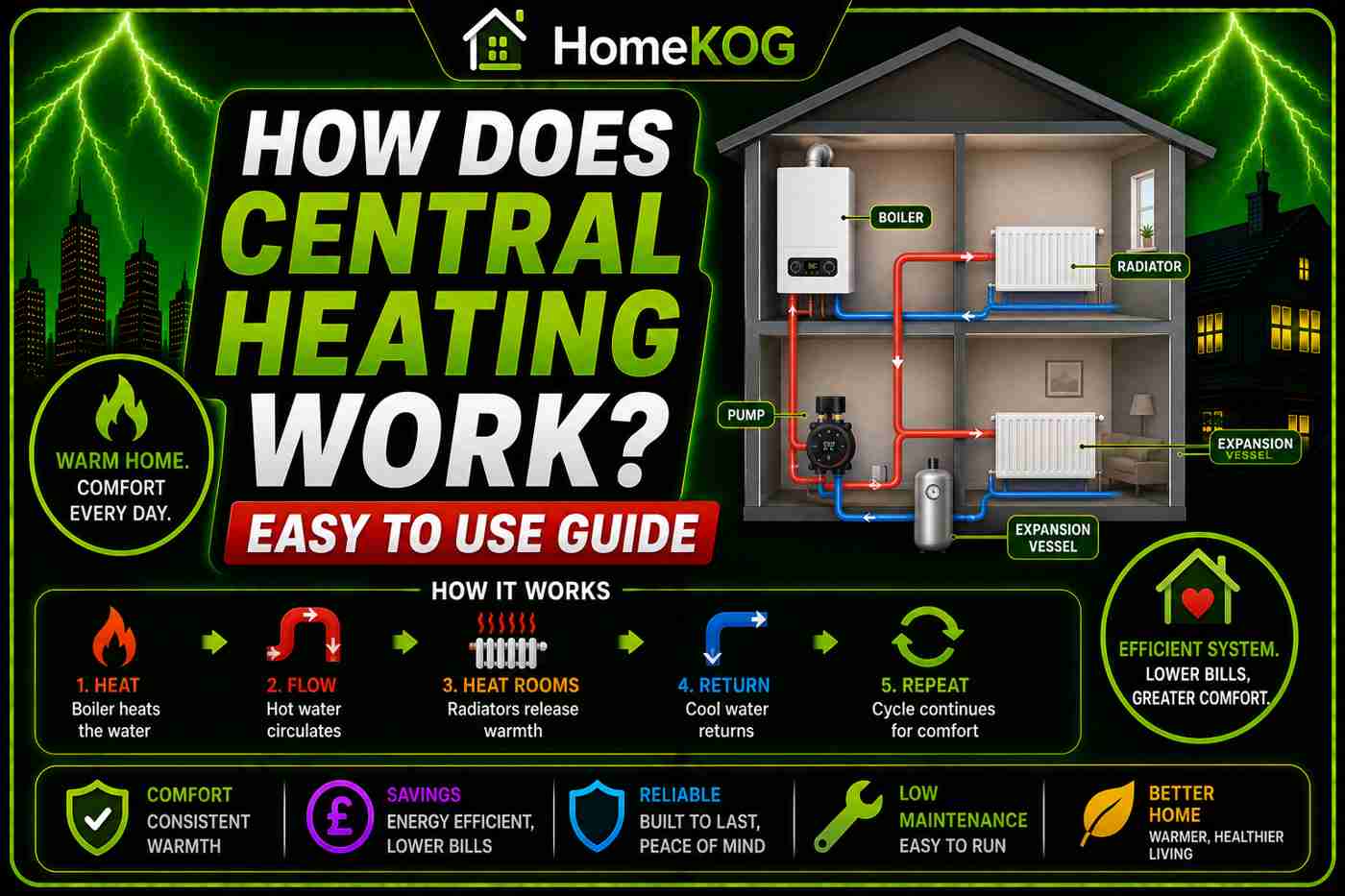
How Does Wet Central Heating Work? Step by Step
Wet central heating is the system that the majority of UK homeowners have. The following explains the full process from gas supply to a warm room.
- Natural gas arrives at the property through the mains gas supply pipe from the street, delivering the chemical energy stored in the gas to the boiler.
- The boiler burns gas with a controlled burner, producing hot combustion gases that pass through the heat exchanger inside the boiler unit.
- The heat exchanger transfers heat from the combustion gases to the water passing through the copper pipework inside the boiler. The water absorbs heat, and its temperature rises significantly, typically to 60°C-80°C in a standard heating circuit.
- The electric pump pushes the heated water out of the boiler and through the sealed pipework circuit — through the flow pipe to the radiators, through each radiator, and back through the return pipe to the boiler.
- Each radiator receives hot water on one side. As the water passes through the radiator’s panels, it transfers heat to the metal surface. The radiator emits heat into the room via convection and radiation, and the cooled water exits on the other side.
- The cooled water returns to the boiler via the return pipe, is reheated by the heat exchanger, and the cycle continues as long as heating demand remains.
- The thermostat monitors room temperature and signals the boiler to stop firing when the set temperature is reached. The boiler returns to standby until the room temperature drops again and the thermostat calls for heat once more.
- Waste combustion gases exit the boiler through the flue — in a modern condensing boiler, a secondary heat exchanger recovers usable heat from these gases before they are vented, raising the boiler’s efficiency above 90%.
The Sealed Loop
The water in a wet central heating system circulates within a permanently sealed loop — the same water is used repeatedly, heating up and cooling down thousands of times over the system’s lifetime. This water is treated with a corrosion inhibitor to prevent rust and limescale formation on the internal surfaces of the boiler, radiators, and pipework.
The sealed nature of the system means the water level and pressure are fixed. Pressure drops when water escapes through a leak or after maintenance that opens the circuit — this is why combi and system boiler owners occasionally need to repressurise through the filling loop. understanding combi boiler functionality helps homeowners ensure their units operate efficiently. Regularly checking the pressure and refill mechanism is essential in maintaining optimal performance. By being aware of these factors, users can prevent larger issues and extend the lifespan of their boilers.
How Is Central Heating Controlled?
Effective control of a central heating system is the most accessible way to reduce energy bills without changing any physical components.
Room Thermostat
A room thermostat monitors air temperature in the space where it is installed and sends a signal to the boiler to fire when the room drops below the target, and to stop when it reaches it. Setting the thermostat to 20°C to 21°C for living areas provides comfortable warmth for most households; every 1°C reduction in the thermostat setting reduces heating energy consumption by approximately 10%.
Programmable and Smart Thermostats
A programmable thermostat allows different temperature targets to be set for different periods of the day, reducing heating output during the night and during working hours when the home is unoccupied. A smart thermostat extends this further with remote control via a smartphone app, automatic schedule learning based on observed occupancy, and weather-responsive adjustment that reduces boiler output on milder days.
Smart thermostats — including Hive, Nest, and Worcester Bosch’s EasyControl — typically reduce heating bills by 10% to 30% compared to a standard programmable thermostat through more precise firing control.
Thermostatic Radiator Valves
Thermostatic radiator valves (TRVs) fitted to individual radiators allow different rooms to be maintained at different temperatures. A bedroom set to TRV position 2 (approximately 17°C) is kept cooler than a living room set to position 3 or 4 (approximately 20°C to 22°C), even though both draw from the same boiler.
TRVs work alongside the room thermostat — the thermostat controls overall system firing while TRVs control individual room output. They should not be installed in the same room as the main thermostat, as the two devices will compete for control.
Boiler Timer
A boiler timer schedules the times at which heating is available — controlling when the boiler can fire rather than at what temperature. Combined with a thermostat, a timer prevents the boiler from running during unoccupied periods, significantly reducing wasted energy.
Making Your Central Heating More Efficient
The most impactful steps for improving central heating efficiency in an existing system are:
- Annual boiler servicing — a Gas Safe engineer cleans the heat exchanger, confirms combustion efficiency, and identifies developing faults before they cause breakdowns.
- Boiler replacement — replacing a boiler over 10 years old with a modern A-rated condensing model can save up to £880 per year in an average UK home.
- Smart thermostat installation — reduces unnecessary boiler firing through automated scheduling and remote control.
- System power flush and magnetic filter — removes iron oxide sludge from the circuit, restoring heat transfer efficiency at the radiators and protecting the boiler’s heat exchanger.
- Radiator TRVs — enable room-by-room temperature control, preventing overheating in rooms that don’t need it.
- Loft and wall insulation — reduces the rate at which heat escapes from the building, reducing the demand on the central heating system to maintain comfort temperatures.
Frequently Asked Questions
How does central heating work?
Central heating works by burning fuel — most commonly natural gas — in a boiler to heat water. An electric pump circulates the heated water through sealed pipework to radiators in each room, which release the heat through convection and radiation. The cooled water returns to the boiler for reheating in a continuous sealed loop. A thermostat monitors room temperature and controls when the boiler fires, turning it off when the target temperature is reached to prevent overheating and unnecessary fuel consumption.
What type of central heating do most UK homes have?
Approximately 85% of UK homes use wet central heating, in which a gas boiler heats water that is circulated through radiators via a sealed pipework circuit. Gas combi boilers are the most common boiler type, providing both central heating and instant hot water from a single unit. System boilers are the preferred choice in larger homes with multiple bathrooms, using a hot water cylinder to store pre-heated water for simultaneous delivery to multiple outlets. how combi boilers provide instant hot water by utilizing a highly efficient heat exchanger that quickly heats cold water as it flows through the system. This means that users can enjoy hot water on demand, whether for a shower, washing dishes, or running multiple taps at once. By eliminating the need for a separate water storage tank, combi boilers save valuable space and energy, making them an ideal choice for modern households.
How does a condensing boiler improve central heating efficiency?
A condensing boiler improves central heating efficiency by recovering heat from the exhaust gases that older non-condensing boilers wented directly to the atmosphere. A secondary heat exchanger inside the condensing boiler cools the exhaust gases from approximately 180°C to below 55°C, extracting the remaining heat and using it to pre-warm the water returning from the radiators. This heat recovery process raises efficiency above 90%, compared to the 55% to 70% typical of older non-condensing models — reducing the gas required to deliver the same amount of heat to the home.
What controls central heating?
Central heating is controlled by a combination of a room thermostat, a boiler timer, and thermostatic radiator valves (TRVs). The room thermostat monitors air temperature and signals the boiler to fire when the room drops below the set level. The timer schedules the periods during which heating is available. TRVs regulate the flow of hot water through individual radiators, allowing different rooms to be maintained at different temperatures. Smart thermostats combine all three functions with remote smartphone control, automatic scheduling, and weather-responsive operation.
What is the difference between wet central heating and electric storage heaters?
Wet central heating uses a boiler to heat water, which is circulated through pipework to radiators throughout the home — it is a single, centralised system controlled from one location. Electric storage heaters are individual, self-contained units that store off-peak electricity as heat in ceramic bricks and release it throughout the day — they operate independently of each other, with no central distribution network. Wet gas central heating is significantly cheaper to run per unit of heat delivered than electric storage heaters in homes with a gas connection.
How can I make my central heating more efficient?
The most effective ways to improve central heating efficiency are: replacing a boiler over 10 years old with a modern A-rated condensing model, installing a smart thermostat to reduce unnecessary boiler firing, fitting TRVs to all radiators for room-by-room temperature control, having the system power flushed to remove sludge from the circuit, and ensuring the boiler is serviced annually. Together, these measures can reduce annual heating costs by hundreds of pounds while maintaining the same level of comfort throughout the home.
Conclusion: Understand Your System, Control It Better
A central heating system that is understood is one that is used efficiently. Knowing how the water circuit works, where the thermostat fits into the process, and why each component exists gives you the context to adjust settings intelligently, identify early signs of problems, and make informed decisions when repairs or replacements are needed. When considering upgrades, various central heating thermostat options available can significantly enhance the comfort and efficiency of your heating system. These devices can provide smarter control over your home’s temperature, allowing for tailored settings that align with your daily schedule. Investing in a quality thermostat not only optimizes energy use but also helps in maintaining a consistent and pleasant indoor climate.
For the majority of UK homeowners with a wet gas central heating system, the greatest efficiency gains available right now are in how the system is controlled — smart thermostat installation, correctly set TRVs, and an appropriate heating schedule consistently deliver meaningful savings without any change to the boiler or pipework. Combine those with annual servicing and a magnetic system filter, and the system will run efficiently and reliably throughout the boiler’s operational life.