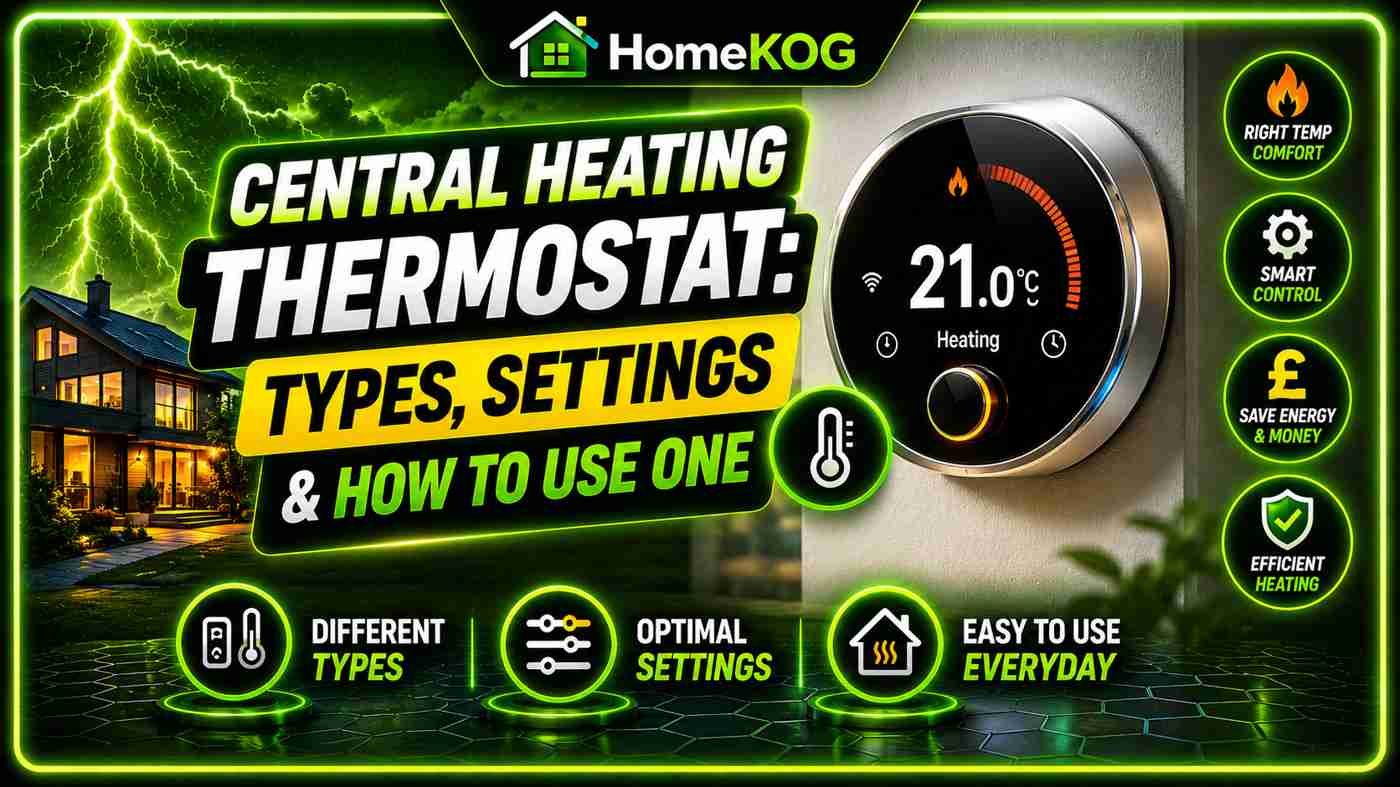

How to Use a Central Heating Thermostat: Complete Guide to Every Type
Quick Answer: A central heating thermostat controls when your boiler fires and at what temperature, turning heating on when the room drops below the set level and off when it reaches it. Setting your thermostat correctly — typically 20°C to 21°C for living areas and 17°C to 19°C for bedrooms — reduces energy bills significantly without sacrificing comfort. Every 1°C reduction in thermostat setting saves approximately 10% on heating costs.
Get boiler cover with a free annual service here >
Introduction
A central heating thermostat is the primary control that determines how much energy your boiler uses — and how much your heating bills cost. Yet most UK homeowners set it once and leave it, missing out on significant savings from using it intelligently.
Understanding how your thermostat works, which type you have, and how to configure it correctly for each room and season gives you direct control over your home’s energy consumption. Whether you have a basic dial thermostat, a programmable digital model, or a smart thermostat that learns your routine automatically, the principles that govern effective use are the same.
This guide covers every type of central heating thermostat, how each one works, how to set it up correctly, seasonal temperature recommendations, thermostatic radiator valves, troubleshooting when it stops working, and how the right thermostat can meaningfully reduce your gas bills.

Understanding Central Heating Thermostats: The Core Relationships
A central heating thermostat is part of an interconnected control system where each component has a defined role in regulating temperature and energy use.
- A central heating thermostat is a device that monitors room temperature and sends a signal to the boiler to fire when the temperature drops below the set level, and to stop when the target is reached.
- A programmable thermostat follows a user-defined schedule, switching the heating on and off at set times and temperatures automatically without manual intervention.
- A smart thermostat learns the household’s occupancy patterns, connects to a smartphone app, and adjusts heating schedules automatically based on routine, weather, and geolocation data.
- A thermostatic radiator valve (TRV) regulates the flow of hot water through an individual radiator, reducing flow when the room reaches the set temperature to prevent overheating in that specific space.
- A boiler timer is a mechanical or electronic scheduling device that controls the times at which the boiler operates — it is separate from the thermostat and controls when heating is available, not what temperature is maintained.
- A digital room thermostat uses electric sensors to read the actual room temperature and compare it against the set target, providing more precise control than a dial thermostat with a bimetallic strip.
- A wireless thermostat connects to the boiler via a radio signal rather than physical wiring, allowing it to be positioned anywhere in the home without cable routing.
- Bosch EasyControl is a smart thermostat designed specifically for Worcester Bosch boilers that enables remote control of heating and hot water via smartphone, with load compensation that adjusts boiler output based on actual room conditions.
- Hive is a smart thermostat system compatible with most UK boilers that provides app-based remote control, scheduling, and heating automation via a smartphone or tablet.
- Nest is a learning smart thermostat that automatically builds a heating schedule based on observed occupancy patterns, adjusting temperature settings without manual programming.
- A geolocation feature in smart thermostats detects when household members have left or are returning to the property, adjusting heating accordingly to avoid warming an empty home.
- Annual boiler servicing should include a check of thermostat controls to confirm they are communicating correctly with the boiler and operating within accurate temperature parameters.
How Does a Central Heating Thermostat Work?
A central heating thermostat measures the temperature of the air around it and compares that reading against the temperature you have set. When the room temperature falls below the target, the thermostat sends a signal to the boiler to begin heating. When the room reaches the target temperature, the thermostat signals the boiler to stop.
This on-off cycle is what keeps your home at a consistent temperature without the boiler running continuously. The thermostat acts as a gatekeeper — without it, the boiler would either run constantly regardless of temperature, wasting gas and overheating your home, or require manual switching on and off every time heating was needed.
The Common Myth About Turning the Thermostat High
A widely held misconception is that setting the thermostat to a high temperature heats the home faster. This is not how thermostats work. The thermostat does not control how quickly the boiler heats — it only controls the target temperature at which the boiler stops. Setting the thermostat to 30°C does not make the radiators heat up faster than setting it to 21°C; it simply means the boiler continues running until the room reaches 30°C rather than 21°C, using significantly more gas in the process.
Set the thermostat to the temperature you actually want in the room, and allow the heating system the time it needs to reach that temperature.
Types of Central Heating Thermostat
Dial Thermostats
A dial thermostat is the most basic type — a wall-mounted unit with a rotating dial that sets the target temperature. When the room drops below the set level, a bimetallic strip inside the thermostat bends due to the temperature change and completes an electrical circuit that signals the boiler to fire. When the temperature rises back to the set level, the strip straightens and breaks the circuit.
Dial thermostats are simple and reliable but offer no scheduling capability — they maintain a constant target temperature 24 hours a day unless manually adjusted. They are common in older properties and provide a cost-effective basic control option.
Best practice: Position the thermostat in a room that represents the average temperature of the home — typically a living room or hallway — away from direct sunlight, behind curtains, near radiators, or in draughty areas, all of which cause inaccurate readings.
Digital Room Thermostats
A digital thermostat uses electronic sensors to measure room temperature more accurately than a mechanical dial unit and displays the current reading on a digital screen. Most digital thermostats include a basic programming function that allows different temperature targets to be set for different periods of the day.
Unlike a dial thermostat, a digital model can be programmed to lower the temperature automatically during the night or when the property is unoccupied, then return to the comfort temperature before occupants wake or arrive home. This scheduling capability produces meaningful energy savings compared to maintaining a constant temperature around the clock.
Best practice: Programme a lower overnight temperature — 17°C to 19°C rather than 20°C to 21°C — and a reduced daytime setting during working hours to reduce gas consumption during periods when the home is not occupied.
Programmable Thermostats
A programmable thermostat extends the digital thermostat’s scheduling capability with more flexible time and temperature programming options. Most programmable models allow different schedules to be set for weekdays and weekends, and some allow individual settings for each day of the week.
A typical energy-saving programme might include:
- A pre-wake period (e.g. 6:30am) where the heating raises the home to 20°C before occupants get up.
- A daytime reduction (e.g. 9:00am to 4:30pm) where the temperature drops to 16°C or the heating turns off entirely while the property is empty.
- An evening comfort period (e.g. 5:00pm to 10:30pm) where the home returns to 20°C to 21°C.
- A night reduction (e.g. 10:30pm) where the temperature drops to 17°C to 19°C for sleeping.
This approach heats the home only when needed, eliminating the gas spent maintaining comfort temperatures throughout an empty property.
Smart Thermostats
A smart thermostat provides the highest level of central heating control available. It connects to the boiler via a receiver unit and to the homeowner’s smartphone via WiFi, enabling remote management of heating and hot water from anywhere with a mobile signal.
The most popular smart thermostats in the UK are Hive, Nest, and Bosch EasyControl. Each offers a different combination of features, but all provide remote control, scheduling, and energy monitoring as standard.
Key features of smart thermostats include:
- Remote control — adjust heating temperature and schedule from a smartphone or tablet, regardless of location.
- Learning capability — models such as Nest observe occupancy patterns over the first weeks of use and automatically build an optimised heating schedule, reducing the need for manual programming.
- Geolocation — the thermostat detects when household members leave or approach the property and adjusts heating accordingly, preventing the home from being heated while empty and ensuring it is warm on arrival.
- Weather responsiveness — some models adjust heating output in response to outdoor temperature forecasts, reducing boiler output on milder days.
- Energy reports — usage data tracked by the thermostat helps identify patterns in heating consumption and supports decisions about where further savings can be made.
Smart thermostats from boiler manufacturers — including Worcester Bosch’s Wave and Bosch EasyControl — are designed to integrate with specific boiler models, enabling load compensation that modulates boiler output based on how far the room is from its target temperature rather than simply cycling the boiler on and off.
Built-in Boiler Thermostats
Many boilers include a built-in temperature control on the front panel that sets the flow temperature — the temperature of the water circulating through the radiators. This is not the same as a room thermostat. The built-in control sets how hot the water in the system gets, while a room thermostat controls when the boiler fires based on room temperature.
Reducing the boiler’s flow temperature — typically from 80°C to a lower setting of 60°C to 70°C — improves the efficiency of condensing boilers by keeping the return water temperature low enough for the condensing process to operate effectively.
Thermostatic Radiator Valves
A thermostatic radiator valve (TRV) is a temperature-sensitive valve fitted to the inlet pipe of an individual radiator. It detects the air temperature around it and adjusts the flow of hot water through the radiator accordingly — reducing flow when the room is warm and increasing it when the room is cool.
TRVs allow different rooms to be maintained at different temperatures without affecting the boiler’s central thermostat setting. A bedroom with a TRV set to position 2 (approximately 16°C to 18°C) will be kept cooler than a living room with a TRV set to position 4 (approximately 22°C to 24°C), even though both are served by the same boiler.
TRV Numbering Guide
| TRV Setting | Approximate Room Temperature |
|---|---|
| 1 | 10°C – 12°C (frost protection) |
| 2 | 16°C – 18°C (bedroom, hallway) |
| 3 | 20°C – 22°C (standard comfort) |
| 4 | 22°C – 24°C (bathroom, living room) |
| 5 | 25°C+ (maximum) |
Important: Do not fit a TRV to the radiator in the room where the main wall thermostat is located. If both are present in the same room, they will compete for control — the TRV closing the radiator prevents the wall thermostat from reaching its target, causing the boiler to run continuously while the room the thermostat monitors stays cold.
Smart radiator valves — the connected version of a TRV — can be controlled via a smartphone app, allowing room-by-room temperature management from anywhere in the home.
How to Position Your Thermostat Correctly
Where a thermostat is installed directly affects the accuracy of its temperature readings and the efficiency of the heating system it controls.
Do position your thermostat:
- In a room that represents the typical temperature of the home — a living room or hallway works well.
- On an interior wall at approximately 1.5 metres height, where air circulates freely around the sensor.
- Away from heat sources including radiators, ovens, and appliances that generate warmth.
Do not position your thermostat:
- In direct sunlight or behind curtains, where solar gain or insulation causes false high readings.
- In a draught from an external door or window, which causes false low readings that keep the boiler running longer than necessary.
- In a rarely used room, where the temperature does not reflect the conditions in the rest of the home.
Recommended Temperature Settings
By Room Type
Setting the right temperature for each room — rather than a single flat setting throughout the property — produces the most comfortable and cost-effective result.
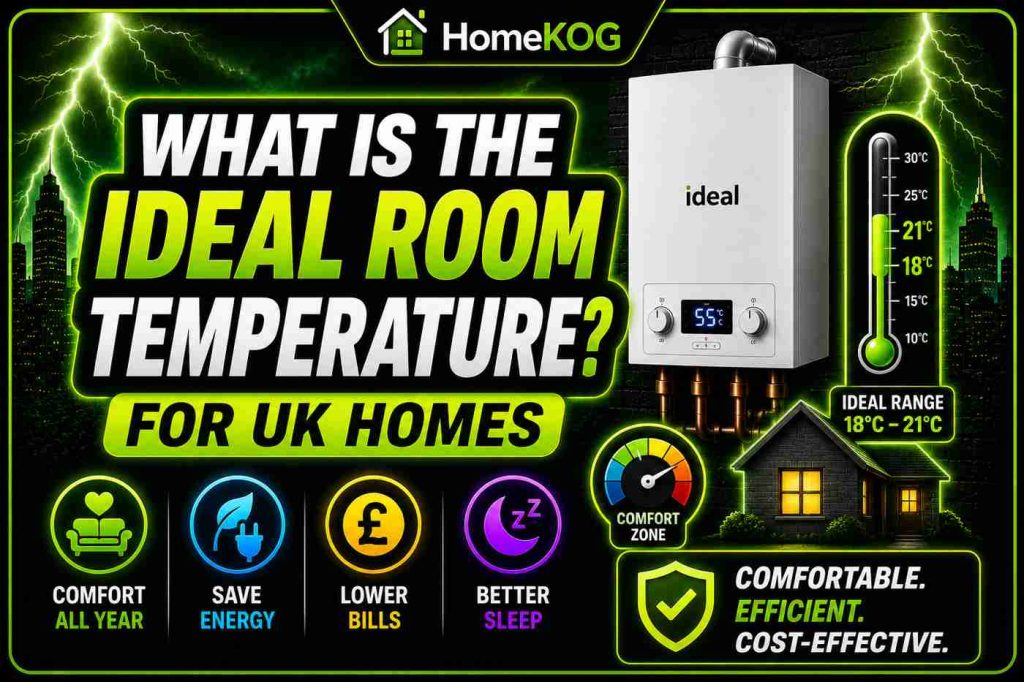
- Living room and home office: 20°C to 21°C — the temperature that supports comfortable seated activity and concentration.
- Bedroom: 17°C to 19°C — the range recommended by the Sleep Council for restorative sleep; temperatures above 24°C disrupt sleep quality.
- Kitchen: 18°C to 20°C — cooking appliances supplement ambient temperature during use, so a slightly lower baseline is appropriate.
- Bathroom: 22°C to 24°C — higher than other rooms because occupants are typically undressed and benefit from additional warmth.
- Hallways and low-use rooms: 15°C to 18°C — a lower setting that prevents damp and cold spots without heating unoccupied spaces unnecessarily.
By Season
- Winter: 20°C to 21°C during daytime occupancy; 17°C to 19°C overnight.
- Summer: Turn central heating off if the outdoor temperature is consistently above 15°C. Use heating for domestic hot water only, activating it as needed rather than on a fixed schedule.
- Holiday mode: Most modern thermostats include a holiday mode that maintains a frost protection minimum — typically 12°C — while the property is unoccupied, preventing pipes from freezing without heating an empty home.
Thermostat Not Working? How to Troubleshoot
If your central heating thermostat is not responding correctly, the following checks resolve the majority of common faults before calling an engineer.
- Check the thermostat is switched on — particularly relevant after a power cut or battery replacement, when some models reset to an off state.
- Replace the batteries — wireless and digital thermostats are battery-powered; flat batteries are the most common cause of a blank or unresponsive display.
- Check the time and schedule — a power cut or clock change can corrupt the programmed schedule, causing the thermostat to operate at the wrong times. Reset the clock and reprogram the schedule.
- Check the temperature setting — if the set temperature is at or below the current room temperature, the thermostat will not call for heat. Raise the setting above the room temperature and observe whether the boiler fires.
- Check the thermostat location — if it has been moved or if a new heat source has been installed nearby, the thermostat may be reading an inaccurate temperature. Confirm it is positioned correctly.
- Check the boiler — if the thermostat is calling for heat but the boiler is not firing, the fault may be with the boiler itself rather than the thermostat. Check for error codes on the boiler display.
- Replace the thermostat — thermostats have a typical lifespan of 10 to 15 years. An old thermostat that has developed sensor drift or electrical faults should be replaced rather than continually adjusted.
Manufacturer-Specific Thermostats
Most major boiler manufacturers produce their own thermostat and controls designed to integrate optimally with their specific boiler models. Using a manufacturer’s own controls typically enables advanced features — such as load compensation and weather compensation — that generic universal thermostats do not support.
- Worcester Bosch — Wave smart thermostat and Bosch EasyControl, both compatible with the Greenstar range and enabling load-compensating control.
- Viessmann — ViCare smart thermostat app and Vitodens-specific controls, integrating with Viessmann’s weather compensation technology.
- Ideal — Ideal Halo smart thermostat, designed for use with Ideal Logic and Vogue boiler ranges.
- Baxi – uSMART thermostat, compatible with the Baxi range and providing app-based remote control.
- Hive and Nest — third-party smart thermostats compatible with the majority of UK combi and system boilers from all manufacturers.
Frequently Asked Questions
How does a central heating thermostat work?
A central heating thermostat monitors the air temperature in the room where it is positioned and compares that reading against the temperature you have set. When the room drops below the target, the thermostat sends a signal to the boiler to begin heating. When the room reaches the target temperature, it signals the boiler to stop. This on-off cycle maintains a consistent room temperature without the boiler running continuously, reducing gas consumption compared to manual switching.
What temperature should I set my thermostat to?
For living areas, a thermostat setting of 20°C to 21°C provides comfortable warmth for most adults during daytime occupancy. Bedrooms are best kept between 17°C and 19°C to support good sleep quality. The NHS recommends a minimum of 18°C throughout the home for adults over 65. Reducing the thermostat setting by 1°C reduces heating energy consumption by approximately 10%, making even a small reduction meaningful over the course of a full heating season.
What is the difference between a thermostat and a timer?
A thermostat controls the temperature at which your heating operates — it signals the boiler to fire when the room drops below the set level and to stop when the target is reached. A timer controls the times at which your heating is available — it schedules the periods during which the boiler can operate. Both controls work together: the timer determines when the heating system is active, and the thermostat determines the temperature maintained during those active periods. They are separate devices that serve different functions.
What is a smart thermostat and is it worth it?
A smart thermostat connects to your boiler via a receiver unit and to your smartphone via WiFi, enabling remote control of heating from anywhere, automatic scheduling based on occupancy patterns, and energy monitoring. Leading models include Hive, Nest, and Bosch EasyControl. Smart thermostats typically cost £150 to £250 including installation and can reduce heating bills by 10% to 30% through more precise control of when and how much the boiler fires, recovering the cost within 1 to 3 heating seasons.
Can I use a thermostat with any boiler?
Most universal thermostats are compatible with the majority of UK combi, system, and conventional boilers. Smart thermostats including Hive and Nest are compatible with most standard boiler types. Manufacturer-specific thermostats — such as Bosch EasyControl for Worcester Bosch boilers or Vitodens controls for Viessmann — offer deeper integration and advanced features but are designed for specific boiler models. A Gas Safe engineer can confirm compatibility before installation.
Where is the best place to put a thermostat?
The best position for a central heating thermostat is on an interior wall in a room that represents the typical temperature of the home — a living room or hallway is ideal. It should be placed at approximately 1.5 metres height where air circulates freely, away from direct sunlight, radiators, ovens, external doors, and draughty areas. Any of these heat or cold sources cause the thermostat to read a false temperature, resulting in the boiler firing too early or too late and wasting energy.
Should I use TRVs with my thermostat?
Thermostatic radiator valves work well alongside a central room thermostat to provide room-by-room temperature control. A TRV on each radiator allows individual rooms to be kept at different temperatures — lower in bedrooms, higher in bathrooms — without affecting the boiler’s overall firing cycle. The one rule to follow is not to fit a TRV to the radiator in the room where the main wall thermostat is located, as both devices will compete for control of the same space, causing inefficient boiler operation.
Conclusion: Use Your Thermostat Intelligently and Save Money
A central heating thermostat is the most accessible tool available for reducing energy bills without reducing comfort. Setting the right temperature for each room, programming the right schedule for your household’s routine, and positioning the thermostat correctly cost nothing, but the savings they produce are immediate and compound across every heating season.
A smart thermostat takes this further by automating the optimisation, learning your routine, and ensuring the heating only runs when and where it is genuinely needed. The investment in a smart thermostat typically pays back within one to three heating seasons through reduced gas consumption.
Whether you upgrade to a smart model or simply programme your existing thermostat more effectively, intelligent thermostat use is the simplest and most impactful step available for reducing household heating costs without compromising on warmth or comfort.