
Hot water temperature in a UK home isn’t just a comfort setting — it directly affects safety, energy bills, and the risk of harmful bacteria developing in your system. Getting it right means understanding two separate things: what temperature your water should be stored at and what temperature it should arrive at the tap.
These are different figures, and confusing them is one of the most common mistakes homeowners make.
The Key Hot Water Temperatures to Know
There are three figures worth understanding:
-
Hot water cylinder storage temperature: 60°C minimum — required to kill Legionella bacteria under HSE ACOP L8 guidance
-
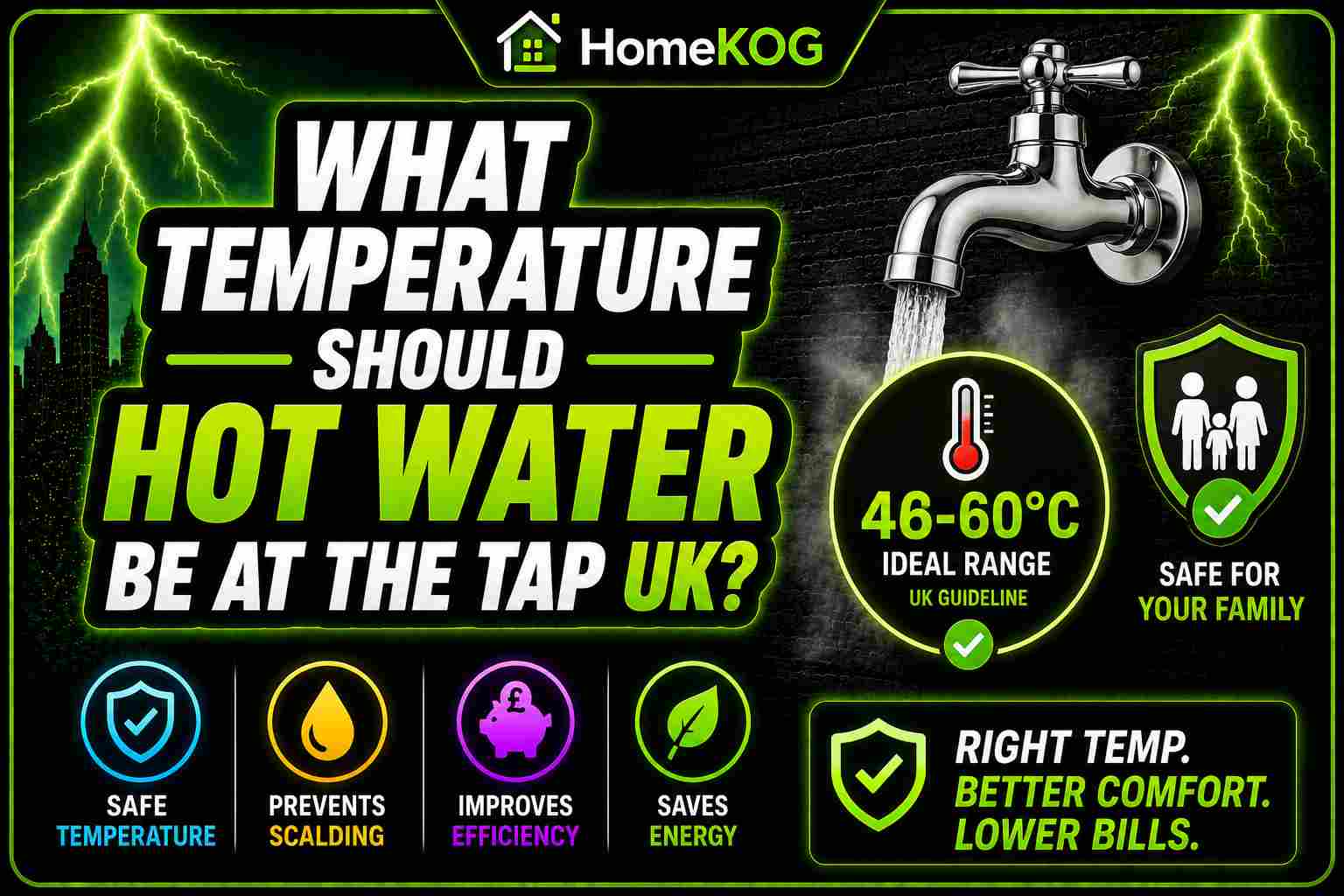
Hot water at the tap: maximum 50°C — the safe upper limit for general domestic outlets under UK hot water temperature regulations
-
Bath and shower water: 41°C–44°C — the recommended delivery temperature for vulnerable users including children and the elderly, typically controlled by a thermostatic mixing valve (TMV)
Storing water at 60°C and delivering it through a correctly set TMV gives you the best of both — safe storage and safe tap delivery without scalding risk.
Why Storage Temperature and Tap Temperature Are Different
A common misconception is that the temperature you store hot water at is the temperature it arrives at the tap. It isn’t — and this distinction matters enormously.
Water in a cylinder or tank must be stored at 60°C or above to prevent Legionella bacteria from multiplying. But water delivered at that temperature would cause a serious scald within seconds. A thermostatic mixing valve (TMV) sits between the storage system and the outlet, blending hot and cold water to bring the delivery temperature down to a safe level before it reaches the tap or showerhead.
This is why HSE guidance specifies both figures separately. The storage requirement is about biological safety. The delivery requirement is about physical safety.
Scalding Risk and Safe Hot Water Temperatures
Water at 60°C causes serious burns within seconds of skin contact. For children, the elderly, or anyone with reduced sensitivity, the injury threshold is lower still. For most adults, tap water consistently above 50°C presents a genuine scalding risk during normal daily use.
HSE guidance recommends that bath outlets should not exceed 44°C in homes where vulnerable users are present — typically managed through a TMV set to that temperature at the outlet. General hand-washing taps in domestic settings should deliver water at no more than 50°C.
Legionella Bacteria and Hot Water Temperature Regulations
Legionella bacteria — the cause of Legionnaires’ disease, a potentially fatal form of pneumonia — thrive in water temperatures between 20°C and 45°C, with peak growth occurring between 32°C and 42°C. They survive in stagnant, lukewarm water and are a genuine risk in poorly maintained domestic hot water systems.
The only reliable way to control Legionella in a stored hot water system is temperature. Water stored at 60°C kills Legionella within a short period. Temperatures below 60°C — even 55°C — do not reliably eliminate the bacteria quickly enough for safe long-term storage. This is why 60°C is the established minimum for hot water cylinders under HSE Approved Code of Practice L8.
Running stored water at 50°C may feel safe from a scalding perspective but creates conditions where Legionella can survive and multiply over time.
How to Control Hot Water Temperature in the UK
Thermostats
The thermostat on your hot water cylinder or boiler controls the storage temperature. For stored systems — system boilers and conventional boilers with a cylinder — this should be set to 60°C minimum. The accepted target range under UK hot water temperature regulations is 60°C to 65°C. the ideal room temperature for London typically hovers around 20°C to 22°C, providing a comfortable environment for most home activities. Maintaining a consistent temperature not only enhances comfort but can also improve energy efficiency. It’s important to monitor your heating system during colder months to ensure that your home remains warm without excessive energy use.
A faulty thermostat that allows water to drop below 60°C creates Legionella risk even if the dial appears correctly set. Regular checks and annual servicing are the most effective way to catch this before it becomes a problem.
Thermostatic Mixing Valves (TMVs)
TMVs are temperature-sensitive devices fitted at the outlet — at the tap, shower, or bath — that blend hot and cold water to deliver a safe, consistent temperature regardless of stored water temperature. They’re the practical solution to storing water safely at 60°C while still delivering it at a safe temperature at point of use.
TMVs are a legal requirement under Building Regulations Part G in certain new builds and properties undergoing relevant renovation work in England and Wales. In homes with young children or elderly residents, fitting them at bath outlets is strongly recommended regardless of legal obligation.
Boiler Settings
On a combi boiler, the domestic hot water (DHW) temperature is set directly on the boiler and typically defaults to around 60°C. For most households, this is the right setting — high enough for safety, efficient enough not to waste energy.
Adjustments beyond basic temperature changes should be carried out by a Gas Safe registered engineer, particularly where the system is behaving inconsistently or where pressure and flow issues are involved.
Types of Hot Water Systems and Temperature Management
Combi Boilers
Combi boilers heat water directly from the cold mains on demand — no storage tank is involved. Because water is heated immediately as it’s called for and not stored, there is no standing water in which Legionella can develop. Hot water is delivered at the boiler’s set DHW temperature through standard pipework.
Combi boilers are the most common system in UK homes and are well-suited to small and medium-sized households. The trade-off is that flow rate is limited to what the boiler can heat in real time — not ideal for large households with simultaneous high hot water demand. Understanding plumber regulations in the UK is essential for ensuring that installations are compliant and safe. These regulations are designed to protect consumers and ensure that plumbing work meets necessary standards. Homeowners should always verify that their plumbers are qualified and adhere to the local guidelines. boiler efficiency standards in the UK play a crucial role in promoting energy conservation and reducing carbon emissions. Compliance with these standards not only benefits the environment but can also lead to significant cost savings for homeowners through lower energy bills. It’s important for consumers to stay informed about these regulations to ensure their systems are operating at peak efficiency.
System and Conventional Boilers
System and conventional boilers use a hot water cylinder to store pre-heated water. The cylinder must be maintained at 60°C minimum to prevent Legionella growth. A correctly set TMV at bath and shower outlets manages delivery temperature and scalding risk.
These systems suit larger homes — the stored volume means multiple outlets can run simultaneously without pressure drops. Cylinder insulation quality directly affects efficiency, as stored hot water loses heat over time regardless of demand.
Heat Pump Hot Water Systems
Heat pumps extract heat from ambient air or the ground and transfer it to a storage tank via a refrigeration cycle. They are significantly more energy-efficient in running cost terms, though upfront installation costs are higher.
One important consideration: heat pumps typically operate at lower flow temperatures than gas boilers — often 45°C to 55°C. At these temperatures, Legionella management requires careful system design, including periodic high-temperature pasteurisation cycles or a supplementary immersion heater that raises cylinder temperature to 60°C at regular intervals. This should be designed into any heat pump installation from the outset.
How Does the Temperature of Hot Water at the Tap Relate to the Use of Unvented and Vented Hot Water Cylinders?
The temperature of hot water at the tap is influenced by the type of system in place, specifically unvented and vented cylinders. Unvented cylinders typically provide higher pressure and consistent temperature, while vented cylinders may experience fluctuations. Understanding this relationship helps ensure optimal water heating efficiency for households.
Troubleshooting Hot Water Temperature Problems
Most hot water temperature issues fall into one of the following categories. Use this as a first reference before calling an engineer:
If adjusting settings doesn’t resolve the issue, always seek a Gas Safe registered engineer rather than continuing to adjust components. Some faults — particularly those involving gas or pressure systems — carry real safety risk if handled incorrectly.
Tips for Maintaining Safe Hot Water Temperature
-
Service your boiler annually — a Gas Safe engineer will verify thermostat accuracy, heat exchanger condition, and overall system performance
-
Check your TMV periodically — TMVs can fail or become scaled over time, causing outlet temperatures to drift higher than the set point
-
Run outlets regularly — infrequently used taps and showers are higher risk for Legionella; flushing them weekly if unused reduces bacterial build-up
-
Insulate your cylinder and pipework — reduces heat loss, maintains storage temperature more efficiently, and lowers running costs
-
Keep a record of system temperatures — periodically testing tap delivery temperature with a thermometer confirms the system is working as intended
FAQs
What temperature should hot water be at the tap in the UK?
General domestic outlets should deliver water at a maximum of 50°C. For bath outlets in homes with children or elderly residents, 44°C is the recommended maximum under HSE guidance, typically achieved using a thermostatic mixing valve.
What temperature should a hot water cylinder be set to?
A minimum of 60°C, as required under HSE ACOP L8 guidance. This reliably kills Legionella bacteria. The accepted target range is 60°C to 65°C.
Is 50°C hot enough for hot water storage?
No. Water stored at 50°C sits within the range where Legionella can survive and multiply. 60°C is the minimum safe storage temperature for domestic hot water cylinders. Use a TMV at outlets to manage scalding risk without compromising storage temperature.
What temperature kills Legionella bacteria in domestic hot water?
60°C kills Legionella within a short period. Temperatures below this — including 55°C — do not eliminate the bacteria reliably enough for safe ongoing storage under UK hot water temperature regulations.
Do combi boilers have a Legionella risk?
The risk is significantly lower because there is no stored water. Water is heated on demand and used immediately, removing the standing water conditions in which Legionella develops. This is a practical advantage of combi systems over stored water alternatives for Legionella management.
What is a TMV and do I need one?
A thermostatic mixing valve blends hot and cold water at the outlet to deliver a safe, consistent temperature. They are a legal requirement under Building Regulations Part G in certain new build and renovation scenarios in England and Wales, and are strongly recommended in any home where children or elderly residents use baths or showers.
How often should a hot water system be serviced?
Annually. Regular servicing confirms the thermostat is functioning correctly, storage temperatures are being maintained, and components including TMVs are working as intended. Annual servicing is also a condition of most boiler manufacturer warranties.
Why does my hot water temperature fluctuate mid-shower?
The most common causes are mains pressure fluctuation affecting the TMV balance, a failing TMV, or — on combi boilers — a scaling issue on the secondary heat exchanger. A Gas Safe engineer can diagnose which is responsible and carry out the appropriate repair.