
What Size Boiler Do I Need? Complete Boiler Sizing Guide for UK Homes
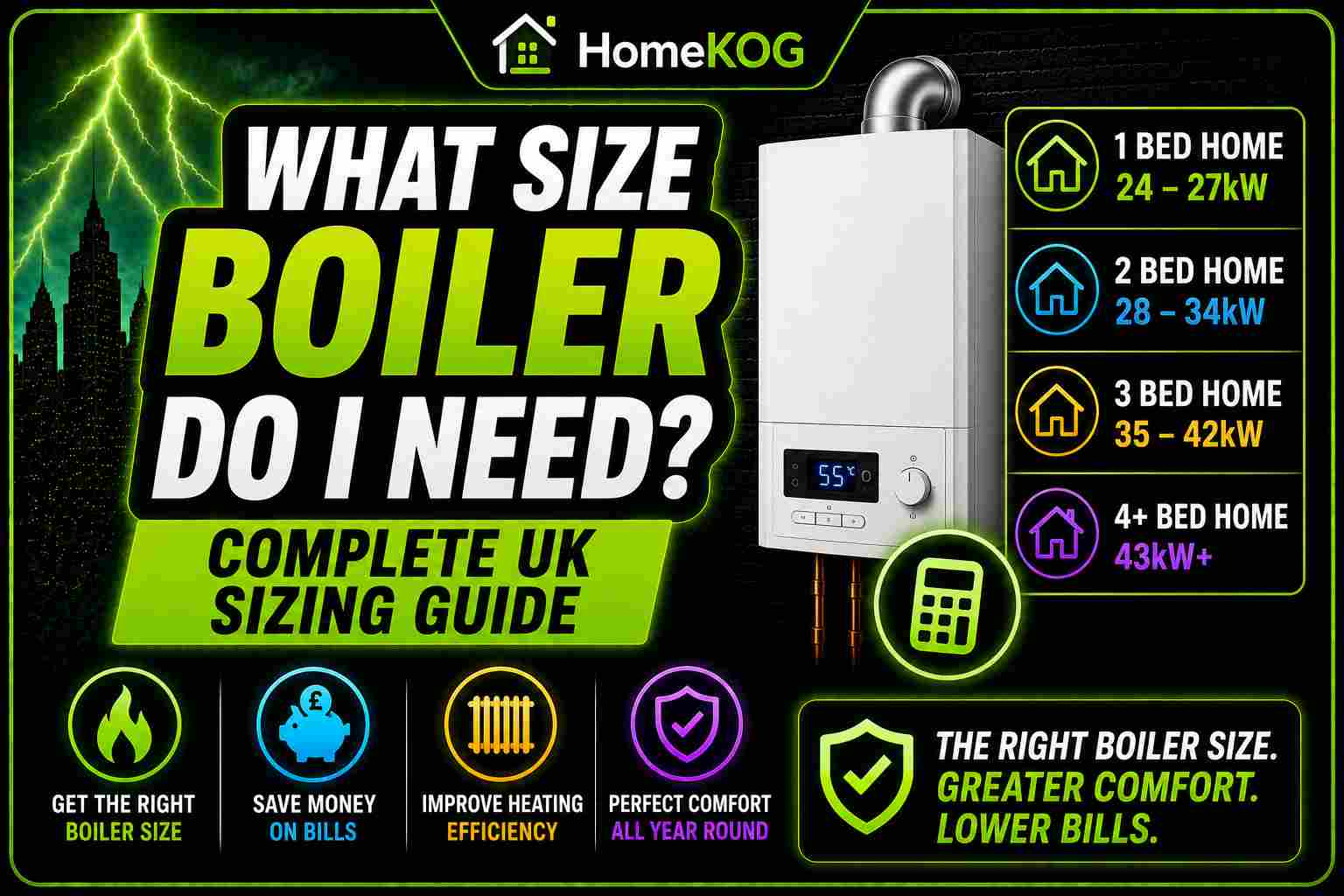
Quick Answer: The right boiler size depends on the number of radiators and bathrooms in your home. For a 2-bedroom house with one bathroom, a 24kW to 28kW combi boiler is typically sufficient. A 3-bedroom house with one bathroom needs 28kW to 30kW. Two bathrooms or more require at least 30kW to 35kW. Large homes with 4 or more bedrooms and multiple bathrooms need 35kW to 42kW. The average UK home suits a 28kW to 30kW combi boiler. When considering the ideal living temperature for London, it’s important to account for the typical weather patterns and seasonal changes. Many residents find a comfortable range between 18°C to 22°C suits their needs, ensuring both warmth and energy efficiency. Adjusting your heating system accordingly can help maintain this ideal temperature throughout the year.
Get a new boiler quote online here >
Introduction
Choosing the wrong boiler size is one of the most costly heating mistakes a homeowner can make — and one of the most common. An undersized boiler struggles to meet peak demand, producing lukewarm water at the tap and radiators that never fully heat. An oversized boiler cycles on and off inefficiently at partial load, consuming more gas than necessary and wearing components faster than a correctly matched unit would.
Getting the right size is straightforward once you understand the key variables and how they translate into a kW output requirement. This guide explains how boiler sizing works, provides sizing tables for combi, system, and conventional boilers across every common property configuration, answers the most frequently asked sizing questions, and gives boiler-specific recommendations for each size category. Understanding pressure release valve functionality explained is also essential for ensuring safety and efficiency in your system. Properly functioning pressure release valves help maintain optimal pressure levels and prevent potential hazards, contributing to the overall performance of your boiler setup. Remember to check these valves regularly as part of your maintenance routine to ensure they operate correctly.

Understanding Boiler Sizing: The Core Relationships
Boiler sizing connects a series of physical demands and outputs — understanding what each one means makes the selection process straightforward.
- Boiler output is measured in kilowatts (kW) and describes the rate at which the boiler can transfer heat to the water in the central heating system and to the domestic hot water supply.
- A correctly sized boiler produces output that matches the property’s peak demand — it meets the maximum heating load during the coldest conditions and the maximum hot water demand during peak usage, without being oversized for typical lower-demand periods.
- An undersized boiler cannot meet peak heating or hot water demand, producing inadequate water temperatures at taps and insufficient heat output at radiators during periods of high demand.
- An oversized boiler operates inefficiently by cycling on and off at partial load more frequently than a correctly sized unit, consuming more gas per useful unit of heat delivered and accelerating wear on the burner and heat exchanger.
- The number of radiators in a property determines the space-heating load — each standard radiator requires approximately 1.5kW of boiler output, and the boiler-sizing calculation adds a fixed allowance of 3kW for the domestic hot-water circuit.
- The number of bathrooms determines the domestic hot water demand — each additional bathroom with a shower or bath significantly increases the required hot water output, particularly in households where simultaneous use is common.
- A combi boiler sizes primarily on the hot water demand because it heats water on demand from the mains — the flow rate at the tap determines whether a given output can keep up with simultaneous hot water use.
- A system boiler sizes primarily on the number of radiators because it heats the sealed circuit — the hot water cylinder capacity and reheat rate are handled separately from the boiler output.
- A heat loss calculation is the professional method for determining the exact boiler output required for a specific property, accounting for insulation level, window area, ceiling height, and wall construction in addition to radiator count and bathroom demand.
- A Gas Safe registered engineer should confirm the boiler output recommendation with a heat loss calculation for the specific property before installation — this prevents both undersizing and oversizing.
- Hydrogen-ready boilers are sized identically to standard gas boilers — output, power, and sizing calculations are the same regardless of hydrogen readiness, as the fuel blend ratio does not affect the thermal output rating.
How Boiler Output (kW) is Calculated
Boiler output is rated in kilowatts (kW). When people refer to “boiler size,” they mean this output rating — not the physical dimensions of the unit. A higher kW rating means the boiler can transfer more heat to the water per second, meeting higher demand from more radiators and more simultaneous hot-water outlets.
For system and conventional boilers, the standard calculation is:
Required output (kW) = (Number of radiators × 1.5kW) + 3kW
This adds a 3kW allowance for the domestic hot water circuit to the total radiator load.
For combi boilers, the hot water flow rate is the critical determining factor alongside the radiator count. More bathrooms and simultaneous hot-water users require a higher-output combi to maintain adequate temperature and flow at each outlet.
Combi Boiler Size Guide
By Number of Bathrooms
The number of bathrooms is the primary sizing factor for combi boilers. The table below gives minimum and recommended output for each configuration.
| Bathrooms / Showers | Minimum kW | Typical Output Range |
|---|---|---|
| 1 bathroom | 24kW | 24kW – 28kW |
| 2 bathrooms | 28kW | 28kW – 32kW |
| 3 bathrooms | 35kW | 32kW – 38kW |
| 3+ bathrooms | 35kW+ | 38kW – 50kW |
By Number of Radiators
| Radiators | Minimum kW | Recommended Range |
|---|---|---|
| Up to 10 | 21kW | 24kW – 28kW |
| 11 – 15 | 28kW | 28kW – 32kW |
| 16 – 20 | 32kW | 32kW – 36kW |
| 21 – 25 | 36kW | 36kW – 42kW |
By Property Size
| Property | 1 Bathroom | 2 Bathrooms |
|---|---|---|
| 2 bedroom house | 24kW – 26kW | 28kW – 30kW |
| 3 bedroom house | 28kW – 30kW | 32kW – 35kW |
| 4 bedroom house | 28kW – 32kW | 35kW – 40kW |
| 5 bedroom house | 32kW – 35kW | 38kW – 42kW |
Important: These are indicative ranges. A Gas Safe engineer should carry out a heat-loss calculation for your property before selecting a final output size. Properties with poor insulation, high ceilings, or extensive glazing require higher outputs than the bedroom/bathroom count alone suggests.
System and Conventional Boiler Size Guide
System and conventional boilers size primarily on the number of radiators. The calculation applies a standard 1.5kW per radiator plus a 3kW hot water allowance. proper radiator sizing for your living space ensures optimal heating efficiency and comfort. It’s essential to account for the dimensions of each room and the type of insulation present to avoid any potential heat loss. Additionally, consulting a professional can help to tailor the system to meet the unique needs of your home.
| Radiators | Calculation | Minimum kW | Typical Model Size |
|---|---|---|---|
| 6 radiators | (6 × 1.5) + 3 | 12kW | 12kW – 15kW |
| 8 radiators | (8 × 1.5) + 3 | 15kW | 15kW – 18kW |
| 12 radiators | (12 × 1.5) + 3 | 21kW | 24kW |
| 15 radiators | (15 × 1.5) + 3 | 26kW | 26kW – 28kW |
| 20 radiators | (20 × 1.5) + 3 | 33kW | 33kW – 35kW |
For system boilers, the hot water cylinder size is selected separately from the boiler output. A 150 to 180 litre cylinder suits 1 to 3 bedrooms; 180 to 250 litres suits 3 to 5 bedrooms with multiple bathrooms.
Boiler Size Recommendations by Property
What Size Boiler for a 2 Bedroom Home?
A 2 bedroom house or flat with a single bathroom and up to 10 radiators is well served by a combi boiler in the 24kW to 28kW range. For a small flat or apartment with 6 to 8 radiators, a 24kW model is sufficient. A 2 bedroom house with a bathroom and en-suite should look at 28kW to handle simultaneous use.
Recommended model: Viessmann Vitodens 050-W 25kW or 29kW — compact, lightweight, and well-suited to smaller properties.
What Size Boiler for a 3 Bedroom Home?
A 3-bedroom house with one bathroom and 10 to 15 radiators typically requires a 28kW to 30kW combi boiler. Adding a second bathroom or en-suite increases the required power from 30kW to 35kW.
Recommended model: Viessmann Vitodens 100-W 30kW for single bathroom; Viessmann Vitodens 100-W 35kW or Worcester Bosch Greenstar 8000 30kW for two bathrooms.
What Size Boiler for a 4 Bedroom Home?
A 4-bedroom house with one bathroom and 15 to 18 radiators needs 28kW to 32kW. With two bathrooms and 15 to 20 radiators, 35kW is the appropriate target. For a 4-bedroom home where simultaneous showering is common, a system boiler with a 180 to 250 litre cylinder outperforms a combi regardless of output size, eliminating the pressure reduction that occurs when multiple outlets draw from the same combi simultaneously.
Recommended model: Worcester Bosch Greenstar 8000 35kW or 40kW for combi; Viessmann Vitodens 100-W system boiler with 200 litre cylinder for multi-bathroom. When considering the best combi boiler brands in the UK, efficiency and reliability are paramount. Brands like Vaillant and Ideal Heating often come highly recommended for their exceptional performance and customer service. It’s essential to evaluate the specific needs of your home to choose the right model from these top-tier manufacturers.
What Size Boiler for a 5+ Bedroom Home?
A 5-bedroom home with 20 or more radiators and multiple bathrooms requires 35kW to 42kW as a combi or a system boiler configuration. For homes with 3 or more bathrooms and regular concurrent demand, a system boiler is strongly preferred over a combi — the stored cylinder volume handles simultaneous demand far more effectively than even a 42kW combi’s on-demand output.
Recommended model: Worcester Bosch Greenstar 8000 40kW combi for up to 2 bathrooms; system boiler with 210 to 250 litre unvented cylinder (e.g. Megaflo) for 3 or more bathrooms.
How Many Radiators Can My Boiler Run?
| Boiler Output | Radiators Supported | Calculation |
|---|---|---|
| 24kW | Up to 14 | (24 – 3) ÷ 1.5 |
| 28kW | Up to 17 | (28 – 3) ÷ 1.5 |
| 30kW | Up to 18 | (30 – 3) ÷ 1.5 |
| 35kW | Up to 21 | (35 – 3) ÷ 1.5 |
| 40kW | Up to 25 | (40 – 3) ÷ 1.5 |
These figures represent the maximum radiator count the boiler can support simultaneously at full output. In practice, most homes do not run all radiators at full output simultaneously, providing a comfortable safety margin.
What Happens If the Boiler Is the Wrong Size?
Too Small
An undersized boiler cannot meet peak demand. In practical terms, this means: water from the hot tap that is warm rather than hot during high-usage periods, radiators that do not reach their target temperature on cold days, and the boiler running continuously without reaching the thermostat set point during particularly cold weather. An undersized combi boiler also produces noticeably reduced shower flow when a second outlet is opened simultaneously.
Too Large
An oversized boiler costs more to purchase than necessary and operates less efficiently once installed. It reaches the thermostat set point quickly, turns off, loses heat through the flue and casing, then fires again — a process called short cycling. Frequent short cycling increases wear on the burner and heat exchanger and reduces condensing efficiency because the heat exchanger does not reach the sustained operating conditions needed for maximum condensing.
Modern boilers with wide modulation ratios — the Viessmann Vitodens range has a 1:6 ratio — mitigate oversizing more effectively than older units by reducing output significantly at low demand, but correct sizing remains the preferred approach.
Frequently Asked Questions
What size combi boiler do I need?
The correct combi boiler size depends on the number of bathrooms and radiators in your home. For a 1 to 2 bedroom home with one bathroom and up to 10 radiators, a 24kW to 28kW combi is typically sufficient. For a 3 bedroom home with one bathroom, 28kW to 30kW is appropriate. Two bathrooms increase the requirement to 30kW to 35kW. Four-bedroom homes with two bathrooms need 35kW to 40kW. A Gas Safe engineer should confirm the correct output with a heat loss calculation for your specific property.
What does kW mean for a boiler?
kW stands for kilowatt — a unit of power that describes the rate at which the boiler transfers heat to the water in the central heating system. A higher kW rating means the boiler can heat water faster, supporting more radiators and more simultaneous hot water outlets. When people refer to “boiler size” they mean this output rating in kW, not the physical dimensions of the unit. The average UK home requires a boiler in the 24kW to 35kW range.
What happens if my boiler is too small?
An undersized boiler cannot fully meet your home’s heating and hot water demand during peak usage periods. In practice this means: water at taps and showers that is warm rather than hot, radiators that don’t reach their target temperature on cold days, and a boiler that runs continuously without satisfying the thermostat set point. If you’ve moved into a property and suspect the boiler is undersized — particularly if hot water performance is poor — a Gas Safe engineer can assess whether the installed output is appropriate for the property. When considering upgrading your system, it’s essential to understand the boiler plus requirements in the UK. These regulations ensure that your heating system maintains efficiency and meets the necessary performance standards. Consulting with a qualified professional will provide insights into the best options that comply with local guidelines and improve your home’s energy efficiency.
What size boiler do I need for a 3-bedroom house?
A 3-bedroom house with one bathroom typically requires a combi boiler in the 28kW to 30kW range. Adding a second bathroom — an en-suite or a family bathroom, plus a separate shower room — increases the required capacity to 30kW to 35kW to support simultaneous use without pressure reduction. For system boilers, a 3 bedroom home with 10 to 15 radiators needs approximately 21kW to 26kW, with a 150 to 180 litre hot water cylinder.
Do I need a bigger boiler if I’m adding an extension?
Yes — if a home extension adds radiators, an additional bathroom, or a wet room, the existing boiler may no longer be correctly sized for the increased demand. Before starting an extension, consult a Gas Safe engineer to assess whether the current boiler output will be adequate for the expanded property. Adding 4 to 6 radiators to a system already at the boiler’s maximum capacity requires a boiler upgrade alongside the building work to avoid performance issues after completion.
Are hydrogen-ready boilers sized differently?
No — hydrogen-ready boilers are sized using exactly the same output calculations as standard gas boilers. A 30kW hydrogen-ready combi boiler supports the same number of radiators and bathrooms as a standard 30kW gas combi. The hydrogen readiness of a boiler describes its fuel compatibility, not its output capacity. All new gas boilers available in the UK in 2026 are hydrogen-ready to a 20% blend as standard.
Conclusion: Get the Size Right Before You Buy
Boiler sizing is the most important specification decision in any new boiler installation — more important than brand, more important than smart features, more important than price. A boiler that is the wrong size for your home will underperform, overspend, or both, regardless of its other specifications. Choosing the right boiler types for home heating can significantly impact energy efficiency and comfort levels. It’s essential to consider not only the size but also the type of fuel and the specific requirements of your household. By carefully evaluating these factors, homeowners can ensure a more reliable and cost-effective heating solution.
Use the sizing tables in this guide to identify the output range appropriate for your property. Then confirm that recommendation with a Gas Safe engineer who will carry out a heat loss calculation before committing to a specific model. The few minutes that step takes prevent years of a poorly matched boiler.
For most 3-bedroom homes, a 28kW to 32kW combi from a leading manufacturer — Viessmann Vitodens 100-W or Worcester Bosch Greenstar 8000 — will serve the property well for 12 to 15 years. For larger homes with multiple bathrooms, consider whether a system boiler’s stored supply better matches the demand profile than any combi’s on-demand output, regardless of its kW rating.