
Types of Boilers in the UK: A Complete Guide to Every Boiler Type
Quick Answer: There are four main types of boiler used in UK homes — combi boilers, system boilers, conventional boilers, and back boilers. Combi boilers are the most popular, heating water on demand without a cylinder. System and conventional boilers store hot water in a cylinder and are suitable for larger homes with multiple bathrooms. All new gas boilers in the UK are condensing boilers by law, achieving over 90% energy efficiency.
Introduction
Choosing the right boiler type is one of the most important decisions a UK homeowner makes. The wrong choice means either paying too much for a system that exceeds your needs, or installing one that cannot keep up with your household’s demand for heat and hot water. When looking for the best gas boilers for home heating, it’s essential to consider factors like efficiency, size, and your specific heating requirements. Investing in a high-quality boiler can lead to significant savings on energy bills while ensuring your home remains warm and comfortable. Researching various brands and models will help you make an informed decision that suits your lifestyle and budget. When exploring the best boiler brands for home heating, it’s crucial to read customer reviews and expert advice to gauge the reliability of different models. Additionally, factors such as warranty coverage and customer service should be taken into account, as they can impact your overall satisfaction with the purchase. By evaluating these elements, you can confidently select a boiler that will serve your home efficiently for years to come.
The UK boiler market offers gas, oil, electric, and biomass options — and within gas, the choice between combi, system, and conventional configurations determines how hot water is stored, delivered, and managed throughout your home. Every new gas boiler manufactured and sold in the UK is a condensing boiler by law, achieving efficiency ratings above 90% and capable of running on hydrogen blends up to 20%.
This guide covers every boiler type available in the UK — what each one is, how it works, the homes it suits, and its pros and cons — giving you the information needed to identify the right boiler for your property. When considering electric boiler types for home heating, it’s important to evaluate factors such as energy efficiency and installation requirements. Different models may cater to various home sizes and heating needs, making it essential to choose one that aligns with your household’s demands. By understanding the options available, you can make an informed decision that best fits your lifestyle and budget.

Understanding Boiler Types: The Core Relationships
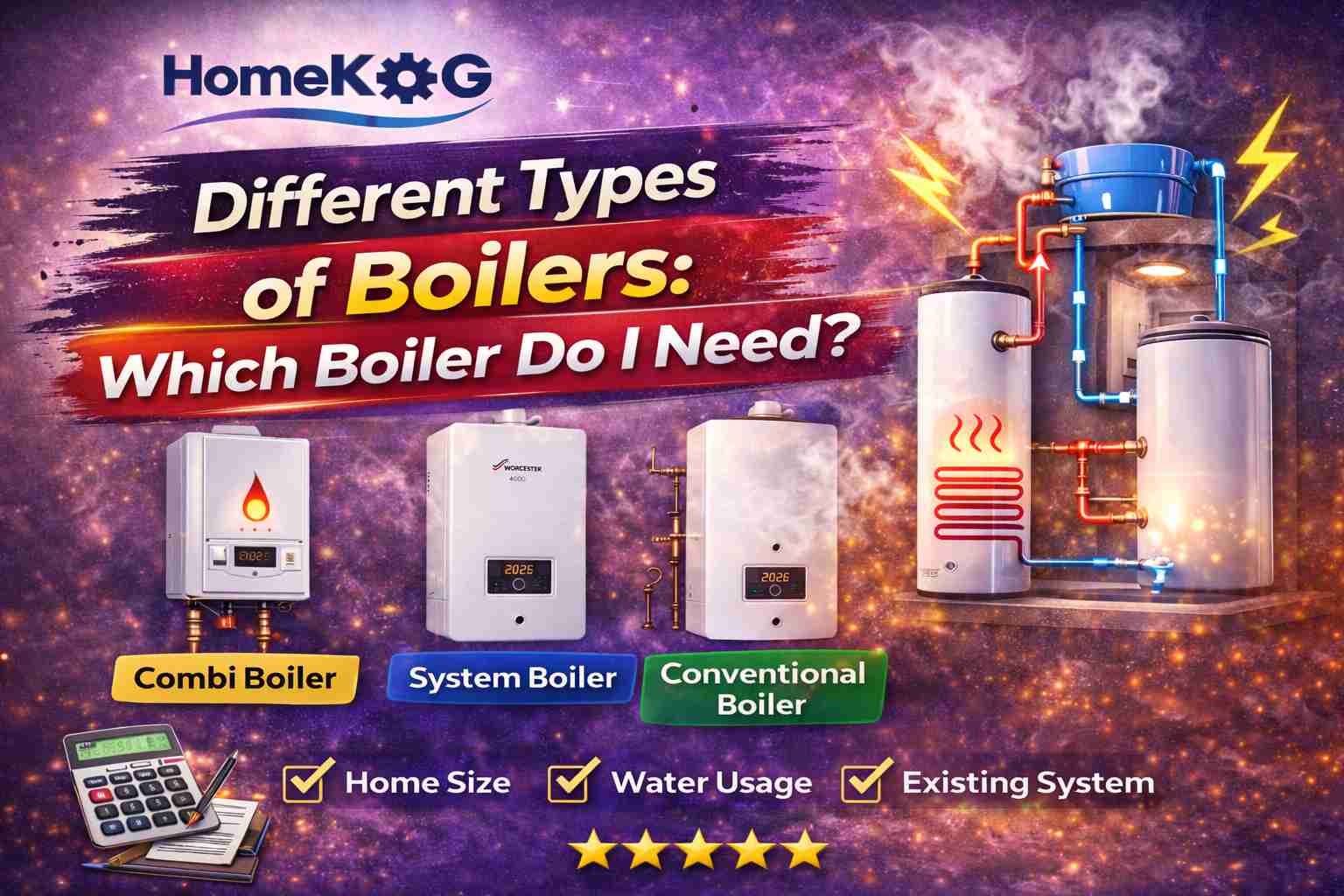
Each boiler type occupies a distinct position in the UK heating market, defined by how it heats water, stores it, and delivers it to the home.
- A combi boiler is a single compact unit that heats domestic hot water on demand from the mains and provides central heating without requiring a separate cylinder or cold water tank.
- A system boiler heats water that is stored in a separate hot water cylinder, supplying multiple outlets simultaneously at consistent pressure without needing a loft-mounted cold water tank.
- A conventional boiler — also called a regular or heat-only boiler — requires both a hot water cylinder and a cold water storage tank in the loft, and is best suited to older larger properties with existing infrastructure.
- A back boiler is installed behind a fireplace and uses the fire’s heat to warm water stored in a separate tank, operating at approximately 70% efficiency — significantly below the 90%+ required by current regulations.
- A condensing boiler captures heat from exhaust gases that older non-condensing boilers vented to the atmosphere, converting it into additional useful heat and raising efficiency above 90%.
- All new gas boilers manufactured and sold in the UK are condensing boilers by law — this applies to combi, system, and conventional gas boiler types without exception.
- An oil boiler operates on the same combi, system, or conventional configurations as a gas boiler but burns oil rather than gas, making it suitable for rural properties off the gas grid.
- A biomass boiler burns wood pellets or logs to generate heat, producing a carbon-neutral heat source that qualifies for renewable heat incentives in the UK.
- An electric boiler heats water using an electric element rather than combustion, making it suitable for properties without a gas connection but significantly more expensive to run than gas alternatives.
- A hydrogen-ready boiler is compatible with gas supplies containing up to 20% hydrogen by volume, future-proofing the installation against the UK’s planned transition away from pure natural gas.
- A Gas Safe registered engineer is the only professional legally qualified to install, service, or repair gas boilers of any type in the UK.
- Annual boiler servicing maintains the efficiency, safety, and warranty compliance of every boiler type, regardless of configuration or fuel source.
Combi Boilers
A combi boiler — short for combination boiler — is a single wall-hung unit that provides both central heating and domestic hot water without requiring a separate cylinder, cold water tank, or loft-mounted components. When a tap or shower is opened, the combi boiler fires and heats water directly from the mains supply on demand, delivering it instantly to the outlet.
Combi boilers are the most common boiler type in the UK, favoured for their compact footprint, straightforward installation, and lower total cost compared to system and conventional alternatives when appropriately sized.
How a Combi Boiler Works
Cold water from the mains enters the combi boiler when a tap is opened. The boiler’s heat exchanger heats the water as it passes through, and it is delivered to the outlet at mains pressure. The boiler stops heating when the tap is closed. The central heating function operates on a separate circuit, with the boiler heating water that circulates through the radiators via the same unit.
Which Homes Suit a Combi Boiler?
A combi boiler is best suited to:
- Properties with 1 to 3 bedrooms and a single bathroom.
- Households with up to 4 occupants where simultaneous hot water demand across multiple outlets is not a daily requirement.
- Homes where storage space is limited, and the compact footprint of a single unit without a cylinder is a practical advantage.
- Properties with adequate mains water pressure to deliver the flow rates the combi boiler is rated for.
Combi Boiler Pros and Cons
Pros:
- Heats water on demand without preheating, so energy is only consumed when hot water is actually needed.
- Compact single-unit design fits in a standard kitchen cupboard or wall-hung position, freeing up airing cupboard and loft space.
- Lower total installation cost than system or conventional boiler alternatives in properties without existing cylinder infrastructure.
- Unlimited hot water on demand — unlike a cylinder-based system, there is no stored volume to exhaust.
- Straightforward sizing — output requirements are determined by property size and radiator count.
Cons:
- Flow rate reduces when multiple outlets are in use simultaneously — not suitable for households where two or more showers run at the same time regularly.
- No backup hot water source if the boiler develops a fault — a cylinder-based system can use an immersion heater as a backup.
- Generally not compatible with solar thermal panels, which require a cylinder to store solar-heated water.
- Performance is dependent on adequate incoming mains pressure — properties with low mains pressure may not benefit from a combi boiler’s flow rates.
System Boilers
A system boiler is a central heating unit that heats water and stores it in a separate hot water cylinder, which is typically installed in an airing cupboard. Unlike a conventional boiler, all the key components — including the pump and expansion vessel — are built into the boiler unit itself, eliminating the need for a loft-mounted cold water storage tank.
The cylinder stores a volume of pre-heated water that is available immediately when taps or showers are opened, delivering it at consistent pressure to multiple outlets simultaneously.
How a System Boiler Works
The system boiler heats primary circuit water and circulates it through an internal coil inside the hot water cylinder. This coil transfers heat to the stored domestic hot water without the two water supplies mixing. The thermostat on the cylinder monitors stored water temperature and signals the boiler to fire when reheating is required. When a tap or shower is opened, pre-heated water flows from the cylinder to the outlet.
Which Homes Suit a System Boiler?
A system boiler is best suited to:
- Larger homes with 3 to 5 bedrooms and two or more bathrooms.
- Households with 4 or more occupants in which simultaneous hot-water demand across multiple outlets is a regular occurrence.
- Properties where a loft-mounted cold water tank is impractical or unwanted, but where cylinder storage space is available.
- Homes are being upgraded from a conventional boiler, where retaining a cylinder is preferable to a full conversion.
System Boiler Pros and Cons
Pros:
- Supplies hot water to multiple bathrooms simultaneously without the pressure reduction that affects combi boilers under concurrent demand.
- All key components are integrated within the boiler unit, simplifying installation compared to a full conventional system.
- No cold-water loft tank required, reducing the footprint compared to a conventional boiler.
- Compatible with solar thermal panels, which can contribute heat to the cylinder and reduce gas consumption.
- An immersion heater can be installed in the cylinder as a hot water backup if the boiler develops a fault.
Cons:
- Requires space for a hot water cylinder — typically an airing cupboard — which is not available in all properties.
- Hot water supply is limited to the volume stored in the cylinder — once exhausted during high-demand periods, a reheat wait is required.
- Higher total installation cost than a combi boiler in most properties due to the cylinder and associated pipework.
- A poorly insulated cylinder loses stored heat, reducing system efficiency and increasing running costs.
Conventional Boilers
A conventional boiler — also known as a regular boiler, heat-only boiler, or open vent boiler — is the oldest established boiler configuration in the UK. It requires both a hot water cylinder (typically in the airing cupboard) and a cold water storage tank, feed, and expansion tank in the loft, making it the most component-intensive and space-demanding of the three main gas boiler types.
Despite requiring more space, conventional boilers deliver excellent hot water performance for large households, work reliably in properties with low mains pressure, and are the most straightforward replacement in older homes where the existing infrastructure is already in place.
How a Conventional Boiler Works
Cold mains water is gravity-fed into the cold water storage tank in the loft. The tank feeds the hot water cylinder, which is heated by the boiler via an internal coil. The feed and expansion tank — a smaller secondary loft tank — accommodates the thermal expansion of water as it heats and maintains the correct water level in the open circuit. When a tap is opened, hot water flows from the cylinder under gravity pressure.
Which Homes Suit a Conventional Boiler?
A conventional boiler is best suited to:
- Larger older properties with 4 or more bedrooms and multiple bathrooms.
- Homes where the existing conventional infrastructure — cylinder and loft tanks — is already in place and in good condition.
- Properties with low incoming mains pressure where a combi or system boiler’s pressure-dependent performance is a concern.
- Households with high simultaneous hot water demand that requires a large stored volume rather than on-demand heating.
Conventional Boiler Pros and Cons
Pros:
- Delivers hot water to multiple outlets simultaneously from the stored cylinder volume without any pressure reduction.
- Suitable for properties with low mains water pressure — gravity-fed operation is not dependent on incoming supply pressure.
- Compatible with solar thermal panels and electric immersion heaters, providing both renewable energy integration and backup hot water.
- Like-for-like replacement in a property with existing conventional infrastructure is the most cost-effective and least disruptive installation option.
Cons:
- Requires the most space of any boiler type — loft tanks, an airing cupboard cylinder, and the boiler unit itself are all needed.
- More complex and time-consuming to install in properties without existing conventional infrastructure.
- Running costs can be higher than a combi boiler in lower-demand households, as the cylinder maintains stored hot water temperature continuously.
- Hot water availability is limited by the cylinder’s volume — larger households may exhaust it during peak demand.
Back Boilers
A back boiler is a heating unit installed behind a gas fire or fireplace that uses heat generated by the fire to warm water stored in a separate hot water tank. Back boilers were common in UK homes from the 1960s through to the 1980s but are no longer manufactured, as they cannot meet current efficiency standards.
Back boilers operate at approximately 70% efficiency — well below the 90%+ required of all new gas boilers by current UK regulations. Replacement parts are increasingly difficult to source, and fewer Gas Safe engineers now train to service them. A back boiler that develops a fault is often more expensive to repair than replacing it with a modern condensing boiler.
If you have a back boiler, replacing it with a combi, system, or conventional boiler is strongly recommended for efficiency, reliability, and safety reasons.
Condensing Boilers
Condensing technology is not a separate boiler type — it is a design feature that all new gas boilers in the UK must incorporate by law. A condensing boiler recovers heat from the exhaust gases that older non-condensing boilers vented directly to the atmosphere through the flue, using this recovered heat to pre-warm the water returning to the boiler from the heating circuit.
This heat recovery process raises the efficiency of a condensing boiler above 90%, compared to the 70% to 80% typical of non-condensing boilers manufactured before the regulation was introduced. Every new combi, system, and conventional gas boiler sold in the UK today is a condensing boiler.
Condensing Boiler Pros and Cons
Pros:
- Over 90% efficiency reduces gas consumption and lowers energy bills compared to pre-condensing boilers.
- Mandatory for all new gas boiler installations in the UK — there is no lower-efficiency alternative available in the new boiler market.
- Reduced carbon emissions per unit of heat generated compared to non-condensing predecessors.
Cons:
- Produces acidic condensate water as a byproduct of the condensation process, which drains through a condensate pipe — this pipe can freeze in cold weather and is a common cause of winter boiler shutdowns.
- Some models carry a higher purchase price than equivalent non-condensing models would have, though efficiency savings offset this over time.
Oil Boilers
Oil boilers are the primary heating solution for rural UK properties that are not connected to the gas grid. They operate on the same combi, system, or conventional configurations as gas boilers, but burn heating oil rather than gas as their fuel source.
Oil must be delivered by tanker and stored in an external tank on the property, which requires sufficient outdoor space and vehicle access. Running costs for oil boilers are typically higher than gas — approximately £1,300 per year — and oil prices are subject to market fluctuation.
Installation and servicing of oil boilers must be carried out by an OFTEC-registered engineer rather than a Gas Safe engineer. Oil boilers qualify for the Boiler Upgrade Scheme grant when being replaced with a low-carbon alternative such as a heat pump.
Oil Boiler Pros and Cons
Pros:
- The most practical heating solution for properties off the gas grid with adequate outdoor space for an oil storage tank.
- Available in combi, system, and conventional configurations, providing the same functional options as gas boilers.
- It can be installed internally or externally, depending on the property layout.
Cons:
- Higher annual running costs than gas boilers due to the higher cost of heating oil.
- Oil price fluctuations make annual running costs less predictable than gas.
- Requires outdoor storage space for the oil tank and regular delivery access.
- OFTEC registration is required for installation and servicing — a different qualification from Gas Safe.
Biomass Boilers
A biomass boiler burns organic fuel — typically wood pellets, wood chips, or logs — to generate heat for central heating and domestic hot water. Biomass is considered a carbon-neutral fuel source because the carbon dioxide released during combustion is offset by the carbon absorbed by the trees during growth.
Biomass boilers qualify for renewable heat incentives and are eligible for the Boiler Upgrade Scheme grant. They are most practical for rural properties with outdoor fuel storage space and delivery access.
Biomass Boiler Pros and Cons
Pros:
- Carbon-neutral operation reduces net carbon emissions compared to gas and oil alternatives.
- Wood pellet fuel prices are less volatile than gas and oil.
- Eligible for the Boiler Upgrade Scheme grant, potentially offsetting the higher upfront installation cost.
- Renewable heat incentive payments may cover the cost of investment over time.
Cons:
- Higher installation cost than gas or oil boilers.
- Requires substantial outdoor storage space for fuel and reliable access for delivery vehicles.
- Annual servicing is essential — biomass boilers require more frequent maintenance than gas alternatives.
- Not practical for urban properties or those without adequate outdoor space.
Electric Boilers
An electric boiler heats water using an electric element rather than combustion, making it an option for properties without a gas connection. Electric boilers are smaller and simpler than gas boilers and do not require a flue, making them easier to install in compact spaces.
The significant disadvantage of electric boilers is running cost — electricity is approximately three to four times more expensive per unit than gas, making electric boilers significantly more costly to operate. They are most practical for flats, studios, and 1 to 2 bedroom properties with low heating demand.
Electric Boiler Pros and Cons
Pros:
- No flue required — can be installed in any room without external wall access.
- Smaller and quieter than gas boilers — suitable for compact spaces.
- Lower installation cost than gas boilers in properties without an existing gas connection.
- Zero direct combustion emissions at the point of use.
Cons:
- Significantly higher running costs than gas boilers due to the higher unit cost of electricity.
- Not cost-effective for larger properties with high heating demand.
- Running costs depend on the carbon intensity of the electricity grid — not genuinely low-carbon unless powered by renewable electricity.
Comparing All Boiler Types
| Boiler Type | Hot Water Storage | Multiple Outlets | Space Required | Best For |
|---|---|---|---|---|
| Combi boiler | None (on demand) | Limited | Low | 1–3 bed homes, 1 bathroom |
| System boiler | Cylinder only | Yes | Medium | 3–5 bed homes, 2+ bathrooms |
| Conventional boiler | Cylinder + loft tanks | Yes | High | Large older homes, low pressure |
| Back boiler | Separate tank | Limited | Behind fireplace | No longer recommended |
| Oil boiler | Depends on type | Depends on type | Depends on type | Off-grid rural properties |
| Biomass boiler | Depends on type | Depends on type | High (+ fuel storage) | Rural, off-grid, eco-conscious |
| Electric boiler | Depends on type | Limited | Low | Flats, small properties, no gas |
How to Choose the Right Boiler Type for Your Home
The right boiler depends on four key factors — the size of your property, the number of bathrooms, available storage space, and your fuel supply.
- Small home, one bathroom, limited space — a combi boiler is almost certainly the right choice.
- Large home, multiple bathrooms, high simultaneous demand — a system boiler or conventional boiler delivers better performance than a combi.
- Older property with existing conventional infrastructure — a like-for-like conventional replacement is the most cost-effective option.
- No gas connection, rural location — an oil boiler is the most practical primary heating solution; biomass is a viable alternative if fuel storage is available.
- Flat or small property without gas — an electric boiler is an option, but running costs should be factored into the long-term budget carefully.
A Gas Safe registered engineer can carry out a full property assessment and recommend the correct boiler type and output rating based on your specific heating and hot water requirements.
Frequently Asked Questions
What are the different types of boilers in the UK?
The main boiler types used in UK homes are combi boilers, system boilers, and conventional boilers — all of which are available as gas condensing models. Oil boilers offer the same configuration options as gas boilers for off-grid properties. Additional types include back boilers (no longer manufactured), electric boilers, and biomass boilers. All new gas boilers sold in the UK are condensing boilers by law, achieving over 90% energy efficiency and hydrogen-ready to a 20% blend.
What is the most common boiler type in the UK?
The combi boiler is the most common boiler type in the UK. Its compact single-unit design, lower installation cost, and ability to provide both central heating and on-demand hot water without a separate cylinder make it the default choice for most new installations and like-for-like replacements in properties with up to 3 bedrooms and one bathroom. System boilers are the second most common type, preferred in larger homes where simultaneous hot water demand exceeds what a combi can provide.
What is the difference between a combi boiler and a system boiler?
A combi boiler heats domestic hot water on demand directly from the mains without any storage cylinder, making it compact but limited to one or two simultaneous outlets. A system boiler stores hot water in a separate cylinder, enabling multiple outlets to be supplied simultaneously at consistent pressure. System boilers require space for a cylinder but do not need a loft-mounted cold water tank. Combi boilers are better suited to smaller homes; system boilers suit larger households with multiple bathrooms.
Are all new boilers condensing boilers?
Yes — all new gas boilers manufactured and sold in the UK are condensing boilers by law. This regulation has been in force since 2005 and applies to combi, system, and conventional gas boiler types without exception. Condensing boilers achieve over 90% efficiency by recovering heat from exhaust gases that older non-condensing boilers lost through the flue. There is no option to purchase a new non-condensing gas boiler for a domestic installation in the UK.
Which boiler type is best for a large family home?
A system boiler or conventional boiler is best for a large family home with multiple bathrooms and high simultaneous hot water demand. Both use a hot water cylinder that stores a substantial pre-heated volume, which can be delivered to multiple outlets simultaneously without pressure reduction. A combi boiler’s on-demand output is split across concurrent demands, which causes pressure reduction when multiple outlets are in use at the same time — making it poorly suited to large households with peak demand across several bathrooms.
Can I change from one boiler type to another?
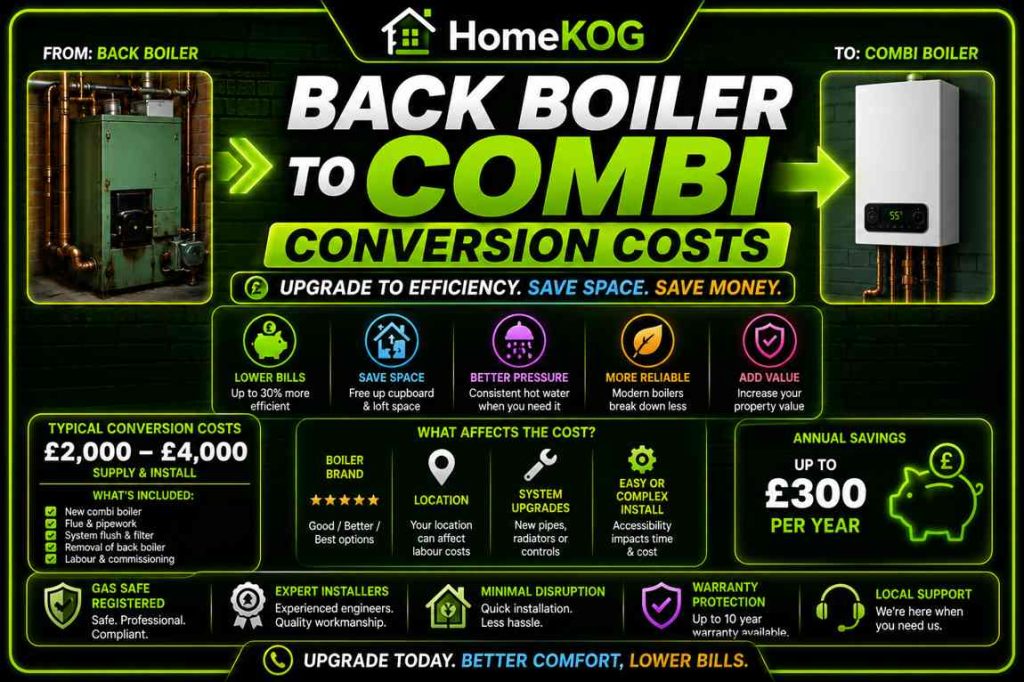
Yes — changing boiler type is called a boiler conversion. The most common conversions are from a conventional boiler to a combi boiler (removing the cylinder and loft tanks) and from a back boiler to a combi. Conversions are more expensive than like-for-like replacements because additional pipework work and component removal are required. Converting from a conventional boiler to a combi typically costs £2,000 to £3,000. A Gas Safe registered engineer will confirm whether a conversion is practical and cost-effective for your property.
Conclusion: Match Your Boiler Type to Your Home
The right boiler type is not the same for every home — it is the one that matches your property’s size, your household’s hot water demand, your available space, and your fuel supply. A combi boiler in a large family home with multiple bathrooms will always underperform. A conventional boiler in a small flat wastes space and money on components that are never fully utilised.
Understanding the differences between combi, system, conventional, and alternative boiler types gives you the foundation to make an informed decision, ask the right questions, and compare quotes with confidence. Every new gas boiler sold in the UK is a condensing model achieving over 90% efficiency — the choice between types determines performance, not energy efficiency class.
Get a fixed price from a Gas Safe-registered engineer who can assess your property, confirm the right boiler type and output rating, and install it to the manufacturer’s specification to protect your warranty from day one.