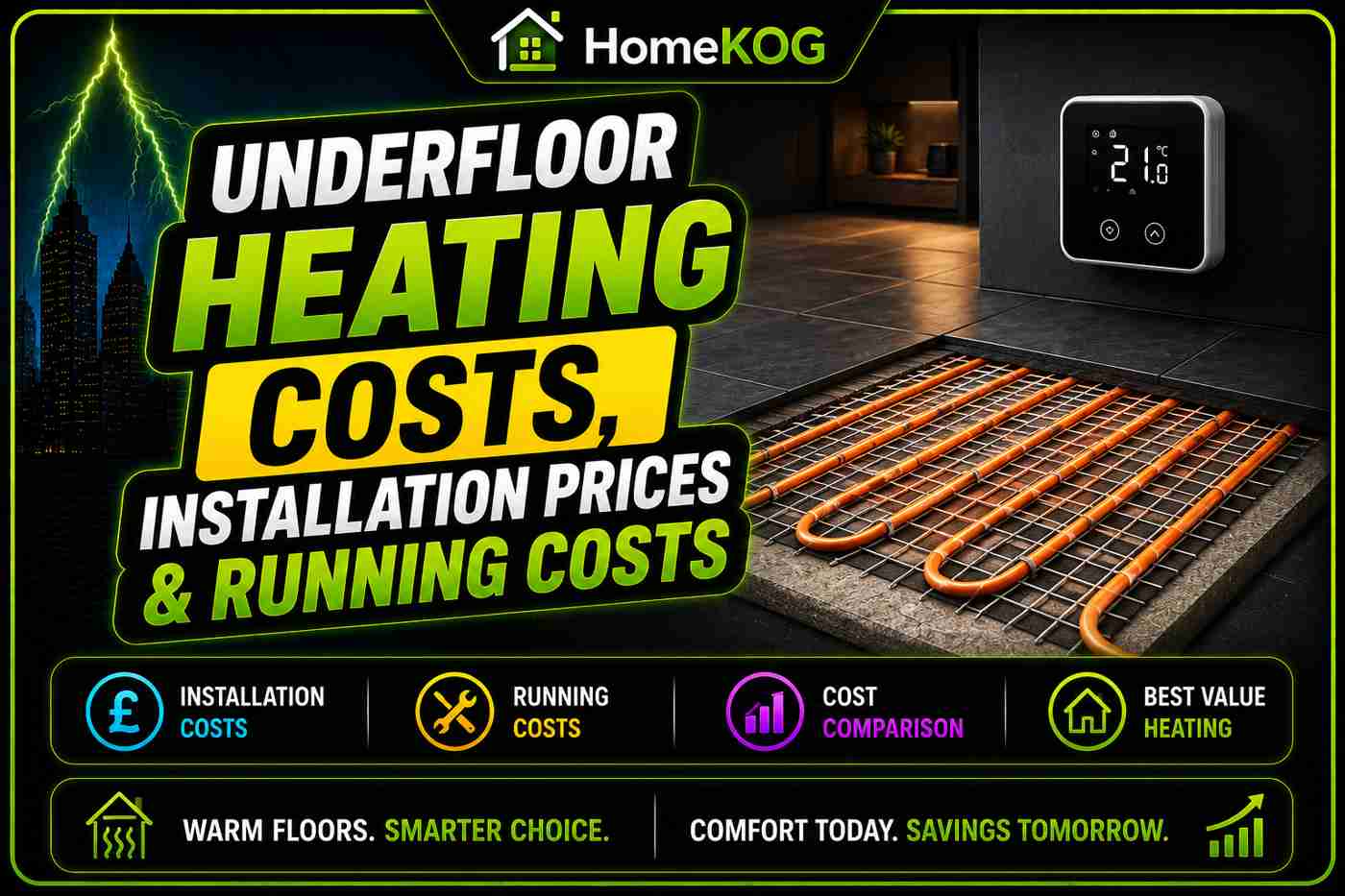

Underfloor Heating Costs, Installation Prices and Running Costs 2026
Quick Answer: Underfloor heating installation costs range from approximately £30 for a small electric mat in a bathroom to £12,000 for a whole-house wet system installation. Electric underfloor heating costs from £35 to £50 per square metre for materials, plus £220 to £350 per day in labour. Wet (water) underfloor heating costs from £40 to £150 per square metre depending on whether it is a new build or renovation. Running costs for a 4m² room heated 4 hours daily cost approximately £11 per month on electricity. Wet systems connected to a heat pump or condensing boiler have lower long-term running costs than electric systems.
Underfloor heating delivers comfortable, even warmth across the entire floor surface rather than concentrating heat near wall-mounted radiators. It pairs exceptionally well with heat pumps — which produce heat at lower flow temperatures — and eliminates the visual intrusion of radiators. The decision between wet and electric systems, and whether to install in a new build or an existing property, has significant implications for installation cost, running cost, and disruption. This guide covers every cost element in detail.
Wet vs Electric: Which System Should You Choose?
The choice between a wet (water) system and a dry (electric) system is the most fundamental decision in underfloor heating and should be made before any other consideration. The two systems suit completely different scenarios.
A wet system circulates warm water through a network of pipes embedded in the floor screed or beneath the floor finish. It connects to the central heating boiler or heat pump and operates at low flow temperatures — typically 35 to 55°C — that are ideally matched to the efficiency characteristics of heat pumps and condensing boilers in weather compensation mode. Wet systems have lower running costs but substantially higher installation costs and disruption.
An electric system uses heating cables or mats beneath the floor finish to generate heat through electrical resistance. Installation is simpler and less disruptive — the heating element sits directly beneath the floor covering without requiring a new screed layer — but electricity costs approximately four times more per unit than gas, making electric systems significantly more expensive to run over time.

When to Choose a Wet System
A wet system is the appropriate choice for a new build where the pipes can be laid in the floor screed before the final floor finish is applied — this avoids the disruption cost of removing and replacing existing floors. It is also the right choice for large areas where the long-term running cost saving over electricity justifies the higher installation investment, and for properties with an air source heat pump where the heat pump’s optimal operating temperature range (35 to 45°C) perfectly matches wet underfloor heating requirements.
When to Choose an Electric System
An electric system is the appropriate choice for a renovation project where laying pipes in a new screed would require removing the existing floor — the thin profile of electric mats or heating film can be installed directly beneath the floor finish without significant floor height change. It also suits small areas such as individual bathrooms, en suites, and kitchen areas where the room size limits the impact of higher running costs, and where the convenience of zone-by-zone control and simple thermostat operation is the priority.
Underfloor Heating Installation Costs 2026
Electric Underfloor Heating Costs
| System Type | Material Cost | Notes |
|---|---|---|
| Electric heating mat | From £35–£50 per m² | Pre-spaced, suits regular rooms |
| Heating foil film | From £30–£50 per m² | Dry rooms, laminate/wood floors |
| Loose cable system | From £20–£40 per m² | Odd-shaped rooms, flexible layout |
Small room (4m² bathroom renovation): Approximately £150 to £300 for materials, plus labour. Total installed cost typically £300 to £600.
Labour cost: £220 to £350 per day. An electric mat installation in a standard bathroom takes approximately half a day to one day including thermostat wiring.
Thermostat: £120 to £250 for a programmable thermostat with floor temperature sensor — always include this in the budget.
Wet Underfloor Heating Costs
| Installation Scenario | Material Cost | Notes |
|---|---|---|
| New build (floor screed) | £40–£80 per m² | Pipes embedded in screed before finish |
| Renovation (existing home) | £100–£150 per m² | Includes floor preparation and screed |
Labour cost: £220 to £350 per day. A wet system installation in a typical 3-bedroom new build takes approximately 3 to 5 days.
Manifold: The manifold controls water flow to each heating zone. Budget approximately £200 to £600 for the manifold unit depending on the number of zones.
Insulation: Non-negotiable for wet systems — insulation beneath the pipes prevents heat being lost downward rather than rising through the floor. Budget £200 to £500 for adequate insulation across a typical installation. Proper insulation improves heat yield and reduces running costs significantly.
Whole-House Installation Cost Summary
| Property | Wet System Estimate | Electric System Estimate |
|---|---|---|
| 2-bed flat (60m²) | £4,800–£9,000 | £2,100–£3,000 |
| 3-bed house (100m²) | £8,000–£15,000 | £3,500–£5,000 |
| 4-bed house (140m²) | £11,200–£21,000 | £4,900–£7,000 |
Note that wet system installation in a renovation context (removing existing floors) sits toward the upper end of the range or above it, while new build installation sits toward the lower end.
Heat Source for Wet Underfloor Heating
Condensing Boiler
A modern A-rated condensing boiler is the most common heat source for wet underfloor heating systems in existing UK properties. A hydrogen-ready combi or system boiler costs approximately £2,000 to £3,500 installed and operates at 92 to 98% efficiency. When paired with a flow temperature set appropriately for underfloor heating (typically 45 to 55°C rather than the 65 to 80°C used for radiator systems), the boiler operates more frequently in condensing mode, improving real-world efficiency. To make the transition to a modern heating system more affordable, many homeowners are exploring boiler finance options for homeowners. These financing plans can ease the upfront cost, allowing for manageable monthly payments while benefitting from higher efficiency and lower energy bills. Additionally, various government incentives may be available to further reduce the overall investment in a new boiler system.
Condensing boilers work best for smaller homes and properties in colder regions where the heating demand is high — the boiler can generate high heat output quickly when needed.
Air Source Heat Pump
An air source heat pump costs £7,000 to £10,000 installed but operates at 300 to 400% efficiency — producing 3 to 4 units of heat for every unit of electricity consumed. The heat pump’s optimal flow temperature (35 to 45°C) exactly matches wet underfloor heating requirements, making the two technologies ideally complementary. As homeowners increasingly seek energy-efficient solutions, it’s essential to stay informed about heat pump installation prices for 2026. With advancements in technology and increased competition in the market, these costs may vary, but the long-term savings on energy bills can significantly offset the initial investment. Additionally, government incentives and environmental benefits make heat pumps an attractive option for many households.
With the £7,500 Boiler Upgrade Scheme grant, the net cost of an air source heat pump can be reduced to near zero in some cases. The long-term running cost advantage of the heat pump over a gas boiler is most pronounced for large properties heated primarily through underfloor heating where the heat pump operates at consistently high efficiency.
For large homes with good insulation and underfloor heating throughout, an air source heat pump is the most cost-effective long-term heat source. For smaller projects or properties with mixed heating (some underfloor, some radiators), a condensing boiler remains practical.
Electric Underfloor Heating Types
Heating Mats
Pre-spaced cable mats are ideal for regular-shaped rooms and are the most commonly installed type in UK bathrooms and kitchens. The mat is rolled out beneath tiles, stone, or marble — floor coverings that retain heat well and benefit most from the consistent warmth of underfloor heating. A mat rated 150 to 200W/m² is appropriate for most UK rooms. Adding a thin insulation layer beneath the mat on a concrete subfloor significantly reduces heat-up time and minimises downward heat loss.
Heating Foil Film
Foil film systems are specifically designed for dry rooms with laminate, parquet, or engineered wood floor coverings. The film is installed beneath the floor finish — either directly under a floating floor or with an overlay for soft floors — and provides effective heat transfer to the floor surface above.
Loose Cable Systems
Loose cable installation offers the greatest flexibility for awkward room shapes, around fixed furniture and appliances, and in rooms where a standard mat’s fixed spacing does not suit the layout. The cable is laid manually at the required spacing to achieve the target wattage for the room. Labour cost is slightly higher than for mat installation due to the additional time for manual layout, but material cost per square metre is lower — making loose cable more economical in larger rooms.
Underfloor Heating Running Costs
Running cost calculations depend on the room size, heating duration, and whether an electric or wet system is used. infrared heating panel features and benefits make them an attractive option for various spaces. With their ability to provide efficient and targeted heating, they can contribute to lower energy bills while ensuring comfort. Additionally, the panels often come with sleek designs that blend seamlessly into modern interiors.
Electric system example: A 4m² bathroom heated 4 hours per day at 150W/m² = 600W total = 2.4kWh per day. At current electricity prices of approximately 24.5p/kWh: 2.4 × 24.5p = 58.8p per day, approximately £18 per month. This calculation highlights the significance of understanding monthly energy bills for home appliances, as they can vary widely based on usage and efficiency. For instance, a refrigerator might add another £15 to the total each month, while energy-efficient devices could help reduce overall expenses. Staying informed about energy consumption can ultimately lead to more cost-effective decisions in household management.
For comparison, a 14m² kitchen heated 4 hours per day: 2.1kWh per hour × 4 hours = 8.4kWh per day × 24.5p = £2.06 per day, approximately £62 per month.
Wet systems connected to a gas boiler or heat pump have substantially lower running costs. For the same 14m² kitchen heated via a wet system connected to a 94% efficient gas boiler, the equivalent heating cost at gas prices of 6p/kWh is approximately £15 per month — less than a quarter of the electric equivalent. Many households are now recognizing the lpg benefits in everyday use, from reduced energy bills to a more consistent heating experience. This shift not only enhances comfort but also contributes to lower carbon emissions, aligning with sustainability goals. As more people explore these alternatives, the demand for efficient heating solutions continues to grow. The benefits of hydrogen fuel use are becoming increasingly apparent as individuals and businesses search for cleaner energy options. This innovative fuel source not only has the potential to significantly reduce greenhouse gas emissions but also to create a more resilient energy infrastructure. As advancements continue in hydrogen production and utilization, it is likely that more households will adopt this alternative to enhance their energy efficiency and environmental impact.
Reducing the wet system’s flow temperature by 1°C saves approximately £10 per year across the heating system. A well-calibrated weather compensation system achieving 5°C average flow temperature reduction saves approximately £50 per year.
FAQ
Is underfloor heating cheaper to run than radiators?
A wet underfloor heating system connected to a condensing boiler or heat pump can be 25 to 40% more efficient than a radiator system. This saving comes from the lower flow temperature required — the underfloor heating operates at 35 to 55°C versus 65 to 80°C for radiators, keeping the boiler in condensing mode more frequently and improving efficiency. Electric underfloor heating costs more to run than gas-heated radiators due to the electricity-to-gas price ratio.
How long does underfloor heating take to install?
An electric mat in a single bathroom takes half a day to one day. A wet system installation in a 3-bedroom new build takes 3 to 5 days for the pipework, plus the time for the screed to cure before the floor finish can be applied — typically 4 to 6 weeks. A wet system retrofit in an existing home takes longer due to the floor preparation and screed work involved.
Can underfloor heating be used with a combi boiler?
Yes. A combi boiler can power a wet underfloor heating system. The flow temperature should be set appropriately for underfloor heating — typically 45 to 55°C rather than the higher temperature used for radiators. A mixing valve or weather compensation control helps maintain the correct flow temperature. Some larger combi boilers may need to be assessed for adequate output capacity if underfloor heating is being added to an existing property.
Is underfloor heating worth the cost?
For new builds where the installation cost is absorbed into the construction budget, wet underfloor heating is almost always worth the investment — the long-term running cost saving and comfort improvement justify the additional specification cost. For renovations, the economics depend on the room size and how long the property will be occupied. Large area renovations with a heat pump connection show the strongest payback. Small bathroom electric mat installations are typically justified purely on comfort grounds rather than running cost economics.
Conclusion
Underfloor heating is a premium heating solution with costs that range from very accessible for a small electric bathroom installation to substantial for a whole-house wet system. The key to making the right decision is matching the system type to the installation context — wet systems for new builds and large areas where long-term running cost savings justify the higher initial investment, and electric systems for small renovation projects where installation simplicity and cost are the priorities.
When a wet underfloor heating system is combined with a heat pump and the £7,500 Boiler Upgrade Scheme grant, the combination represents one of the most energy-efficient and lowest-carbon home heating configurations available in the UK — delivering genuinely lower running costs while eliminating visible radiators and providing comfortable even warmth throughout the floor area.