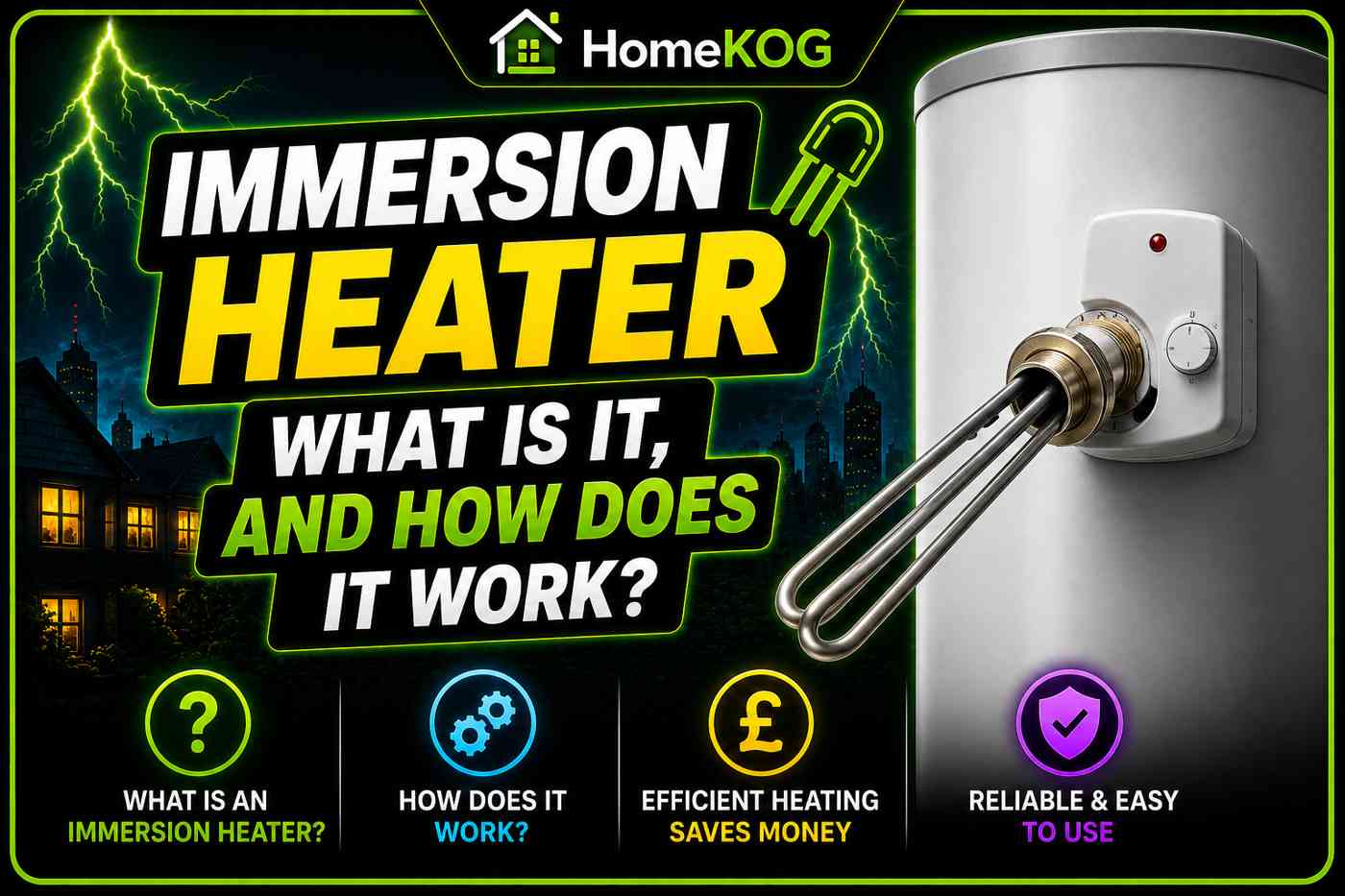

What is an Immersion Heater and How Does It Work? 2026
Quick Answer: An immersion heater is an electric heating element submerged inside a hot water cylinder that heats water in the same way a kettle heats water — by passing an electric current through a resistance element. It takes 1 to 2 hours to heat a full cylinder from cold, costs significantly more per unit than gas, and supplies hot water only — not central heating. Immersion heaters are most practical for flats without a gas supply, second homes, and as a boiler backup. A thermostat-controlled schedule using off-peak electricity rates is the most cost-effective way to run one.
Over half of all energy spending in the average UK home goes towards heating and hot water. Understanding the full range of hot water system options — including immersion heaters and when they make practical sense — is an important part of making the right choice for a specific property and situation. This guide covers everything homeowners need to know about immersion heaters: how they work, what they cost to run, how they compare to gas boilers, safety considerations, and how to maximise efficiency if one is already installed.
What is an Immersion Heater?
An immersion heater is an electric water heating system built around a resistance heating element submerged directly inside a hot water storage cylinder. The principle is identical to that of a kettle — an electric current passes through a coil-shaped element, generating heat that transfers directly into the surrounding water. The cylinder stores the heated water until it is needed, maintaining temperature through insulation rather than continuous heating.
Most immersion heaters are connected directly to the property’s mains electricity supply and are controlled by a thermostat that monitors water temperature and switches the element off automatically once the target temperature is reached. Larger hot water cylinders may contain two separate elements — one positioned lower in the cylinder for full tank heating and one higher up for heating a smaller volume when only partial hot water demand is expected.
How Does an Immersion Heater Work?
When the immersion heater is switched on — either manually or via a timer — electrical current flows through the resistance element inside the cylinder. The element converts electrical energy into heat, which transfers directly into the water surrounding it. As the water temperature rises towards the thermostat’s set point, the thermostat monitors progress and cuts power to the element automatically when the target temperature is reached.
A well-insulated hot water cylinder retains the heated water at usable temperature for several hours after the element has switched off. This means the heater does not need to run continuously — heating a cylinder during off-peak electricity hours and relying on insulation to maintain temperature through the day is the standard approach for keeping running costs manageable.
Water inside the cylinder should be heated to a minimum of 50°C to eliminate the risk of Legionella bacteria growth. Most immersion heater thermostats are factory-set to 60°C to provide a margin above the minimum safe threshold.
How Long Does an Immersion Heater Take to Heat Water?
A typical immersion heater takes 1 to 2 hours to heat a full cylinder of water from cold. The exact time depends on the cylinder capacity, the power rating of the heating element, and the starting temperature of the incoming water. A partially cooled cylinder that has already been heated earlier in the day will reach temperature significantly faster than a cylinder that has fully cooled overnight.
Is an Immersion Heater Expensive to Run?
Yes — immersion heaters are considerably more expensive to run than a gas boiler for equivalent hot water production. Electricity costs approximately four times more per unit than gas, making the fuel cost comparison straightforward.
| Energy Source | Approximate Cost Per kWh (2026) |
|---|---|
| Electricity (standard rate) | ~28p |
| Electricity (off-peak rate) | ~13p |
| Gas | ~6p |
| Oil | ~7p |
Running an immersion heater as the sole hot water source in a typical UK home costs substantially more annually than an equivalent gas boiler system. For homeowners currently using an immersion heater alongside an ageing gas boiler, upgrading to a modern A-rated gas combi boiler — which can achieve over 90% efficiency — can save up to £800 per year compared to an old G-rated boiler, while also providing full central heating that an immersion heater cannot supply.
How to Reduce Immersion Heater Running Costs
Use a Thermostat and Timer
Fitting an immersion heater thermostat with a timer allows the cylinder to heat during off-peak electricity hours and rely on insulation to maintain temperature through the day. Off-peak electricity rates are roughly half the standard rate, and scheduling heating to coincide with the cheapest tariff period is the single most effective way to reduce running costs without changing the system.
Invest in a Well-Insulated Cylinder
A well-insulated hot water cylinder retains heat for several hours after the element has switched off. A cylinder jacket — a thick insulating wrap fitted around the tank — significantly reduces heat loss and extends the period that water remains at usable temperature between heating cycles. For older cylinders without factory-fitted foam insulation, a cylinder jacket is a low-cost upgrade that delivers meaningful running cost savings.
Connect to Solar Panels
Linking an immersion heater to a solar panel installation eliminates the electricity cost for water heating during daylight hours, as surplus solar generation can be directed into the immersion element before being exported to the grid. The Smart Export Guarantee (SEG), introduced in January 2020, pays households for any surplus electricity exported to the national grid from qualifying solar installations, partially offsetting the upfront cost of solar panel installation.
Should You Leave an Immersion Heater On All Day?
No. Leaving an immersion heater running continuously is the most expensive and least efficient way to use one. The correct approach is to heat the cylinder to temperature using a timer — ideally during off-peak electricity hours — and rely on insulation to maintain water temperature until it is needed. A well-insulated cylinder heated in the early hours of the morning will typically remain at a usable temperature through the morning and early afternoon without any additional heating.
For households with highly variable hot water demand patterns that cannot be predicted in advance, boosting the heater on-demand for a shorter period is preferable to leaving it running all day. A modern combi boiler is a more appropriate solution for households who want genuinely on-demand hot water without a storage tank. Understanding how a combi boiler operates is crucial for maximizing energy efficiency in these scenarios. By heating water only when needed, it significantly reduces energy consumption compared to traditional systems. This not only leads to lower utility bills but also contributes to a reduced carbon footprint for environmentally conscious homeowners. Moreover, the combi boiler installation benefits include easy installation and minimal maintenance requirements, making it a hassle-free addition to any home. Many homeowners appreciate the compact design of these systems, which saves valuable space often occupied by traditional water heating solutions. Additionally, the instant hot water supply ensures that families can enjoy uninterrupted showers and clean dishes without waiting for the water to heat up.
Immersion Heater vs Gas Boiler: Key Differences
| Feature | Immersion Heater | Gas Boiler |
|---|---|---|
| Provides central heating | No | Yes |
| Provides hot water | Yes | Yes |
| Fuel type | Electricity | Gas or oil |
| Running cost | Higher | Lower |
| Heating time | 1–2 hours from cold | Near-instant (combi) |
| Gas supply required | No | Yes |
| Installation complexity | Lower | Higher |
| Best suited for | Flats, second homes, backup | Most UK homes |
The most fundamental difference is that an immersion heater provides hot water only, while a gas boiler provides both hot water and central heating from a single unit. For the majority of UK homes with a gas supply and radiator central heating, a gas boiler is the more practical and cost-effective primary heating system. Immersion heaters are most appropriate for properties without a gas connection — such as rural locations relying on oil, new-build flats with no gas supply, or second homes where demand is intermittent.
Having both a gas boiler and an immersion heater in the same property is not uncommon. The immersion heater provides a hot water backup during boiler breakdowns without requiring any emergency call-out for the hot water supply specifically.
Can an Immersion Heater Explode?
Immersion heater explosions are rare but possible if safety mechanisms fail. All immersion heaters include a temperature and pressure relief valve that opens automatically when internal temperature or pressure exceeds safe limits, releasing the excess and preventing dangerous pressure build-up. If this valve is functioning correctly, the risk of explosion is extremely low. Three warning signs indicate that a professional inspection is needed before a problem escalates.
A relief valve that remains open or drips continuously suggests that temperature or pressure is regularly reaching the valve’s activation threshold — a sign that the thermostat or element may be malfunctioning. Popping, knocking, or clicking sounds from within the cylinder indicate sediment build-up around the element, where water becomes trapped between the deposit and the heating surface. Brown or discoloured hot water suggests rust or significant sediment accumulation inside the cylinder that may indicate the tank is nearing the end of its serviceable life.
Any of these signs should prompt contact with a qualified plumber. Six-monthly visual checks of the cylinder, relief valve, and connections are the minimum recommended maintenance interval for an immersion heater in regular use.
Who Repairs and Fits Immersion Heaters?
A qualified plumber handles the majority of immersion heater repairs and replacements, particularly one who holds both plumbing and electrical qualifications. For more complex electrical faults involving the wiring, connection to the consumer unit, or the mains supply circuit, a qualified electrician may be required in addition to or instead of the plumber. Immersion heater installation and replacement constitutes notifiable electrical work under Part P of the Building Regulations in England and Wales, meaning the work must be carried out by or certified by a competent person registered with an approved scheme such as NICEIC or NAPIT. Understanding the differences between heating engineer vs plumber explained can help homeowners make informed decisions when it comes to their heating systems and plumbing needs. While both professionals play crucial roles in ensuring a home’s systems function properly, their expertise and training can vary significantly. It’s essential to choose the right specialist for the specific issues at hand to achieve the best results.
How Long Do Immersion Heaters Last?
A well-maintained immersion heater typically lasts 10 to 20 years, with the heating element itself the most common component to require replacement over that period. The lifespan is significantly influenced by water hardness — properties in hard water areas experience faster limescale build-up on the element, which reduces efficiency and accelerates wear. Annual draining and flushing of the cylinder to remove sediment and limescale is the most effective maintenance measure for extending element life.
FAQ
What is the difference between an immersion heater and a boiler?
A boiler provides both central heating and hot water and runs primarily on gas or oil. An immersion heater provides hot water only and runs exclusively on electricity. Boilers are more cost-effective for whole-home heating, while immersion heaters suit properties without a gas supply or as a backup hot water source when the main boiler fails. the heat exchanger functions in boilers plays a crucial role in transferring heat from the combustion process to the water circulating in the system. This efficient heat transfer ensures quick heating and helps maintain consistent temperatures throughout the home. Moreover, regular maintenance of the heat exchanger is essential to optimize boiler performance and energy efficiency.
Are immersion heaters gas or electric?
Immersion heaters run exclusively on electricity. They have no gas connection and cannot burn any fuel. The electricity supply can come from the mains grid or from a renewable source such as solar panels, which significantly reduces running costs when surplus solar generation is directed into the immersion element.
Is it cheaper to use an immersion heater or a gas boiler?
A gas boiler is significantly cheaper to run for hot water production — gas costs approximately 6p per kWh versus around 28p per kWh for standard-rate electricity in 2026. Over the course of a year, the difference in running costs for a typical household hot water demand is substantial. An immersion heater running on off-peak electricity narrows the gap but does not close it, and the immersion heater cannot supply central heating, which a gas boiler provides at the same time.
What temperature should an immersion heater be set to?
The thermostat should be set to a minimum of 60°C. This ensures the water temperature is high enough to kill Legionella bacteria, which can colonise water stored between 20°C and 45°C. Most factory settings are at 60°C to 65°C, which provides the correct safety margin. Setting the temperature higher than 65°C wastes energy unnecessarily and increases the risk of scalding at the hot tap.
Can I fit an immersion heater myself?
Immersion heater installation and replacement is notifiable electrical work under UK Building Regulations. While a competent and experienced DIYer can physically install the element and cylinder connections, the work must be signed off by a registered competent person scheme such as NICEIC or NAPIT to comply with regulations. Having a qualified plumber or electrician carry out and certify the installation is the recommended approach for most homeowners.
Is an immersion heater suitable as the only hot water source in a UK home?
Yes, for properties without a gas supply — including rural properties, new-build flats without a gas connection, and second homes. For properties with an existing gas supply, a gas boiler is more cost-effective and additionally provides central heating. The main practical limitation of an immersion heater as a sole hot water source is the 1 to 2-hour heating time from cold, which requires planned usage patterns rather than the genuinely on-demand response of a combi boiler.
How can I make my immersion heater cheaper to run?
The most effective cost reduction measures are using a thermostat timer to heat during off-peak electricity hours, ensuring the cylinder has adequate insulation to retain heat between heating cycles, and connecting the immersion heater to a solar panel installation to use surplus daytime solar generation. For homeowners who are considering an immersion heater primarily because of boiler reliability concerns, a modern A-rated gas combi boiler is likely to be more cost-effective over the medium term and eliminates the need for a separate hot water cylinder entirely.
Conclusion
Immersion heaters serve a clear and practical purpose for specific property types and circumstances — properties without a gas supply, second homes with intermittent demand, and as a boiler backup in properties with both systems. Their primary limitation is running cost: electricity at standard rates costs approximately four times more per unit than gas, making an immersion heater significantly more expensive to operate as a sole hot water source than any modern gas boiler.
For homeowners using an immersion heater out of necessity rather than choice, three measures — off-peak tariff scheduling, good cylinder insulation, and where feasible solar panel integration — can substantially reduce the cost gap. For homeowners with a gas supply who are considering an immersion heater as an alternative to boiler replacement, the arithmetic strongly favours investing in a new A-rated combi boiler, which will provide both hot water and central heating at a lower annual running cost while removing the 1 to 2-hour wait for a hot cylinder.