
Worcester Bosch EA 229 Fault Code: Causes & How to Fix It
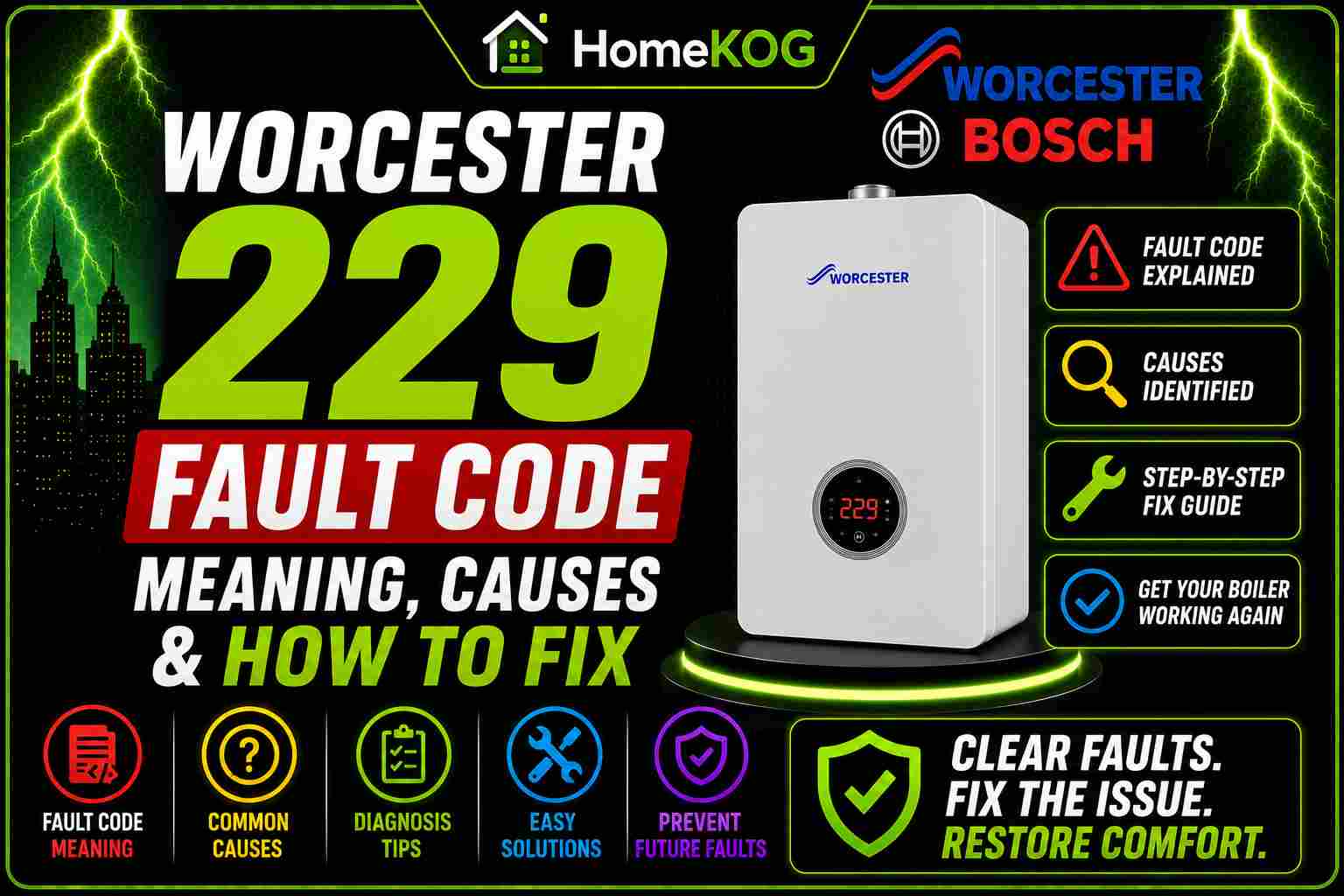
Quick Answer: The Worcester Bosch EA 229 fault code means the boiler’s flame went out during operation — not a failure to ignite in the first place, but a flame that was already burning and then extinguished. The most common causes are a frozen condensate pipe, a blocked flue, a faulty gas valve, or a PCB flame detection fault. A frozen condensate pipe can be resolved by the homeowner; all other causes require a Gas Safe registered engineer. If you encounter a worcester c6 fault code meaning, it’s crucial to identify the underlying issue promptly. This fault code usually indicates a problem with the electrical components or circuitry. Ensuring that the system is checked by a qualified technician can prevent further complications and ensure your heating system operates efficiently.
The EA 229 fault code is one that catches many Worcester Bosch owners off guard because it is frequently mistaken for an ignition failure. The distinction matters for diagnosis: the boiler lit successfully, ran for a period, and then the flame died during operation. That narrows down the possible causes considerably and, in cold weather particularly, points most immediately toward the condensate pipe. Understanding exactly what the boiler is telling you makes the difference between restoring heating in minutes and spending time troubleshooting the wrong components. Another common issue reported by users is the worcester u9 fault code explanation, which can occur when there is a blockage or fault in the system. This code specifically indicates that the boiler has detected an error related to the water flow or temperature sensors, which could lead to heating failures if not addressed promptly. By familiarizing yourself with these fault codes, you can ensure quicker resolutions and maintain the efficiency of your heating system.
Worcester Bosch EA 229 Fault Code: Key Entity Relationships
- The Worcester Bosch EA 229 fault code is a flame loss error displayed on Worcester Bosch boilers when a flame that was successfully established during operation has subsequently been extinguished, triggering a safety lockout that prevents continued operation.
- Flame loss during operation is distinct from ignition failure in a Worcester Bosch boiler, occurring when the burner flame extinguishes after the ignition sequence has completed rather than failing to establish in the first place.
- A frozen condensate pipe is the most common cause of the EA 229 fault code in cold weather, occurring when the plastic waste pipe carrying acidic condensate from the boiler to an external drain freezes and blocks the discharge pathway, causing the boiler to lock out.
- A condensate pipe is the plastic external waste pipe required on all condensing boilers installed since 2005 that discharges acidic wastewater from the boiler to a household drain, with a typical diameter of 21.5mm distinguishing it from the larger flue pipe.
- A printed circuit board is the control component of the Worcester Bosch boiler that monitors the flame detection signal during operation and initiates the EA 229 lockout when that signal is lost or drops to a level indicating flame extinction.
- A faulty gas valve is a cause of the EA 229 fault when incorrect adjustment or mechanical failure delivers insufficient gas to the burner to sustain combustion after ignition, producing a flame that lights but cannot be maintained under normal operating conditions.
- A blocked flue is a cause of EA 229 when debris, nesting material, or physical damage restricts the exhaust pathway of the Worcester Bosch boiler, disrupting the combustion airflow required to maintain a stable burner flame during operation.
- A frozen gas meter regulator is an external cause of EA 229 in cold weather where the outdoor meter regulator freezes and reduces gas flow to the boiler below the level required to sustain the burner flame, with the restriction disappearing as the regulator thaws.
- Heat exchanger debris is a cause of EA 229 on older Worcester Bosch boilers where accumulated scale, sludge, or combustion deposits restrict heat transfer and affect burner performance to the point where flame stability is compromised during operation.
- A Gas Safe registered engineer is the legally required professional for all internal Worcester Bosch boiler inspection and repair work related to the EA 229 fault, including PCB assessment, gas valve adjustment or replacement, flue inspection, and burner jet cleaning.
- The Worcester Bosch boiler reset button is the homeowner control used to clear the EA 229 lockout after the underlying cause has been identified and resolved, allowing the boiler to attempt a fresh ignition sequence and return to normal operation.
- Annual Worcester Bosch boiler servicing by a Gas Safe registered engineer reduces the likelihood of EA 229 fault appearances by identifying gas valve calibration drift, heat exchanger debris accumulation, and flue blockages before they cause flame loss during operation.

What Does the Worcester Bosch EA 229 Fault Code Mean?
The EA 229 code on a Worcester Bosch boiler specifically indicates that a flame which was already burning has gone out during operation. This is an important distinction from codes that indicate a failure to ignite — in the case of EA 229, the boiler completed its ignition sequence successfully and was running normally before the flame was lost.
When the flame sensor reports to the printed circuit board that the flame has been extinguished, the PCB immediately shuts the gas supply and locks out the boiler as a safety precaution. The boiler will not attempt to reignite automatically. It remains in lockout until the fault has been investigated, the cause addressed, and the reset button pressed to clear the lockout and allow a fresh start.
The causes of flame loss during operation are narrower than those that prevent ignition in the first place, which makes the EA 229 code a useful diagnostic starting point. The challenge is that several of those causes — a partially blocked flue, a gas valve delivering marginally insufficient gas, a PCB flame detection issue — can produce intermittent rather than consistent flame loss, making the fault harder to reproduce and diagnose on a single visit.
Common Causes of the Worcester Bosch EA 229 Fault Code
Frozen Condensate Pipe
A frozen condensate pipe is the most common cause of EA 229 during cold weather and the only cause that most homeowners can safely resolve without professional help. The condensate pipe is a plastic waste pipe, typically 21.5mm in diameter, that exits the property through an external wall and connects to a drain. It carries the acidic wastewater produced by the boiler’s condensing process away from the appliance.
When outdoor temperatures drop significantly, water within the external section of this pipe can freeze. As the blockage develops, back pressure builds within the boiler’s condensate system and the appliance locks out to protect itself — on Worcester Bosch boilers this frequently presents as the EA 229 fault code because the flame is extinguished as part of the lockout response.
To resolve a frozen condensate pipe, locate the external section of the pipe where it exits the property wall. Pour warm water along the frozen section — not boiling water, which risks cracking the plastic pipe. A warm damp cloth wrapped around the pipe, a hot water bottle held against it, or lukewarm water from a watering can applied gradually all work effectively. Once the ice clears and water flows freely through the pipe, press the reset button on the boiler to clear the EA 229 lockout and allow the boiler to reignite.
If the condensate pipe freezes repeatedly across winter, insulating the external section of the pipe prevents recurrence and is a straightforward task to arrange once the immediate fault is resolved.
Faulty Gas Valve
The gas valve controls the flow of gas from the supply into the boiler’s burner. A valve that has become stuck, worn, or incorrectly adjusted may deliver enough gas for the boiler to ignite but insufficient gas to sustain a stable flame under normal operating load. The flame lights, the boiler begins operating, and then the flame goes out as the gas supply proves inadequate — producing the EA 229 lockout.
Gas valve problems are more common on older boilers that have not received regular annual servicing. A valve that has been correctly calibrated during installation but has drifted out of adjustment over time is a particularly common presentation on boilers that are several years into their service life. In some cases an engineer can adjust the valve without replacing it; in others, where the valve mechanism has deteriorated or seized, replacement is the appropriate course of action.
The cost of a gas valve replacement on a Worcester Bosch boiler is approximately £300 including labour. This is a repair that must be carried out by a Gas Safe registered engineer — gas valve work is not within the scope of homeowner maintenance and carries serious safety risks if approached without the appropriate qualifications.
PCB Flame Detection Fault
The printed circuit board is responsible for monitoring the flame sensor signal during boiler operation. If the PCB develops a fault in the flame detection circuit, it may interpret the sensor’s data incorrectly — reporting flame loss when the flame is actually still burning, or failing to detect the flame reliably. This produces the EA 229 code even though the boiler’s combustion components are functioning normally.
A PCB flame detection fault can be intermittent, making it difficult to reproduce consistently. A Gas Safe engineer can check the flame detection connections using a multimeter to identify whether the signal is being received reliably or whether the PCB is experiencing communication issues with the flame sensor. Where the PCB itself has failed, replacement is required — a repair that typically costs upwards of £500 including parts, diagnostics, and labour.
At that cost level, the age of the boiler becomes a relevant factor. On a Worcester Bosch Greenstar boiler that is already 10 years old or more, a PCB replacement cost approaching £500 may make a new installation the more financially sensible decision when the full picture of the boiler’s condition and likely remaining service life is considered.
Blocked Flue
The flue is the duct system that carries combustion exhaust gases out of the boiler and away from the property. A partially blocked flue restricts the airflow that the burner requires to sustain stable combustion. While a severe blockage might prevent ignition entirely, a partial blockage allows the boiler to light and operate for a period before the restricted airflow becomes sufficient to destabilise the flame and cause it to go out — the characteristic EA 229 presentation.
Debris entering a vertical flue, physical damage to an external flue terminal, or a flue terminal that was not installed to the manufacturer’s specification are the most common causes of EA 229-triggering flue problems. Strong draughts can contribute to flame instability on a partially blocked flue, though an unimpeded flue is generally resistant to wind-induced flame loss on its own.
A Gas Safe engineer will inspect the flue terminal and the full flue run for blockages, damage, and installation compliance. Clearing debris, repairing or repositioning the flue terminal, and fitting a flue guard on a vertical flue to prevent future debris entry are the typical remediation steps.
Blocked Gas Meter Regulator
Many UK properties have their gas meters situated externally, exposing the regulator — the component that controls the pressure of gas entering the property — to cold weather conditions. In severe cold, the regulator can partially or fully freeze, reducing the gas flow rate entering the property below the level required to sustain the boiler flame during operation.
A frozen regulator is an external cause of EA 229 that sits outside the boiler entirely. The boiler lights on the gas available at the moment of ignition, but as the demand increases during operation the restricted flow cannot sustain the flame. As the regulator thaws, the gas flow returns to normal — which is why EA 229 caused by a frozen meter regulator can appear to resolve spontaneously during milder periods of the day.
The gas meter and its regulator are the responsibility of the gas network operator rather than the homeowner or a private heating engineer. Contact your gas supplier if you suspect a frozen or faulty regulator — they will attend to inspect and address the issue, and in cases where the restriction originates in the network infrastructure the repair is typically carried out at no cost to the homeowner.
Insulating the gas meter and its exposed pipework reduces the risk of regulator freezing in future cold spells and is a simple preventive step for properties with externally positioned meters.
Heat Exchanger Debris
Debris accumulation within the heat exchanger — whether from scale build-up in hard water areas, sludge from a system without adequate inhibitor treatment, or combustion deposits on older appliances — can affect burner performance to the point where flame stability is compromised during operation. This is more likely on older boilers or systems that have not received consistent annual maintenance and inhibitor treatment.
A Gas Safe engineer will assess the heat exchanger as part of the EA 229 diagnostic process, particularly on boilers where other causes have been ruled out. Power flushing the system or cleaning the heat exchanger directly are the typical interventions, though a severely scaled or damaged heat exchanger may require replacement.
Does EA 229 Mean the Worcester Bosch Boiler Needs Replacing?
In most cases, no. The EA 229 fault is a lockout code triggered by a specific, identifiable cause rather than a sign of fundamental boiler failure. A frozen condensate pipe resolved by the homeowner, a gas valve adjustment by an engineer, or a flue clearance are all repairs that restore normal boiler operation without replacement. Understanding the ideal f1 fault code explained can help homeowners diagnose issues more effectively. By recognizing the symptoms associated with various fault codes, such as the EA 229, you can take appropriate action before calling in a professional. This knowledge can empower you to address minor problems swiftly and avoid unnecessary expenses.
Replacement becomes the more relevant consideration when the underlying cause is a PCB failure on an older boiler, when multiple component faults are present simultaneously, or when the boiler is already over 10 years old and accumulating repair costs that begin to approach the price of a new installation. A Gas Safe engineer who has assessed the fault will give honest guidance on whether repair or replacement makes better long-term financial sense for your specific boiler and situation.
FAQ: Worcester Bosch EA 229 Fault Code
What does the Worcester Bosch EA 229 fault code mean?
The EA 229 fault code on a Worcester Bosch boiler indicates that the burner flame went out during operation — not a failure to ignite, but a flame that was already established and then extinguished. The boiler locks out as a safety precaution when the flame sensor reports flame loss to the PCB. Common causes include a frozen condensate pipe, insufficient gas supply from a faulty or incorrectly adjusted gas valve, a blocked flue, a frozen gas meter regulator, and a PCB flame detection fault. The cause determines whether the homeowner or a Gas Safe engineer needs to resolve it. Understanding Worcester boiler error code meanings is essential for diagnosing issues effectively. Homeowners can refer to the manufacturer’s manual or reliable online resources for a comprehensive list of these codes and their corresponding implications. Addressing problems promptly can prevent further complications and ensure the boiler operates safely and efficiently.
Can I fix the Worcester EA 229 fault code myself?
The only cause of EA 229 that homeowners can safely resolve independently is a frozen condensate pipe. Applying warm water to the frozen external section of the pipe thaws the blockage, and resetting the boiler after the pipe is clear typically restores normal operation. All other causes — including gas valve faults, PCB issues, flue blockages, and heat exchanger debris — require a Gas Safe registered engineer. Pressing the reset button without identifying and resolving the cause will result in the fault recurring.
How do I fix a frozen condensate pipe causing the Worcester EA 229 code?
Locate the plastic condensate pipe where it exits the property through an external wall — it is typically 21.5mm in diameter and should not be confused with the larger flue pipe. Apply warm water to the frozen section using a watering can, a warm cloth, or a hot water bottle. Avoid boiling water, which can crack the pipe. Once the ice clears and water flows freely through the pipe, press the Worcester Bosch reset button to clear the EA 229 lockout. If condensate pipe freezing recurs regularly, insulating the external section of the pipe prevents repetition.
What is the difference between EA 229 and an ignition failure on a Worcester boiler?
An ignition failure means the boiler attempted to light but could not establish a flame at all during the ignition sequence. The EA 229 fault code specifically means the boiler ignited successfully and was operating with a live flame, which then went out during normal running. This distinction matters for diagnosis because the causes of flame loss during operation are different from the causes of ignition failure, and the correct diagnostic approach — and the component most likely to be at fault — differs accordingly. Understanding the ideal f2 fault code explanation is crucial for technicians as it outlines specific issues related to fuel supply and burner operation. Misinterpretation of fault codes can lead to unnecessary repairs or overlooked problems that could escalate. Proper diagnosis ensures that the right components are targeted, ultimately improving the efficiency and reliability of boiler performance.
How much does it cost to repair a Worcester Bosch EA 229 fault?
Repair costs vary depending on the cause. Thawing a frozen condensate pipe costs nothing if done by the homeowner. Gas valve adjustment or replacement costs approximately £300 including labour. PCB replacement typically costs upwards of £500 including parts, diagnostics, and labour. Flue clearance and terminal repairs vary based on access and the extent of the work. An engineer’s diagnostic visit will identify the cause and provide a specific repair estimate before any work proceeds.
Why does the EA 229 code appear in cold weather on my Worcester Bosch boiler?
Cold weather makes both a frozen condensate pipe and a frozen gas meter regulator more likely, both of which cause EA 229 by restricting the flow of condensate or gas during boiler operation. A frozen condensate pipe blocks discharge, causing the boiler to lock out with flame loss. A frozen meter regulator reduces gas flow below the level needed to sustain the burner flame once the boiler is running. Both conditions are more prevalent during sharp cold snaps and both can recur across a winter period if the pipe or meter is not insulated.
When should I consider replacing my Worcester Bosch boiler instead of repairing an EA 229 fault?
Replacement is worth serious consideration when the EA 229 fault is caused by a PCB failure on a boiler over 10 years old, when multiple components are found to be faulty during the diagnostic process, or when repair costs approach the price of a new installation. An older Worcester Bosch Greenstar boiler operating with declining efficiency and accumulating repair costs is likely costing more to maintain than a modern A-rated replacement would over the same period. A Gas Safe engineer who has assessed the boiler can give you clear and honest guidance on the relative merits of repair versus replacement for your specific situation.
Does pressing the reset button fix the EA 229 fault permanently?
No. The reset button clears the lockout and allows the boiler to attempt a fresh ignition sequence, but it does not address the underlying cause of the flame loss. If the cause has not been resolved before the reset is pressed, the boiler will either fail to reignite or will reignite, run for a period, and then lose the flame again — returning the EA 229 code. The reset should only be pressed after the cause has been identified and rectified. Where the cause is not immediately obvious, a Gas Safe engineer should investigate before further reset attempts are made.
Conclusion
The Worcester Bosch EA 229 fault code is a precise and useful diagnostic signal. By distinguishing flame loss during operation from ignition failure, it points the investigation toward a specific set of components and conditions — with a frozen condensate pipe at the top of the list in cold weather and gas valve or PCB issues the most likely causes when the fault occurs independently of temperature. When troubleshooting a Worcester 224 fault code explained, it is essential to conduct a thorough examination of the system. Check for any signs of operational inconsistencies, particularly with the gas supply and electrical components. Addressing these areas can often lead to a swift resolution of the issue, ensuring the heating system operates efficiently again.
Thawing the condensate pipe is the one intervention homeowners can carry out safely and immediately. For all other causes, a Gas Safe registered engineer is the appropriate and legally required professional. Acting on the fault promptly rather than repeatedly resetting the boiler reduces the risk of ongoing damage to the components involved and gives the engineer the clearest possible picture of what the boiler was doing when the flame was lost.
Annual Worcester Bosch servicing remains the most effective preventive measure — a service that catches gas valve drift, heat exchanger deposits, and flue condition issues before they develop into the EA 229 lockout that leaves you without heating during the coldest part of the year.