
E1 Boiler Error Code: Meaning, Causes & How to Fix It
Quick Answer: The E1 error code on a boiler most commonly indicates low water pressure and appears most frequently on Baxi, Potterton, and Main boilers, which share the same fault code system. In most cases it can be resolved by repressurising the boiler using the filling loop until the pressure gauge reads 1.5 bar. If the code returns after repressurisation or pressure was not the cause, contact a Gas Safe registered engineer.
An E1 code on your boiler display is one of the more common fault codes UK homeowners encounter, and the good news is that the most frequent cause — low water pressure — is something you can safely address yourself in a few minutes. Understanding what the code means, how to check whether pressure is the cause, and what the related E1 variant codes indicate puts you in a much stronger position to get your heating restored quickly and avoid an unnecessary call-out.
E1 Boiler Error Code: Key Entity Relationships
- The E1 error code is a fault display that appears on Baxi, Potterton, and Main boilers to indicate low water pressure within the sealed central heating circuit, typically when pressure has dropped below the safe operating threshold.
- Baxi, Potterton, and Main are three boiler brands manufactured by the same parent company that share a common fault code system, meaning the E1 code and its associated variant codes carry the same meaning and require the same diagnostic approach across all three ranges.
- Low water pressure is a condition in a sealed central heating system where the water pressure within the circuit drops below the minimum operating level — typically 0.5 bar — preventing the boiler from firing safely and triggering the E1 lockout.
- A filling loop is a flexible silver pipe fitted beneath most combi and system boilers that connects the mains cold water supply to the central heating circuit, used by homeowners to repressurise the system when pressure drops below the required level.
- The pressure gauge is a dial or digital display on the front of a Baxi, Potterton, or Main boiler that shows the current water pressure within the heating circuit, with a reading between 1 and 1.5 bar indicating correct operating pressure.
- The E119 fault code is a specific variant of the E1 pressure family displayed on Baxi, Potterton, and Main boilers when water pressure has dropped below 0.5 bar, confirming low pressure as the direct cause of the boiler lockout.
- The E133 fault code is displayed on Baxi, Potterton, and Main boilers when there is a gas supply issue or a frozen condensate pipe preventing ignition, requiring either condensate pipe thawing or investigation by a Gas Safe registered engineer.
- The E110 fault code indicates that the primary water or flue system has overheated and the boiler has shut down as a safety precaution, requiring a reset attempt and professional investigation if the boiler does not return to normal operation.
- The E168 fault code is a general safety shutdown code displayed on Baxi, Potterton, and Main boilers when an unspecified internal fault has caused the appliance to isolate itself, always requiring assessment by a Gas Safe registered engineer.
- A Gas Safe registered engineer is the legally required professional for any internal boiler inspection or repair beyond basic pressure adjustment, including assessment of faulty components, overheating faults, and gas supply issues indicated by E1 variant codes.
- Annual boiler servicing by a Gas Safe registered engineer reduces the frequency of pressure-related E1 fault code appearances by identifying and addressing slow system leaks, expansion vessel faults, and component wear before they cause a full pressure drop.
- Repressurisation is the process of restoring correct water pressure to a sealed central heating system by opening the filling loop taps until the pressure gauge reaches the target level, a task homeowners can safely carry out themselves without gas qualifications.

What Does the E1 Error Code Mean on a Boiler?
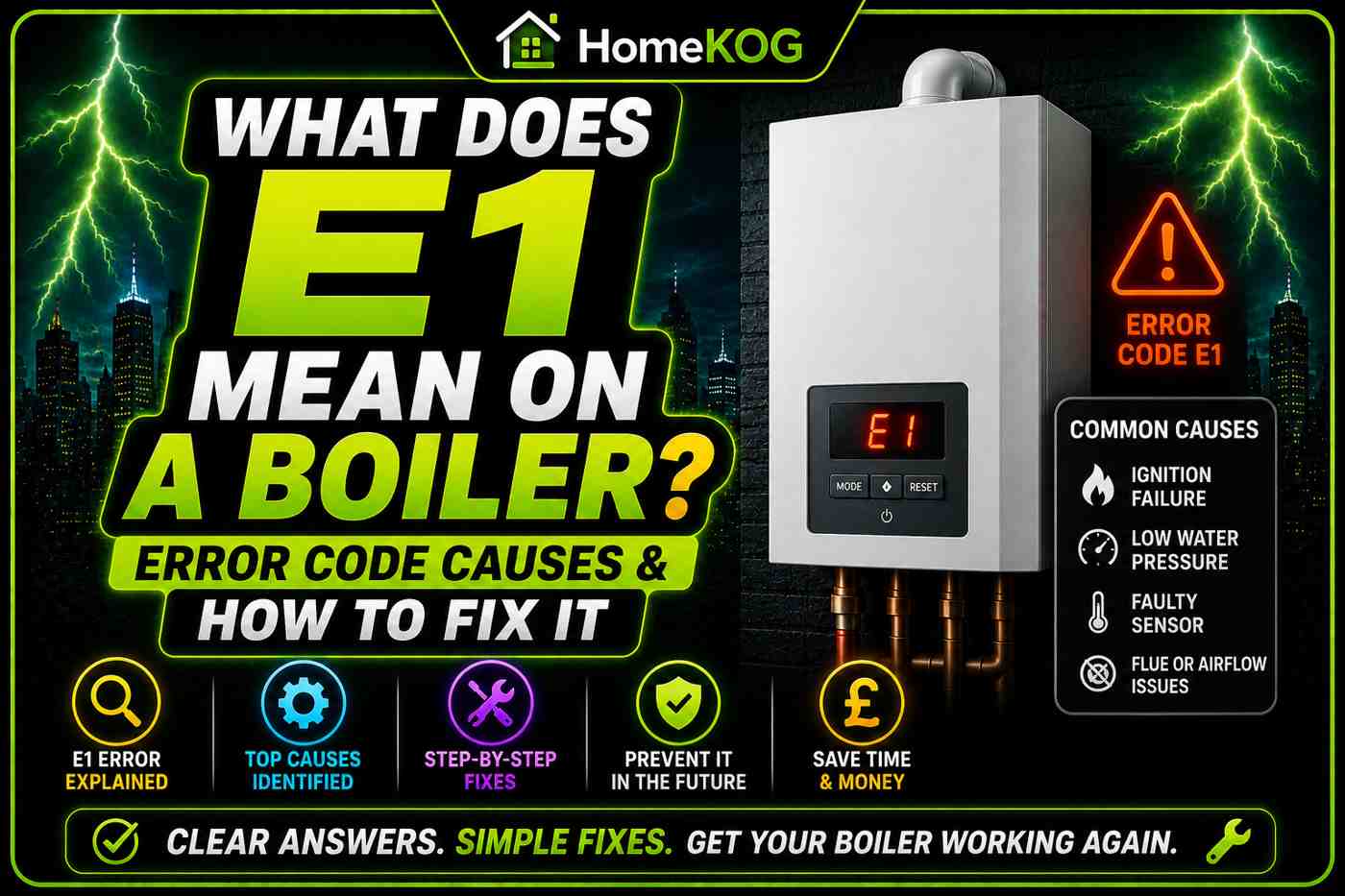
The E1 error code on a Baxi, Potterton, or Main boiler is a pressure alert. It tells you that the water pressure within the sealed central heating circuit has dropped to a level at which the boiler cannot operate safely. As a precaution, the appliance shuts down and displays the code rather than continuing to run at insufficient pressure.
Baxi, Potterton, and Main boilers are all manufactured by the same parent company and share an identical fault code system. An E1 code on any of these three brands means the same thing and is investigated and resolved in the same way. The same code also appears on some Ideal boilers, which use a related fault code structure.
Pressure loss in a sealed heating system is a common occurrence as boilers age. Small amounts of water can escape through micro-leaks in radiator valves, pipe joints, or the boiler itself over time, and the system pressure gradually drops as a result. Annual servicing is the most effective way to identify these slow leaks before they cause a pressure drop significant enough to trigger the E1 code.
How to Fix the E1 Error Code: Repressurising Your Boiler
Repressurising the boiler is the first response to an E1 code and is a task most homeowners can carry out safely without any specialist tools or gas qualifications. The process takes only a few minutes.
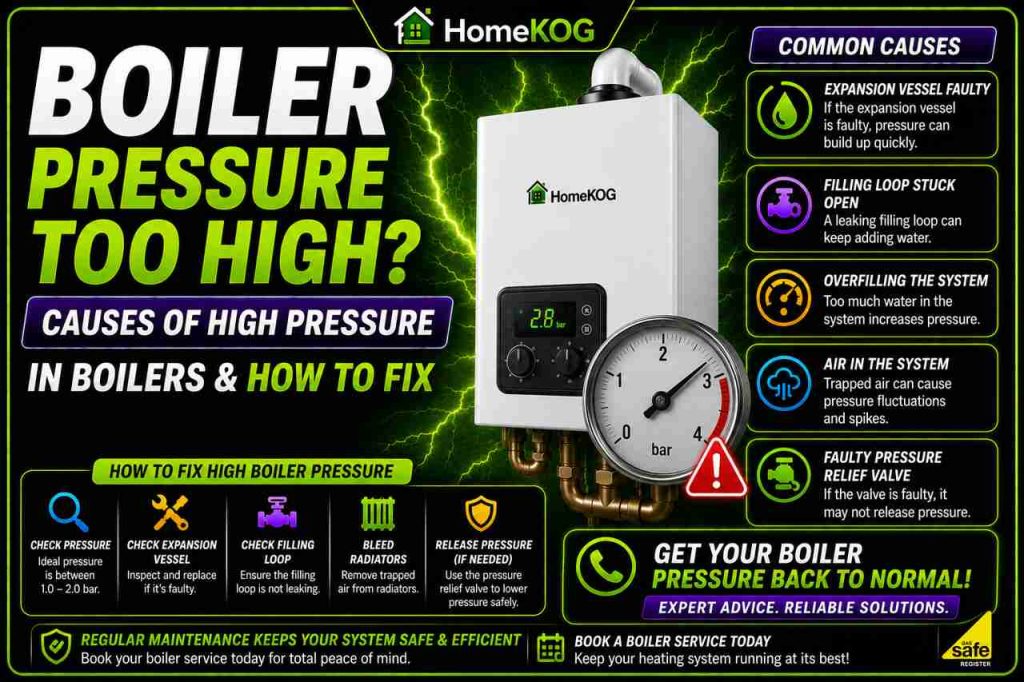
Begin by locating the filling loop beneath the boiler. This is a short, flexible silver pipe with one or two black taps on it — it connects the mains cold water supply to the heating circuit and is the only entry point for adding water to the system. Before opening either tap, check the pressure gauge on the boiler to confirm the reading has dropped and to give yourself a baseline to monitor as you add pressure.
Open both taps by rotating them to a 45-degree angle. You will hear water entering the system. Keep a close eye on the pressure gauge as you do this — the needle should begin to move toward the target range. The goal is a reading of approximately 1.5 bar, which falls comfortably within the safe operating zone indicated on most gauges by a green marked section.
Once the gauge reaches 1.5 bar, close both taps fully, returning them to their original positions. Do not allow the pressure to exceed 2 bar, as overpressure creates its own set of problems including discharge through the pressure relief valve. With the taps securely closed, reset the boiler and check whether the E1 code has cleared and the boiler fires normally.
If the boiler operates correctly after repressurisation and the E1 code does not return within a normal period of use, the fault was a straightforward pressure drop. If the pressure drops again within a short time and the code reappears, a slow leak somewhere in the system is the likely cause and a Gas Safe registered engineer should be contacted to locate and repair it.
E1 Variant Fault Codes on Baxi, Potterton and Main Boilers
The E1 designation covers a family of related fault codes on Baxi, Potterton, and Main boilers, each providing more specific information about the nature of the problem. Understanding these variants helps you determine quickly whether the fault is one you can address yourself or whether professional help is needed from the outset.
Baxi, Potterton and Main Boiler E1 Fault Code Reference
| Fault Code | Meaning | Recommended Action |
|---|---|---|
| E119 | Water pressure has dropped below 0.5 bar | Repressurise the boiler using the filling loop to reach 1.5 bar |
| E110 | Primary water or flue system has overheated | Attempt a boiler reset; if it does not resume normal operation, contact a Gas Safe engineer |
| E133 | Gas supply issue or frozen condensate pipe | Check gas supply to property; if condensate pipe is frozen, thaw with warm water; if unresolved, call a Gas Safe engineer |
| E168 | Unspecified internal fault — safety shutdown | Contact a Gas Safe registered engineer immediately |
| E20, E28, E50, E160 | Faulty internal components | Requires inspection and repair by a Gas Safe registered engineer |
E119: Low Water Pressure
The E119 code is the most specific pressure-related code in the E1 family, confirming that the boiler’s water pressure has fallen below 0.5 bar. The fix is identical to the standard E1 response — repressurise the system using the filling loop until the gauge reads 1.5 bar, then reset the boiler. If E119 appears repeatedly over a short period, a slow leak in the system is the probable cause and should be investigated professionally.
E110: Overheating
The E110 code indicates that the primary water circuit or the flue system has reached an unsafe temperature and the boiler has shut itself down to prevent damage. Attempting a reset is a reasonable first step — if the boiler fires and operates normally after the reset, the shutdown may have been caused by a temporary condition. If the boiler fails to reset or the E110 code returns, leave the appliance switched off and contact a Gas Safe registered engineer, as continuing to operate an overheating boiler risks damage to the heat exchanger and other internal components.
E133: Gas Supply Issue or Frozen Condensate Pipe
The E133 code covers two distinct causes that require different responses. The first is a gas supply problem — either no gas is reaching the boiler or there is a blockage in the supply. Testing another gas appliance in the property confirms quickly whether the supply is live. If other appliances work normally but the boiler shows E133, attempting a reset is a reasonable next step. If the code persists, a Gas Safe engineer should investigate the boiler’s internal gas circuit.
The second cause of E133 is a frozen condensate pipe — a particularly common trigger during cold snaps. The condensate pipe is the plastic waste pipe that carries acidic water from the boiler to an external drain. When this pipe freezes, the resulting blockage prevents the boiler from operating and triggers the E133 code. Locating the external section of the pipe and applying warm water to the frozen area typically clears the blockage. Once thawed, reset the boiler and it should reignite normally.
E168: Unspecified Safety Shutdown
The E168 code indicates that the boiler has identified an internal fault serious enough to trigger a precautionary shutdown, but the nature of that fault requires professional diagnostic equipment to identify. This code should not be reset and monitored by the homeowner — contact a Gas Safe registered engineer directly for an assessment.
Does the E1 Error Code Mean I Need a New Boiler?
An E1 code caused by low pressure does not indicate a need for immediate boiler replacement. It is a maintenance issue that, in most cases, is resolved by repressurisation and, if a leak is found, a straightforward repair. The boiler itself is functioning as designed by shutting down to alert you to the problem.
Replacement becomes a more relevant consideration when the boiler is over 10 years old and the E1 code is appearing alongside other recurring faults, when repair costs are accumulating, or when a major component such as the heat exchanger is found to be the source of the pressure loss. At that point, the combined cost of repairs relative to the age and efficiency of the boiler may make a new installation the more cost-effective long-term decision. Understanding the system boiler working principles explained can help homeowners recognize whether their current system is efficient and worth repairing. Increased efficiency can significantly affect energy bills, making it essential to evaluate if the existing boiler is meeting modern standards. Ultimately, a clear grasp of these principles aids in making informed decisions regarding upgrades or replacements.
A Gas Safe engineer who has assessed the boiler can give you an honest view of whether continued repair or replacement makes better financial sense for your specific situation. When considering boiler replacement options for homeowners, it’s important to evaluate the efficiency and energy savings that a new model can provide. Many modern boilers offer advanced technology that can lead to significant reductions in heating bills. Additionally, investing in a reliable system may increase the overall value of your home. Finding effective boiler efficiency tips for homeowners can further enhance the benefits of a new boiler. These strategies can optimize performance, reduce energy consumption, and lead to even greater savings over time. Proper maintenance and regular check-ups are key components in ensuring that your system operates at peak efficiency.
FAQ: E1 Boiler Error Code
What does the E1 error code mean on a boiler?
The E1 error code on a Baxi, Potterton, or Main boiler indicates low water pressure within the sealed central heating circuit. The boiler has detected that pressure has dropped below its safe operating threshold and has shut down as a precaution. In most cases, the fault can be resolved by repressurising the system using the filling loop until the pressure gauge reads 1.5 bar. If the code persists after repressurisation or pressure was not the cause, a Gas Safe registered engineer should be contacted.
How do I fix the E1 error code on my boiler myself?
Locate the filling loop beneath the boiler — a flexible silver pipe with one or two black taps. Open both taps to a 45-degree angle and watch the pressure gauge until it reaches 1.5 bar. Close both taps fully, then reset the boiler. If the boiler fires normally and the E1 code clears, the fix is complete. If the pressure drops again quickly and the code returns, a slow leak somewhere in the heating system is the likely cause and a Gas Safe registered engineer should investigate.
What is the E119 fault code on a Baxi boiler?
The E119 fault code on a Baxi, Potterton, or Main boiler specifically indicates that water pressure has dropped below 0.5 bar — the minimum threshold for safe boiler operation. The resolution is the same as for a standard E1 code: repressurise the system using the filling loop to reach 1.5 bar, then reset the boiler. If E119 appears repeatedly over a short period, a leak within the heating circuit is causing ongoing pressure loss and a Gas Safe engineer should be asked to locate and repair it.
What causes the E133 fault code on a Baxi boiler?
The E133 fault code on Baxi, Potterton, and Main boilers indicates either a gas supply issue or a frozen condensate pipe. To identify which, check whether other gas appliances in the property are working — if they are, the supply is live and the issue may be internal to the boiler, requiring a Gas Safe engineer. If the fault occurs in cold weather, check the condensate pipe for signs of freezing. Applying warm water to the frozen section typically clears the blockage and allows the boiler to restart after a reset.
Do Baxi, Potterton, and Main boilers share the same fault codes?
Yes. All three brands are manufactured by the same parent company and use an identical fault code system. An E1, E119, E133, or E168 code means the same thing on a Baxi, Potterton, or Main boiler, and the diagnostic and repair process is the same across all three ranges. This also means that guidance and parts for one brand are generally applicable to the others, and engineers familiar with one range are equipped to work on all three.
When should I call a Gas Safe engineer for an E1 fault?
A Gas Safe engineer should be called if the E1 code persists after repressurisation, if the pressure drops repeatedly over a short period suggesting a leak, if the fault code is E168 or E110 rather than a straightforward pressure code, or if any variant code indicates a gas supply or internal component issue. All internal boiler inspection and repair work — including heat exchanger assessment, gas valve inspection, and overheating diagnosis — must be carried out by a qualified Gas Safe registered professional.
How do I prevent the E1 error code from recurring?
Annual servicing by a Gas Safe registered engineer is the most effective preventive measure. A service includes checking system pressure, inspecting radiator valves and pipe joints for slow leaks, and assessing the expansion vessel — all common sources of gradual pressure loss that trigger the E1 code. Insulating the external condensate pipe reduces the risk of E133 faults in cold weather. Monitoring the pressure gauge periodically between services allows early detection of a developing pressure drop before it reaches the E1 threshold.
Does the E1 code mean my boiler needs replacing?
Not in most cases. The E1 code is typically caused by low pressure — a maintenance issue rather than a sign of fundamental boiler failure. Repressurisation resolves the immediate problem, and a small leak repair resolves the underlying cause if pressure loss is recurring. Replacement becomes the more practical consideration when the boiler is over 10 years old, is developing multiple faults, or when a repair estimate for a major component such as the heat exchanger approaches the cost of a new installation. A Gas Safe engineer can give clear guidance on whether repair or replacement is the better option.
Conclusion
The E1 error code is one of the most straightforward boiler faults a homeowner can encounter, and in the majority of cases it is fully resolvable without a professional call-out. Repressurising the system using the filling loop takes only a few minutes and clears the fault when low water pressure is the cause — which it is in most instances.
Where pressure was not the cause, or where the code returns quickly after repressurisation, the E1 variant codes provide more specific guidance on what to investigate next. E119 confirms a pressure drop below 0.5 bar, E133 points to a gas supply issue or frozen condensate pipe, and E168 signals an internal fault requiring immediate professional assessment.
Annual servicing remains the most reliable way to prevent pressure-related faults from developing in the first place. A Gas Safe registered engineer who inspects the system once a year will identify slow leaks, expansion vessel faults, and component wear before they cause a lockout — keeping your heating running reliably through the colder months.