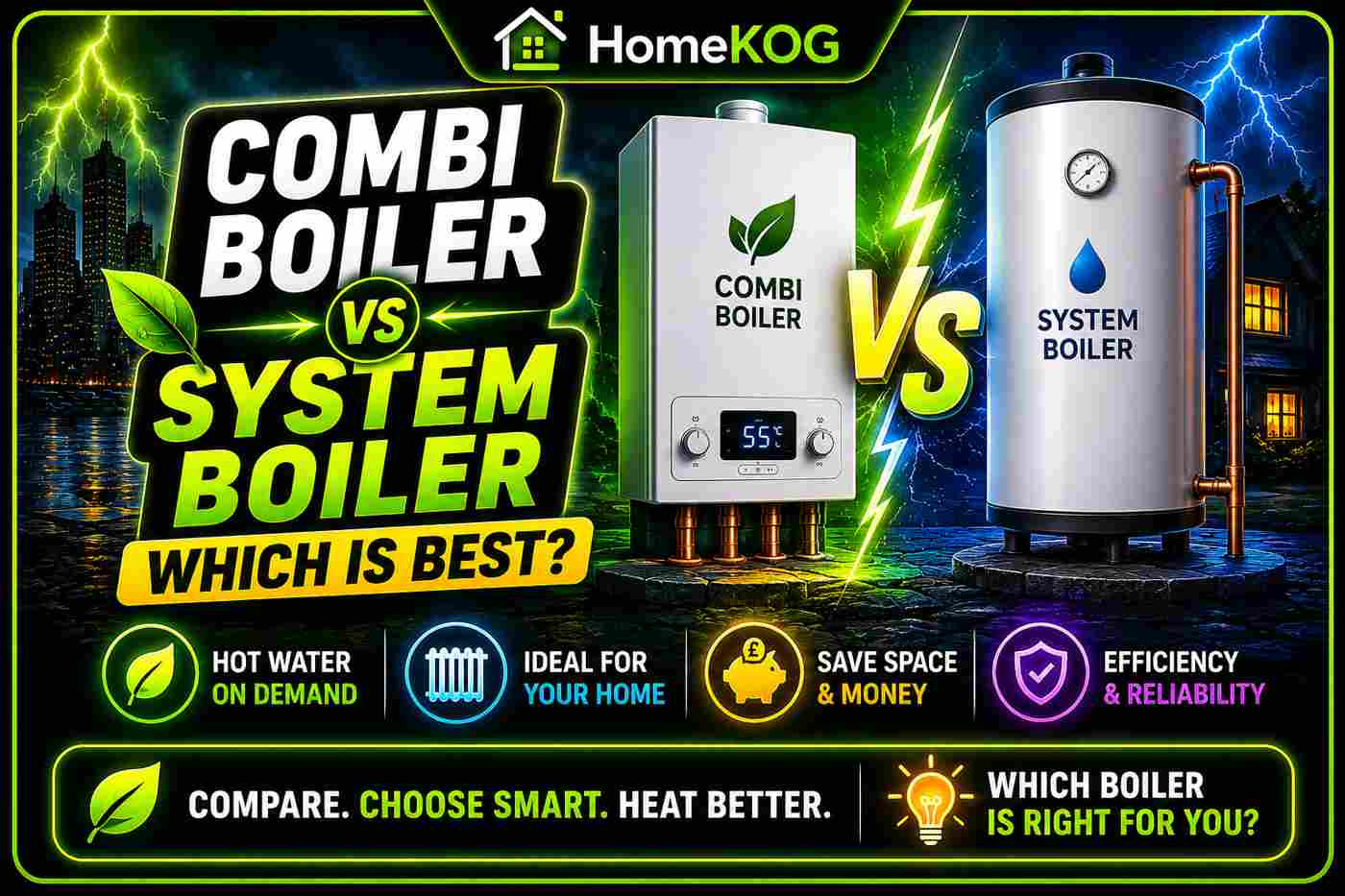

Combi Boiler vs System Boiler: Which Is Best for Your Home in 2026?
Quick Answer: A combi boiler heats water on demand without a storage cylinder and suits most homes with up to two bathrooms. A system boiler heats water and stores it in a hot water cylinder, making it better for larger homes with multiple bathrooms and high simultaneous demand. The right choice depends on the size of your home, the number of bathrooms, and how often multiple outlets need hot water at the same time.
Choosing between a combi boiler and a system boiler is one of the most important heating decisions a homeowner makes, and getting it wrong means either paying more than necessary to run the system or ending up with a boiler that cannot meet the household’s hot water demand. Neither type is universally better — the right answer depends entirely on the property and the people living in it. There are different types of boilers explained through their specific functions and features, such as efficiency and capacity. Understanding these distinctions can help homeowners make informed decisions that align with their specific needs. Regardless of the choice, familiarity with the various models available will ensure optimal performance and comfort in the home.
How Does a Combi Boiler Work?
A combi boiler is a single compact unit that handles both central heating and hot water supply without requiring any additional storage tanks or cylinders. When a hot tap is opened or the heating is switched on, the boiler fires up and heats water directly from the mains supply on demand, delivering it immediately to the outlet or radiator circuit.
Because there is no stored water to maintain at temperature, a combi boiler only uses gas when heat is actually needed. This on-demand approach makes it inherently efficient for lower-demand households and is one of the reasons combi boilers became the dominant choice in UK homes over the past two decades. The absence of a cylinder also keeps the installation compact, which is particularly valuable in smaller properties and flats.

How Does a System Boiler Work?
A system boiler takes cold water from the mains, heats it using the heat exchanger, and stores it in an unvented hot water cylinder at mains pressure. When hot water is needed, it is drawn from the cylinder rather than heated at the point of demand. All the main components including the pump and expansion vessel are contained within the boiler unit, which distinguishes it from a conventional boiler that requires a cold-water tank in the loft as well.
The stored water in the cylinder is maintained at temperature and ready for immediate delivery to multiple outlets simultaneously. This is the defining advantage of a system boiler — it can supply a shower, a bath, and a kitchen tap at the same time without any drop in pressure or temperature, something a combi boiler cannot reliably achieve under simultaneous demand.
Combi Boiler Pros and Cons
Pros
A combi boiler requires no hot water cylinder, which saves significant space in smaller properties and eliminates the cost and complexity of a separate cylinder installation. Hot water is delivered on demand from the mains at high pressure, meaning there is no timer to program and no waiting for a stored supply to heat up — though a few seconds is needed for the heat exchanger to reach temperature after the tap is opened.
All new combi boiler installations must achieve a minimum 92% efficiency rating, and many of the best models exceed this considerably. The Viessmann Vitodens 050-W for example achieves 92% SEDBUK efficiency, while the Vitodens 200-W reaches 98%. Installation is faster and less expensive than a system boiler setup, as there is no cylinder to fit or connect, and with fewer components overall there is less to go wrong over the boiler’s lifetime. Worcester 4000 boiler benefits for homeowners include reliable performance and a reputation for longevity, making them a popular choice in the market. Additionally, these boilers come with advanced features that enhance energy efficiency, ultimately leading to reduced energy bills. With Worcester’s commitment to quality, homeowners can also expect excellent customer support and warranty options, further ensuring their investment is protected.
Cons
A combi boiler struggles to cope when multiple outlets need hot water at the same time. Running a shower while the dishwasher is filling and someone opens a kitchen tap will cause a noticeable drop in flow rate or temperature at one or more of those outlets. This is not a flaw in the boiler — it is a fundamental characteristic of on-demand heating that no combi boiler can fully overcome under simultaneous demand.
Hot water delivery is slightly slower than a system boiler because the water must be heated from cold each time a tap is opened. The few seconds of delay is minor for most users but is noticeable compared to the instant delivery a system boiler with a pre-heated cylinder provides. Combi boilers also rely on adequate mains water pressure — in properties with low incoming pressure, the flow rate at taps and showers can be disappointing regardless of the boiler’s output.
System Boiler Pros and Cons
Pros
The primary advantage of a system boiler is its ability to deliver hot water simultaneously to multiple outlets at mains pressure without any loss of flow or temperature. A household where two showers, a bath, and the kitchen might all be running at the same time will find a properly sized system boiler handles that demand comfortably where a combi would not.
Hot water delivery is immediate because the cylinder stores pre-heated water ready for use. System boilers are compatible with solar panels that can contribute to heating the stored water, which reduces gas consumption and running costs for households that have an existing or planned solar installation. The wide range of outputs available — from 12kW up to 64kW on models like the Vaillant ecoTEC Plus — means there is a correctly sized system boiler for almost any property.
Cons
A system boiler requires space for a hot water cylinder, typically in an airing cupboard or utility room. For properties without that space, a system boiler installation requires either finding a suitable location or reconsidering the boiler type entirely. The cylinder also adds cost to the installation compared to a combi replacement.
Once the stored hot water in the cylinder is exhausted, the household must wait for the boiler to heat another tank before hot water is available again. This is rarely a problem in a correctly sized system, but an undersized cylinder relative to the household’s demand will expose the limitation. The cylinder must be well insulated to minimise heat loss while the water is stored, and more components in the system means more potential points of failure and slightly higher maintenance costs over time compared to a combi boiler.
Combi vs System Boiler: Head to Head
| Feature | Combi Boiler | System Boiler |
|---|---|---|
| Hot Water Storage | No — on demand | Yes — unvented cylinder |
| Simultaneous Hot Water | Limited | Yes — multiple outlets |
| Space Required | Boiler only | Boiler and cylinder |
| Hot Water Speed | Seconds delay | Instant from cylinder |
| Installation Cost | Lower | Higher |
| Mains Pressure Required | Yes | Yes (cylinder at mains pressure) |
| Solar Panel Compatible | Limited | Yes |
| Best For | Homes up to 2 bathrooms | Homes with 2+ bathrooms |
| Running Costs | Lower for small homes | Lower for larger homes |
When Is a Combi Boiler the Better Choice?
A combi boiler is the right choice for a single person in a flat, a couple in a smaller property, or a family in a home with up to two bathrooms where simultaneous demand from multiple outlets is not a regular occurrence. The space-saving benefits, lower installation cost, and on-demand efficiency make it the most practical solution for the majority of UK homes.
A three-bedroom home with one bathroom is typically well served by a combi boiler, provided the household’s routine does not involve multiple people needing hot water at the same time during peak periods. Modern high-output combi boilers in the 35kW to 40kW range can cope with more demanding scenarios than older models, which has pushed the threshold at which a system boiler becomes necessary upward over recent years.
When Is a System Boiler the Better Choice?
A system boiler becomes the clearer choice when the property has three or more bedrooms, two or more bathrooms, and four or more regular occupants where hot water demand from multiple outlets at the same time is a daily reality. If the morning routine involves two showers, a bath, and a kitchen running concurrently, a system boiler of the correct size will handle that demand without complaint where any combi boiler would struggle.
Very large homes with five or more bedrooms, multiple ensuites, and consistently high demand throughout the day may benefit from a system boiler with a high-capacity unvented cylinder or a high-output model such as the Baxi Megaflo or Vaillant ecoTEC Plus 64kW. Properties with solar panels already installed are also better served by a system boiler, as the solar thermal contribution to heating the cylinder reduces gas consumption in a way that is not easily replicated in a combi setup. When considering the best boiler brands for home heating, it’s essential to evaluate efficiency and reliability specific to your property’s needs. Brands like Worcester Bosch and Ideal Boilers are renowned for their durable systems, which can significantly enhance heating performance. Additionally, investing in a quality boiler can lead to long-term energy savings, making it a worthwhile consideration for homeowners.
Which Is the Best Combi Boiler in 2026?
The Viessmann Vitodens 050-W is our top pick for the best combi boiler in 2026. It achieves 92% SEDBUK efficiency, is built around a stainless steel Inox-Radial heat exchanger that is significantly more durable than aluminium alternatives, and is compact enough to fit inside a standard kitchen cupboard. It comes with built-in WiFi, a touchscreen display, a 1:8 modulation ratio for precise efficiency management, and a 7-year warranty extendable to 10 years. For the combination of reliability, efficiency, price, and long-term build quality, it is the strongest all-round combi boiler available at its price point. As homeowners seek sustainable heating solutions, the demand for the best electric boilers for 2026 is expected to rise. These units not only offer efficient heating options but also align with environmental goals by reducing carbon footprints. With advancements in technology, brands are focusing on integrating smart features that enhance user experience and energy management.
For larger homes where a combi is still appropriate, the Viessmann Vitodens 200-W at 98% efficiency and a 1:17 modulation ratio is the premium option, delivering the highest fuel-to-heat conversion of any residential gas boiler currently available in the UK.
Which Is the Best System Boiler in 2026?
The Viessmann Vitodens 100-W system boiler is our recommendation for the best system boiler in 2026. It achieves up to 94% efficiency, features the same stainless steel Inox-Radial heat exchanger as the combi version, and comes with a 10-year warranty extendable to 12 years through an approved installer. Available in 11kW, 19kW, 25kW, and 32kW outputs, it covers a wide range of property sizes and has received Which? Best Buy recognition alongside a strong track record of reliability in independent surveys. As winter approaches, homeowners will want to consider the best combi boilers for winter 2026 to ensure optimal comfort and efficiency. These models not only provide reliable performance but also come equipped with advanced features designed to reduce energy costs. With the right choice, you can enjoy a cozy environment throughout the colder months while benefiting from long-lasting warranties and high efficiency ratings.
FAQ
What is the main difference between a combi and system boiler?
The main difference is that a combi boiler heats water on demand directly from the mains without any storage, while a system boiler heats water and stores it in an unvented hot water cylinder at mains pressure ready for immediate delivery. A combi is more compact and simpler to install but cannot supply multiple outlets simultaneously without a drop in performance. A system boiler requires space for a cylinder but handles simultaneous demand from multiple bathrooms without any loss of pressure or temperature.
Is a combi or system boiler cheaper to run?
For smaller homes with one or two bathrooms and moderate hot water demand, a combi boiler is generally cheaper to run because it only heats water when it is needed and has no standing heat loss from a stored cylinder. For larger homes with high simultaneous demand, a correctly sized system boiler is more cost-effective because it meets demand efficiently from stored water rather than struggling under load like an undersized combi would. Running costs depend significantly on the efficiency rating of the specific boiler chosen rather than the type alone.
Can a combi boiler supply two showers at the same time?
A standard combi boiler will struggle to supply two showers at the same time at full pressure and temperature. High-output combi boilers in the 35kW to 40kW range can handle two simultaneous outlets better than smaller models, but even at these outputs the flow rate and temperature will be lower than when only one outlet is in use. For households where two showers running simultaneously is a regular requirement, a system boiler with an appropriately sized unvented cylinder is a more reliable and practical solution.
Is it expensive to convert from a system boiler to a combi boiler?
Converting from a system boiler to a combi boiler involves removing the existing hot water cylinder and any associated pipework, installing the new combi boiler, and connecting it to the existing heating circuit. The cost of removing and disposing of a hot water cylinder is significant, and the conversion is more disruptive than a like-for-like boiler replacement. For homes where the system boiler is the correct type for the property’s demand, converting to a combi to save space may cost more in the long run if the household later finds the combi cannot meet its hot water needs.
How do I know if I need a combi or system boiler?
The most reliable way to determine the right boiler type is to consider the number of bathrooms, the number of regular occupants, and how often multiple outlets are used at the same time. One or two bathrooms with no regular simultaneous demand points toward a combi. Two or more bathrooms with regular morning demand from multiple users simultaneously points toward a system boiler. A Gas Safe registered engineer can assess the property and make a recommendation based on the actual heating and hot water requirements rather than property size alone.
What are the best combi and system boilers in 2026?
The Viessmann Vitodens 050-W is our top recommendation for the best combi boiler in 2026, combining 92% efficiency, a stainless steel heat exchanger, built-in WiFi, and a 7-year warranty at a competitive price. For larger homes where a combi remains appropriate, the Viessmann Vitodens 200-W at 98% efficiency is the premium option. The Viessmann Vitodens 100-W system boiler is our top system boiler pick, achieving 94% efficiency with a 10-year warranty extendable to 12 years and a Which? Best Buy rating. When considering options for boiler systems, the Worcester Bosch boiler performance review highlights its exceptional reliability and energy efficiency. Many homeowners have reported significant savings on their heating bills, attributing these benefits to the innovative design and technology employed by Worcester Bosch. Additionally, the ease of installation and maintenance further solidifies its reputation as a leading choice in the market.
Does a system boiler need a hot water cylinder?
Yes, a system boiler always requires a separate hot water cylinder to store the water it heats. This is the fundamental difference between a system boiler and a combi boiler, and it means a system boiler installation requires space in an airing cupboard, utility room, or similar location to house the cylinder. Vaillant, Viessmann, and Worcester Bosch all produce compatible cylinders designed to work optimally alongside their respective system boiler ranges, which simplifies the specification process and ensures the boiler and cylinder are matched correctly from the outset.
Conclusion
There is no single correct answer in the combi versus system boiler debate — the right choice is determined entirely by the property and the household’s hot water habits. For the majority of UK homes with up to two bathrooms and standard demand, a modern A-rated combi boiler delivers all the efficiency, convenience, and reliability needed at the lowest installed cost and in the most compact footprint available. When considering the best combi boilers for UK homes, it’s essential to evaluate options that not only save energy but also fit within your budget. Many of the top models come with advanced technology that enhances performance and user control, ensuring you enjoy consistent heating and hot water. Investing in one of these efficient systems can lead to significant savings on energy bills over time.
For larger homes where simultaneous demand from multiple bathrooms is a daily reality, a system boiler with a correctly sized unvented cylinder is the more practical and ultimately more cost-effective long-term solution. Getting the specification right from the outset — matched to the actual demand of the household rather than the nearest available approximation — is what makes the difference between a boiler that serves the home well for fifteen years and one that falls short from day one.