
Is a Noisy Boiler Dangerous? Causes and Fixes for Every Boiler Noise 2026
Quick Answer: A noisy boiler is not usually dangerous, but it is always a sign that something needs attention. The most common causes are trapped air (gurgling, rattling), limescale build-up on the heat exchanger (whistling, banging, tapping), a frozen condensate pipe (gurgling), or a loose component (rattling). Trapped air is a DIY fix — bleed the radiators. Limescale causing kettling or banging requires a power flush by a Gas Safe engineer. A buzzing noise from the boiler always requires same-day engineer attendance. If you’re experiencing boiler noise troubleshooting tips, start by identifying the specific sounds your boiler is making. Understanding the types of noises can help pinpoint the issue more effectively. For instance, if you hear a consistent banging sound, it could indicate limescale build-up that necessitates professional help.
Every boiler makes some noise during normal operation — a low hum when firing, a click when the thermostat reaches temperature, the occasional creak from pipework expanding and contracting. These sounds are expected and harmless. The noises that indicate a problem are irregular, louder than usual, or new — and they almost always have a specific cause that can be identified and resolved. This guide explains what every common boiler noise means, which can be addressed at home, and which need a Gas Safe engineer. When considering boiler options for three bedroom homes, it’s important to choose models that provide both efficiency and reliability. Many homeowners may wonder which features are most beneficial for their specific needs and budget. Additionally, consulting with professionals can help ensure that the selected system is adequately sized and installed for optimal performance.
Is a Noisy Boiler Dangerous?
Not usually — but the noise should always be investigated rather than ignored. Modern boilers include multiple built-in safety mechanisms that trigger an automatic shutdown if pressure, temperature, or combustion conditions reach unsafe levels. The greater risk from ignoring unusual boiler noises is not an immediate safety emergency but progressive damage to components — a limescale build-up that cracks a heat exchanger, a trapped air pocket that causes a pump to seize, or a loose component that vibrates against a connection until it fails. Damaged components reduce efficiency and increase running costs before eventually requiring expensive repair or replacement.
Always check whether the boiler is displaying a fault code when an unusual noise is first noticed. Fault codes narrow down the cause immediately and should be the first diagnostic step before investigating the noise further.

Gurgling Boiler
Trapped Air in the System
Trapped air is the most common cause of a gurgling boiler and is the one that homeowners can resolve without calling an engineer. Air accumulates in the heating system through small leaks, hydrogen generation from internal corrosion, or following repressurisation. The air creates a partial blockage that water gurgles past as it circulates. The noise may come from the boiler directly, from the radiators, or from pipework throughout the property.
Confirm the cause by touching the radiators with the heating on — a radiator that is warm at the bottom but cold at the top contains trapped air. Bleed each affected radiator using a bleed key until the hissing of escaping air stops and a drip of water appears, then close the valve. Check and restore boiler pressure to 1.0 to 1.5 bar after bleeding if it has dropped.
Low System Pressure
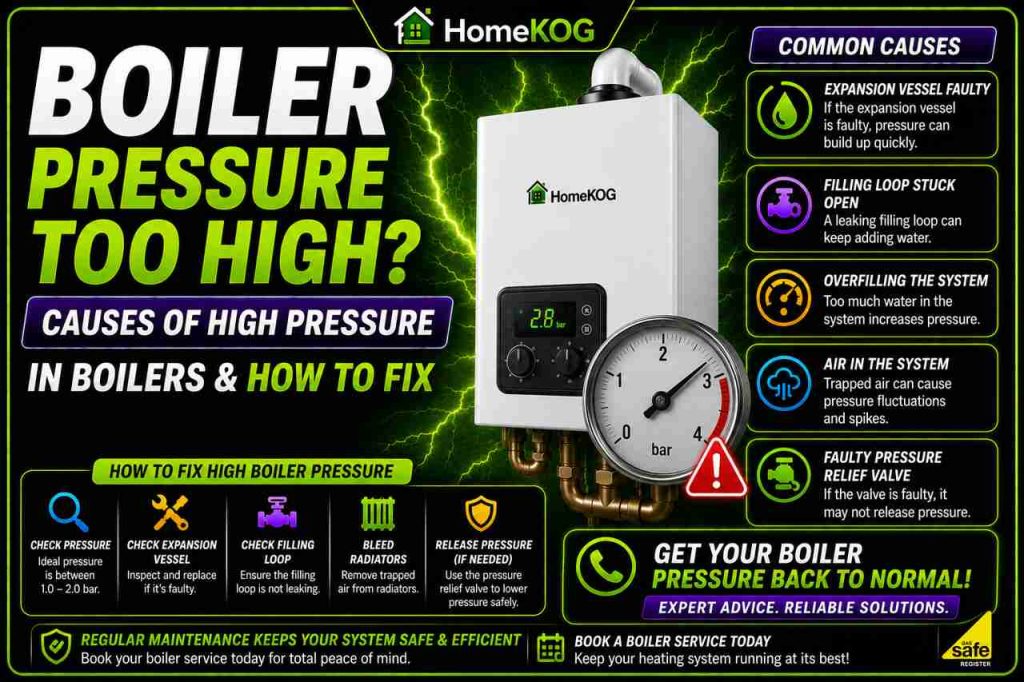
Pressure below 1.0 bar can produce gurgling as the pump struggles to push a low water volume around the system. Check the pressure gauge on the boiler front panel — the reading should sit in the green zone, typically between 1.0 and 1.5 bar. If pressure is below this, repressurise via the filling loop until the gauge returns to the correct range, then reset the boiler. If pressure drops repeatedly within a short period, a system leak is the likely cause and a Gas Safe engineer should investigate.
Frozen Condensate Pipe
In cold weather, the condensate pipe — which carries acidic wastewater from the boiler to an external drain — can freeze and block, causing the boiler to gurgle and then lock out. Thaw the frozen section by applying warm water or wrapping the external pipe in a hot water bottle or warm towels. Never use boiling water, which can damage the plastic pipe. Once the blockage clears, reset the boiler. Lagging the exposed external section of the condensate pipe prevents recurrence in subsequent cold spells.
Failing Circulation Pump
A pump that is not moving water efficiently can produce a gurgling sound as water flow becomes intermittent. If bleeding radiators and checking pressure have not resolved the gurgling, the pump should be inspected by a Gas Safe engineer. A pump blocked with debris or with a failing impeller is the typical cause — the engineer can clean the pump or arrange replacement if necessary.
Buzzing Boiler
A buzzing sound is not a normal boiler noise at any point during operation. It indicates either a faulty electrical component or a defective burner — both of which require a Gas Safe engineer to diagnose and repair. Do not ignore a buzzing boiler or attempt to investigate the internal components. Contact a Gas Safe engineer for prompt attendance — a faulty electrical component that is not addressed risks further damage to the boiler’s control system.
Humming or Vibrating Boiler
Before calling an engineer, check the external flue outlet for obstructions. A bird’s nest, leaf debris, or other blockage in the intake flue can cause the boiler to hum as airflow is restricted. Clearing the obstruction from outside often resolves the noise immediately without any further action.
If the flue is clear, check whether the boiler filter is blocked — some manufacturers permit homeowners to clean the filter and the manual will specify whether this applies to the specific model. A blocked filter restricts water flow and can cause vibration throughout the system.
Where neither the flue nor the filter is the cause, the vibration most likely originates from the pump — either set to a flow rate higher than the system requires, or with a bearing beginning to fail. An engineer can reduce the pump speed setting if it has been set unnecessarily high, or replace the pump if a bearing fault is confirmed. A humming noise from the pump that started suddenly, rather than gradually, more likely indicates a bearing failure than a speed setting issue.
Rattling Boiler
A rattling noise typically indicates a loose component — either on the boiler casing itself or within the system pipework. Inspect the outside of the boiler casing for any loose screws, panels, or valve caps and tighten them. This takes a few minutes and resolves the noise in a significant proportion of cases.
If the casing is secure, trapped air vibrating the pipework is the next most likely cause. Bleeding the radiators clears air from the system and eliminates this cause. After bleeding, check any accessible pipe clips along visible pipework — a clip that is too loose allows the pipe to move and knock against the surrounding structure. A clip with excess plastic trim that rattles against the pipe can be resolved by trimming the surplus.
If casing tightening, radiator bleeding, and pipe clip inspection do not resolve the rattle, an engineer should open the boiler unit and check internal components — a loose internal part is the most likely remaining cause.
Whistling Boiler (Kettling)
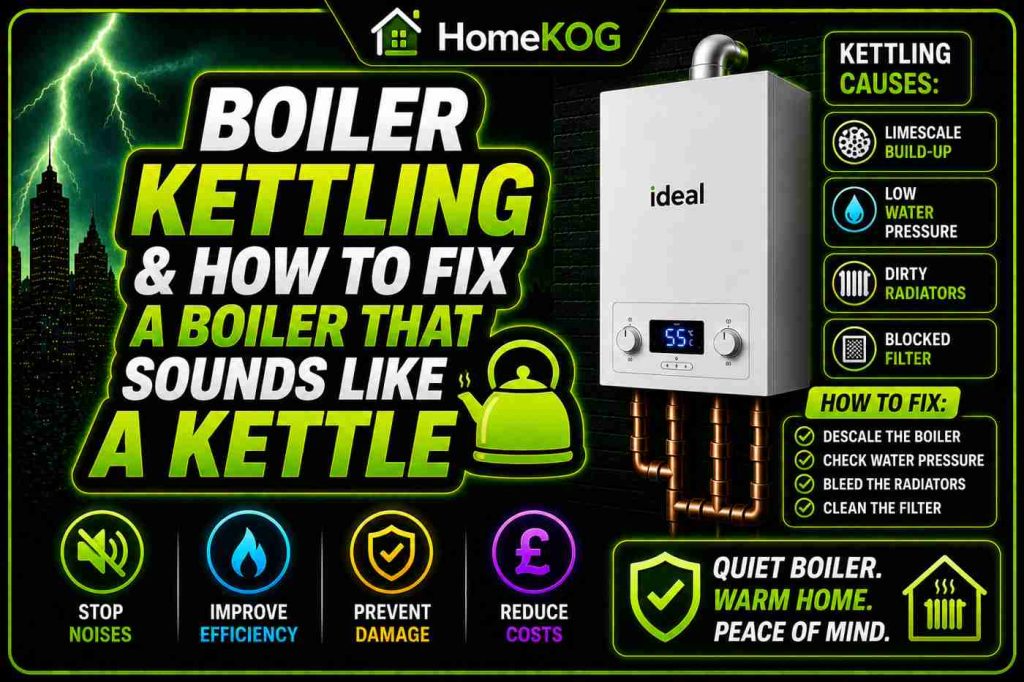
A whistling noise that resembles a boiling kettle is called kettling and is caused by limescale or sludge restricting water flow around the heat exchanger. As the restricted water overheats locally, it boils and produces steam, which escapes and creates the whistle. Kettling is significantly more prevalent in hard water areas where mineral deposits accumulate faster, but can develop in any system without adequate inhibitor maintenance. If you’re experiencing this issue, there are several boiler kettling noise solutions you can explore, including regular system maintenance and the use of water softeners to combat limescale buildup. Additionally, flushing the heating system periodically can help remove sludge and improve overall efficiency. Implementing these strategies not only reduces unwanted noises but also prolongs the lifespan of your heating system.
A Gas Safe engineer should carry out a power flush to clear the limescale and restore free water flow through the heat exchanger. Kettling left unaddressed progressively worsens — the water flow restriction increases, the local boiling becomes more intense, and the thermal stress on the heat exchanger accelerates cracking and failure. At the point of heat exchanger failure, the repair cost is substantially higher than the cost of a power flush carried out at the first sign of kettling.
A whistling noise can also be caused by a system leak reducing water volume, causing the remaining water to overheat, or by a faulty thermostat or diverter valve allowing system temperature to rise above its correct set point. If a power flush has already been carried out and whistling persists, thermostat and diverter valve function should be checked by an engineer.
Banging Boiler
Banging is an advanced stage of kettling — the same limescale and sludge restriction that produces a whistle when mild produces a bang when severe. With significant flow restriction, the boiling water produces steam that expands rapidly and collapses with sufficient force to create a loud bang. The greater the build-up, the more violent the sound. A boiler producing banging noises is working under considerable stress and should be attended to promptly.
A Gas Safe engineer will recommend a power flush for significant build-up. Where chemical accumulation is less severe or more recent, a chemical clean — adding cleaning chemicals to the system, allowing them to circulate and break down debris, then draining and refilling with clean inhibited water — may be sufficient. The engineer will assess which is appropriate based on the system’s condition and history.
Tapping Boiler
Tapping sounds from the boiler or pipework are caused by the same limescale and sludge accumulation that produces whistling and banging — but at an earlier stage. Water trapped on the heat exchanger surface boils intermittently, producing a rhythmic tap as it does so. A magnetic filter fitted by an engineer traps iron oxide particles continuously and is the most effective ongoing preventative measure. For existing accumulation, a power flush clears the debris and restores efficient operation.
Trapped air also causes tapping — the air bubbles expand and contract as they heat and cool, producing a tap from radiators and pipework. Bleeding the radiators to release trapped air is always worth attempting before arranging a professional flush.
Clicking Boiler
A continuous clicking noise from the boiler indicates a fault with the ignition system. When the boiler fires successfully, the igniter should cut off immediately once a stable flame is detected. If the flame sensor is faulty, the igniter remains active after ignition and clicks continuously. This requires a Gas Safe engineer to inspect and replace the ignition sensor or electrode — it cannot be resolved by resetting the boiler and will recur until the faulty component is replaced.
What Every Boiler Noise Means: Quick Reference
| Noise | Most Likely Cause | DIY Fix Available? |
|---|---|---|
| Gurgling | Trapped air, low pressure, frozen condensate pipe | Yes — bleed radiators, repressurise, thaw condensate |
| Buzzing | Faulty electrical component or burner | No — engineer required urgently |
| Humming/vibrating | Blocked flue, blocked filter, pump fault | Check flue and filter — engineer for pump |
| Rattling | Loose casing, trapped air, loose pipe clips | Yes — tighten casing, bleed, check clips |
| Whistling (kettling) | Limescale on heat exchanger | No — power flush by engineer |
| Banging | Severe limescale restriction | No — power flush by engineer urgently |
| Tapping | Early limescale, trapped air | Bleed first — engineer for persistent tapping |
| Clicking | Faulty ignition sensor | No — engineer required |
How to Keep Your Boiler Quiet and Healthy
Annual servicing by a Gas Safe engineer is the single most effective measure — it catches developing problems before they generate the noises described above, maintains warranty validity, and keeps the boiler operating at peak efficiency. At each service the engineer cleans the magnetic filter, checks inhibitor levels, inspects the heat exchanger and pump, and tests the ignition and combustion systems.
Fitting a magnetic filter to the return pipework removes sludge particles before they accumulate in the heat exchanger and pump. A system flush or chemical clean every few years removes accumulated debris from the full circuit before it reaches the concentration at which kettling and banging develop. In hard water areas, an electrolytic scale reducer or water softener significantly slows the rate of limescale formation throughout the heating system.
FAQ
Is a noisy boiler dangerous?
Not usually. Boiler noises almost always indicate a maintenance issue rather than an immediate safety emergency. Modern boilers have safety devices that trigger automatic shutdown before dangerous pressure or temperature conditions develop. The risk from ignoring boiler noise is progressive component damage and reduced efficiency rather than an acute hazard. The exception is a buzzing noise, which can indicate a faulty electrical component and should prompt same-day engineer attendance.
Why is my boiler making a noise when the heating comes on?
A noise that occurs specifically when the heating fires up is most commonly caused by trapped air being disturbed as hot water begins to circulate, or by the early stages of kettling as the heat exchanger warms up with some limescale accumulation. Bleeding the radiators is the appropriate first step. If the noise persists after bleeding, an engineer should check for limescale build-up.
Why does my boiler make a noise at night when the heating is off?
Ticking and creaking from pipework at night is caused by the thermal contraction of metal pipes as they cool after the heating has been on. This is entirely normal and not a fault. A consistent clicking or buzzing noise when the heating is off — rather than the intermittent creak of cooling metal — indicates a component that is running when it should not be and requires engineer investigation.
Can I fix a noisy boiler myself?
Trapped air causing gurgling and rattling can be resolved by bleeding radiators — a safe DIY task. A frozen condensate pipe can be thawed with warm water. Loose screws on the boiler casing can be tightened. All internal boiler work, including pump inspection, heat exchanger cleaning, ignition sensor replacement, and power flushing, must be carried out by a Gas Safe registered engineer. Never open the boiler casing to attempt repairs.
How much does it cost to fix a noisy boiler?
The cost depends on the cause. Radiator bleeding costs nothing. A power flush for kettling or banging costs £300 to £500 depending on property size. Pump repair or replacement costs £150 to £350. Ignition sensor replacement costs £100 to £200. Heat exchanger replacement — the most serious outcome of ignoring persistent kettling — costs £300 to £600. Annual servicing at around £80 remains the most cost-effective way to prevent these faults from developing.
Conclusion
Every boiler noise has a specific cause, and identifying the type of noise is the most reliable first step towards resolving it. Trapped air causing gurgling and rattling is the most common noise and the most straightforward to fix — bleeding the radiators takes under an hour and costs nothing. Limescale build-up causing whistling, tapping, and banging is the most important noise to address promptly, because the progressive damage to the heat exchanger from unresolved kettling is the most expensive consequence of ignoring a boiler noise. Looking at various solutions, many homeowners may want to explore affordable boiler financing options to help manage repair costs. By considering these financing plans, you can ensure timely maintenance and avoid larger expenses associated with more severe boiler issues down the line. Taking proactive steps like this not only improves the efficiency of your heating system but also contributes to long-term savings.
Annual servicing, a magnetic filter, and adequate inhibitor maintenance are the three measures that prevent the majority of boiler noises from developing in the first place. A boiler that is consistently quiet is almost always one that is regularly maintained — and a consistently maintained boiler is one that delivers its full expected lifespan without the costly component failures that irregular maintenance allows to develop undetected.