
Boiler Making Noise: Causes, Types & How to Fix a Noisy Boiler
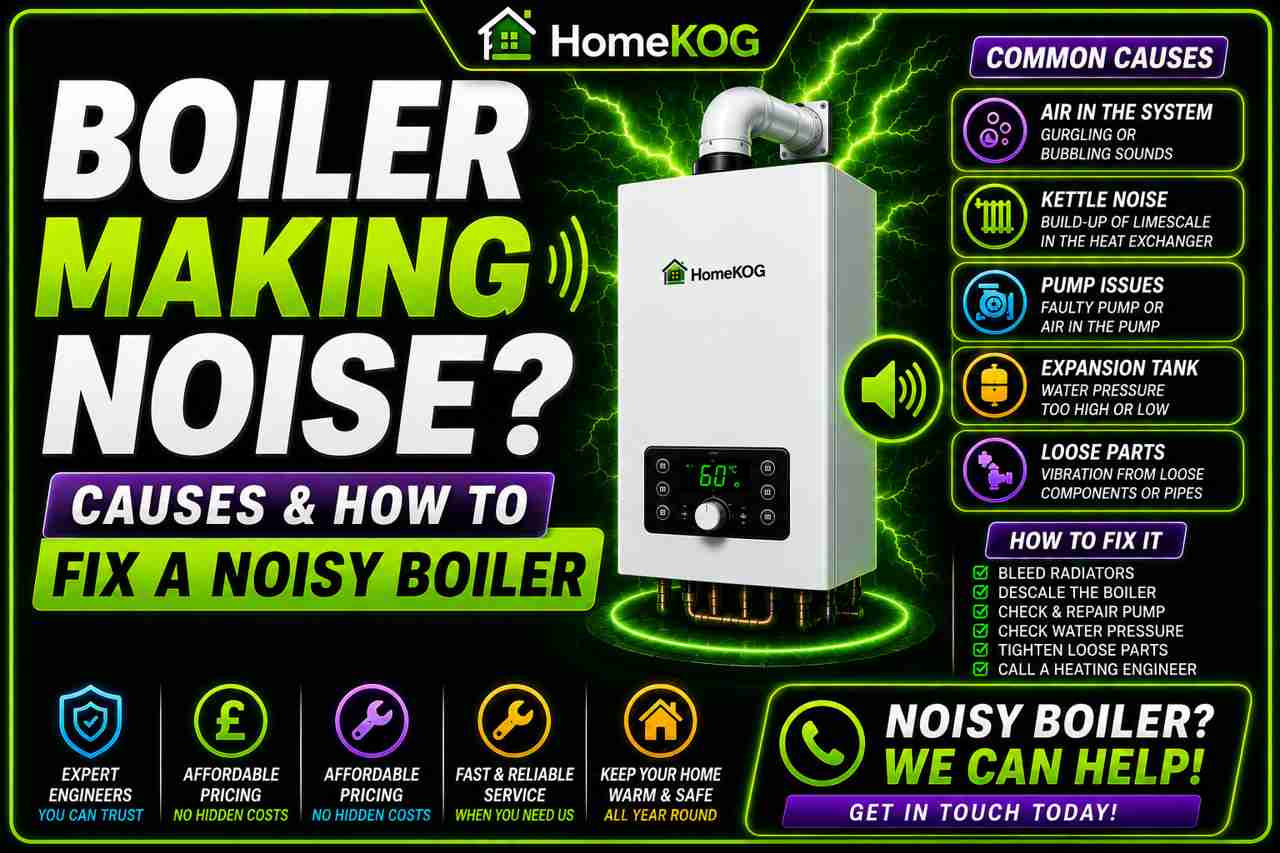
Quick Answer: A boiler making noise is usually caused by limescale or sludge build-up on the heat exchanger, trapped air in the system, low water pressure, or a faulty thermostat. The type of noise — kettling, banging, gurgling, or buzzing — points to a specific cause. Some fixes can be done yourself, but most require a Gas Safe registered engineer.
A noisy boiler is one of the most common reasons UK homeowners call out a heating engineer. The sound might be a low rumble, a loud bang, a persistent whistle, or something in between — and while it is easy to dismiss as a minor irritation, unusual boiler noise is nearly always a sign that something needs attention.
This guide covers every main type of boiler noise, what is causing it, and what you should do about it in 2026.
Key Facts: Boiler Noise Relationships
- A boiler making noise is a symptom that typically indicates an underlying fault such as limescale build-up, trapped air, low water pressure, or a failing component.
- Kettling is a boiler noise caused by limescale or sludge restricting water flow through the heat exchanger, leading to localised overheating and steam production.
- Limescale is a mineral deposit composed primarily of calcium that accumulates inside boiler components and pipework in hard water areas of the UK.
- Hard water is water with a high concentration of dissolved minerals and is more prevalent in regions such as London, Bristol, and Southampton, increasing the risk of limescale-related faults.
- A heat exchanger is the boiler component most commonly affected by limescale build-up, and restricted flow through it causes the overheating that produces kettling noises.
- A power flush is a high-pressure cleaning process carried out by a Gas Safe engineer to remove limescale, sludge, and debris from the central heating system.
- A frozen condensate pipe is a common cause of vibrating or loud boiler noise during cold weather and can be resolved by applying warm water to the affected section of pipe.
- Low water pressure is a condition in which insufficient water flows over the heat exchanger, causing overheating, steam bubbles, and banging or gurgling sounds.
- A faulty thermostat is a boiler component that, when malfunctioning, can allow water temperature to exceed safe limits and generate loud banging or rumbling noises.
- Bleeding a radiator is the process of releasing trapped air from the central heating system and is an effective self-help remedy for gurgling noises caused by air in the pipework.
- A Gas Safe registered engineer is the only qualified professional legally permitted to diagnose and repair internal boiler faults in the UK.
- Pump overrun is a normal function of a combi boiler in which the pump continues to operate briefly after the boiler has shut down in order to cool the system, and can produce noise that is sometimes mistaken for a fault.

Why Is My Boiler Making Noise?
Before diagnosing the specific sound your boiler is making, it helps to understand a basic principle: the noise you hear is not always coming from inside the boiler itself. Copper pipes expanding and contracting as they heat up, air moving through radiators, and water rushing through narrow sections of pipework can all produce sounds that appear to originate from the boiler but actually have a different source.
The first step when you notice an unusual noise is to try to locate where it is coming from. Walk around the affected area and listen carefully. Is the noise coming directly from the boiler casing, from the pipes running to and from it, or from the radiators themselves? Identifying the source narrows down the cause considerably and helps any engineer you call out to work more efficiently.
Once you have a sense of the location, the type of noise becomes the most important clue.
Types of Boiler Noise and What They Mean
Kettling or Whistling Noise
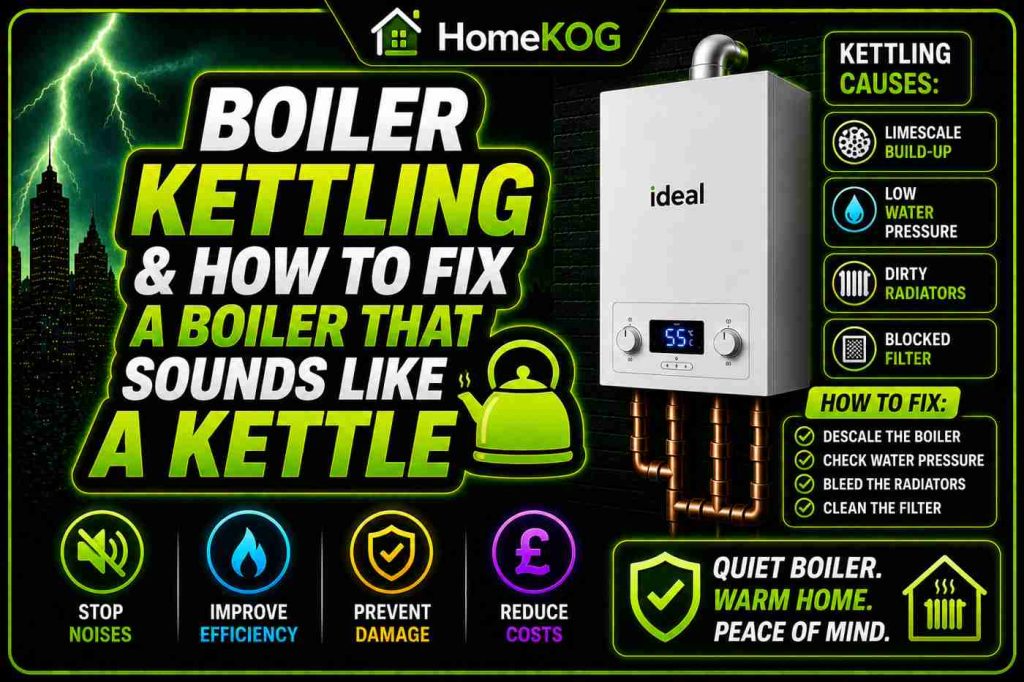
A kettling noise is probably the most recognisable boiler sound — a low rumble or whistle that closely resembles the sound of a kettle coming to the boil. It is one of the most common boiler faults reported by UK homeowners and is strongly associated with hard water areas.
Kettling occurs when limescale builds up on or around the heat exchanger, narrowing the internal passages through which water flows. As water is forced through these restricted areas, it heats up rapidly and begins to produce steam. The steam expands and forces its way through narrow gaps in the system, creating the characteristic whistling sound.
Sludge and debris accumulating around the heat exchanger can produce a very similar noise. In some cases, a partially blocked boiler pump is the underlying cause, causing water to move too slowly through the system and overheat.
Kettling is not merely an irritation — it actively damages the boiler over time. Each episode puts thermal stress on the heat exchanger and reduces the efficiency of the system as a whole. A boiler that is kettling needs more fuel to reach the desired flow temperature, which increases monthly energy bills. Left untreated, it shortens the working life of the heat exchanger and other components.
Kettling requires professional attention. A Gas Safe engineer will typically carry out a power flush to remove the limescale and debris responsible, and may also fit a scale reducer or magnetic system filter to prevent the problem from recurring.
Gurgling Noise
A gurgling or bubbling sound coming from the boiler or radiators is most commonly caused by trapped air in the central heating system. Small amounts of air enter the system naturally over time, and as this air moves through the pipework and components, it produces the gurgling sound you hear.
Low water pressure can also cause gurgling. When the system pressure drops below the recommended level, water does not flow smoothly through the circuit and can create an uneven, bubbling effect.
In cold weather, a frozen condensate pipe is another cause of gurgling. The condensate pipe carries acidic wastewater from a condensing boiler to an external drain, and in sub-zero temperatures this pipe can freeze solid, causing water to back up into the boiler and produce unusual sounds.
Bleeding your radiators is the simplest and most effective first step for gurgling caused by trapped air. You will need a radiator bleed key to open the small valve on each radiator and release the air. Once water begins to flow steadily from the valve, the air has been expelled. After bleeding the radiators, check the system pressure gauge on the boiler and repressurise if needed.
If the gurgling persists after bleeding, or if the noise is accompanied by a drop in heating performance, a Gas Safe engineer should investigate further.
Loud Banging Noise
A loud banging sound coming from the boiler is one of the more concerning noises and should never be ignored. It is most commonly associated with significant limescale or sludge build-up on the heat exchanger, or with a faulty thermostat that is allowing the water temperature to climb too high.
When water overheats and produces steam, the rapid expansion and sudden collapse of steam bubbles creates a sharp banging or cracking sound — a process known as thermal shock. A malfunctioning thermostat that fails to regulate temperature correctly can trigger this repeatedly, putting serious strain on the heat exchanger and other internal components.
Air entering the pipework can also cause banging. As air pockets move through the system and meet pressure changes, they can produce sudden, sharp knocks that travel along the pipes and sound as though they are coming from the boiler itself.
If your boiler is making a loud banging noise, switch it off immediately. Continuing to run a boiler in this condition risks damaging internal components and could result in a significantly more expensive repair. Call a Gas Safe engineer as soon as possible and do not attempt to open or inspect the boiler yourself.
Buzzing Noise
A buzzing sound from the boiler usually points to a problem with one of its key mechanical components — most commonly the burner, the circulating pump, or the fan. These parts are built to last, but years of continuous use inevitably lead to wear, and as they begin to deteriorate, they can produce an electrical or mechanical buzzing sound during operation.
A buzzing burner may indicate that the gas supply to the boiler is not igniting cleanly. A worn pump can produce vibration as its bearings degrade. A failing fan — which is responsible for expelling combustion gases through the flue — can buzz or rattle as its motor begins to wear out.
Buzzing noises always warrant a call to a Gas Safe engineer. These components are not straightforward to diagnose or replace without the correct tools and training, and attempting to investigate them without qualifications is both dangerous and illegal on a gas appliance.
Vibrating or Loud Rumbling Noise
A boiler that is vibrating loudly, rather than simply making noise, can indicate a blockage in the flue or fan. The flue is the duct through which combustion gases are safely expelled from the property, so any restriction in this pathway is a safety concern that needs to be addressed promptly.
Check the external flue terminal for obvious obstructions such as debris, a bird’s nest, or ice during cold weather. If something is visibly blocking the outlet, remove it carefully. If the vibration continues after the external flue appears clear, the blockage may be internal and will require an engineer’s inspection.
A frozen condensate pipe during cold snaps is another frequent cause of loud vibrating noise. The pipe is typically located on an external wall and can be thawed safely by pouring warm — not boiling — water over the frozen section. Once the pipe is clear, the boiler can usually be reset and will return to normal operation.
Boiler Making Noise When Not in Use
A boiler that makes noise when it appears to be switched off is not always a cause for alarm, but it is worth understanding why it happens.
For combi boilers, the most common explanation is pump overrun. After the boiler finishes a heating cycle, the pump continues to run for a short period to circulate water and cool the heat exchanger down gradually. This is a normal function and should produce no more noise than the boiler makes during regular operation.
For system and conventional boilers, the boiler may fire up periodically throughout the day to maintain the temperature of water in the hot water cylinder. The frequency depends on how well the cylinder is insulated — a poorly insulated tank loses heat quickly and requires the boiler to reheat the water more often. Improving the cylinder’s insulation can reduce the number of times the boiler needs to run and will also lower your energy bills.
If the noise when not in use is significantly louder than normal operation, or is accompanied by any of the symptoms described earlier in this guide, a professional inspection is advisable.
What to Do First When Your Boiler Makes a Strange Noise
Not every boiler noise requires an immediate call to an engineer. Running through the following checks first can save time and money.
Step one is to identify the location of the noise. Establish whether it is coming from the boiler itself, from nearby pipework, or from the radiators.
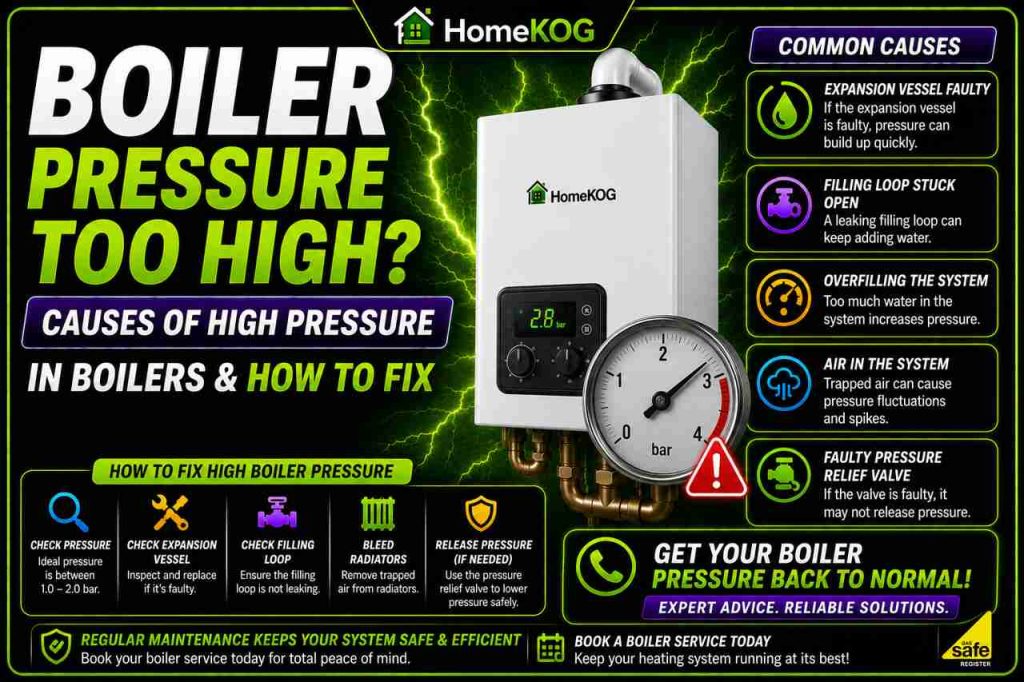
Step two is to check the system pressure. Look at the pressure gauge on the boiler — it should sit between 1 and 1.5 bar when the system is cold. If it has dropped below 1 bar, the system needs to be repressurised using the filling loop, and this may resolve gurgling or banging caused by low pressure.
Step three is to bleed the radiators if air in the system is suspected. Start with the radiator furthest from the boiler and work back towards it. Check the pressure gauge again after bleeding and top up if necessary.
Step four is to check the condensate pipe in cold weather. If the pipe runs externally and temperatures have been below zero, it may have frozen. Thawing it with warm water and resetting the boiler often resolves the issue immediately.
Step five is to call a Gas Safe engineer if the noise persists, if it is loud and sudden, or if you are unable to identify the source. Do not open the boiler casing or attempt any internal investigation yourself.
When to Call a Gas Safe Engineer
| Noise Type | Likely Cause | Action Required |
|---|---|---|
| Kettling or whistling | Limescale or sludge on heat exchanger | Call a Gas Safe engineer for power flush |
| Loud banging | Limescale, faulty thermostat, trapped air | Switch off boiler immediately, call engineer |
| Gurgling | Trapped air, low pressure, frozen condensate | Bleed radiators, repressurise, or thaw pipe |
| Buzzing | Worn burner, pump, or fan | Call a Gas Safe engineer |
| Vibrating | Blocked flue, frozen condensate, or fan fault | Check flue externally, thaw condensate pipe, call engineer if unresolved |
| Noise when not in use | Pump overrun (combi) or cylinder reheating (system) | Usually normal — investigate if significantly louder than usual |
Frequently Asked Questions
Why is my boiler making a whistling noise?
A boiler making a whistling or kettling noise is almost always caused by limescale build-up restricting water flow through the heat exchanger. Water trapped in narrow passages overheats, produces steam, and forces its way through gaps in the system, creating the familiar whistling sound. Hard water areas of the UK, including London, Bristol, and Southampton, are particularly prone to this fault. A Gas Safe engineer will need to carry out a power flush to resolve it.
Is a banging boiler dangerous?
A loud banging sound from a boiler can indicate a serious fault such as extreme overheating caused by limescale accumulation or a malfunctioning thermostat. In either case, the boiler should be switched off immediately and a Gas Safe engineer called out as soon as possible. Running the boiler with this fault active risks damaging the heat exchanger and other internal components, which can turn a manageable repair into a significantly more expensive one.
Can I fix a gurgling boiler myself?
In many cases, yes. If the gurgling is caused by trapped air in the central heating system, bleeding the radiators is an effective solution that most homeowners can carry out without professional help. If the noise is caused by low system pressure, repressurising the boiler using the filling loop will often resolve it. A frozen condensate pipe can also be thawed at home using warm water. If none of these steps stop the gurgling, a Gas Safe engineer should investigate further.
What causes a boiler to make noise when it is not running?
For combi boilers, a brief period of noise after the heating switches off is usually pump overrun — a normal cooling function. For system and conventional boilers, the boiler may be firing up to reheat the water in the hot water cylinder as it cools down through the day. This is normal but can be reduced by improving the insulation around the cylinder. If the noise when not in use is unusually loud or has changed recently, it is worth having an engineer take a look.
Why is my boiler buzzing?
A buzzing noise from a boiler typically indicates wear or damage to one of its key mechanical components — most commonly the burner, the circulating pump, or the fan. These parts degrade over time through normal use, and buzzing is often the first audible sign that a component is beginning to fail. A Gas Safe engineer should be called to diagnose and replace the affected part before the fault develops further.
What is boiler kettling and how does it affect efficiency?
Kettling is the term used to describe the whistling or rumbling noise produced when water overheats inside a restricted heat exchanger. Beyond the noise, kettling reduces boiler efficiency because the system has to burn more fuel to reach the desired flow temperature through a partially blocked component. Each kettling episode also places thermal stress on the heat exchanger, shortening its working life. Left unaddressed, it can lead to heat exchanger failure, which is one of the more costly boiler repairs.
How can I prevent my boiler from making noise?
Annual boiler servicing is the single most effective way to prevent noise-related faults. A Gas Safe engineer will clean components, check for early signs of limescale or sludge, and identify any parts showing wear before they fail. Fitting a magnetic system filter helps capture debris before it accumulates inside the boiler. Maintaining the correct concentration of central heating inhibitor reduces corrosion and sludge formation. In hard water areas, fitting a scale reducer to the boiler’s water inlet provides additional protection against limescale build-up.
Should I replace my boiler if it keeps making noise?
Not necessarily, but persistent noise is a signal worth taking seriously. If the fault is isolated — a one-off limescale build-up or a single worn component — a repair is usually sufficient. However, if the boiler is more than ten years old and has developed repeated noise-related faults, the cost of ongoing repairs may begin to approach the cost of a new installation. A modern replacement boiler will be more energy efficient, quieter, and will come with a full manufacturer warranty, making replacement the more cost-effective choice over a longer timeframe for many households.
Conclusion
A boiler making noise is rarely something to dismiss. Whether it is a faint whistle, a persistent gurgle, or a sudden loud bang, each sound carries a specific meaning and points to a fault that will only worsen if left unaddressed.
Some causes — trapped air, low pressure, a frozen condensate pipe — can be resolved at home with basic steps. Others, including limescale build-up, failing components, and thermostat faults, require the skills and tools of a Gas Safe registered engineer.
Booking an annual boiler service remains the most reliable way to catch problems early, keep the system running quietly, and avoid the kind of faults that turn a straightforward repair into a major expense. If your boiler has started making unusual noises and you are unsure of the cause, the safest and most sensible step is always to call a qualified engineer.