
Back Boiler Removal: Cost, Mess, Time & Everything You Need to Know
Quick Answer: Back boiler removal must be carried out by a Gas Safe registered engineer — it is illegal to attempt it yourself due to the gas connections involved. The process typically takes 2 to 3 days and costs upwards of £3,000, including replacement with a new combi boiler. The removal creates temporary disruption — floor damage, pipework removal, dust, and dirty water — but engineers leave the property clean and tidy on completion. Switching from a G-rated back boiler to a modern A-rated combi boiler can save over £800 per year on energy bills.
We can quote online for back boiler to combi boiler here >
Introduction
Back boiler removal is one of the most impactful home heating upgrades available — and for homeowners still running one, it is increasingly urgent. Back boilers are no longer allowed to be replaced like-for-like under UK building regulations, meaning when one fails, a full conversion to a modern boiler is the only legally compliant option. Understanding the working of a back boiler system is crucial for homeowners contemplating this upgrade. Many are unaware of how these systems operate, which can lead to inefficiencies and increased energy costs. Transitioning to a modern heating solution not only enhances energy efficiency but also improves the overall comfort of the home. When considering boiler selection tips for homeowners, it’s essential to evaluate factors such as energy efficiency ratings, the size of your home, and specific heating needs. Additionally, consulting with a certified installer can provide personalized recommendations tailored to your situation. Investing in the right boiler can lead to significant long-term savings on energy bills and enhance comfort throughout the entire living space.
The two questions most homeowners ask before committing to removal are: how much will it cost, and how much mess will it make? Both are valid concerns when dealing with a boiler system built into the fabric of the fireplace and integrated with the flue, pipework, and structure of the room around it.
This guide answers both questions honestly, covers the full removal process, explains the grant and finance options available to reduce the upfront cost, and explains what to expect during and after the work.

Understanding Back Boiler Removal: The Core Relationships
Back boiler removal involves a network of connected components, regulations, and decisions — understanding each one helps set realistic expectations before work begins.
- A back boiler is a central heating unit installed behind a fireplace that provides both space heating via radiators and domestic hot water, operating at approximately 70% efficiency compared to over 90% for modern A-rated condensing boilers.
- A Gas Safe registered engineer is the only professional legally qualified to disconnect, decommission, and remove a back boiler — the gas connections make DIY removal illegal and potentially fatal.
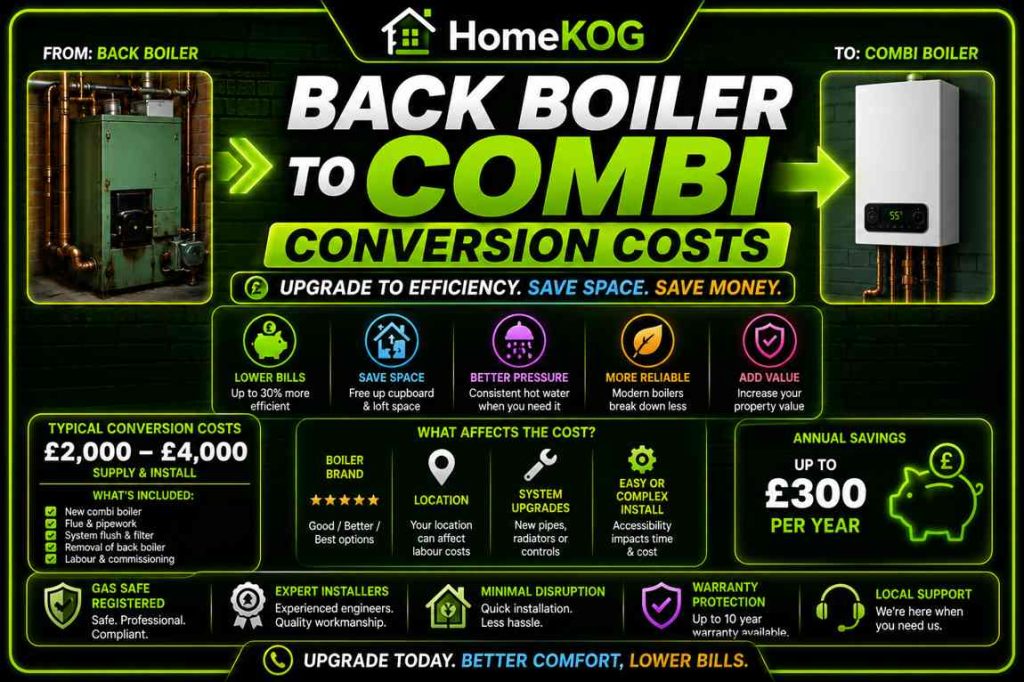
- Back boiler removal costs typically start at £3,000, including the supply and installation of a replacement combi boiler — the total varies depending on the replacement boiler chosen and the complexity of the conversion.
- A back boiler conversion replaces the back boiler and associated components with a modern wall-hung boiler installed in a new location, with new pipework, a new flue, and decommissioned gas fire connections.
- The Energy Company Obligation (ECO) scheme provides grant funding to help low-income and vulnerable households replace inefficient heating systems, potentially covering part or all of the cost of replacing a back boiler for eligible homeowners.
- The Energy Saving Trust estimates that replacing a G-rated back boiler with a modern A-rated condensing boiler saves over £800 per year on gas bills — a saving that repays the conversion cost within 3 to 5 years in most cases.
- A combi boiler is the most common replacement for a back boiler — it eliminates the need for the hot water cylinder and cold water storage tank that back boiler systems require, freeing up significant storage space.
- Back boiler legislation introduced by the UK government prohibits replacing an existing back boiler with another back boiler — a modern condensing boiler is the only legally compliant replacement.
- A back boiler flue must be removed or properly capped during decommissioning — leaving an unused gas flue open creates a safety hazard and is not compliant with current building regulations.
- Floor damage, uprooted pipework, dust, and dirty water are normal byproducts of back boiler removal — a competent Gas Safe engineer will manage and clean up these during the 2 to 3 day installation process.
- Finance options allow the cost of back boiler removal and replacement to be spread over monthly payments, making the conversion accessible to homeowners who cannot meet the full upfront cost.
- A hydrogen-ready combi boiler is the recommended replacement — all current UK combi boilers are compatible with gas supplies containing up to 20% hydrogen, future-proofing the installation against the planned transition of the gas network.
Why Remove a Back Boiler?
The case for removing a back boiler is built on efficiency, safety, cost, and legality.
Efficiency: A G-rated back boiler converts approximately 70% of the gas it burns into usable heat. A modern A-rated condensing combi boiler converts over 90%. This 20% efficiency gap translates directly into energy bills — the Energy Saving Trust calculates savings of over £800 per year when switching from a G-rated back boiler to a modern condensing combi. When looking for the best combi boilers for UK homes, it is crucial to consider not just energy efficiency but also the quality and reliability of the brand. Many homeowners have reported significant reductions in their heating costs after upgrading to these modern systems. Additionally, selecting a combi boiler that offers excellent customer service and warranty can provide long-term peace of mind.
Safety: Back boilers are not as safe as modern boilers. They lack the carbon monoxide protection, pressure regulation, and automatic safety shutoff systems standard in all modern gas boilers. An unused back boiler left in place without proper decommissioning creates an ongoing gas safety risk.
Legality: UK building regulations introduced in 2005 and strengthened subsequently prohibit the installation of new non-condensing boilers as replacements in domestic properties. When a back boiler fails, it cannot be replaced with an equivalent unit — conversion to a modern condensing boiler is the only legally compliant option.
Cost: Running a G-rated back boiler costs significantly more per unit of heat delivered than any modern alternative. On top of higher running costs, back boiler servicing costs more than a standard boiler service because the gas fire element must be serviced at the same time.
Can You Remove a Back Boiler Yourself?
No — back boiler removal must be carried out by a Gas Safe registered engineer. This is not a legal technicality; it is a genuine safety requirement.
Back boilers are directly connected to the gas supply. Disconnecting any gas appliance or pipework without Gas Safe registration is illegal under the Gas Safety (Installation and Use) Regulations 1998 and creates an immediate risk of gas leak, fire, and carbon monoxide exposure.
Beyond the gas connections, back boilers are often integrated with the structural fabric of the chimney breast and the surrounding fireplace, creating additional risks of structural damage if the removal is not handled correctly by an engineer with experience of this specific type of installation.
Always use a Gas Safe registered engineer for back boiler removal. Verify registration at gassaferegister.co.uk before allowing any work to proceed.
How Is a Back Boiler Removed?
Back boiler removal is a multi-stage process that a Gas Safe engineer carries out systematically over 2 to 3 days.
Stage 1: System Draining
The engineer drains all water from the central heating system — the back boiler, pipework, and all radiators — before disconnection. This removes the dirty water from years of system use, which is disposed of safely.
Stage 2: Gas and Electrical Disconnection
All gas connections to the back boiler and the gas fire are safely disconnected and capped. All electrical connections including the pump and controls are isolated and removed. This stage must be completed by the Gas Safe engineer and is the stage that makes DIY removal illegal. Understanding how a pressure release valve works is crucial for ensuring safety during the removal process. This valve plays a key role in regulating the pressure within the system, preventing potential hazards during maintenance. Proper functioning of this component is essential for the overall integrity of the heating system, especially when dealing with gas and electrical disconnections.
Stage 3: Back Boiler and Gas Fire Removal
The back boiler unit and gas fire are physically removed from the fireplace recess. This involves disconnecting the flue, removing the boiler from its mounting, and clearing the recess. The fireplace opening can then be closed, sealed, or converted to an aesthetic electric fire depending on the homeowner’s preference.
Stage 4: Pipework Changes
The existing pipework from the back boiler installation is assessed. Some pipework may be reused if it is in good condition; pipework that is corroded, incorrectly routed, or incompatible with the new boiler is replaced. This stage produces the majority of the disruption — pipework removal creates holes in walls and floors and generates significant waste.
Stage 5: New Boiler Installation
The replacement boiler — most commonly a modern gas combi — is installed in the new location, typically a kitchen or utility room. New pipework is run from the existing radiator circuit to the new boiler position. A new flue is installed through the exterior wall. The boiler is commissioned, tested, and handed over to the homeowner.
How Much Mess Does Back Boiler Removal Create?
The mess created by back boiler removal is significant but temporary. Understanding what to expect helps homeowners prepare the room appropriately before the engineer arrives.
The following commonly occur during a back boiler removal:
- Floor damage — removing pipework that runs beneath or through the floor requires lifting floorboards or cutting through floor coverings. Boards are replaced where possible, but floor coverings (carpet, tiles, laminate) in the work area may not survive intact.
- Pipework waste — back boilers use a substantial amount of pipework that must be uprooted during removal, generating significant waste material and leaving holes in walls and floors that require making good.
- Dirty water — the drained central heating system water is typically dark with iron oxide sludge from years of radiator corrosion. One to two buckets of this discoloured water commonly emerge during draining and disconnection.
- Dust and debris — working within a chimney breast and fireplace recess generates dust, small fragments of brick, and mortar debris. Floor coverings, furniture, and soft furnishings in the immediate area should be protected or removed before work begins.
A competent Gas Safe engineer will manage this disruption professionally and leave the property clean and tidy at the end of each working day. The conversion typically takes 2 to 3 days — the mess is temporary and most engineers include clean-up as part of the service.
Prepare for the work by:
- Removing floor coverings and rugs from the work area.
- Moving furniture away from the fireplace and the route the engineer will use to access the boiler installation location.
- Covering soft furnishings and surfaces with dust sheets.
- Confirm with the engineer which areas they will be working in so you can prepare accordingly.
What Happens to the Fireplace?
One of the key decisions homeowners face before back boiler removal is what to do with the fireplace after the boiler and gas fire are removed.
Option 1: Seal the fireplace — the recess is closed and plastered over, creating a flat wall. This is the simplest and least expensive option, and it is the most common choice when the fireplace opening has no aesthetic value.
Option 2: Convert to an electric fire — the recess is retained as a decorative feature and fitted with an electric fire insert. This preserves the look of a working fireplace at a modest cost. Electric fires do not require a flue and are a straightforward conversion once the gas connections are removed.
Option 3: Convert to a real flame gas fire — in some cases, the fireplace can be retained and fitted with a new modern gas fire that operates independently of the back boiler (which is being removed). This requires a Gas Safe engineer to install and commission the new fire and to assess the existing flue for suitability.
Option 4: Open fireplace — if the chimney is in good condition, the fireplace may be opened to create a solid-fuel open fireplace. This requires a chimney survey and appropriate notification to building regulations.
Back Boiler Removal Cost
The total cost of back boiler removal and replacement depends primarily on the chosen replacement boiler and the complexity of the required pipework changes.
| Scenario | Estimated Cost |
|---|---|
| Back boiler removal + combi boiler installation | £3,000 – £4,500 |
| Back boiler removal + system boiler installation | £3,500 – £5,000 |
| Additional pipework modifications (complex) | +£500 – £1,500 |
| Electric fire conversion of fireplace | +£200 – £600 |
The removal and decommissioning element alone — without any replacement boiler — typically costs £500 to £1,000 in labour. However, in practice, removal is almost always carried out alongside a new boiler installation, and most engineers quote both as a combined package.
Grants and Finance for Back Boiler Replacement
Energy Company Obligation (ECO)
The Energy Company Obligation scheme provides government-backed grant funding to help low-income and vulnerable households improve home energy efficiency, including boiler replacement. The scheme is means-tested — eligibility depends on household income, benefit receipt, and property characteristics. If eligible, the grant can contribute significantly to or in some cases cover the full cost of a back boiler replacement.
Check current ECO eligibility on the government’s website or through a registered installer — the scheme’s terms and eligibility criteria are updated periodically.
Finance Options
For homeowners who do not qualify for grant funding, spreading the cost through finance is a practical alternative. Many heating installers offer monthly payment plans that allow the full conversion cost to be spread over 2 to 10 years. Repayments as low as £17 per month may be available depending on the plan term and the total cost of the installation.
The annual energy savings of over £800 from the efficiency improvements mean the ongoing cost of finance repayments may be partly or wholly offset by the reduction in monthly gas bills — making the conversion financially accessible even for homeowners without the upfront capital.
Frequently Asked Questions
How much does back boiler removal cost?
Back boiler removal and replacement with a new combi boiler typically costs between £3,000 and £4,500 depending on the replacement boiler model and the complexity of the pipework modifications required. The removal and decommissioning element alone costs approximately £500 to £1,000 in labour, but this is almost always carried out as part of a combined removal and new boiler installation package. Government grants through the ECO scheme may be available for eligible low-income households.
How long does back boiler removal take?
Back boiler removal and replacement with a new boiler typically takes 2 to 3 days. The variation depends on the complexity of the pipework changes required, the distance between the fireplace recess and the new boiler location, and whether the fireplace is being sealed, converted, or retained. Most competent Gas Safe engineers complete the work within this timeframe and leave the property clean and tidy at the end of each working day.
Can I remove a back boiler myself?
No — back boiler removal must be carried out by a Gas Safe registered engineer. The gas connections involved make DIY removal illegal under the Gas Safety (Installation and Use) Regulations 1998, and the risk of gas leak during incorrect disconnection is a genuine danger to life. Beyond the legal requirement, back boilers are often integrated with the structural fabric of the chimney breast, creating structural risks if removal is not handled by an engineer with experience of this specific installation type.
How much mess does back boiler removal make?
Back boiler removal creates significant but temporary disruption including floor damage from pipework removal, one to two buckets of dirty system water, dust and small pieces of brick from the chimney breast area, and pipework waste. Floor coverings and furniture in the work area should be protected or removed before the engineer arrives. A professional Gas Safe engineer will manage this disruption and leave the property clean at the end of each working day. The conversion typically takes 2 to 3 days.
How much can I save by replacing a back boiler?
The Energy Saving Trust estimates that replacing a G-rated back boiler with a modern A-rated condensing boiler saves over £800 per year on gas bills. This saving results from the efficiency improvement — a G-rated back boiler converts approximately 70% of its fuel into usable heat, while a modern A-rated condensing combi converts over 90%. At average UK gas prices, this 20% efficiency improvement directly reduces annual gas consumption and the associated cost by a substantial margin.
What replaces a back boiler?
The most common replacement for a back boiler is a modern gas combi boiler, which eliminates the need for the hot water cylinder and cold water storage tanks that back boiler systems require. For larger homes with multiple bathrooms and high hot water demand, a system boiler with a modern unvented cylinder is the alternative. Both options are available as hydrogen-ready models, future-proofing the installation against the UK’s planned gas network transition. The back boiler conversion also creates an opportunity to consider an air source heat pump as a low-carbon alternative heat source.
Conclusion: The Mess Is Temporary, the Savings Are Permanent
Back boiler removal is disruptive, takes 2 to 3 days, and creates the kind of short-term mess that makes homeowners hesitant to commit. But the disruption is temporary — managed by a professional engineer who leaves the property tidy — and the benefits begin immediately after completion.
The £800-per-year energy saving is real, compounding, and permanent. The safety improvement is immediate. The freedom from a heating system that cannot be repaired or legally replaced when it fails is significant. Every year a G-rated back boiler continues operating is another year of avoidable cost and risk.
Get quotes from Gas Safe registered engineers, check ECO grant eligibility, explore finance if the upfront cost is a barrier, and arrange the conversion at a time that suits your schedule. The installation is the hardest part — everything that follows is simpler, cheaper, and safer than what came before.