
Back Boiler: How It Works, Why They’re Being Replaced & What to Do Next
Quick Answer: A back boiler is an old-style heating unit installed behind a fireplace that heats water using the fire’s heat and stores it in a separate tank. Back boilers operate at approximately 70% efficiency — well below the 90%+ required of all new gas boilers in the UK. They can no longer be replaced like-for-like and should be converted to a modern A-rated combi system or conventional boiler. Switching from a G-rated back boiler to a modern combi can save up to £580 per year on gas bills. By upgrading to a modern boiler, homeowners can experience significant energysaving benefits of your boiler, leading to reduced energy bills and a smaller carbon footprint. Additionally, modern systems often come with advanced features that enhance efficiency and simplify maintenance. Investing in a high-efficiency model not only provides immediate financial relief but also ensures long-term sustainability in energy consumption.
Introduction
Millions of UK homes were built with back boilers — heating units concealed behind gas fires or open fireplaces that provided both central heating and hot water from a single installation. In their time, they were considered efficient and practical. That time has passed. As these systems age, it becomes increasingly important for homeowners to adhere to boiler maintenance frequency guidelines to ensure safety and efficiency. Regular inspections and servicing can prevent unexpected breakdowns and prolong the lifespan of the unit. Homeowners should prioritize understanding these guidelines to avoid costly repairs and ensure a reliable heating solution through the colder months.
Back boilers are no longer manufactured and cannot be replaced like-for-like under current UK regulations. They operate at significantly lower efficiency than modern boilers, cost more to service, and carry safety risks not present in contemporary heating systems. The question for anyone still living with a back boiler is not whether to replace it, but when and with what.
This guide covers what a back boiler is, how it works, the different fuel types available, why they are being phased out, the safety risks involved, the cost of running one versus a modern alternative, and your replacement options. In addition to exploring back boilers, it’s important to consider boiler types for energy efficiency, as modern systems can significantly reduce energy consumption and lower utility bills. By comparing various options, you can identify which boiler types for energy efficiency best align with your heating needs and budget. Understanding the advancements in energy-efficient technology will also help you make a more informed decision when selecting a replacement. system boiler operation explained is a key aspect of modern heating technology. These systems provide efficient and reliable heat by using a centralized boiler to distribute hot water throughout the home. Understanding their operation can help homeowners make better choices when looking at new heating solutions that suit their lifestyles and energy needs.

Understanding Back Boilers: The Core Relationships
A back boiler sits within a network of heating components whose relationships explain both how the system worked and why it has been superseded.
- A back boiler is a heating unit installed in a recess behind a fireplace or gas fire that heats water using the fire’s heat energy, storing it in a separate hot water tank for distribution to radiators and taps.
- A gas fire back boiler — such as the Baxi Bermuda — was the most widely installed type in UK homes during the 1970s and 1980s, using a gas burner both to heat the visible fire and to heat the water behind it.
- A coal-fired open-back boiler used solid-fuel combustion to heat water, requiring regular fuel loading, ash removal, and significantly more maintenance than gas alternatives.
- A hot water storage tank is required by a back boiler to hold the heated water supply, unlike modern combi boilers which heat water on demand without any storage.
- A heat exchanger inside the back boiler transfers heat from the fire’s combustion to the cold water supply, raising it to the temperature required for storage and distribution.
- A pump circulates the heated water from the storage tank through the radiator circuit and to the hot water outlets throughout the property.
- A G-rated back boiler operates at approximately 70% efficiency, meaning approximately 30% of the energy in the fuel is wasted as heat that escapes through the flue rather than being used to heat the home.
- A modern A-rated condensing combi boiler operates at over 90% efficiency, recovering heat from exhaust gases that older non-condensing boilers wasted — producing the energy saving of up to £580 per year when replacing a G-rated back boiler.
- UK regulations introduced in 2005 and strengthened in subsequent years restrict back boiler installations, prohibiting like-for-like replacement when an existing back boiler fails.
- A back boiler conversion replaces the back boiler and associated components with a modern boiler — typically a combi or system boiler — installed in a new location with new pipework and a dedicated flue.
- A Gas Safe registered engineer is the only professional legally qualified to decommission, remove, and replace a back boiler installation in the UK.
- Hydrogen-ready combi and system boilers are compatible with gas supplies containing up to 20% hydrogen, making them the future-proof replacement option for back boiler conversions.
What Is a Back Boiler?
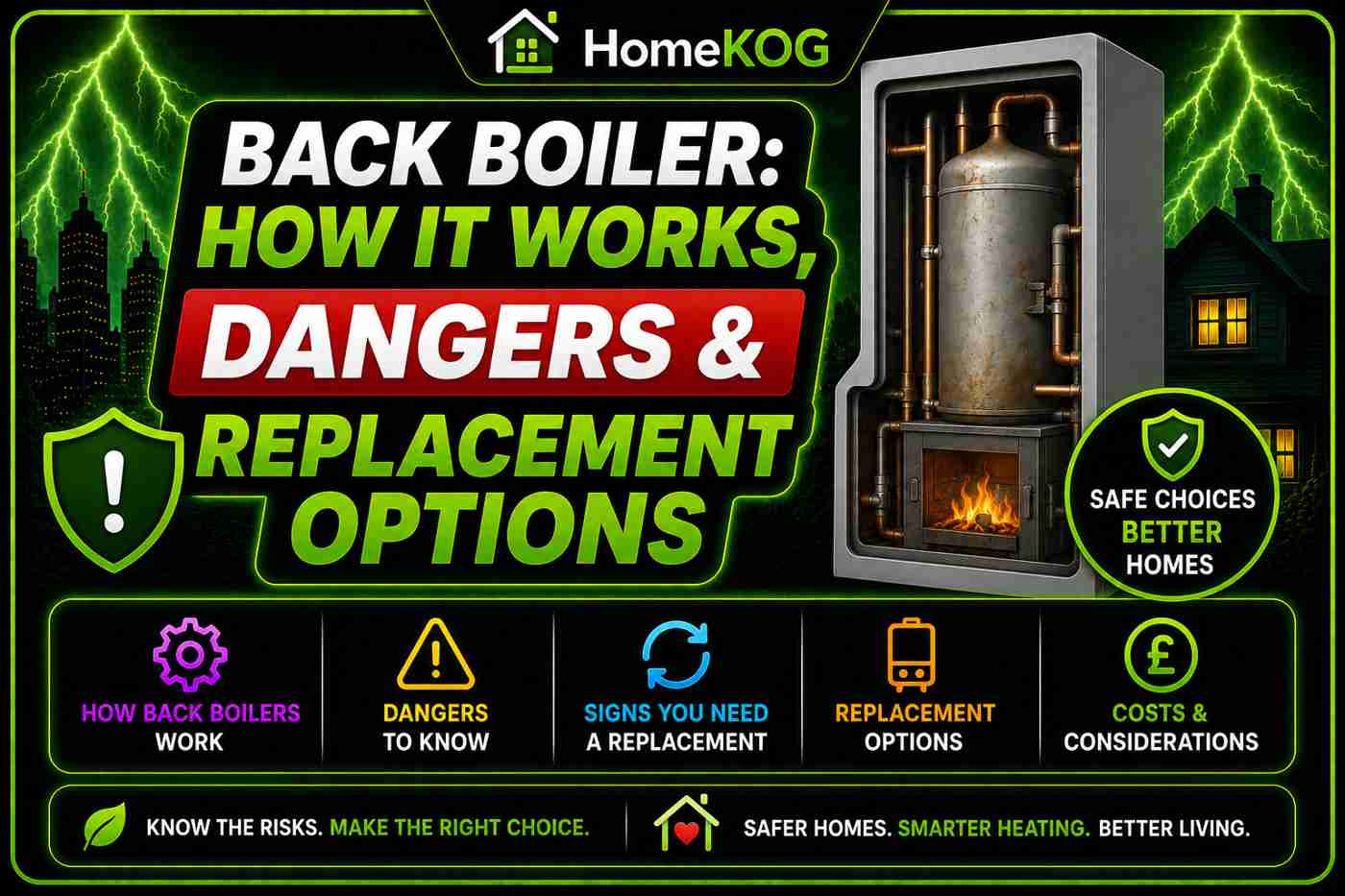
A back boiler is a central heating unit built into the recess behind a fireplace or gas fire. It was designed to use the heat generated by the fire to simultaneously heat domestic hot water and central heating, combining the visual appeal of a fireplace with the functional output of a boiler in a single installation.
Back boilers were first introduced in the 1960s and reached peak popularity through the 1970s and 1980s. The Baxi Bermuda was one of the most widely installed models in UK homes during this period. At the time, they represented an efficient use of available space and a cost-effective heating solution. The arrival of modern condensing boilers — which achieved significantly higher efficiency through flue gas heat recovery — rendered back boilers obsolete by comparison.
Back boilers are no longer manufactured. When an existing back boiler fails, it cannot be replaced with an equivalent unit — current UK building regulations prohibit the installation of non-condensing boilers as replacements in domestic properties. Conversion to a modern condensing boiler is the only compliant option.
How Does a Back Boiler Work?
A back boiler operates using the same fundamental principle as any water-heating boiler — a heat source transfers energy to water, which is then stored and distributed.
- Cold water from a storage tank in the loft enters the back boiler’s heat exchanger.
- The gas or solid-fuel fire burns in front of the back boiler unit, generating heat.
- The heat exchanger behind the fire absorbs this heat and transfers it to the cold water passing through.
- The heated water is pumped to an external hot water storage tank, typically in an airing cupboard, where it is held at temperature until needed.
- When central heating is required, the pump circulates the hot water from the storage tank through the radiator circuit.
- When hot water is required at a tap or bath, it is drawn from the storage tank and delivered to the outlet.
- Cold water from the loft tank continuously replenishes the storage cylinder as hot water is drawn off.
The primary limitation of this process is efficiency. The heat exchanger in a back boiler is relatively small and unsophisticated compared to modern equivalents, and there is no secondary heat recovery from the exhaust gases — all combustion byproducts exit through the flue and are wasted. This produces the characteristic 70% efficiency rating that makes back boilers so expensive to run by modern standards.
Types of Back Boiler
Gas Fire Back Boiler
The gas-fired back boiler was the most common type installed in UK homes. A gas fire provided both the visible flame effect in the living room and the heat source for the boiler behind it. Models such as the Baxi Bermuda dominated the market through the 1970s and 1980s, when they represented a modern and relatively efficient heating solution.
By today’s standards, gas back boilers are significantly inefficient. Their G efficiency rating means they convert only approximately 70% of the gas they consume into useful heat — compared to over 90% for a modern A-rated condensing combi. For a household on an average gas tariff, this efficiency gap costs approximately £580 per year in wasted energy.
Coal Open Fire Back Boiler
A coal open fire back boiler used solid fuel combustion — burning coal or similar solid fuel — to heat the water behind the fireplace. These are considerably rarer than gas back boilers and require even more maintenance, including regular fuel loading, ash removal, and chimney sweeping to maintain safe operation.
Coal is not a clean fuel, and coal back boilers produce significantly higher carbon emissions per unit of heat than gas alternatives. If you have a coal back boiler that has failed, conversion to a modern gas, oil, or heat pump system is strongly recommended.
Back Boiler vs Modern Combi Boiler
The comparison between a back boiler and a modern combi boiler illustrates clearly why the replacement case is so compelling.
| Feature | Back Boiler | Modern Combi Boiler |
|---|---|---|
| Efficiency rating | G-rated (~70%) | A-rated (90%–94%) |
| Estimated annual gas bill saving | Baseline | Up to £580 less per year |
| Space required | Fireplace + loft tank + cylinder | Single wall-hung unit |
| Can be replaced like-for-like | No | Yes |
| Hot water supply | Storage tank (finite) | On demand (unlimited) |
| Smart thermostat compatible | Limited | Yes |
| Hydrogen-ready | No | Yes (20% blend) |
| Servicing cost | Higher (gas fire service also required) | Standard boiler service |
The efficiency gap alone justifies conversion in most cases. A household spending £1,200 per year on gas with a back boiler could expect to spend approximately £620 to £680 per year with a modern A-rated combi — saving the cost of installation within 3 to 5 years through lower bills.
Disadvantages of a Back Boiler
- Low efficiency — operating at approximately 70% efficiency, a G-rated back boiler wastes around 30% of the gas it burns, producing significantly higher energy bills than any modern alternative.
- Cannot be replaced like-for-like — UK building regulations introduced in 2005 prohibit the installation of non-condensing boilers as replacements in domestic properties. When a back boiler fails, conversion to a modern condensing boiler is the only legally compliant option.
- Higher servicing costs — servicing a back boiler requires both a boiler service and a separate gas fire service, increasing the annual maintenance cost compared to a standalone modern boiler.
- Space-intensive — a back boiler installation requires the fireplace unit, a cold water storage tank in the loft, and a hot water cylinder — significantly more space than a modern combi boiler occupying a single airing cupboard position.
- Limited hot water capacity — hot water is dependent on the volume stored in the cylinder. During high-demand periods, the stored supply can be exhausted, requiring a wait while the cylinder reheats.
- Not hydrogen-ready — back boilers cannot operate on hydrogen-blend fuels, meaning they cannot be future-proofed against the UK’s planned gas network transition.
- Higher repair cost — parts for back boilers are increasingly difficult to source as manufacturers have ceased production, making repairs more expensive and sometimes impossible to complete.
- Not suitable for smaller households — the high running and servicing costs relative to the output make back boilers particularly poor value for single-person or smaller households with lower hot water demand.
Is a Back Boiler Safe?
Back boilers are not considered as safe as modern boilers. While a back boiler explosion is rare, the risk is not zero — and the conditions that create it are more likely in a neglected or poorly maintained back boiler than in a modern unit with current safety systems.
The specific risk arises when a back boiler is not in active use but its components — including the flue, the gas supply, and the fireplace structure — remain in place. Without the flue effectively drawing combustion gases out, gas can become trapped in the pipework. In a fireplace that is still used as a real fire without the back boiler being properly decommissioned, heat and pressure can build in weakened pipework, creating an explosion hazard.
If you suspect your back boiler is overheating, smell gas near the fireplace, or have concerns about the safety of the installation, do not attempt to investigate it yourself. Contact a Gas Safe registered engineer immediately.
If you have a back boiler that is no longer in use but has not been formally decommissioned, arrange for a Gas Safe engineer to assess and properly decommission it. Leaving unused gas components connected is not safe.
Back Boiler Regulations
The UK government introduced regulations in 2005 that restricted the installation of new non-condensing boilers in domestic properties, effectively prohibiting like-for-like back boiler replacements from that point. Subsequent regulatory updates further strengthened these restrictions.
The result is that any back boiler currently in use in a UK home is operating on legacy equipment that cannot be replaced in kind. When the back boiler fails — or when the homeowner decides to upgrade — the replacement must be a modern condensing boiler installed to current building regulations.
Replacing a Back Boiler: Your Options
Converting from a back boiler to a modern heating system is a more complex installation than a standard boiler replacement, because it involves removing the back boiler from behind the fireplace, decommissioning the gas fire, capping or removing the old flue, and installing a new boiler in a completely different location with new pipework. The fireplace opening can then be sealed, restored, or converted to an aesthetic non-functional feature.
Combi Boiler Conversion
The most common replacement for a back boiler is a modern gas combi boiler. A combi eliminates the hot water cylinder and loft tank entirely, freeing up the airing cupboard and loft space previously occupied by storage components. It delivers instant mains-pressure hot water and provides central heating from a single compact unit. For homeowners looking to optimize the performance of their new combi boiler, understanding boiler maintenance tips for homeowners is essential. Regular servicing can enhance efficiency and prolong the lifespan of the unit, ensuring smooth operation during peak heating times. Additionally, homeowners should be aware of common signs that indicate the need for professional repairs or maintenance, helping to prevent costly breakdowns.
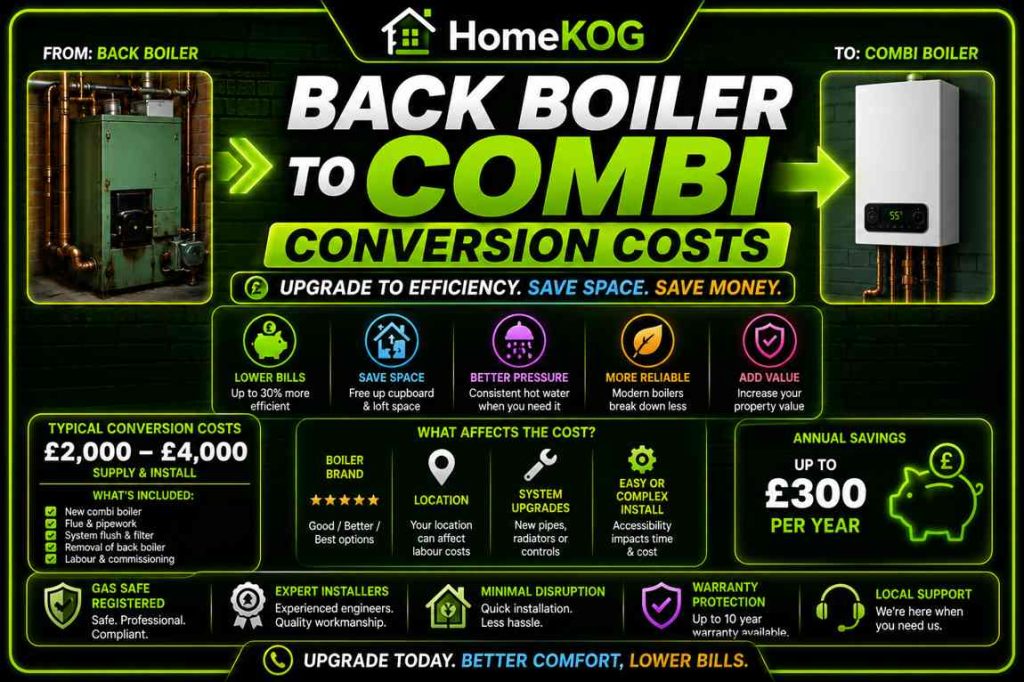
A back boiler-to-combi conversion typically costs £3,000 to £5,000, averaging £4,000, and usually takes 2 to 3 days. The efficiency savings compared to the old back boiler mean the conversion typically pays back its cost in energy savings within 3 to 5 years.
System Boiler Conversion
For larger homes with multiple bathrooms and high simultaneous hot water demand, a system boiler paired with a modern unvented hot water cylinder — such as a Megaflo — may be the better replacement option. A system boiler delivers hot water to multiple outlets simultaneously at full mains pressure, outperforming a combi boiler in properties with regular concurrent demand.
Conventional Boiler Replacement
If the existing conventional hot water cylinder and associated pipework are in good condition, a like-for-like conventional boiler replacement — simply replacing the back boiler unit with a modern conventional condensing boiler mounted in a new location — preserves the existing storage infrastructure while upgrading the heat source to a current A-rated condensing model.
Frequently Asked Questions
Can a back boiler be replaced?
A back boiler cannot be replaced with an equivalent back boiler — UK building regulations introduced in 2005 prohibit the installation of non-condensing boilers as replacements in domestic properties. When a back boiler fails or a homeowner decides to upgrade, the replacement must be a modern condensing boiler. The most common replacement is a gas combi boiler installed in a new location, with the back boiler and gas fire decommissioned and removed.
How much does it cost to replace a back boiler?
Replacing a back boiler with a modern combi boiler typically costs between £3,000 and £5,000, with an average of approximately £4,000. The conversion involves removing the back boiler, decommissioning the gas fire, and installing a new combi boiler in a new location, with new pipework and a dedicated flue — typically a 2 to 3-day installation. The annual energy savings of up to £580 mean the conversion pays for itself in reduced bills within 3 to 5 years.
How efficient is a back boiler?
A back boiler operates at approximately 70% efficiency — meaning approximately 30% of the fuel it burns is wasted as heat that exits through the flue, unused to heat the home. Modern A-rated condensing boilers achieve efficiency ratings of 90% to 94%, recovering heat from exhaust gases that back boilers waste entirely. This efficiency gap costs approximately £580 per year in additional gas bills compared to a modern replacement, making back boilers significantly more expensive to run than any current alternative.
Is a back boiler dangerous?
Back boilers carry safety risks not present in modern boilers. While a back boiler explosion is rare, it can occur when unused gas components remain in place and are not properly decommissioned, allowing gas to accumulate in weakened pipework. Back boilers are also not equipped with the safety systems and carbon monoxide protection features standard in modern units. If you have concerns about a back boiler — whether in use or not — contact a Gas Safe-registered engineer for a safety assessment.
Should I replace my back boiler?
Yes — if you have a back boiler, replacing it with a modern condensing boiler is strongly recommended for efficiency, safety, and regulatory compliance reasons. Back boilers cannot be replaced like-for-like when they fail, making conversion an inevitability. Replacing it proactively — before it fails — allows time to compare quotes, choose the right replacement boiler type, and plan the installation at a convenient time. The annual energy savings of up to £580 mean the sooner the conversion takes place, the sooner those savings begin to accumulate.
What replaced back boilers?
Back boilers were replaced by modern gas condensing boilers — primarily combi boilers for most UK homes, and system boilers for larger properties with multiple bathrooms and high hot water demand. Modern condensing combi boilers achieve over 90% efficiency compared to a back boiler’s 70%, are significantly more compact, require less maintenance, and are hydrogen-ready to a 20% blend for future fuel compatibility. The combi boiler is now the most common type of central heating boiler in the UK. When considering a new boiler, it’s important to follow some boiler installation tips for homeowners to ensure the process goes smoothly. Proper sizing and placement can greatly affect efficiency and comfort, making it essential to consult with professionals. Additionally, understanding the unique demands of your home, such as the number of bathrooms and heating needs, can further guide your selection and installation process.
Conclusion: Don’t Wait for a Back Boiler Breakdown
A back boiler is not a heating system to maintain — it is one to replace. Its inefficiency costs money every day it remains in operation. Its inability to be replaced like-for-like when it fails means a conversion is an inevitability, not a choice. And its safety risks — while manageable with regular servicing — are not present in any modern alternative. Homeowners need to be aware of the importance of boiler maintenance frequency for homeowners to ensure their heating systems are running efficiently. Regular checks can help identify issues before they become significant problems, ultimately saving money and enhancing safety. Ignoring these maintenance needs can lead to larger, costlier repairs and potential risks in the long run.
The £3,000 to £5,000 cost of a back boiler conversion is a significant investment, but one that delivers an immediate and substantial return through reduced energy bills. The annual saving of up to £580 means the conversion pays for itself within 3 to 5 years — and every year beyond that, the saving is pure financial benefit. understanding ideal boiler service costs explained can further illuminate the financial advantages of such conversions. By investing in quality service, homeowners can ensure their systems run efficiently, maximizing savings on energy bills. With a well-maintained boiler, the potential for additional cost savings and home comfort is significant. Evaluating boiler service duration and schedule is crucial for maintaining optimal performance and prolonging the lifespan of your system. Regularly scheduled services not only prevent unexpected breakdowns but also ensure that the boiler operates at peak efficiency. Homeowners should consider the long-term benefits of consistent maintenance, as it contributes to ongoing energy savings and reliability.
Get a fixed price from a Gas Safe-registered engineer, confirm the right replacement boiler type for your property, and arrange the conversion at a time of your choosing, rather than waiting for the back boiler to fail in the middle of winter.