
How Long Does a Boiler Installation Take? Complete Time Guide
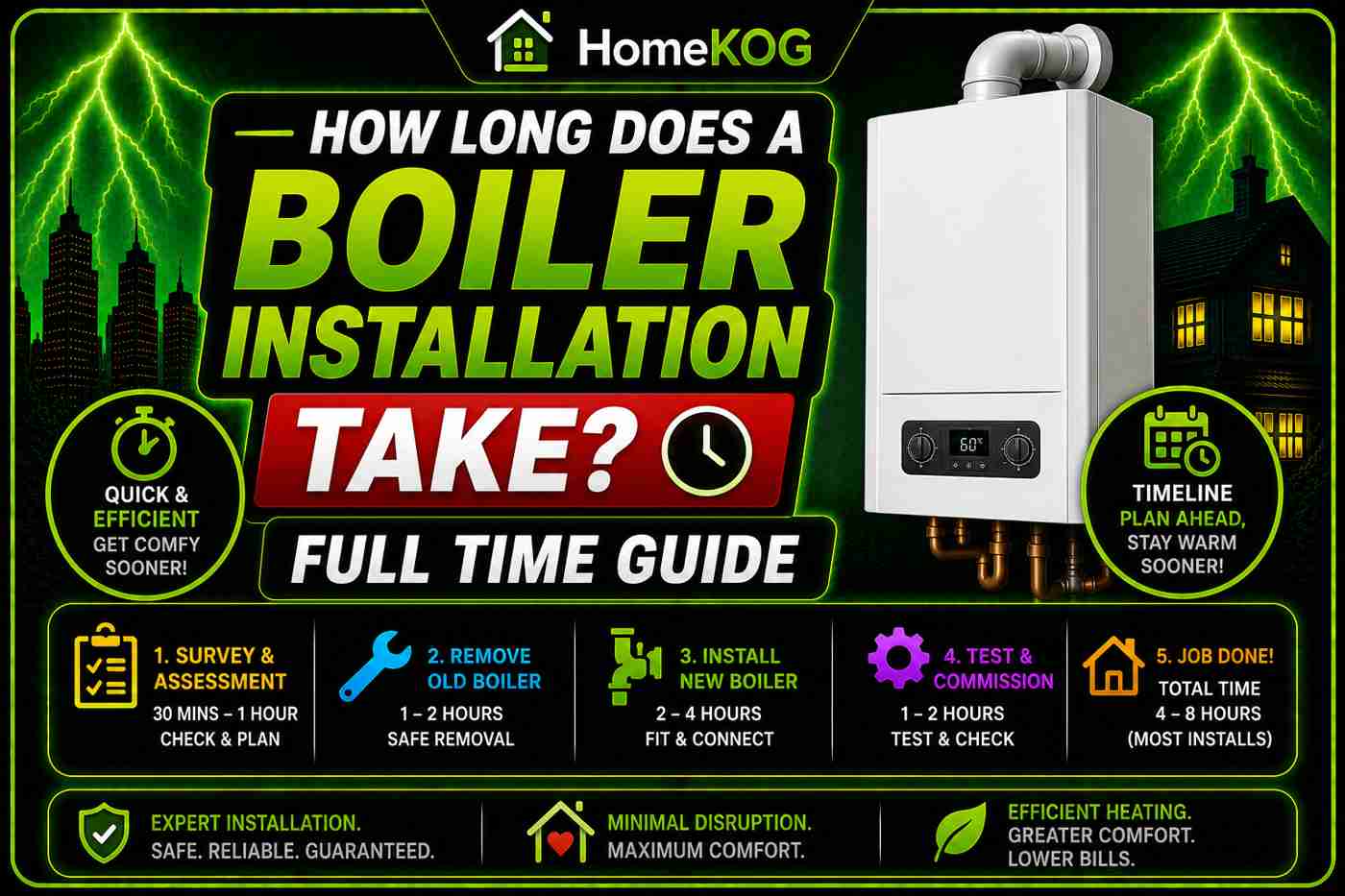
Quick Answer: A like-for-like boiler swap in the same location typically takes 4 to 6 hours, one day at most. Moving the boiler to a new location adds half a day to a full day. Converting from one boiler type to another — for example, a conventional boiler to a combi — takes 1 to 2 days. A back boiler conversion takes 2 to 3 days. All gas boiler installations must be carried out by a Gas Safe-registered engineer.
Get a new boiler quote here online >
Introduction
One of the most common questions before arranging a new boiler installation is how long the work will take and how much disruption to expect. The honest answer is: it depends on the type of installation, whether the boiler is staying in the same location, and whether the boiler type is changing.
A simple like-for-like combi boiler swap in the same kitchen cupboard is one of the quickest and least disruptive domestic heating jobs available — often completed within a single working day with the heating back on before the engineer leaves. A full back boiler conversion or a switch from a conventional system to a combi in a new location is a more involved 2 to 3 day project.
This guide gives accurate time estimates for every common installation scenario, explains what happens during the installation process, and covers how to make the process as smooth and efficient as possible.

Understanding Boiler Installation Times: The Core Relationships
Boiler installation time is determined by the interaction of several factors — understanding each one allows realistic planning before the engineer arrives. One important consideration is the best season for boiler installation, as demand fluctuates throughout the year. Scheduling your installation during the off-peak season can not only result in quicker service but also potentially lower costs. Additionally, being proactive in your planning can ensure that you have a fully functional heating system when the colder months arrive. When considering boiler installation, it’s also essential to familiarize yourself with ideal boiler service pricing details to avoid unexpected expenses. Researching various service providers can help you gauge the average market rates and select a deal that aligns with your budget. This knowledge can empower you to make informed choices about both installation and ongoing maintenance for your heating system.
- A like-for-like boiler swap replaces an existing boiler with the same boiler type in the same location, reusing the existing pipework, flue position, and connections — it is the fastest installation scenario and typically takes 4 to 6 hours.
- A boiler relocation moves the boiler unit from its existing position to a new location in the property, requiring new pipework runs, a new flue penetration through the external wall, and additional connection work — adding half a day to a full day to the total time.
- A boiler type conversion switches from one boiler configuration to another — for example, from a conventional boiler to a combi — requiring removal of the old system’s components and significant pipework changes that extend the installation to 1 to 2 days.
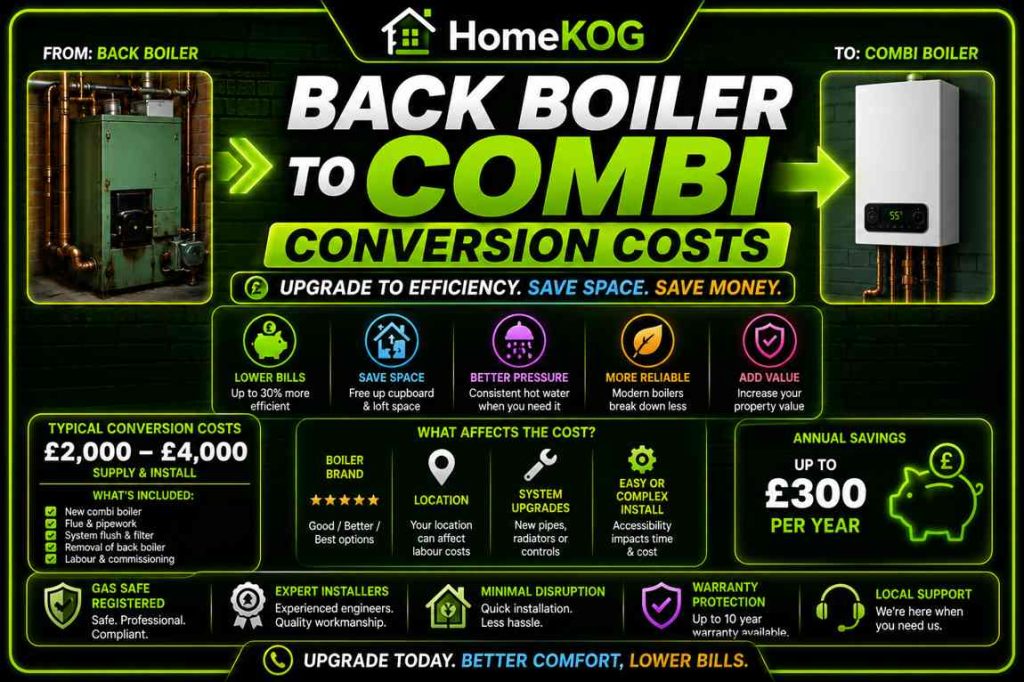
- A back boiler conversion replaces a back boiler behind a fireplace with a modern wall-hung boiler in a new location — the most complex domestic boiler installation, typically taking 2 to 3 days due to the structural and pipework implications.
- A Gas Safe registered engineer is the only professional legally qualified to install a gas boiler in the UK — gas, water, and electrical connections all require Gas Safe certification, and installation by an unregistered person is illegal and dangerous.
- An installation time estimate provided at the surveyor or quotation stage accounts for the specific pipework layout, flue routing, and system configuration of the individual property — it is more accurate than a general average.
- A boiler commissioning process involves testing gas pressure and flow, confirming flue installation and ventilation, verifying heating and hot water output, and completing the required Gas Safe documentation — this testing phase is part of the quoted installation time.
- A boiler service takes approximately 1 to 2 hours and should be carried out annually by a Gas Safe engineer to maintain efficiency, validate the manufacturer warranty, and identify developing faults.
- An unvented cylinder installation — such as a Megaflo — adds 1 to 3 days to the installation time depending on the size of the unit and the property, making it one of the longer domestic heating installations.
- Unexpected complications including corroded pipework, an insufficient gas supply pipe, or flue routing challenges can extend any installation beyond the estimated time — a good engineer will communicate these promptly and provide a revised timeline.
- Next-day boiler installation is available from specialist heating installers for standard like-for-like replacement scenarios where no major pipework or system conversion is required.
Boiler Installation Time by Scenario
The following table gives accurate average installation times for every common scenario.
| Installation Scenario | Typical Time |
|---|---|
| Like-for-like combi boiler swap (same location) | 4–6 hours (1 day) |
| Combi boiler swap with relocation | 1–2 days |
| System boiler like-for-like swap (same location) | 1 day |
| System boiler with relocation | 1–2 days |
| Conventional boiler like-for-like swap | 1 day |
| Conventional boiler with relocation | 1–2 days |
| Conventional boiler to combi conversion | 1–2 days |
| System boiler to combi conversion | 1–2 days |
| Combi to conventional boiler conversion | 2–4 days |
| Back boiler to combi conversion | 2–3 days |
| New unvented cylinder (Megaflo) installation | 1–3 days |
| Annual boiler service | 1–2 hours |
These are average times under normal conditions. An engineer’s site-specific estimate, provided after a survey or detailed property assessment, will be more accurate for a specific installation.
Like-for-Like Combi Boiler Swap: The Fastest Installation
A like-for-like combi boiler swap is the most common and fastest boiler installation scenario in the UK. It involves replacing an existing combi boiler with a new combi boiler in the same wall position, reusing the existing flue, gas connection, and pipework connections.
Under normal conditions — no corroded pipework, no flue rerouting, no gas supply issues — a like-for-like combi swap takes 4 to 6 hours. An engineer starting at 8am will typically have the new boiler operational and fully tested by early afternoon. The heating system is off for the duration of the work, which for a single-day installation represents minimal disruption.
What makes a like-for-like swap fast:
- The flue position does not change — no new wall penetration is required.
- The existing gas supply connection is reused — no gas pipe extension needed.
- The existing pipework connections are adapted for the new boiler — minimal new pipework is required.
- The controls wiring from the thermostat is reconnected to the new unit — no new cabling in most cases.
The remainder of the day — after the physical installation — is spent on commissioning and safety testing, which are required for Gas Safe compliance and to register the installation with the manufacturer for warranty purposes.
Boiler Relocation: Adding Half a Day to a Full Day
Moving the boiler from its current position to a new location — for example, from a bedroom airing cupboard to a kitchen cupboard — adds half a day to a full day to the total installation time, depending on the distance and complexity of the new pipework route. To ensure optimal performance and longevity, it is crucial to adhere to boiler maintenance schedule guidelines following the installation. Regular checks can help identify potential issues before they escalate, thereby reducing repair costs and enhancing safety. Homeowners should familiarize themselves with these guidelines to maximize efficiency and reliability. Understanding the recommended boiler servicing frequency is essential for maintaining peak performance. This involves scheduling regular inspections, typically once a year, to ensure everything functions correctly and to prevent breakdowns. By following this frequency, homeowners can extend the lifespan of their boiler and avoid costly repairs down the line.
The additional time accounts for:
- New pipework — the existing flow and return pipes from the radiator circuit must be extended or rerouted to reach the new boiler position.
- New gas supply pipe — the gas supply must be extended from its existing connection point to the new boiler location.
- New flue penetration — the flue must exit through the nearest suitable external wall from the new boiler position, which may require drilling through brick or blockwork.
- Making good — any holes or pipe routes through walls and floors must be sealed, plastered, or boarded where required.
A boiler relocation that involves only a short move within the same room or to the adjacent wall is typically completed in a day. A relocation to a different room or floor can require 2 days.
Boiler Type Conversion: 1 to 2 Days
Converting from one boiler type to another involves more than replacing the boiler unit — it requires removing or decommissioning the components associated with the old system and modifying the pipework to suit the new configuration.
Conventional Boiler to Combi Conversion
Converting from a conventional (regular) boiler to a combi boiler is one of the most common conversion scenarios. It involves:
- Removing the conventional boiler and replacing it with the combi.
- Decommissioning the hot water cylinder in the airing cupboard.
- Removing or bypassing the cold water storage tank and feed and expansion tank in the loft.
- Modifying the pipework from a gravity-fed configuration to a mains pressure configuration.
This work typically takes 1 to 2 days. The removal of the loft tanks and airing cupboard cylinder frees up significant storage space as a benefit of the conversion.
System Boiler to Combi Conversion
Switching from a system boiler to a combi is similar but slightly simpler than a conventional to combi conversion — system boilers have no loft tanks, so only the hot water cylinder needs decommissioning in addition to the boiler replacement. Typical time: 1 to 2 days.
Combi to Conventional Boiler Conversion
Converting in the other direction — from a combi to a conventional or system boiler — is the most time-intensive common conversion. It involves installing new infrastructure that did not previously exist: a hot water cylinder, and in the case of a conventional boiler, cold water storage tanks. Installing and connecting new cylinder infrastructure extends the job to 2 to 4 days.
Back Boiler Conversion: 2 to 3 Days
A back boiler conversion is the longest common domestic boiler installation, typically taking 2 to 3 days. The additional time compared to other conversions reflects the structural element of removing a boiler from behind a fireplace, decommissioning the gas fire, creating a new flue penetration in an external wall, and running entirely new pipework from the fireplace recess to the new boiler position in another room.
Back boiler conversions also generate more disruption than other installation types — floor damage, pipework removal, dust, and dirty water are all common. A competent Gas Safe engineer will manage this professionally and leave the property clean at the end of each working day. back boiler operation and maintenance requires careful attention to detail to ensure safety and efficiency. Regular servicing is essential to prevent potential issues that could arise from wear and tear over time. Homeowners should schedule annual checks to maintain optimal performance and avoid costly repairs.
What Happens During a Boiler Installation?
Understanding what the engineer actually does during an installation helps set expectations for how the day will run.
1. Disconnection and Removal of the Old Boiler
The engineer switches off the gas, water, and electrical supplies to the existing boiler, drains the system where required, disconnects all connections, and removes the boiler from its mounting bracket. Old boilers are typically taken away for disposal.
2. Preparation of the Mounting Position
If the new boiler is being installed in the same position, the wall bracket from the new boiler is fitted and any minor pipework adjustments are made. For a relocation or conversion, new pipework and gas connections are run at this stage.
3. Boiler Installation
The new boiler is hung on the bracket and all connections are made — gas supply, cold water inlet, flow and return pipes to the heating circuit, and electrical connections for the controls. The flue is fitted through the external wall.
4. System Filling and Pressure Testing
The system is refilled with water, a dose of central heating inhibitor is added, and the sealed system is pressurised to the correct operating range (1 to 1.5 bar). The gas connections are tested with leak detection fluid or an electronic leak detector before the gas is turned on.
5. Commissioning and Safety Testing
The boiler is lit for the first time and run through a full heating cycle. The engineer checks all radiators heat correctly, confirms hot water delivery at the recommended temperature, tests the flue for correct operation and ventilation, and measures gas pressure and flow against the manufacturer’s specifications. Smart thermostat or controls are set up and demonstrated.
6. Handover and Documentation
The engineer completes the required Gas Safe registration, provides the homeowner with the boiler manual and warranty information, registers the installation with the manufacturer for warranty activation, and demonstrates the controls. A Building Regulations Compliance Certificate is issued for the installation.
Can You Install a Boiler Yourself?
No — installing a gas boiler yourself is illegal under the Gas Safety (Installation and Use) Regulations 1998. Gas connections, gas pressure testing, and gas appliance commissioning must be carried out by a Gas Safe registered engineer. An installation by an unregistered person is illegal regardless of the outcome, is not covered by any warranty, and creates a risk of gas leak, carbon monoxide exposure, and fire.
All gas boiler installations in the UK must be carried out by a Gas Safe registered engineer. Verify any engineer’s registration at gassaferegister.co.uk before allowing work to proceed.
Frequently Asked Questions
How long does a boiler installation take?
A like-for-like combi boiler swap in the same location takes 4 to 6 hours — typically completed within a single working day. Moving the boiler to a new location adds half a day to a full day. Converting from one boiler type to another — for example, from a conventional boiler to a combi — takes 1 to 2 days. A back boiler conversion takes 2 to 3 days. All installations must be carried out by a Gas Safe registered engineer.
How long does a like-for-like combi boiler swap take?
A like-for-like combi boiler swap — replacing an existing combi with a new combi in the same position — typically takes 4 to 6 hours under normal conditions. The physical installation is completed in the first portion of the day, with the remainder spent on commissioning, safety testing, Gas Safe documentation, and handover to the homeowner. Most homeowners have their heating and hot water back on the same day.
How long does a conventional boiler to combi conversion take?
Converting from a conventional boiler to a combi boiler typically takes 1 to 2 days. The additional time compared to a like-for-like swap reflects the work required to decommission the hot water cylinder and cold water storage tanks, reroute the pipework from a gravity-fed to a mains-pressure configuration, and install the new combi boiler in the appropriate position. The benefit is a significantly simpler system that requires less maintenance and frees up substantial storage space.
Can I get a boiler installed next day?
Yes — next-day boiler installation is available from specialist heating installers for standard like-for-like replacement scenarios. Combi boiler swaps, system boiler swaps, and conventional boiler swaps in the same location can all typically be arranged for next-day installation. More complex conversions or relocations may require a survey visit before a firm installation date can be confirmed.
Does boiler installation include removal of the old boiler?
Yes — boiler replacement includes removal of the old boiler as part of the installation process. Removing an old boiler from its wall bracket is relatively quick and does not add significantly to the overall installation time. Most engineers include old boiler disposal as part of the installation service. The main time variables in any boiler replacement are the new pipework required, the flue routing, and any system conversion work.
How long does a boiler service take?
An annual boiler service typically takes 1 to 2 hours. The service includes cleaning the heat exchanger, checking the burner and combustion performance, inspecting the flue and all safety devices, checking system pressure, and identifying any developing faults. Annual servicing is required to maintain the validity of most manufacturer warranties and is recommended by all major boiler manufacturers and Gas Safe engineers for all gas appliances. boiler servicing times for homeowners can vary depending on the specific requirements of the system and the efficiency of the technician. It’s important for homeowners to schedule their annual service in advance to ensure availability and avoid potential delays in the colder months. Regular maintenance not only extends the lifespan of the boiler but also enhances energy efficiency, helping to reduce overall heating costs.
Conclusion: Plan for the Right Amount of Time
The time required for a boiler installation is predictable once the installation type is confirmed. A like-for-like combi swap is a one-day job; a back boiler conversion is a 2 to 3 day project. Planning around the correct timescale — and understanding what the engineer will be doing throughout — makes the installation experience straightforward rather than stressful.
Get a site-specific estimate from a Gas Safe engineer before committing to an installation date. A brief phone conversation or visit to confirm the pipework layout, flue position, and system configuration takes the guesswork out of timescales and ensures the boiler is available on the day, the work is completed properly, and your heating is back on as quickly as possible.