
Worcester Bosch U9 Fault Code: Meaning, Causes & How to Fix It
Quick Answer: The Worcester Bosch U9 fault code indicates the boiler has reached an internal temperature of 109°C — 9 degrees above the 100°C threshold at which the “U” overheating indicator activates. It appears across all Worcester Bosch combi and conventional models and is typically caused by limescale in the heat exchanger or flow pipe, an air blockage, a faulty circulation pump, or a failed thermistor. A Gas Safe registered engineer is required to diagnose and repair the fault.
The U9 code is not listed in the standard Worcester Bosch user manual fault tables, which is why it catches many homeowners off guard. It is not a conventional fault code in the strictest sense — it is an overheating indicator displaying how far above 100°C the boiler has climbed, with the digit after U showing the excess degrees. A U9 therefore means 109°C, and the number will drop as the boiler cools. What it tells you reliably is that something is preventing heat from being circulated away from the boiler effectively enough to keep internal temperatures within a safe range.
Get a new boiler quote online here >
Worcester Bosch U9 Fault Code: Key Entity Relationships
- The Worcester Bosch U9 fault code is an overheating indicator displayed when the boiler’s internal temperature reaches 109°C, with the letter U representing temperatures above 100°C and the digit 9 indicating the number of degrees above that threshold.
- Overheating in a Worcester Bosch boiler occurs when heat generated in the heat exchanger cannot be distributed through the central heating circuit at a sufficient rate, causing internal temperatures to rise to the level that triggers the U9 lockout.
- Limescale build-up in the heat exchanger is the most common cause of the U9 fault code in hard water areas, where calcium and mineral deposits progressively restrict water flow through the exchanger and reduce its ability to transfer heat into the central heating circuit.
- The heat exchanger is the primary component within the Worcester Bosch boiler through which combustion gases transfer heat into the circulating central heating water, with limescale blockage or physical cracking causing circulation restriction and the overheating that produces the U9 code.
- The flow pipe thermistor is a temperature-sensing resistor mounted at the flow pipe of the Worcester Bosch boiler that monitors water temperature and reports resistance readings to the PCB, with limescale accumulation around the thermistor creating localised hot spots that can produce an elevated U9 reading.
- A central heating pump is the circulation component that drives heated water from the boiler through the radiator circuit, with pump failure, seizure, or blockage by heating sludge preventing adequate flow and causing the boiler to overheat and display the U9 fault code.
- Heating sludge is the mixture of rust particles, iron oxide, and debris that accumulates in the central heating circuit and can block pump components and pipework, restricting water circulation to the level that triggers overheating and the U9 code.
- An air blockage is a cause of U9 when trapped air within the heating circuit prevents water from flowing freely through radiators or pipework, reducing circulation and causing the boiler to retain heat that would normally be distributed through the system.
- A power flush is a professional system cleaning process in which a Gas Safe engineer uses high-velocity water and specialist chemicals to remove limescale and heating sludge from the heat exchanger, pipework, and pump, restoring adequate circulation and resolving the overheating condition that triggers U9.
- A magnetic filter is a supplementary heating system device that captures iron oxide and metallic debris circulating in the heating water, reducing the rate of sludge accumulation that blocks pumps and pipework and contributes to U9 overheating conditions.
- A Gas Safe registered engineer is the legally required professional for all Worcester Bosch U9 fault diagnosis and repair work, including heat exchanger assessment and flushing, pump inspection and replacement, thermistor testing, and air blockage identification.
- Annual Worcester Bosch boiler servicing by a Gas Safe registered engineer reduces the likelihood of U9 fault appearances by identifying developing limescale, sludge accumulation, and pump deterioration before they restrict circulation to the level that causes overheating.

What Does the Worcester Bosch U9 Fault Code Mean?
The U code on a Worcester Bosch boiler display is not a standard fault code in the way that EA 229 or A21 are — it is an overheating indicator. When the boiler’s internal temperature exceeds 100°C, the letter U appears on screen, and the digit that follows shows how many degrees above that threshold the boiler has reached. U9 therefore means the boiler has hit 109°C.
The reason U9 does not appear in the standard Worcester Bosch fault code manual is that it is an informational display rather than a coded diagnostic message. What it communicates is clear regardless: the boiler is significantly hotter than it should be, it has locked out to prevent further heat build-up and internal damage, and the cause is something preventing adequate heat distribution through the central heating circuit.
When the boiler is in U9 lockout, attempting to switch the heating on will cause it to fire briefly, heat up rapidly, and cut out again as the overheating condition reasserts itself. As the boiler cools following lockout, the number displayed after U will drop — U8, U7, and so on — confirming the unit is cooling rather than deteriorating further. Once cool, a reset may allow the boiler to operate briefly, but the U9 code will return if the underlying circulation fault has not been addressed.
Common Causes of the Worcester Bosch U9 Fault Code
Limescale Build-Up in the Heat Exchanger
Limescale accumulation in the heat exchanger is the most frequent cause of U9, particularly in hard water areas across much of England. The heat exchanger is where combustion heat transfers into the central heating water, and it does this job effectively only when water can flow through it freely. When calcium, magnesium, and mineral deposits progressively build up on the inner surfaces of the exchanger, the available water pathway narrows and flow resistance increases.
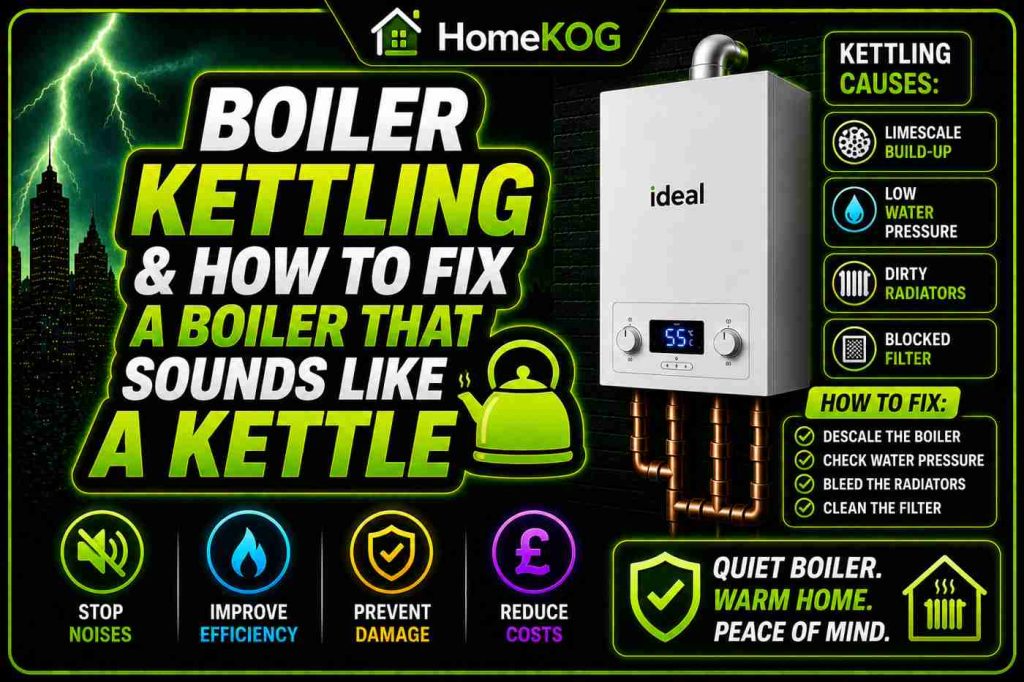
The characteristic sign of significant heat exchanger limescale is a kettling sound from the boiler — a rumbling or hissing noise similar to a kettle approaching boiling point, caused by water superheating within the scale-restricted passages. As the restriction worsens, the water cannot carry heat away from the exchanger fast enough, internal temperatures rise, and U9 follows.
If identified before the heat exchanger cracks, a Gas Safe engineer can carry out a power flush — sending specialist chemical cleaners through the heating system under pressure to dissolve and flush out the accumulated deposits. The cost depends on the number of radiators in the property, which determines the chemical volume and time required. Where the limescale has caused the heat exchanger to crack, water can escape internally, further reducing flow and potentially damaging other boiler components. A cracked heat exchanger requires replacement, costing up to approximately £550 depending on the Worcester Bosch model. Fitting a magnetic filter and adding inhibitor after treatment reduces the rate of future accumulation.
Limescale Around the Flow Pipe Thermistor
A related but distinct cause of U9 involves limescale accumulating specifically around the flow thermistor rather than throughout the heat exchanger. The flow thermistor monitors water temperature at the flow pipe and transmits resistance readings to the PCB as confirmation that the system is operating safely. When limescale builds up around the thermistor itself, it creates a localised hot spot — a small section of the flow pipe where the temperature is elevated relative to the rest of the system.
The PCB receives the thermistor’s resistance reading and interprets it as an elevated flow temperature, triggering the U9 overheating response even though the broader system may be operating within acceptable parameters. A Gas Safe engineer will test the thermistor using a multimeter to confirm whether it is reading accurately. Where the thermistor is found to be inaccurate due to limescale interference or age-related failure, replacement is required — the part itself is inexpensive at approximately £10, with the total cost determined by the labour time involved.
Air Blockage in the Heating Circuit
Trapped air in the central heating circuit can prevent water from flowing freely through radiators and pipework, creating circulation restrictions that reduce the system’s ability to carry heat away from the boiler. When affected radiators fail to heat fully — particularly at the top where air tends to collect — the overall circulation rate drops and internal boiler temperatures rise toward the U9 threshold.
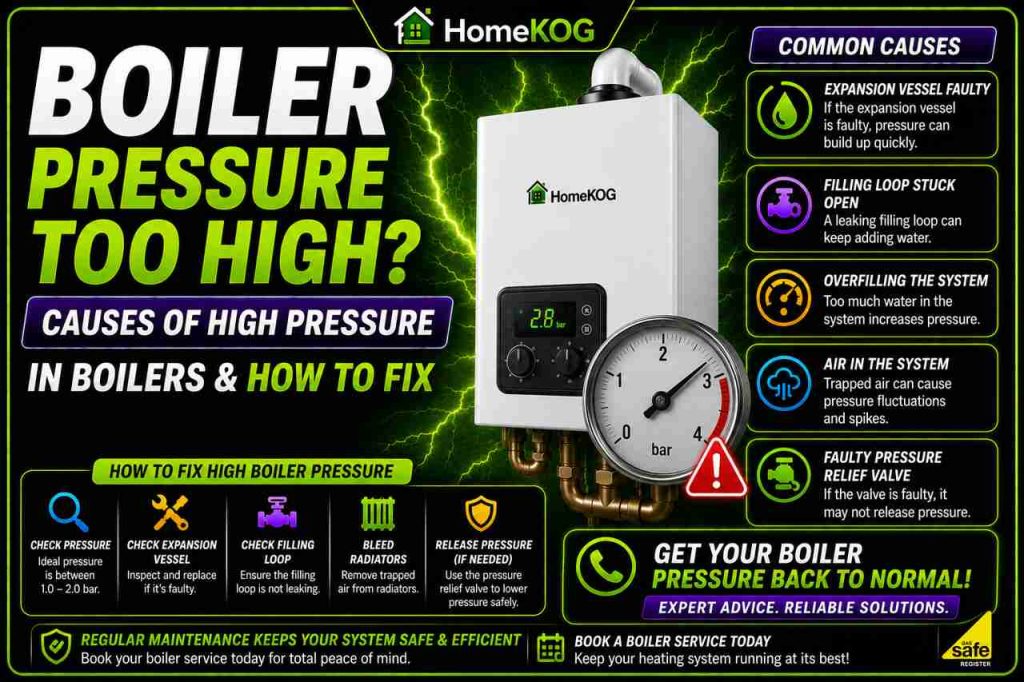
Bleeding radiators is the homeowner-accessible step for addressing air blockages. Using a radiator key to open the bleed valve on each radiator and allowing air to escape until water flows steadily from the valve purges the trapped air and restores normal flow. After bleeding, the system pressure will drop slightly and should be restored to 1.5 bar using the filling loop before resetting the boiler.
If the U9 code persists after bleeding and repressurisation, the air blockage was not the primary cause or was not the only restriction present in the system, and a Gas Safe engineer should investigate further.
Faulty Circulation Pump
The circulation pump drives the movement of heated water from the boiler through the radiator circuit and back. A pump that has failed, seized, or been partially blocked by heating sludge cannot maintain the flow rate the system requires, and the heat generated in the heat exchanger accumulates within the boiler rather than being distributed. The result is the overheating that triggers U9.
Heating sludge — the rust and debris mixture that builds up in poorly maintained systems — is a particular risk to pumps, as particles can work their way into moving components and cause jamming. A pump that makes unusual sounds during operation, or that feels excessively hot on its casing, may be indicating developing internal damage. In some cases, a gentle mechanical tap on the pump body can free a seized component temporarily, though this is not a lasting fix.
A Gas Safe engineer will check the pump speed setting first, as a speed that is too low for the property size will produce the same symptom as partial failure. If the pump is blocked by sludge, flushing the system and cleaning the pump may restore function. Where the pump has failed mechanically, replacement is required. Fitting a magnetic filter after any pump-related repair prevents future sludge accumulation from causing the same problem.
Failed Thermistor
Where limescale, pump faults, and air blockages have all been assessed and found not to be the cause of U9, a thermistor that has failed through age or component deterioration may be responsible. A thermistor that has stopped functioning correctly does not report accurate temperature data to the PCB, and the board may respond to inaccurate readings by triggering the overheating lockout even when the actual system temperature is within a safe range.
A Gas Safe engineer uses a multimeter to test the thermistor’s resistance against expected values for the current water temperature. Where the thermistor is found to be reading outside specification, replacement is straightforward and inexpensive.
What Can the Homeowner Do?
The one practical step available to homeowners when U9 appears is bleeding the radiators. If some radiators are not heating fully, particularly at the top, trapped air is a plausible contributing cause and bleeding them is a safe and useful action before an engineer is called.
To bleed a radiator, insert a radiator key into the bleed valve — located at the top corner of the radiator — and turn it anticlockwise by a quarter turn. Hold a cloth beneath the valve to catch any water. Hissing air will escape initially, and once a steady drip of water appears the air has been purged. Close the valve, move to the next radiator, and repeat. Top up the boiler pressure to 1.5 bar via the filling loop once all radiators have been bled.
Beyond bleeding radiators, all further investigation and repair must be carried out by a Gas Safe registered engineer. An overheating boiler carries genuine risks — at extreme temperatures internal damage escalates rapidly, and attempting to investigate combustion system components or pump assemblies without appropriate qualifications is both illegal and dangerous. In addition to the mentioned hazards, homeowners should also consider back boiler safety concerns and risks that can arise if the appliances are not regularly serviced. Regular inspections not only ensure compliance with safety regulations but also help in identifying potential issues before they escalate. It is essential to prioritize these safety measures to protect both the property and its occupants.
FAQ: Worcester Bosch U9 Fault Code
What does the Worcester Bosch U9 fault code mean?
The U9 fault code on a Worcester Bosch boiler indicates the internal temperature has reached 109°C. The letter U appears when the boiler exceeds 100°C, and the digit indicates how many degrees above that threshold it has climbed. U9 therefore means 109°C. The boiler locks out to prevent further heat build-up and internal damage. It is not listed in the standard Worcester Bosch fault manual as it is an overheating indicator rather than a conventional fault code, but it is a serious condition that requires diagnosis and repair by a Gas Safe registered engineer.
What causes the Worcester Bosch U9 fault code?
The most common causes are limescale build-up in the heat exchanger restricting water flow, limescale accumulation around the flow thermistor creating inaccurate elevated temperature readings, air blockages in the circuit preventing full circulation, a faulty or seized circulation pump unable to distribute heat from the boiler, and heating sludge blocking pump components or pipework. In less common cases, a thermistor that has failed through age produces inaccurate readings that trigger the U9 overheating response.
Can I fix the Worcester U9 fault code myself?
The only action a homeowner can safely take is bleeding the radiators to purge any trapped air that may be contributing to circulation restriction. Radiator bleeding requires only a radiator key and a cloth, and is safe to carry out without Gas Safe registration. If the U9 code persists after bleeding and repressurisation, all further investigation — heat exchanger assessment, pump testing, thermistor checking, and system flushing — must be carried out by a Gas Safe registered engineer. An overheating boiler should not be repeatedly reset and run without professional diagnosis.
What does the kettling sound mean on a Worcester Bosch boiler?
A kettling sound — a rumbling or hissing noise similar to a kettle nearing boiling point — is a strong indicator of limescale accumulation within the heat exchanger. The sound is produced when water superheats within scale-restricted passages in the exchanger before it can flow freely through the system. Kettling that precedes a U9 fault code is a reliable sign that limescale is the primary cause of the overheating, and that the heat exchanger requires a professional power flush or, if cracking has occurred, replacement.
How much does it cost to repair a Worcester Bosch U9 fault?
Repair costs depend on the identified cause. Radiator bleeding costs nothing for the homeowner. A power flush to remove limescale and sludge costs vary based on the number of radiators in the system. Thermistor replacement is inexpensive at approximately £10 for the part, with the total determined by labour time. Heat exchanger replacement — the most serious potential outcome — costs up to approximately £550 depending on the Worcester Bosch model. A Gas Safe engineer will provide a specific estimate after diagnosis. When looking at central heating costs in London, homeowners should also consider the potential for annual maintenance fees. Regular servicing can prevent larger, more costly issues down the line. Additionally, energy prices in the capital may influence overall heating expenses, prompting some to explore more efficient heating solutions.
How can I prevent the Worcester U9 fault code from recurring?
Annual servicing by a Gas Safe registered engineer is the most effective preventive measure, covering heat exchanger condition, thermistor accuracy, pump operation, and system pressure. Using central heating inhibitor annually slows the corrosion and limescale formation that restricts circulation. Fitting a magnetic filter captures metallic sludge before it reaches the pump and heat exchanger. Bleeding radiators at the start of each heating season removes accumulated air. In hard water areas, adding a limescale reducer to the system significantly reduces the mineral deposition that causes heat exchanger blockage and U9 overheating.
Does the U9 fault code mean my Worcester Bosch boiler needs replacing?
Not automatically. Where the fault is caused by a pump issue, thermistor failure, or a limescale blockage that responds to flushing, repair is typically appropriate on boilers of most ages. Replacement becomes a more relevant consideration when the heat exchanger has cracked due to limescale damage on a boiler that is already 10 years old or more, where the combined repair cost approaches the installed price of a new A-rated appliance. A Gas Safe engineer who has assessed the specific cause and the overall condition of the boiler is the right person to advise on whether repair or replacement makes better long-term financial sense. When considering boiler service costs in the UK, homeowners should also factor in the potential benefits of regular maintenance to prevent costly repairs. Many service providers offer package deals that can help minimize expenses over time, ensuring that the boiler operates efficiently. It’s wise to gather multiple quotes before making a decision to find the best value for service without sacrificing quality.
Is the U9 code dangerous?
A boiler operating at 109°C is operating significantly above its intended temperature range, and the condition should be treated as a serious fault that requires prompt professional attention. Continuing to reset and run a boiler in U9 lockout without addressing the cause risks accelerating heat exchanger damage, causing internal leaks, and in extreme cases leading to component failure under pressure. The boiler’s lockout function is designed to prevent these outcomes, but it cannot protect indefinitely against an underlying circulation fault that is not resolved. Contact a Gas Safe registered engineer as soon as the U9 code appears. An ideal boiler service checklist should be utilized to ensure all potential issues are addressed during maintenance. This includes checking for proper water levels, inspecting pressure gauges, and ensuring that safety mechanisms are functioning correctly. Regular adherence to this checklist can significantly prolong the life of your boiler and enhance its efficiency.
Conclusion
The Worcester Bosch U9 fault code is an overheating indicator that tells you something meaningful and actionable: the boiler cannot distribute heat through the central heating circuit fast enough to keep internal temperatures within a safe range, and it has shut itself down to prevent damage. The number in the display shows how hot the situation has become, and the fall in that number as the boiler cools confirms the lockout is working as designed.
Addressing the cause rather than repeatedly resetting the boiler is the only sensible approach. Bleeding the radiators is the one homeowner intervention worth trying — it takes only a few minutes and can resolve an air blockage that was the primary restriction. For all other causes, a Gas Safe registered engineer is needed, and the diagnostic work they carry out will confirm whether a flush, a pump repair, a thermistor replacement, or in the worst case a heat exchanger replacement is required.
Annual servicing, consistent inhibitor treatment, and a magnetic filter are the three most practical steps for preventing the limescale accumulation and sludge build-up that make U9 progressively more likely as a Worcester Bosch boiler ages.