
Can a Boiler Explode? Causes, Warning Signs and Prevention 2026
Quick Answer: Yes, a boiler can explode, but it is extremely rare in modern, correctly maintained installations. Modern boilers include multiple safety devices — pressure relief valves, overheat thermostats, and low-pressure cutoffs — that activate before dangerous conditions develop. The main causes of boiler explosions are excessive pressure buildup (most common), gas leaks causing fuel accumulation in the combustion chamber, and mechanical failure of safety components. If your boiler is overheating, smells of gas or sulphur, is making unusual banging noises, or is producing brown or discoloured water, turn it off immediately, shut off the gas supply, and call a Gas Safe registered engineer.
The word “explosion” applied to a domestic boiler sounds alarming, but the reality is that boiler explosions are extremely rare events in the UK — particularly with modern condensing boilers from reputable manufacturers that include multiple independent safety systems. Understanding why boiler explosions occur, recognising the warning signs, and knowing the correct preventive maintenance are the three elements that keep the risk negligible for any properly maintained installation. This guide covers all three.
How Common Are Boiler Explosions?
Boiler explosions in modern UK domestic installations are genuinely rare. The combination of mandatory annual safety checks for landlord properties, Gas Safe registration requirements for all installation and repair work, the ErP minimum efficiency standards that remove older, less safe boilers from the market, and the built-in safety devices that shut boilers down before dangerous conditions can develop has made catastrophic boiler failure an uncommon event.
The historical cases of boiler explosions that attract media attention typically involve neglected boilers — often in commercial or industrial settings, or in domestic settings where the boiler has been operating well beyond its expected lifespan without servicing, or where illegal modifications have been made.
That said, understanding the mechanisms by which boiler explosions can occur is not alarmism — it is the foundation for understanding why the recommended safety practices matter.

Types of Boiler Explosion
Pressure Explosion
The most common mechanism for a boiler explosion involves a catastrophic failure of the pressure containment when internal pressure exceeds the structural integrity of the boiler vessel. Water under pressure and heat can store enormous amounts of energy — when containment fails, that energy is released near-instantaneously as superheated steam expansion. To mitigate such risks, many homeowners are turning to energyefficient boiler solutions for homes that not only enhance safety but also optimize energy consumption. These modern systems are designed with multiple fail-safes and improved materials, significantly reducing the likelihood of pressure containment issues. Investing in these advanced solutions not only protects the household but also contributes to lower energy bills and a reduced carbon footprint.
The pressure relief valve is the primary safety device that prevents pressure explosions. It is designed to open and discharge water when system pressure reaches approximately 3 bar, well below the pressure at which structural failure would occur. A PRV that has become faulty — stuck closed due to corrosion or scale accumulation — removes this protection and allows pressure to continue rising unchecked.
Modern boilers also have overheat thermostats that shut the boiler down before the water reaches temperatures that would generate dangerous steam pressure. These are independent of the main control thermostat and act as a final safety backstop.
Fuel Combustion Explosion
If gas accumulates in the boiler’s combustion chamber without being immediately ignited — due to a failed ignition attempt, a faulty igniter, or a gas valve that opens without successful ignition — the accumulated unburned gas can ignite as a sudden explosive combustion when the subsequent ignition attempt succeeds. This is why modern boilers are designed to attempt ignition within a very short window of the gas valve opening, and to lock out and prevent further ignition attempts if a flame is not detected after a preset number of tries.
A boiler that repeatedly fails to ignite and is repeatedly reset — forcing further ignition attempts without identifying the underlying fault — increases the risk of combustion chamber gas accumulation. Repeated resetting of an ignition failure fault without engineer diagnosis is unsafe practice.
Mechanical Failure
Corrosion of the boiler pressure vessel — the heat exchanger and associated internal components — reduces the structural integrity of the vessel walls over time. A significantly corroded heat exchanger can fail at pressures lower than a new unit would withstand. This is why heat exchanger condition is assessed at every annual service and why older boilers with significant corrosion are recommended for replacement rather than repair.
A failed or absent pressure relief valve removes the primary protection against overpressure. The PRV should be tested and inspected at every annual service to confirm it opens and reseats correctly.
Warning Signs Your Boiler May Be at Risk
Modern boilers provide multiple warning signs before reaching a genuinely dangerous state. Any of the following symptoms should prompt immediate engineer attendance.
Overheating
A boiler that is running significantly hotter than normal — too hot to touch the casing safely, producing steam from the pressure relief valve discharge pipe, or repeatedly triggering the overheat safety thermostat and locking out — has a control system fault that is preventing correct temperature regulation. If safety controls are failing, the boiler may not shut down at the appropriate temperature. This is a situation requiring immediate engineer attendance and the boiler should not be operated until the fault is diagnosed.
Sulphurous or Rotten Egg Smell
Natural gas has mercaptan added specifically to make it detectable — the characteristic rotten egg smell indicates gas is present where it should not be. A sulphurous smell from the boiler may indicate a gas leak from a connection within or near the boiler, or incomplete combustion producing hydrogen sulphide. This is a gas emergency situation — turn off the gas supply at the meter, open windows, leave the property, and call the National Gas Emergency Service on 0800 111 999 from outside.
An odd smell that is not the specific rotten egg smell of gas but is metallic, burning, or unusual should also be investigated by an engineer — it may indicate overheating of electrical components or unusual combustion.
Brown or Discoloured Hot Water
Brownish hot water indicates significant rust and corrosion within the heating system — either in the boiler itself or in the connected pipework and radiators. This level of corrosion weakens the structural integrity of metal components and can lead to leaks, pressure losses, and in extreme cases failure of pressure-bearing components. A system producing brown water should be flushed and the source of corrosion investigated.
Unusual Noises — Banging, Pinging, or Kettling
Loud banging, pinging, or popping from the boiler or pipework indicates either significant limescale/sludge accumulation causing localised overheating (kettling) or water hammer from pressure surges. Severe kettling places thermal stress on the heat exchanger and can cause cracking. These noises should not be ignored — they indicate a system that needs a power flush and/or heat exchanger inspection.
A sudden, very loud single bang from the boiler — different from the ongoing noise of kettling — may indicate a combustion event (minor gas accumulation igniting) and warrants immediate shutdown and engineer attendance.
Boiler Pressure Consistently Too High
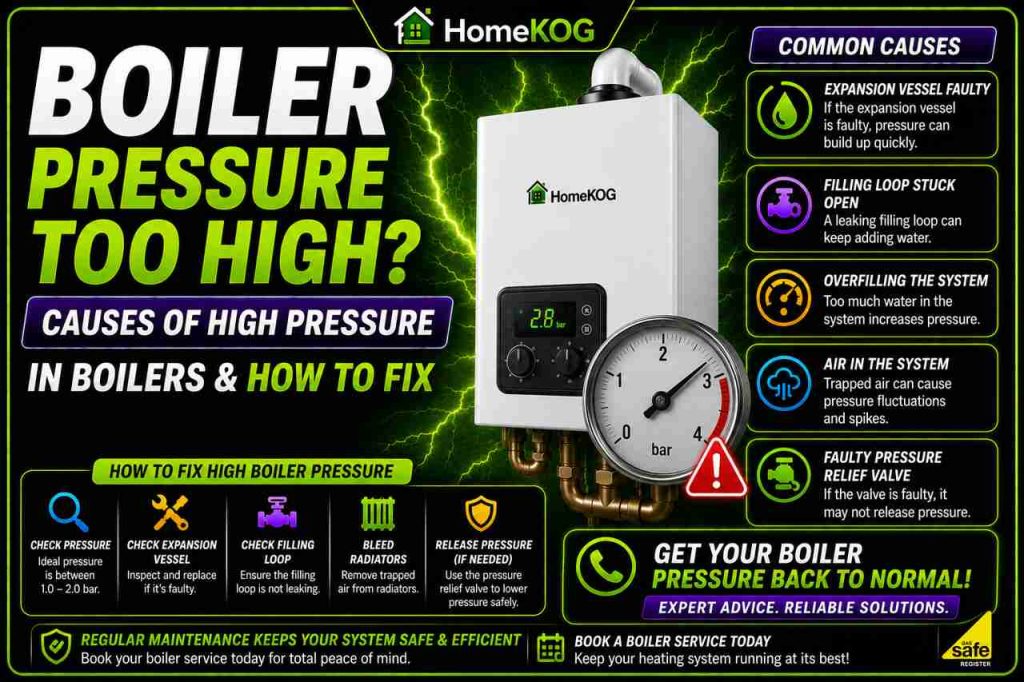
A pressure gauge that consistently reads above 2.5 bar — or that rises above 3 bar and activates the pressure relief valve — indicates an expansion vessel problem, a faulty filling loop, or a pressure regulation fault. A PRV that discharges regularly is under stress and may eventually fail to reseat correctly, leaving the system unprotected. Persistent high pressure should be investigated by an engineer.
How to Prevent Your Boiler from Exploding
Annual Servicing
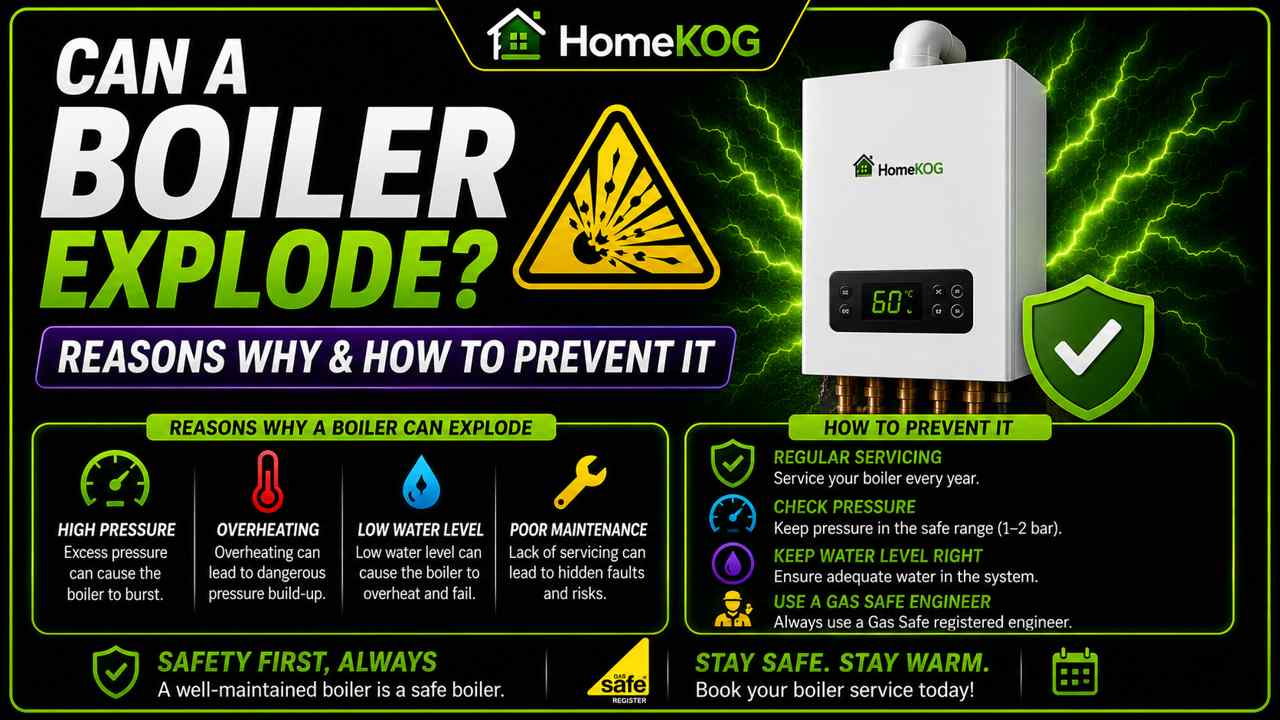
The most important single preventive measure. A Gas Safe engineer at each annual service tests the pressure relief valve, inspects the heat exchanger condition, checks combustion quality and gas valve operation, verifies the overheat thermostat function, and identifies any components showing signs of deterioration before they fail. An explosion-risk scenario is almost always preceded by months or years of developing faults — annual servicing finds these faults while they are manageable rather than dangerous.
Maintain Correct System Pressure
Keep the system pressure in the green zone — 1.0 to 1.5 bar cold. Pressure consistently above 2.0 bar at rest should be investigated. Never repeatedly repressurise a system that keeps losing pressure without finding and repairing the leak.
Do Not Repeatedly Reset a Locking-Out Boiler
A boiler that locks out and displays a fault code is communicating that something is wrong. Resetting it once to see if it clears a transient fault is appropriate. Resetting it repeatedly without identifying the cause is not — it risks gas accumulation in the combustion chamber and masks a developing fault that will worsen. Call an engineer when a fault code persists after one reset.
Use a Qualified Gas Safe Engineer for All Work
All gas boiler installation, repair, and maintenance work must be carried out by a Gas Safe registered engineer. Unqualified work on gas appliances is illegal, voids warranties, invalidates insurance, and creates the conditions for the kind of faulty installation that causes explosions. Verify Gas Safe registration at gassaferegister.co.uk before any engineer begins work.
Install Carbon Monoxide and Gas Alarms
A carbon monoxide alarm does not prevent an explosion but provides critical early warning of combustion problems that indicate the boiler is not operating safely. A gas detector near the boiler provides early warning of gas leaks before the concentration reaches a level where ignition becomes a risk.
What to Do if You Suspect Your Boiler is at Risk
If the boiler is overheating, producing unusual smells, making alarming noises, or showing any of the warning signs described above, the correct response is immediate shutdown rather than continued use.
Turn off the boiler at the boiler’s own switch or at the programmer. If a gas smell is present, also turn off the gas supply at the meter — the emergency valve handle turns 90 degrees to the closed position. Open windows and doors and leave the property if the gas smell is strong. Call the National Gas Emergency Service on 0800 111 999 from outside the property for a gas emergency.
For non-gas-smell boiler faults — overheating, unusual noises, discoloured water — call a Gas Safe engineer promptly. Do not use the boiler until the fault has been diagnosed and repaired.
FAQ
Can a modern boiler actually explode?
Yes, but it is extremely rare. Modern boilers have multiple independent safety devices — pressure relief valves, overheat thermostats, low-pressure cutoffs, and combustion monitoring systems — that prevent dangerous conditions from developing. Explosions in modern UK domestic boilers occur almost exclusively in situations of severe neglect, illegal or unqualified modification, or cascade failure of multiple safety components. A correctly installed, annually serviced boiler from a reputable manufacturer presents a negligibly small explosion risk. The gas boiler ban timeline for 2026 has sparked discussions on how to transition to safer, more sustainable heating alternatives. Homeowners will need to prepare for potential changes in regulations and consider upgrading their heating systems well in advance. This shift could also lead to advancements in technology and increased availability of energy-efficient options in the market.
What causes high boiler pressure?
High boiler pressure is most commonly caused by an overfilled system through the filling loop, a faulty expansion vessel that cannot absorb thermal expansion, or a filling loop that has been left open or has an internal leak. Pressure above 2.5 bar should be reduced through radiator bleeding and, if it recurs, investigated by a Gas Safe engineer.
Is a boiler smelling of gas an emergency?
Yes. Any smell of gas near the boiler should be treated as a gas emergency. Turn off the gas supply at the meter, open windows and doors, leave the property without operating any switches or creating any ignition source, and call the National Gas Emergency Service on 0800 111 999 from outside. Do not re-enter the property until the emergency service has attended and confirmed it is safe.
How do I know if my boiler’s pressure relief valve is working?
The pressure relief valve should be tested at each annual service by the Gas Safe engineer — they will manually operate the PRV to confirm it opens and reseats correctly. Signs that the PRV may be faulty include the PRV discharge pipe dripping or flowing water when the system pressure is within the normal range, or conversely, system pressure rising above 3 bar without any discharge occurring.
Will my boiler shut itself down before exploding?
In a correctly functioning modern boiler with all safety devices intact, yes — the overheat thermostat, pressure relief valve, and gas valve safety interlock should prevent explosive failure by shutting the boiler down. The risk scenario arises when safety devices have deteriorated, been bypassed, or failed simultaneously — which is why annual testing of these devices at the service visit is so important.
Conclusion
Boiler explosions, while genuinely possible in theory, are an extremely rare event in properly maintained modern UK installations. The safety systems built into every current boiler — pressure relief valves, overheat thermostats, combustion monitors, and gas valve interlocks — provide multiple layers of protection that make catastrophic failure unlikely when the boiler is correctly installed, regularly serviced, and promptly repaired when faults are identified. Understanding back boiler dangers is crucial for homeowners to ensure safety and efficiency in their heating systems. Regular checks and adherence to maintenance guidelines can significantly mitigate risks. Additionally, educating oneself about the signs of potential issues can empower individuals to act promptly before any situation escalates.
The preventive measures that keep this risk negligible are neither complicated nor expensive: annual servicing by a Gas Safe engineer, maintaining correct system pressure, not repeatedly resetting a fault-displaying boiler without diagnosis, and responding promptly to warning signs rather than ignoring them. A boiler that is serviced every year and whose fault codes are investigated rather than dismissed will almost certainly never approach the conditions required for an explosive failure.