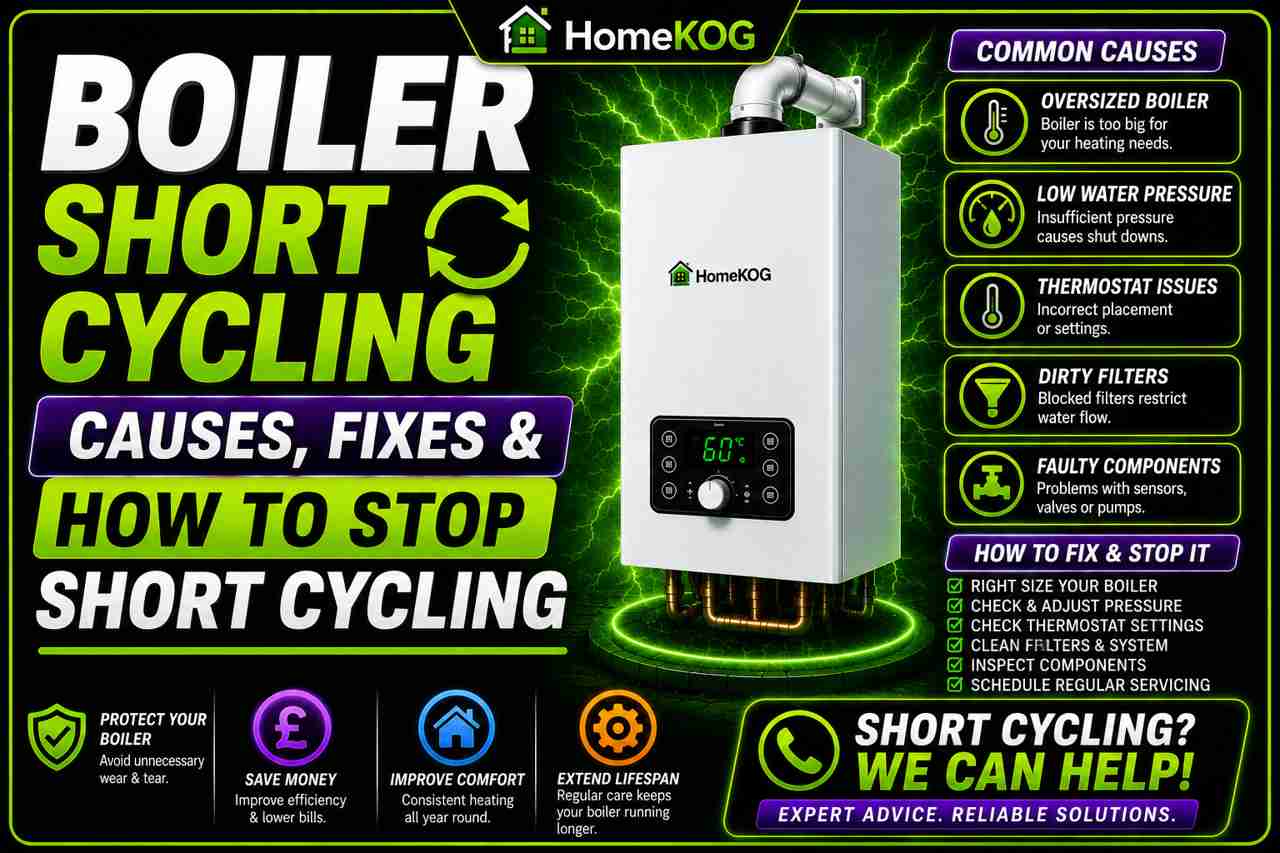

Boiler short cycling — where the boiler fires, shuts off quickly, and then fires again within minutes — is one of the most common causes of high gas bills, premature component failure, and unnecessary wear on your heating system.
Why Boiler Short Cycling Is a Problem
A boiler that short cycles never completes a proper heating cycle. Instead of running steadily to heat your home efficiently, it repeatedly ignites, reaches a cut-off temperature too quickly, shuts down, and restarts. Each ignition sequence puts stress on the burner, heat exchanger, and pump. Over time, this accelerates wear on components that are designed to handle a limited number of start cycles over the boiler’s lifetime.
The practical consequences are higher gas bills — a boiler uses more energy per unit of heat during start-up than during steady operation — more frequent breakdowns, and a shortened system lifespan. In severe cases, prolonged thermal stress on the heat exchanger can lead to cracking, which on older open-flued appliances carries a risk of combustion gases, including carbon monoxide, entering the property. Fit a carbon monoxide alarm if you do not already have one.
What Causes Boiler Short Cycling
Oversized Boiler
The most common cause, and the hardest to fix without replacing the boiler, is oversizing. A boiler with a maximum output significantly larger than your home’s actual heat demand will satisfy the thermostat call almost immediately — before the system has time to distribute heat properly — and then shut off. Modern homes, particularly well-insulated ones, have relatively low heat demands, and an oversized boiler will short cycle chronically regardless of other adjustments. Another issue that many homeowners may face is the overall efficiency of the system, which can be impacted by the lack of regular maintenance. When operating conditions are not ideal, the Viessmann boiler common issues overview indicates that reduced efficiency can lead to higher energy bills and increased wear on components. Regular checks and prompt repairs of minor issues can prevent larger, costlier problems in the future.
Correct boiler sizing requires a proper heat loss calculation based on the property’s construction, insulation levels, and radiator circuit. A competent Gas Safe registered engineer should carry this out before any boiler is specified. Once the heat loss calculation is complete, the next step involves determining the system boiler specifications and costs to ensure the chosen model meets the property’s heating requirements efficiently. It’s essential to compare different brands and models, as prices can vary significantly, and some may offer better warranty options or energy efficiency ratings. Consulting with the engineer about reputable brands can help make an informed decision.
Thermostat Positioning and Faults
A room thermostat placed near a heat source — a sunny window, a lamp, a radiator — will read a falsely high temperature and cut the boiler off prematurely. The same applies to a thermostat in a small hallway that heats up quickly while the rest of the house remains cold. Relocating the thermostat to a more representative room, or upgrading to a smart thermostat with better sensing and learning capability, can eliminate this cause entirely.
A faulty thermostat that intermittently drops its connection or sends incorrect signals will also produce short cycling behaviour. If the problem is intermittent and tied to thermostat activity, replacement is usually straightforward and cost-effective.
Trapped Air and Pressure Issues
Air trapped in the heating circuit disrupts water flow and can cause the boiler to reach its high-limit temperature rapidly due to reduced flow rate, triggering a shutdown. Bleeding radiators — starting from the ground floor and working upward — removes trapped air and restores normal circulation.
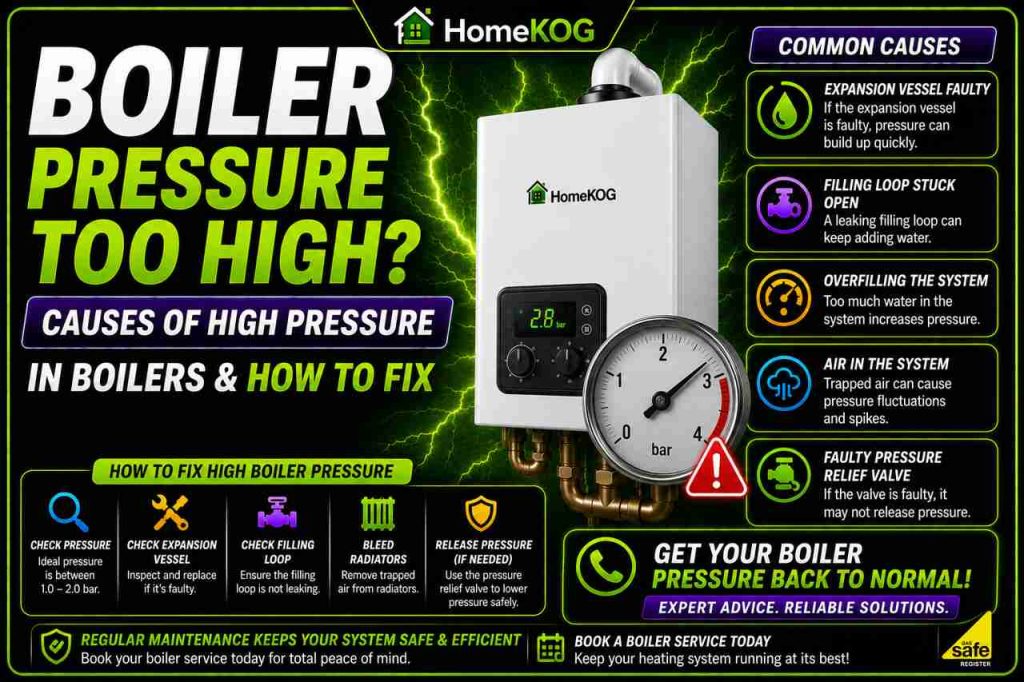
System pressure also plays a role. Cold fill pressure should be around 1.0–1.5 bar; normal operating pressure with the heating running is typically 1.5–2.0 bar. If pressure is too low, the boiler may lock out or short cycle due to insufficient water in the circuit. If pressure is too high, the pressure relief valve (PRV) may vent repeatedly. Neither condition should be ignored. Do not attempt to reduce high pressure by bleeding radiators — this is not the correct procedure. A Gas Safe registered engineer can assess and correct system pressure safely.
Restricted Flow Rate
Short cycling can result from insufficient water flowing through the boiler. Causes include a partially closed service valve, a failing pump, heavily sludged pipework, or thermostatic radiator valves (TRVs) all closing simultaneously — leaving the boiler nowhere to send heat. Fitting an automatic bypass valve ensures a minimum flow circuit remains open at all times, preventing the boiler from overheating on a no-demand condition.
Troubleshooting Short Cycling: Common Symptoms and Causes
What Should I Check If My Boiler is Short Cycling and Not Igniting?
If your boiler is short cycling and not igniting, it’s crucial to perform some checks. Start by inspecting the thermostat settings and the pilot light. Additionally, ensure there are no blockages in the vents. For a comprehensive understanding, consider these helpful boiler ignition troubleshooting tips to resolve your issues efficiently.
How to Prevent Short Cycling
Annual servicing by a Gas Safe registered engineer is the single most effective preventative measure. A service includes checking system pressure, inspecting the heat exchanger, verifying the expansion vessel pre-charge, and confirming correct burner operation — all factors that contribute to short cycling if left unchecked.
Beyond servicing, the following steps reduce risk significantly:
Bleed radiators at the start of each heating season to remove accumulated air. Check system pressure when the boiler is cold and top up via the filling loop if it has dropped below 1.0 bar. Ensure all radiators have correctly functioning TRVs and that at least one radiator (typically the bathroom towel rail) has no TRV fitted, maintaining a minimum flow circuit.
Insulating exposed pipework in unheated spaces — lofts, garages — reduces heat loss and helps the system maintain stable temperatures, reducing the frequency of boiler calls.
Advanced Solutions for Persistent Short Cycling
Weather Compensation
Weather compensation is the most effective engineering solution for short cycling caused by oversizing or excessive flow temperatures. A weather compensation controller reads the external temperature via an outdoor sensor and automatically adjusts the boiler’s flow temperature — running cooler on mild days and warmer on cold days. This keeps the boiler running for longer, steadier periods rather than firing hard and shutting off quickly. Many modern boilers from Worcester Bosch, Vaillant, and Viessmann have weather compensation built in or available as an add-on.
Load Compensation and Smart Controls
Load compensation adjusts boiler output based on how far the room temperature is from the setpoint, rather than simply switching the boiler on and off. Smart thermostats such as the Nest, Hive, or Tado achieve a version of this through their modulation and learning features. Under the Boiler Plus regulations introduced in 2018, all new combi boiler installations in England must include a form of time and temperature control with load or weather compensation capability.
Boiler Modulation
Modern condensing boilers can modulate their output — turning down to a fraction of their maximum capacity rather than running at full power. A well-matched, correctly commissioned boiler running at low modulation will short cycle far less than one constantly hitting its upper limit. If your boiler is modulating correctly but still short cycling, the issue is almost certainly oversizing or flow restriction.
Hydraulic Separation
Where an oversized boiler cannot be replaced immediately, fitting a low loss header (hydraulic separator) between the boiler and the heating circuit can buffer the system and reduce short cycling frequency. This is more common in commercial systems but is sometimes used in larger domestic properties with complex heating circuits.
When to Call a Gas Safe Registered Engineer
Contact a Gas Safe registered engineer if standard checks — bleeding radiators, verifying pressure, checking thermostat position — do not resolve the problem. You should also call an engineer immediately if you notice any of the following, as these indicate potentially dangerous faults rather than simple short cycling:
An unusual smell near the boiler or on the gas supply should be treated as a possible gas leak. Leave the property, do not operate any switches, and call the National Gas Emergency Service on 0800 111 999. A yellow or orange boiler flame instead of blue, soot marks around the boiler casing, or unexplained headaches and nausea could indicate incomplete combustion and possible carbon monoxide exposure — call an engineer and test your CO alarm immediately.
Is It Time to Replace Your Boiler?
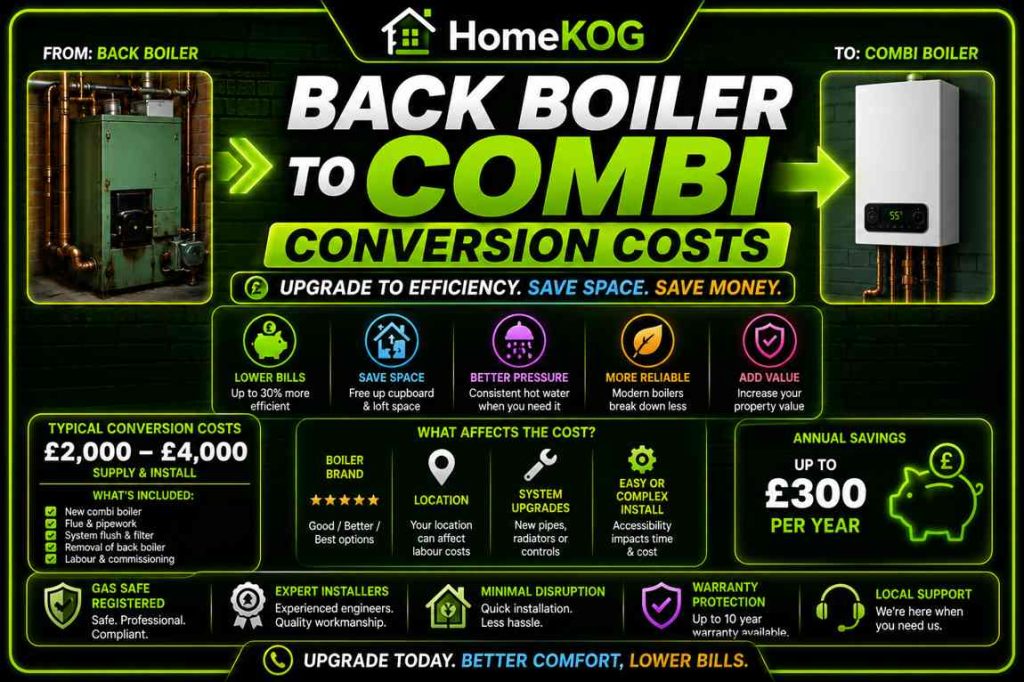
If your boiler is over 15 years old, has a history of recurring faults, or is a non-condensing model, short cycling may be a symptom of a system that has simply reached the end of its reliable service life. A modern A-rated condensing boiler, correctly sized with a proper heat loss calculation and fitted with weather compensation, will deliver materially better efficiency and far fewer short cycling episodes. Understanding boiler lifespan and replacement signs is crucial for homeowners to ensure optimal heating performance. Regular maintenance checks can help identify early signs of wear and tear, enabling timely replacements before the system fails entirely. Investing in a new boiler can not only enhance efficiency but also lead to significant energy savings in the long run.
A Gas Safe registered engineer can advise on whether repair or replacement makes more economic sense based on the boiler’s age, fault history, and your heating requirements.
Frequently Asked Questions
How do I fix a short cycling boiler?
Start by bleeding the radiators, checking system pressure, and verifying thermostat position and function. If those steps don’t resolve it, a Gas Safe registered engineer should inspect the boiler for oversizing issues, expansion vessel condition, flow rate problems, and whether weather compensation controls should be fitted.
Can short cycling damage my boiler?
Yes. Each ignition cycle puts stress on the burner, heat exchanger, and electrical components. A boiler designed for a finite number of start cycles over its lifetime will exhaust those cycles far sooner if it is short cycling repeatedly, leading to premature component failure and costly repairs.
Should I be worried about carbon monoxide with a short cycling boiler?
Short cycling itself does not directly cause carbon monoxide leaks, but prolonged thermal stress on a heat exchanger can eventually lead to cracking. Ensure you have a working carbon monoxide alarm — this is important regardless of whether your boiler is short cycling. If your CO alarm triggers, leave the property immediately and call 0800 111 999.