
Hydrogen Fuel for Home Heating: Advantages, Disadvantages and How It Works 2026
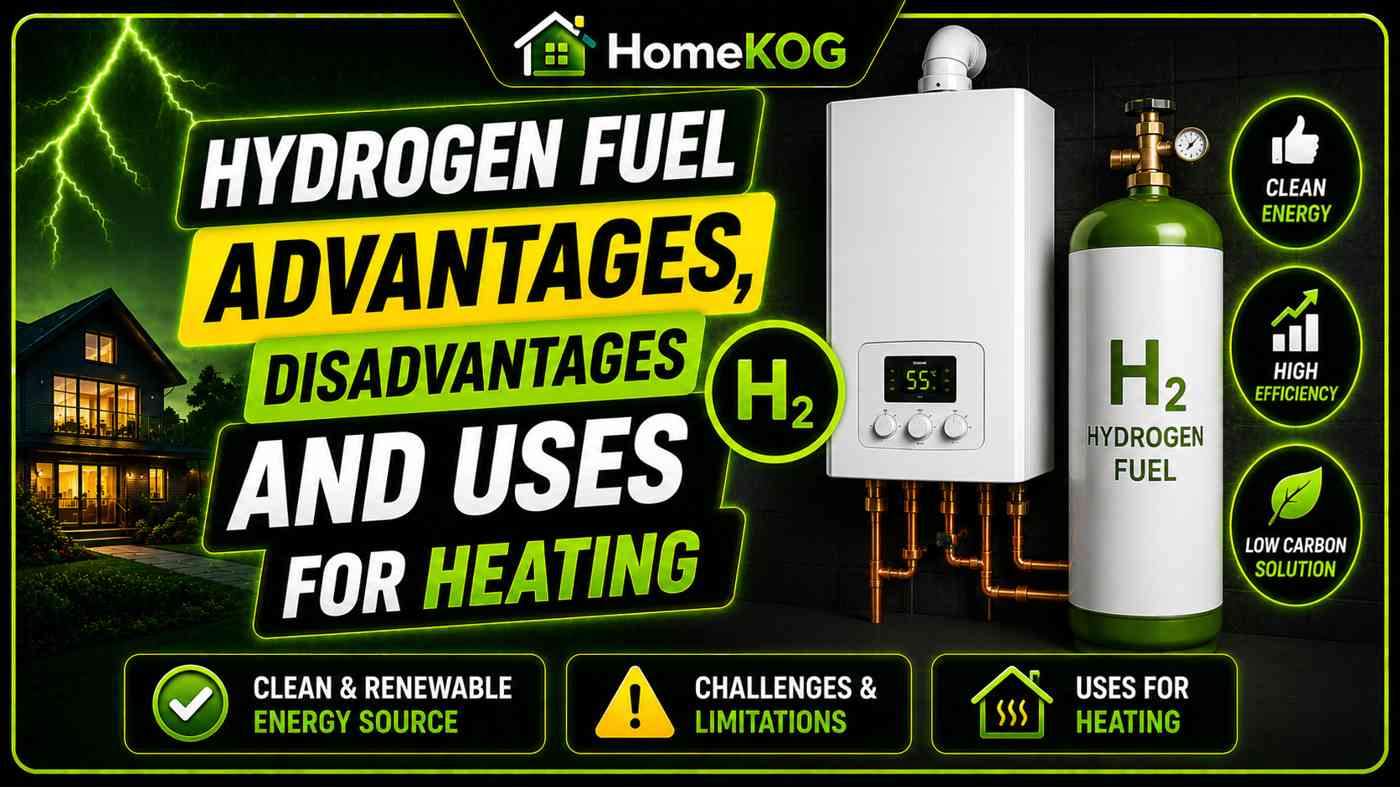
Quick Answer: Hydrogen fuel offers zero carbon emissions at the point of combustion, making it a potentially clean alternative to natural gas for home heating. Burning hydrogen produces only water vapour — no CO₂, no carbon monoxide, no particulates. The principal advantages are energy density (three times more powerful than fossil fuels), abundant supply, compatibility with the existing gas network infrastructure, and compatibility with current boiler technology through hydrogen-ready models. The main disadvantages are the current high production cost, limited distribution infrastructure, flammability risk, and the fact that the most widely used production method — steam-methane reforming — currently emits carbon unless Carbon Capture Utilisation and Storage (CCUS) technology is applied. Virtually all new gas boilers are hydrogen-ready to a 20% blend as standard in 2026.
As the UK works toward its legally binding net zero target by 2050, hydrogen fuel has emerged as one of the most discussed potential solutions to the challenge of decarbonising domestic heating. Unlike heat pumps, which require changes to how homes distribute heat and demand good insulation, hydrogen can in principle flow through the existing gas network and burn in a modified boiler — allowing the heating infrastructure that 85% of UK homes already depend on to continue operating with dramatically reduced carbon emissions. This guide examines hydrogen fuel objectively — what it is, how it is produced, its genuine advantages and disadvantages for home heating, and what hydrogen-ready boilers mean for homeowners today.
What is Hydrogen Fuel?
Hydrogen is the most abundant element in the universe and the simplest — a single proton and a single electron. In its natural state it does not exist independently on Earth but is found combined with other elements: two hydrogen atoms bonded with one oxygen atom form water (H₂O), and hydrogen is present in vast quantities in organic compounds throughout the natural world.
As a fuel, hydrogen is combusted in air to produce heat, with the only byproduct being water vapour. Unlike natural gas combustion — which produces carbon dioxide, carbon monoxide, and other greenhouse gas emissions — hydrogen combustion produces no carbon emissions whatsoever at the point of use. This characteristic is why hydrogen is attracting significant attention as a potential replacement for natural gas in the UK’s gas grid.
The challenge is not combustion — hydrogen burns effectively and can be used in boilers through modified versions of existing technology — but production. Hydrogen does not exist in usable form without being separated from the compounds in which it is found, and this separation process currently requires significant energy input.

How is Hydrogen Produced?
Green Hydrogen — Electrolysis
Green hydrogen is produced through electrolysis — passing a high electrical current through water to separate it into hydrogen gas and oxygen. When the electricity used for this process comes from renewable sources — solar, wind, or hydropower — the process produces no carbon emissions and the hydrogen generated is genuinely zero-carbon throughout its lifecycle. This is why green hydrogen is considered the ideal long-term goal.
The limitation is cost. Electrolysis is currently an expensive process, and producing green hydrogen at the scale needed to supply the UK’s gas network requires substantial renewable electricity generation capacity. Production costs are projected to fall significantly as the technology matures and renewable electricity generation expands — from approximately £6/kg in 2015 toward an estimated £2/kg by the mid-2020s — but have not yet reached the level that would make large-scale grid deployment economically straightforward.
Blue Hydrogen — Steam-Methane Reforming
Blue hydrogen is produced through steam-methane reforming (SMR) — mixing natural gas with extremely hot steam and a catalyst to produce a chemical reaction that separates the hydrogen and carbon. The carbon monoxide produced is converted to carbon dioxide through a further reaction, and the CO₂ is captured using Carbon Capture Utilisation and Storage (CCUS) technology rather than released to the atmosphere.
Steam-methane reforming is currently the most widely used hydrogen production method globally because it can produce hydrogen in large quantities at relatively low cost. The carbon neutrality of blue hydrogen depends entirely on the effective capture and permanent storage of the CO₂ produced during the process — if CCUS is not applied, the carbon is released and the hydrogen provides no climate benefit over natural gas.
Blue hydrogen represents a practical transitional pathway — deployable at scale using existing gas network infrastructure while green hydrogen production capacity develops — but it is not a permanent solution if the captured carbon cannot be stored indefinitely.
Advantages of Hydrogen Fuel for Home Heating
Zero Carbon Emissions at Point of Use
When hydrogen burns, the only combustion product is water vapour. No carbon dioxide, no carbon monoxide, no nitrogen oxides above natural background levels, no particulates. A home heated by hydrogen produces zero direct carbon emissions from the heating system — the same outcome as an electric heat pump from the user’s perspective, but achieved through a boiler burning fuel rather than a compressor moving heat.
For the UK, where gas boilers in homes produce approximately 14% of national carbon emissions, transitioning from natural gas to hydrogen in the existing gas grid would eliminate these emissions at the household level without requiring the replacement of every boiler in the country.
Compatible With Existing Gas Infrastructure
Perhaps hydrogen’s greatest advantage over all other low-carbon heating alternatives is that it can, in principle, flow through the UK’s existing gas network to homes using modified versions of existing boiler technology. Heat pumps require changes to the heating distribution system — lower flow temperatures, larger radiators, better insulation — and the installation of new external equipment. Hydrogen requires only a modification to the boiler burner and flame detection components.
This means the transition from natural gas to hydrogen could, from the homeowner’s perspective, involve an engineer visit of approximately one hour to modify the boiler — rather than a multi-day installation involving new infrastructure. The scale of this difference in disruption and cost for 23 million UK households is enormous.
Three Times More Energy-Dense Than Fossil Fuels
Hydrogen has a significantly higher energy content per unit of mass than natural gas or other fossil fuels — approximately three times the energy density of petrol. This means less hydrogen is needed to produce the same amount of heat, and the energy-producing potential of the gas network could be maintained or improved even if the physical volume of hydrogen transported through pipes is less than the equivalent volume of natural gas.
Renewable and Effectively Unlimited Supply
Unlike fossil fuels which exist in finite quantities and are depleted by use, hydrogen can be produced continuously from water through electrolysis powered by renewable electricity. As long as renewable electricity generation continues — and solar and wind resources are effectively unlimited on any humanly relevant timescale — green hydrogen production can continue indefinitely. This removes the supply depletion concern that applies to natural gas and oil.
Job Creation and Economic Opportunity
Expanding hydrogen production, distribution, and utilisation infrastructure creates substantial employment opportunities. Estimates suggest that developing hydrogen for home heating in the UK could create up to 9,000 jobs by 2030, with further employment across supply chains, installation, maintenance, and research as the sector matures.
Non-Toxic and Safe in Normal Use
Hydrogen is non-toxic — it poses no direct health risk to humans beyond the asphyxiation risk of any inert gas in a confined space without adequate oxygen. This compares favourably with natural gas, which is mildly toxic at high concentrations, and carbon monoxide — the product of incomplete combustion — which is acutely toxic. A hydrogen boiler running correctly produces only water vapour: there is no carbon monoxide risk from hydrogen combustion.
Disadvantages of Hydrogen Fuel for Home Heating
High Production Cost
The current production cost of green hydrogen — the genuinely low-carbon variety — remains significantly higher than the cost of producing an equivalent amount of heat from natural gas. Until green hydrogen production costs fall further, the running cost of hydrogen-heated homes would be higher than gas-heated homes at equivalent tariff structures. Government intervention through subsidies or carbon pricing would be needed to make hydrogen competitive with natural gas on running cost terms. Moreover, as households explore alternative heating solutions, understanding underfloor heating installation prices becomes increasingly important. These systems can offer improved energy efficiency and comfort, but initial costs may deter some homeowners. To encourage adoption, financial incentives or reduced installation costs could play a crucial role in driving the transition to greener heating options.
Flammability and Leak Detection
Hydrogen is more flammable than natural gas — its flammability range in air is wider — and burns with an invisible flame, making hydrogen fires difficult to detect visually. Natural gas has mercaptan added as an odorant to enable leak detection by smell; the same approach would need to be applied to hydrogen. Hydrogen’s smaller molecular size means it can permeate materials that contain natural gas effectively, requiring upgraded sealing materials in the gas distribution network and in home appliances.
Safety protocols and engineering standards would need to be developed and implemented throughout the supply chain and installation industry before widespread domestic hydrogen use could proceed.
Limited Distribution Infrastructure
The UK’s existing gas distribution network was designed and built for natural gas. Converting it to carry hydrogen involves materials assessments, valve and fitting replacements, and safety certification across the entire network — a multi-decade and multi-billion-pound undertaking. The distribution infrastructure does not currently exist for 100% hydrogen delivery to homes at national scale.
Hydrogen fuel stations, pipelines, and storage facilities similarly do not exist at the scale needed for a fully hydrogen-based economy. This infrastructure gap is one of the most significant barriers to hydrogen deployment timelines.
Difficult to Store and Transport
Hydrogen is the lightest element and, as a gas, has very low density — it requires very high compression or very low temperatures to achieve the energy density needed for practical storage. Compressed hydrogen storage at the pressures needed is technically demanding and expensive. Liquid hydrogen storage requires temperatures close to absolute zero, which requires continuous energy input to maintain.
These storage challenges affect the supply chain for hydrogen from production sites to distribution networks to homes, adding cost and complexity at every stage.
Some Production Methods Emit Carbon
Blue hydrogen through steam-methane reforming currently represents most hydrogen production, and its carbon neutrality depends on CCUS being applied effectively. If CCUS is imperfect or incomplete, some carbon is released. The hydrogen market remains predominantly non-green hydrogen in 2026, meaning that hydrogen in the near term is not necessarily zero-carbon unless it is specifically certified as green.
Hydrogen-Ready Boilers: What They Mean for Homeowners Today
Hydrogen-ready boilers are gas condensing boilers designed to operate on natural gas today and on 100% hydrogen at a future date, with conversion requiring only a burner swap and flame detection component replacement — estimated at approximately one hour of engineer time.
All major boiler manufacturers now produce hydrogen-ready models as standard for the UK market. The distinction exists at two levels — hydrogen blend ready (capable of running on up to 20% hydrogen mixed with natural gas, which requires no modification) and fully hydrogen-ready (capable of conversion to 100% hydrogen). Most new boilers sold in the UK in 2026 are hydrogen blend ready to 20% as standard.
For homeowners replacing a boiler today, specifying a hydrogen-ready model rather than a standard gas condensing boiler costs little or nothing extra and provides long-term protection against any government decision to introduce hydrogen into the gas grid. If hydrogen blending proceeds as trialled, no boiler modification is needed. If full hydrogen conversion follows, the conversion is simple and low-cost rather than requiring a new boiler installation.
Worcester Bosch and Viessmann are among the leading manufacturers investing most significantly in hydrogen boiler development — both brands are committed to hydrogen-ready technology across their ranges and are involved in government hydrogen trial programmes.
The Future of Hydrogen Fuel for UK Home Heating
The UK government has been conducting hydrogen town trials to test whether hydrogen can be safely and practically distributed through existing gas networks to homes at scale. The outcomes of these trials — on safety, customer experience, appliance performance, and cost — will inform policy decisions on whether and how rapidly hydrogen blending and eventual full conversion might proceed.
The timeline for hydrogen in UK homes remains uncertain in 2026. Green hydrogen production costs need to fall further. CCUS infrastructure for blue hydrogen needs to scale. Gas network hydrogen compatibility requires extensive verification. Regulatory frameworks need development. These are multi-year and potentially multi-decade challenges.
The practical conclusion for homeowners is that hydrogen may play a meaningful role in UK home heating over the coming decades, but the timeline is uncertain enough that a hydrogen-ready boiler — purchased primarily as insurance against this eventuality rather than in expectation of an imminent switch — is the prudent choice when replacing a boiler today. The cost difference between a hydrogen-ready and a standard boiler is negligible, and the optionality it preserves has real value.
FAQ
Are hydrogen boilers available now?
Hydrogen blend-ready boilers — capable of running on up to 20% hydrogen mixed with natural gas — are available now and represent virtually all new gas boilers sold in the UK. Fully hydrogen-ready boilers capable of conversion to 100% hydrogen are available from leading manufacturers. Boilers running exclusively on 100% pure hydrogen are not commercially available for domestic installation in 2026, as 100% hydrogen is not yet available through the UK gas grid.
Will my existing boiler work with hydrogen?
Most existing gas boilers can run on a 20% hydrogen-natural gas blend without any modification — if blending is introduced to the gas grid, it would be transparent to current boiler users. Running on 100% hydrogen requires either a hydrogen-ready boiler with a burner swap, or complete boiler replacement. Older boilers that are not hydrogen-ready would need to be replaced if full hydrogen conversion is eventually mandated.
Is hydrogen safer than natural gas?
Both have safety risks that are managed through engineering standards and regulatory requirements. Hydrogen is more flammable than natural gas and cannot be detected by smell without an added odorant. However, hydrogen combustion produces no carbon monoxide — the most significant safety risk of gas combustion — and hydrogen’s low density means it disperses rapidly in open conditions rather than accumulating at floor level as LPG does. With appropriate safety standards, hydrogen can be used safely in domestic settings.
How much would hydrogen heating cost to run?
Green hydrogen production costs remain above natural gas costs in 2026, meaning hydrogen heating would currently cost more to run than natural gas heating at unsubsidised tariff rates. Government subsidies, carbon pricing mechanisms, or carbon taxes on natural gas could equalise the costs over time. The long-term trajectory for green hydrogen costs is downward as renewable electricity generation scales and electrolysis technology matures. As the demand for more efficient heating solutions increases, homeowners will also need to consider factors such as heat pump installation costs for 2026, which are expected to fluctuate based on advancements in technology and economies of scale. These costs could influence consumer choices between hydrogen heating systems and heat pumps, with financial incentives potentially playing a crucial role in the adoption of greener alternatives. Ultimately, the integration of sustainable heating technologies will depend on both market dynamics and government support to encourage a transition away from traditional fossil fuels.
Should I buy a hydrogen-ready boiler now?
Yes, if you are replacing a boiler regardless of the hydrogen situation. The marginal cost difference between a hydrogen-ready and a standard gas condensing boiler is negligible, while the protection it provides against future grid hydrogen introduction has genuine value. All the leading brands’ current boiler ranges are hydrogen-ready to at least 20% blend as standard — there is no meaningful reason to choose a non-hydrogen-ready model for a new installation today.
Conclusion
Hydrogen fuel presents a genuinely compelling long-term pathway for decarbonising UK home heating — zero carbon at the point of combustion, compatible with existing infrastructure, and requiring relatively simple modifications to existing boiler technology. The advantages of energy density, abundance, and infrastructure compatibility are real and significant.
The disadvantages are equally real — production cost, limited current infrastructure, flammability risk management requirements, and the carbon emissions of current mainstream production methods all represent genuine challenges that require substantial investment, technological development, and regulatory work before hydrogen can play a large-scale role in UK domestic heating.
For homeowners navigating this uncertainty today, the practical position is clear: buy a hydrogen-ready boiler when the current boiler needs replacing, benefit from its 92 to 98% efficiency as a condensing natural gas boiler in the near term, and preserve the option of low-cost conversion to hydrogen if and when the gas grid transitions. This approach combines the best available current technology with meaningful future optionality at negligible additional cost — which is precisely the kind of investment decision that makes sense when the destination is known but the timeline is genuinely uncertain. In addition to considering the efficiency and future flexibility of the boiler, homeowners should also explore various boiler financing options for homeowners that can ease the financial burden of such an investment. By aligning the purchase with available financing solutions, homeowners can make this transition more manageable while ensuring their heating systems are both current and future-proof. This proactive strategy not only addresses immediate needs but also supports long-term sustainability goals.