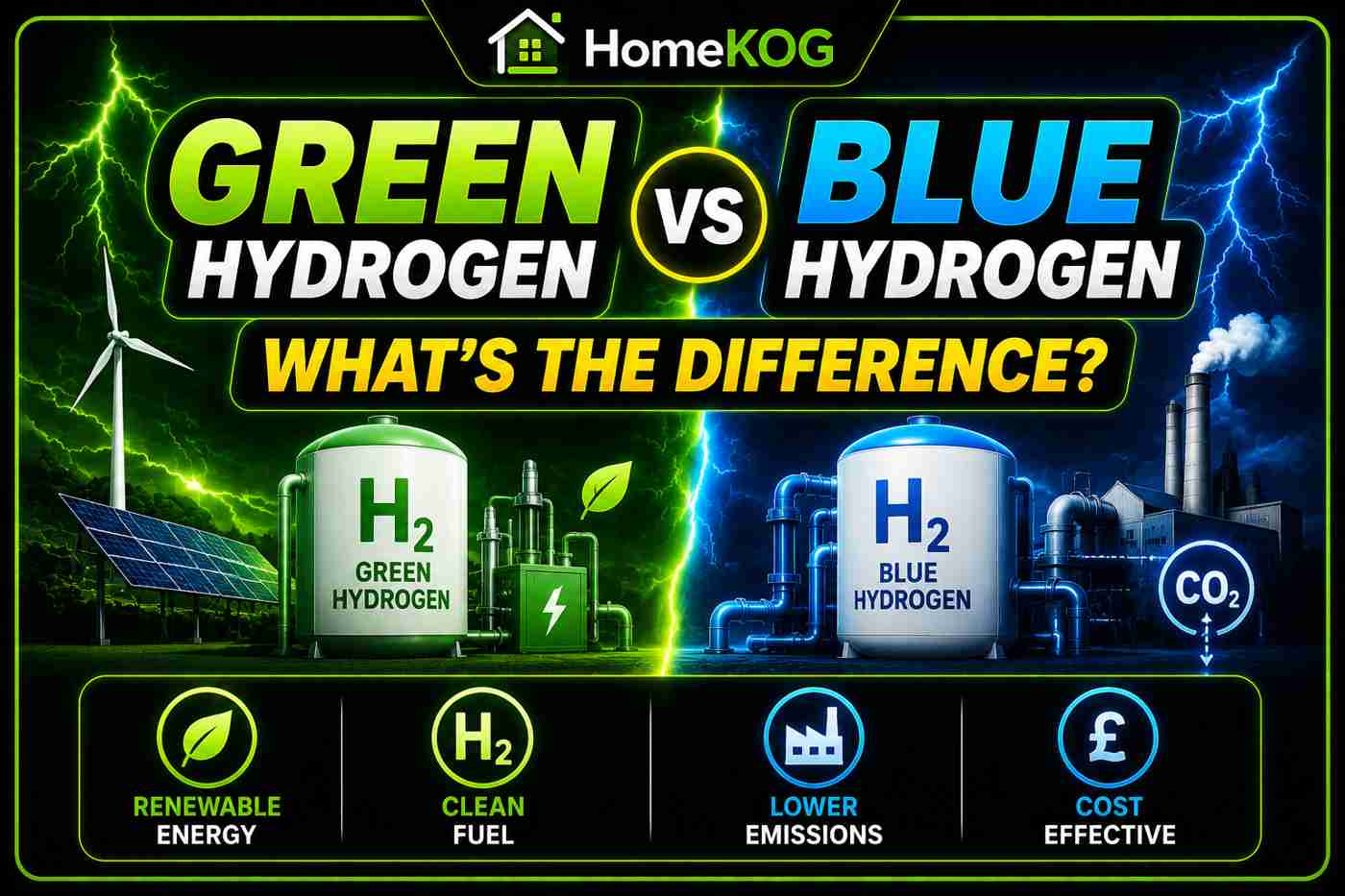

Green Hydrogen vs Blue Hydrogen: What’s the Difference and Why Does It Matter?
Quick Answer: Green hydrogen is produced using renewable energy to split water into hydrogen and oxygen, creating zero carbon emissions in the process. Blue hydrogen is made from natural gas using steam methane reforming, with carbon capture applied to reduce — but not eliminate — emissions. Green hydrogen is cleaner but currently more expensive to produce. Blue hydrogen is cheaper and more readily scalable today but remains dependent on fossil fuels.
Hydrogen is increasingly central to discussions about how the UK and the wider world will decarbonise energy systems over the coming decades. For homeowners, it is directly relevant to the future of home heating — hydrogen-blend ready boilers are already widely available, and the composition of the gas supply network is expected to change as hydrogen production scales up.
Not all hydrogen is produced the same way, however, and the difference between green and blue hydrogen matters enormously — both for the environment and for the long-term credibility of hydrogen as a clean fuel source.
Key Facts: Green Hydrogen and Blue Hydrogen Relationships
- Green hydrogen is hydrogen produced through electrolysis powered entirely by renewable energy sources such as wind or solar, resulting in zero carbon emissions during the production process.
- Blue hydrogen is hydrogen produced from natural gas through steam methane reforming, with carbon capture and storage applied to reduce — but not fully eliminate — the associated carbon dioxide emissions.
- Electrolysis is the process of passing electricity through water to separate it into hydrogen and oxygen, and is the method used to produce green hydrogen.
- Steam methane reforming is the industrial process used to produce blue hydrogen, combining natural gas with high-temperature steam using a catalyst to generate hydrogen and carbon dioxide.
- Carbon Capture, Utilisation and Storage (CCUS) is the process applied to blue hydrogen production to capture carbon dioxide before it enters the atmosphere, though current technology captures only 65 to 90% of emissions produced.
- Methane leakage is a significant environmental concern associated with blue hydrogen production, occurring during the drilling, extraction, and transportation of the natural gas feedstock used in steam methane reforming.
- A hydrogen-blend ready boiler is a gas boiler engineered to operate on a mixture of natural gas and up to 20% hydrogen, and is the current standard specification for new boiler installations in the UK.
- Renewable energy is the power source that distinguishes green hydrogen from all other hydrogen production methods, and includes wind, solar photovoltaic, and hydroelectric power.
- The International Energy Agency estimates that one tonne of methane is equivalent to between 28 and 36 tonnes of CO2 in terms of greenhouse gas impact over a 100-year period.
- Green hydrogen production currently costs between USD 3 and USD 7 per kilogram, compared to approximately USD 1 per kilogram for hydrogen produced using fossil fuels.
- Blue hydrogen production costs between USD 1.50 and USD 3.50 per kilogram, including USD 0.50 to USD 1 for carbon capture and storage processes.
- Net zero 2050 is the UK government target for eliminating net carbon emissions, and hydrogen — particularly green hydrogen — is identified as a significant contributor to achieving that goal.

Why Isn’t Hydrogen Already in Widespread Use?
Hydrogen is the most abundant element in the universe, but it does not exist freely on Earth in a usable form. Hydrogen atoms bond readily with other elements — most commonly oxygen, forming water — which means energy must be expended to break those bonds and isolate hydrogen in a usable state.
This energy requirement is the fundamental challenge facing hydrogen as a fuel. Producing hydrogen always involves a process, and the environmental credentials of the resulting hydrogen depend entirely on the energy source and method used to produce it.
The energy industry has adopted a colour-coding shorthand to describe how hydrogen is produced. Green and blue are the two types most relevant to the UK’s energy transition and to the future of domestic heating.
What Is Green Hydrogen?
Green hydrogen is produced through electrolysis — the process of passing an electrical current through water to split it into its constituent elements, hydrogen and oxygen. What makes it green is the source of the electricity used to power that electrolysis: renewable energy, such as wind turbines, solar panels, or hydroelectric generation.
Because the electricity driving the process comes entirely from renewable sources, no carbon dioxide is emitted during production. The only by-product is oxygen. Green hydrogen is therefore the cleanest form of hydrogen available and the one that offers genuine long-term potential as a zero-carbon fuel.
Scientists estimate that green hydrogen could meet up to 24% of world energy requirements by 2050 if production scales sufficiently, contributing meaningfully to net zero targets globally.
The Cost Challenge Facing Green Hydrogen
The primary obstacle to green hydrogen reaching its potential is cost. Producing one kilogram of green hydrogen currently costs between USD 3 and USD 7, compared to approximately USD 1 per kilogram for hydrogen produced using conventional fossil fuel processes.
This cost gap has narrowed significantly in recent years and is expected to continue closing. Electrolysis costs have fallen by around 50% over the past five years, driven by technological advances, increasing production scale, private investment, and government hydrogen strategies in the UK and elsewhere.
Industry projections suggest that green hydrogen production costs could fall to between USD 1 and USD 2 per kilogram by 2050 — a level at which it becomes genuinely competitive with fossil fuel-derived hydrogen at scale. The trajectory mirrors what happened with solar photovoltaic technology, which saw a 90% cost reduction between 2010 and 2019 as investment and manufacturing scale increased.
What Is Blue Hydrogen?
Blue hydrogen is produced from natural gas using a process called steam methane reforming. In this process, natural gas is mixed with high-temperature steam in the presence of a catalyst, triggering a chemical reaction that produces hydrogen alongside carbon monoxide. The mixture is then combined with water in a second stage, converting the carbon monoxide into carbon dioxide and releasing additional hydrogen.
The carbon dioxide produced in this process can be captured and stored underground rather than released into the atmosphere — a technique known as Carbon Capture, Utilisation and Storage, or CCUS. It is this carbon capture step that earns the hydrogen the “blue” designation, distinguishing it from “grey” hydrogen, which is produced from natural gas without any carbon capture at all.
The Blue Hydrogen Production Process
There are two principal methods for producing blue hydrogen at industrial scale. Steam methane reforming is the more widely used of the two. Auto-thermal reforming is the alternative, and while the specific chemistry differs, both processes separate natural gas into hydrogen and carbon dioxide using the same fundamental chemistry.
| Production Method | Feedstock | Carbon Capture Applied | Cost per kg (USD) |
|---|---|---|---|
| Green hydrogen (electrolysis) | Water + renewable electricity | N/A — zero emissions | 3.00–7.00 |
| Blue hydrogen (steam methane reforming) | Natural gas | Yes — CCUS, 65–90% capture rate | 1.50–3.50 |
| Grey hydrogen (steam methane reforming) | Natural gas | No | ~1.00 |
The Limitations of Blue Hydrogen
Blue hydrogen is considerably cheaper to produce than green hydrogen and can be scaled up more rapidly using existing industrial infrastructure. However, it carries significant environmental limitations that mean it cannot be considered a long-term clean energy solution in the way that green hydrogen can.
The first limitation is the efficiency of the carbon capture process itself. Current CCUS technology captures between 65% and 90% of the carbon dioxide produced during steam methane reforming. This means that between 10% and 35% of the CO2 generated escapes into the atmosphere regardless of the measures in place — a meaningful residual emission that green hydrogen does not produce at all.
The second and arguably more significant limitation is methane leakage. Natural gas — the feedstock for blue hydrogen — is predominantly methane, and methane is released into the atmosphere at multiple points during the drilling, extraction, and transportation process before it even reaches a reforming facility.
Methane does not persist in the atmosphere as long as carbon dioxide, but its warming effect while it is present is substantially more potent. The International Energy Agency estimates that one tonne of methane is equivalent in greenhouse impact to between 28 and 36 tonnes of CO2 over a hundred-year period. Some researchers argue that the methane leakage rates associated with natural gas production are systematically underestimated, meaning the true carbon footprint of blue hydrogen may be worse than official figures suggest.
Green Hydrogen vs Blue Hydrogen: A Direct Comparison
| Factor | Green Hydrogen | Blue Hydrogen |
|---|---|---|
| Production method | Electrolysis using renewable electricity | Steam methane reforming of natural gas |
| Carbon emissions at production | Zero | Partial — 10–35% CO2 escapes capture |
| Methane leakage risk | None | Present throughout natural gas supply chain |
| Current production cost | USD 3–7 per kg | USD 1.50–3.50 per kg |
| Projected 2050 cost | USD 1–2 per kg | Depends on fossil fuel prices and CCUS costs |
| Scalability today | Limited by renewable energy capacity | More immediately scalable |
| Long-term clean energy credentials | Strong | Disputed |
| Fossil fuel dependency | None | High |
| Industry backing | Climate and renewable energy sector | Oil and gas sector |
What Does This Mean for Home Heating in the UK?
The relevance of green and blue hydrogen to UK homeowners is direct and growing. Hydrogen-blend ready boilers — designed to operate on a mixture of natural gas and up to 20% hydrogen — are already the standard specification for new boiler installations in 2026. These boilers are engineered to be compatible with anticipated changes to the composition of the gas supply network as hydrogen production scales up. As homeowners seek efficient heating solutions, understanding the best combi boilers for the UK becomes essential. These models not only promise enhanced energy efficiency but also adapt to the evolving energy landscape. Investing in a reliable combi boiler now can lead to long-term savings and a reduced carbon footprint.
The critical question for the long-term environmental credentials of hydrogen heating is which type of hydrogen fills that network. A home heating system running on green hydrogen from renewable electrolysis would be genuinely low-carbon. The same system running on blue hydrogen with imperfect carbon capture and upstream methane leakage delivers a much more modest emissions reduction.
The UK government’s hydrogen strategy acknowledges both production pathways during the current transition period, while identifying green hydrogen as the preferred long-term destination. For homeowners investing in hydrogen-blend ready boilers today, the boiler itself is compatible with either route — the carbon impact will depend on decisions made at the production and infrastructure level rather than within the home.
The Investment Case for Green Hydrogen
Green hydrogen represents one of the more significant energy investment opportunities of the 2020s. The technology underpinning green hydrogen production — electrolysis — is well understood, and the costs are falling at a rate that mirrors the early trajectory of solar and wind power before both became mainstream energy sources.
Government hydrogen strategies in the UK and across Europe are directing substantial funding into green hydrogen research, infrastructure, and production capacity. Private investment is following. The combination of falling electrolysis costs, growing renewable energy capacity, and policy support creates conditions in which green hydrogen could become economically competitive with fossil fuel-derived alternatives within the decade.
For blue hydrogen, the long-term picture is less clear. Its role as a transitional fuel — providing hydrogen supply while green production scales up — is broadly accepted. Whether it remains viable once green hydrogen reaches cost parity is more uncertain, particularly if methane leakage accounting becomes more rigorous and the true carbon cost of blue hydrogen production is more accurately reflected in its price.
Frequently Asked Questions
What is the difference between green hydrogen and blue hydrogen?
Green hydrogen is produced by using renewable electricity to split water into hydrogen and oxygen through electrolysis, generating zero carbon emissions. Blue hydrogen is produced from natural gas through steam methane reforming, with carbon capture and storage applied to reduce — but not eliminate — the associated carbon dioxide output. Green hydrogen is the cleaner option but is currently more expensive to produce. Blue hydrogen is cheaper and more immediately scalable but remains dependent on fossil fuels and carries residual emissions from both imperfect carbon capture and methane leakage in the natural gas supply chain.
Why is green hydrogen so expensive compared to blue hydrogen?
The cost of green hydrogen is higher primarily because of the cost of the renewable electricity required to power the electrolysis process and the current manufacturing cost of electrolysers at scale. Blue hydrogen uses existing natural gas infrastructure and established industrial processes, which keeps its production cost lower. However, green hydrogen costs have been falling consistently — declining by around 50% over the past five years — and industry projections suggest they could reach USD 1 to USD 2 per kilogram by 2050, at which point green hydrogen becomes economically competitive with fossil fuel alternatives.
Is blue hydrogen actually clean?
Blue hydrogen is cleaner than grey hydrogen — which is produced from natural gas with no carbon capture at all — but it is not genuinely clean in the way that green hydrogen is. Current carbon capture technology retains between 65% and 90% of the CO2 produced during steam methane reforming, meaning a significant proportion still enters the atmosphere. Methane leakage during the extraction, drilling, and transportation of the natural gas feedstock adds further emissions that are difficult to quantify precisely but are potentially significant given methane’s high warming impact relative to carbon dioxide.
What is steam methane reforming?
Steam methane reforming is the industrial process used to produce blue hydrogen. Natural gas is combined with high-temperature steam in the presence of a catalyst, producing a mixture of hydrogen and carbon monoxide. This mixture is then combined with additional water, converting the carbon monoxide into carbon dioxide and releasing more hydrogen. The carbon dioxide produced in this process is then captured and stored underground using CCUS technology in blue hydrogen production, whereas in grey hydrogen production it is simply released into the atmosphere. As the demand for cleaner energy sources increases, homeowners are becoming more interested in combi boiler efficiency for homeowners. These systems not only provide heating and hot water on demand but also offer significant energy savings compared to traditional boilers. By optimizing their efficiency, homeowners can reduce their carbon footprint and lower their utility bills simultaneously.
How does hydrogen relate to home heating in the UK?
Hydrogen is increasingly relevant to UK home heating because hydrogen-blend ready boilers are now the standard specification for new boiler installations. These boilers are engineered to run on a mixture of natural gas and up to 20% hydrogen, positioning them for compatibility with anticipated future changes to the gas supply network. The long-term carbon impact of hydrogen heating will depend on whether the hydrogen entering the gas network is produced using green or blue methods — a decision that will be made at the infrastructure and policy level over the coming decade.
What is CCUS and how effective is it for blue hydrogen?
CCUS stands for Carbon Capture, Utilisation and Storage. It is the process applied during blue hydrogen production to intercept carbon dioxide before it is released into the atmosphere and store it underground or repurpose it industrially. Current CCUS technology achieves a capture rate of between 65% and 90% of the CO2 produced during steam methane reforming. While this represents a significant reduction compared to no capture at all, it means that between 10% and 35% of the carbon dioxide generated during blue hydrogen production still enters the atmosphere, limiting its credentials as a genuinely clean energy source.
Will green hydrogen replace blue hydrogen in the future?
The prevailing view among climate scientists and energy researchers is that green hydrogen should replace blue hydrogen as the dominant production method once costs fall sufficiently and renewable energy capacity grows to support large-scale electrolysis. Blue hydrogen is generally positioned as a transitional fuel — a way to build hydrogen supply and infrastructure while green production scales up. Once green hydrogen reaches cost parity with fossil fuel alternatives, which current projections suggest could happen by around 2050, the case for continuing to produce blue hydrogen at scale becomes significantly weaker, particularly if methane leakage accounting is tightened.
Can my current boiler run on hydrogen?
Standard gas boilers currently installed in UK homes are not designed to run on pure hydrogen, but hydrogen-blend ready boilers — the current standard for new installations — can operate on a mixture of natural gas and up to 20% hydrogen without any modification. Fully hydrogen-ready boilers, designed to run on 100% hydrogen, are in development and are expected to become available for installation in UK homes as the gas network transitions. If you have a hydrogen-blend ready boiler, you are already positioned for the first phase of the gas network transition without any changes to your heating system.
Conclusion
The difference between green and blue hydrogen is not merely technical — it reflects two fundamentally different visions for how hydrogen fits into the long-term energy transition.
Blue hydrogen offers a faster and cheaper route to building hydrogen supply today, but its dependence on natural gas, the limitations of current carbon capture technology, and the poorly quantified risk of methane leakage mean it cannot be considered a genuine long-term clean energy solution. It has a role to play in the transition period, but that role is time-limited.
Green hydrogen, produced from renewable electricity with zero direct emissions, is the version that can genuinely contribute to net zero targets. The barrier today is cost and production scale, but both are moving in the right direction at pace. The same forces that made solar power and wind energy economically viable — technology development, investment, and policy support — are now being applied to green hydrogen production.
For UK homeowners, the immediate practical takeaway is that hydrogen-blend ready boilers are already widely available and are the default specification for new installations in 2026. The type of hydrogen that eventually flows through the gas network will be determined by decisions made at the infrastructure and policy level — but the equipment in your home is already prepared for the transition.