
What Is Boiler Plus? UK Boiler Installation Requirements Explained
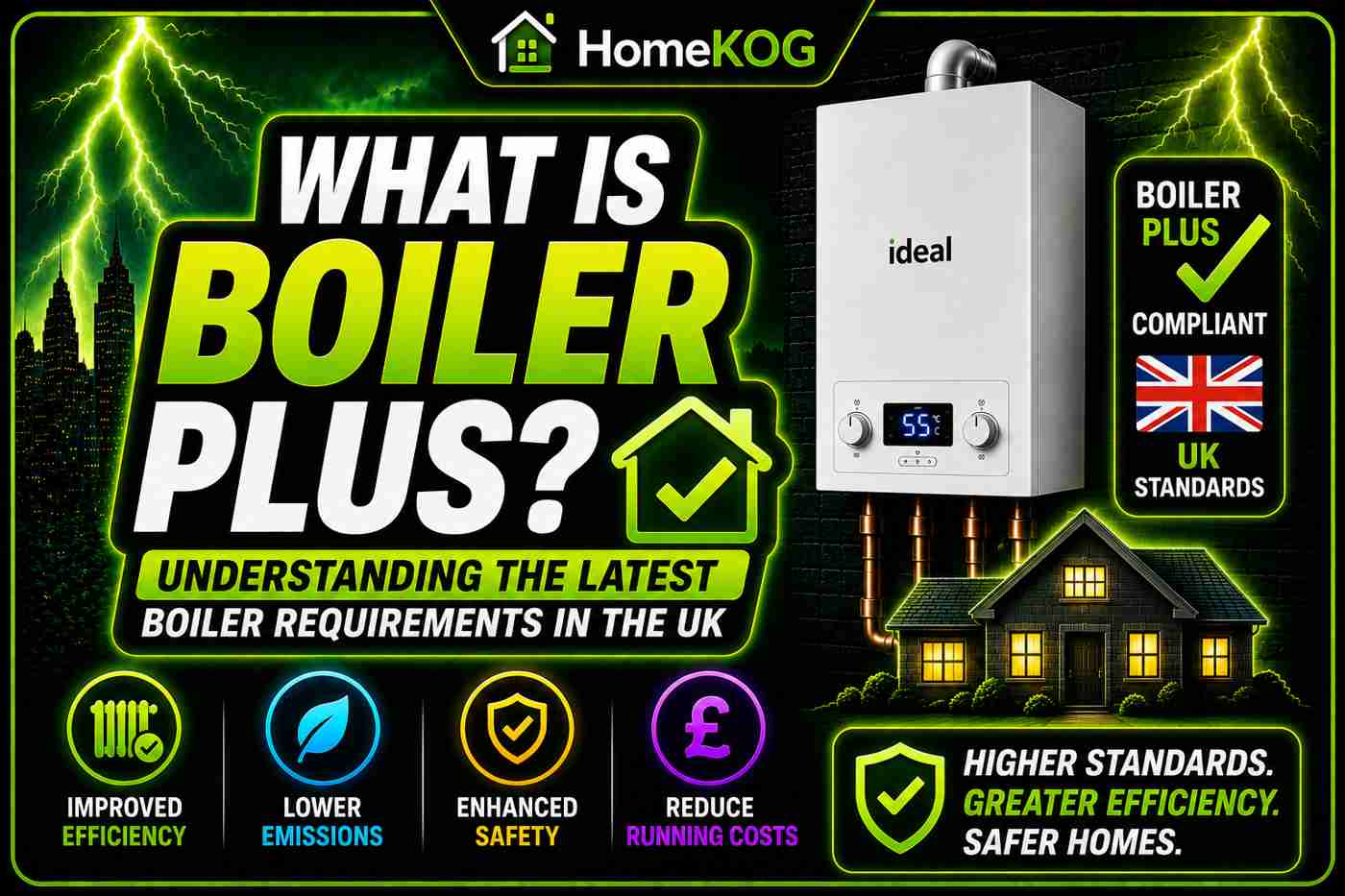
Quick Answer: Boiler Plus is a UK government standard introduced in April 2018 that requires all new gas boiler installations in England to achieve a minimum 92% ErP efficiency rating and to include at least one form of advanced heating control — load compensation, weather compensation, smart thermostat with automation, or flue gas heat recovery. It applies to all domestic gas boiler replacements and new installations in England. Scotland, Wales, and Northern Ireland have separate but broadly similar regulations. boiler servicing benefits for homeowners include improved energy efficiency, cost savings on utility bills, and enhanced safety. Regular maintenance ensures that the system operates at peak performance, reducing the risk of unexpected breakdowns. Additionally, a well-serviced boiler can extend the lifespan of the unit, providing peace of mind for families.
Get a boiler quote online here >
Introduction
If you have recently received a quote for a new boiler, you will have noticed that the installer includes a smart thermostat or advanced controls as part of the package. That is not a sales add-on — it is a legal requirement under Boiler Plus, the UK government standard that has governed all new domestic gas boiler installations in England since April 2018.
Boiler Plus was introduced as part of the government’s drive to reduce domestic carbon emissions and energy consumption. By requiring a minimum efficiency level and advanced controls on every new installation, the regulation ensures that every boiler replaced in England delivers a meaningful improvement in energy performance over the unit it replaces. The value addition from a new boiler also extends to long-term cost savings for homeowners, as higher efficiency translates into lower utility bills. This shift not only benefits individual households but also contributes to the national goal of sustainability, promoting greener alternatives across the country. As more households invest in modern heating solutions, the collective impact on reducing carbon emissions can be substantial.
Understanding what Boiler Plus requires — and what it means for your installation, your controls, and your energy bills — ensures you can engage confidently with any installer quote and know exactly what you are getting and why.

Understanding Boiler Plus: The Core Relationships
Boiler Plus connects several regulatory requirements, technical components, and performance standards that together determine what a legally compliant new boiler installation must include.
- Boiler Plus is a UK government regulation introduced under the Energy Efficiency (Private Rented Property) (England and Wales) Regulations, which set minimum standards for all new domestic gas boiler installations in England from April 2018.
- A minimum 92% ErP efficiency rating is required by Boiler Plus for every new gas boiler installed in England — ErP stands for Energy-related Products, the EU-derived efficiency measurement standard used to rate all domestic heating appliances.
- An ErP efficiency rating measures the seasonal efficiency of a boiler across a full year of varied operation conditions, including part-load performance — it is a more accurate indicator of real-world efficiency than the older SEDBUK rating it replaced.
- Load compensation is an advanced control that adjusts the boiler’s output continuously based on the difference between the current room temperature and the target — it modulates the boiler down during mild conditions rather than cycling it at full power, improving efficiency by 3% to 8% in typical operation.
- Weather compensation is an advanced control that reads the outdoor temperature and adjusts the boiler’s flow temperature accordingly — reducing heat output on milder days and increasing it on colder days, improving real-world efficiency across the heating season.
- A smart thermostat with automation and optimum start is a Boiler Plus-compliant control that uses time-of-day scheduling, occupancy detection, and predictive start to ensure the home reaches the target temperature at the right time without running the boiler longer than necessary.
- Flue gas heat recovery (FGHR) is a device fitted to the boiler flue that recovers heat from exhaust gases and uses it to pre-heat the domestic hot water supply — it is a Boiler Plus compliant option specifically applicable to combi boiler installations.
- Boiler Plus applies only to gas boilers in England, Scotland, Wales, and Northern Ireland, which operate under separate but broadly similar national heating efficiency regulations.
- A Gas Safe-registered engineer is legally required to install any new gas boiler under Boiler Plus and must issue a Building Regulations Compliance Certificate confirming the installation meets the standard’s requirements.
- All leading UK boiler manufacturers — including Worcester Bosch, Viessmann, Vaillant, Baxi, and Ideal — produce ranges that meet or exceed the Boiler Plus 92% minimum efficiency requirement as standard across their 2026 product lines.
- The Boiler Plus standard does not currently apply to oil boilers, LPG boilers, or electric boilers — separate regulations govern efficiency requirements for these fuel types.
- A Building Regulations Compliance Certificate must be issued by the Gas Safe engineer upon completion of any Boiler Plus-compliant installation, confirming that the boiler and controls meet the required standards.
What Does Boiler Plus Require?
Boiler Plus has two distinct requirements that must both be met for an installation to be legally compliant. boiler installation guidelines for bathrooms emphasize the importance of ensuring adequate ventilation and safety measures. Additionally, it’s crucial to consider the size of the space and the heating needs of the bathroom to achieve optimal efficiency. Following these guidelines will help prevent common issues and enhance overall performance.
Requirement 1: Minimum 92% ErP Efficiency
Every new gas boiler installed in England must achieve a minimum seasonal efficiency of 92% under the ErP measurement standard. This requirement effectively bans the installation of non-condensing boilers and lower-efficiency condensing models that fall below this threshold.
In practice, all new gas boilers from leading UK manufacturers already meet or exceed this requirement — the market had largely transitioned to high-efficiency condensing boilers before the 2018 legislation, and the 92% threshold reflects the minimum standard of contemporary boiler technology rather than a challenging new target.
The ErP rating system replaced the older SEDBUK (Seasonal Efficiency of Domestic Boilers in the UK) rating in 2015. Where older boilers were rated A to G on the SEDBUK scale, the ErP system uses A+++ to G, with a rating of A or above required to meet the Boiler Plus 92% threshold.
Requirement 2: Advanced Heating Controls
The controls requirement is where Boiler Plus has the most practical impact on installations. Every new gas boiler installation must include at least one of the following four types of advanced heating control:
Option 1: Load Compensation
A load compensation controller continuously modulates the boiler’s output based on how far the room temperature deviates from the set target. Rather than firing the boiler at full output whenever the thermostat calls for heat, load compensation reduces the boiler’s output as the room approaches the target temperature — the closer to target, the lower the output. This prevents overshoot, reduces cycling, and improves real-world efficiency by 3% to 8% compared to a standard on-off thermostat.
Load compensation is built into several Worcester Bosch EasyControl and Bosch smart thermostat configurations. It is the most commonly installed Boiler Plus-compliant control type in the UK.
Option 2: Weather Compensation
A weather compensation controller uses an outdoor temperature sensor to adjust the boiler’s flow temperature—the temperature of the water circulating through the radiators—based on the outside temperature. On mild autumn days, the flow temperature is reduced; on the coldest winter days, it is raised. This modulation ensures the boiler always operates at the minimum flow temperature needed to heat the home, rather than at a fixed high temperature regardless of outdoor conditions.
Weather compensation typically improves real-world efficiency by 5% to 15% compared to a fixed flow temperature setting. It is particularly effective in well-insulated homes, where heating demand varies significantly across seasons. Viessmann’s weather compensation controls and Vaillant’s VRC series are popular examples of this control type.
Option 3: Smart Thermostat with Automation and Optimum Start
A smart thermostat that qualifies under Boiler Plus must include both automation — the ability to follow a programmed schedule or respond to occupancy — and optimum start, which learns how long the home takes to reach the target temperature and starts the boiler at the right time to arrive at the target when needed without running it unnecessarily long beforehand.
Popular smart thermostats that qualify include Hive Active Heating, Nest Learning Thermostat, Worcester Bosch Wave, and Bosch EasyControl. Most smart thermostats sold in the UK today are Boiler Plus compliant by design, as the standard was incorporated into product development across the industry following the 2018 introduction.
Option 4: Flue Gas Heat Recovery (Combi Boilers Only)
Flue gas heat recovery is a Boiler Plus-compliant option specifically for combi boiler installations. An FGHR unit is fitted to the boiler’s flue and recovers heat from the exhaust gases exiting the boiler after combustion. This recovered heat is used to pre-warm the cold mains water entering the boiler for domestic hot water heating, reducing the energy required to raise it to the target temperature. understanding combi boiler functionalities is essential for optimizing energy efficiency and enhancing overall performance. By leveraging the features of advanced systems, homeowners can ensure they are getting the most out of their heating solutions. This knowledge can also guide users in making informed decisions about maintenance and upgrades, which can further improve energy savings.
FGHR is less commonly installed than the other three control options — smart thermostats are simpler to fit and more familiar to installers and homeowners — but it provides genuine efficiency improvement on combi boilers with high domestic hot water demand, particularly in larger households.
How Much Do Boiler Plus Controls Cost?
The controls requirement is included in most installer quotations as a standard part of the installation package rather than a separately priced add-on. A smart thermostat from a reputable manufacturer — Hive, Nest, or a manufacturer-specific model — typically costs £150 to £250, including installation, when supplied as part of a boiler replacement.
For most homeowners, the cost of Boiler Plus-compliant controls is largely absorbed into the overall boiler installation quote. However, it is worth confirming with any installer exactly which control type is being supplied and whether it is load-compensating, weather-compensating, or a qualifying smart thermostat — some budget quotes use basic programmable thermostats that do not qualify under Boiler Plus.
| Control Type | Typical Cost (Supply and Install) | Efficiency Improvement |
|---|---|---|
| Smart thermostat with automation | £150 – £250 | 10% – 30% |
| Load compensation control | £100 – £200 | 3% – 8% |
| Weather compensation control | £150 – £300 | 5% – 15% |
| Flue gas heat recovery (FGHR) | £200 – £400 | 4% – 10% |
Does Boiler Plus Apply Outside England?
Boiler Plus, in its current form, applies only to gas boiler installations in England. The other UK nations operate under separate but broadly similar regulations. can plumbers install boilers in London is a frequently asked question among homeowners looking to upgrade their heating systems. With a variety of options available, it’s essential for residents to choose skilled professionals who comply with local regulations. Understanding the distinctions in installation processes between different regions in the UK can also help ensure a safe and efficient boiler setup. When considering the best combi boiler for UK homes, energy efficiency and reliability become paramount factors. Homeowners should assess their heating needs and the specific requirements of their properties to make an informed decision. Consulting with experienced professionals can further simplify the selection process and ensure a proper installation that meets both safety standards and performance expectations.
Scotland applies the Energy Efficiency Standard for Social Housing (EESSH) and the Scottish Building Standards, which require comparable efficiency standards for new boiler installations. Scottish regulations were already stringent before Boiler Plus and align closely in practice.
Wales operates under separate Building Regulations (Part L for Wales) that set efficiency requirements for new boiler installations. Wales has not formally adopted Boiler Plus, but its Building Regulations require equivalent efficiency performance.
Northern Ireland follows separate Building Regulations that do not directly replicate Boiler Plus but set minimum efficiency standards for new domestic boiler installations.
In practical terms, all leading boiler manufacturers design their products to exceed the 92% minimum threshold across all UK nations, and most UK installers include advanced controls as standard, regardless of which national regulation applies to a specific installation.
Does Boiler Plus Apply to Oil or LPG Boilers?
Boiler Plus, in its current form, applies specifically to gas boilers. It does not directly govern oil boiler or LPG boiler installations, which are subject to separate efficiency requirements under Building Regulations Part L. However, the broader direction of UK heating regulation is toward higher efficiency standards across all fuel types, and oil and LPG boiler installations are expected to face equivalent controls requirements in future regulatory updates.
What Are the Benefits of Boiler Plus?
The Boiler Plus standard delivers three interconnected benefits for homeowners.
Lower energy bills. A 92%+ efficient condensing boiler with load- or weather-compensating controls uses significantly less gas than an older non-condensing boiler with a basic on-off thermostat. The combination of high efficiency and intelligent controls reduces annual gas consumption by 15% to 40% compared to the systems they typically replace in like-for-like scenarios.
Reduced carbon emissions. Every percentage point of efficiency improvement reduces the volume of gas burned per unit of useful heat delivered, directly reducing the carbon dioxide and other greenhouse gas emissions associated with domestic heating. Boiler Plus installations contribute to the UK’s commitment to reducing domestic sector carbon emissions.
Better heating comfort. Load and weather-compensating controls prevent the temperature from overshooting and cycling that basic thermostats produce. Smart thermostats with an optimum start ensure the home is at the right temperature when needed, without running the heating longer than necessary. The result is a more consistently comfortable home with fewer temperature fluctuations.
Frequently Asked Questions
What is Boiler Plus?
Boiler Plus is a UK government regulation introduced in April 2018 that sets minimum standards for all new domestic gas boiler installations in England. It requires every new gas boiler to achieve a minimum 92% ErP seasonal efficiency rating and to be installed with at least one form of advanced heating control — load compensation, weather compensation, a qualifying smart thermostat with automation and optimum start, or flue gas heat recovery for combi boilers. All Gas Safe registered engineers must comply with Boiler Plus when installing a new gas boiler in England.
Does Boiler Plus apply to my boiler replacement?
Yes — if you are having a gas boiler replaced or newly installed in England, Boiler Plus applies. The installing engineer must fit a boiler achieving at least 92% ErP efficiency and must include a qualifying advanced control as part of the installation. This applies to all gas combi, system, and regular boiler replacements regardless of the property type, age, or the reason for replacement. If your installer’s quote does not reference Boiler Plus-compliant controls, ask them specifically which control type they are including.
What controls qualify under Boiler Plus?
Four types of advanced heating control qualify under Boiler Plus: load compensation, which modulates boiler output based on room temperature proximity to the target; weather compensation, which adjusts flow temperature based on outdoor conditions; a smart thermostat with automation and optimum start, such as Hive, Nest, or Worcester Bosch EasyControl; and flue gas heat recovery, which is a compliant option specifically for combi boiler installations. An installation must include at least one of these four; most installations use a smart thermostat as it is the most familiar and straightforward option.
Does Boiler Plus apply in Scotland, Wales, and Northern Ireland?
Boiler Plus, in its current form, applies only to gas boiler installations in England. Scotland, Wales, and Northern Ireland operate under separate national building regulations that set comparable but independently structured efficiency requirements for new boiler installations. In practice, all leading boiler manufacturers produce ranges that exceed the 92% minimum across all UK nations, and most installers include advanced controls as standard regardless of the specific national regulation that applies. When considering boiler size recommendations for UK homes, it is crucial to assess the heat loss of each property to ensure optimal efficiency. Proper sizing can lead to significant energy savings and improved comfort levels for residents. Homeowners should consult with qualified professionals to determine the best solution tailored to their specific needs.
What is load compensation on a boiler?
Load compensation is a Boiler Plus-compliant control that adjusts the boiler’s output continuously based on the difference between the current room temperature and the set target. Rather than cycling the boiler on at full output and off when the thermostat is satisfied, load compensation reduces boiler output as the room approaches the target, preventing overshoot and unnecessary cycling. This modulation improves real-world efficiency by 3% to 8% compared to a standard on-off thermostat in typical UK heating conditions.
What is weather compensation on a boiler?
Weather compensation is a Boiler Plus-compliant control that uses an outdoor temperature sensor to adjust the boiler’s flow temperature—the temperature of the water circulating through the radiators—based on outdoor conditions. On milder days, the flow temperature is reduced; on colder days, it is raised. This ensures the boiler always operates at the minimum output needed to heat the home rather than at a fixed high setting, regardless of the weather, typically improving seasonal efficiency by 5% to 15%. Understanding pressure release valve functionality explained is essential for ensuring the safe and efficient operation of heating systems. These valves prevent excessive pressure build-up, which can lead to potential failures or hazards within the system. Proper maintenance and regular checks of these components are vital for long-term reliability and efficiency in any heating setup.
Is a smart thermostat enough to comply with Boiler Plus?
Yes — a qualifying smart thermostat with automation and optimum start satisfies the Boiler Plus controls requirement on its own. The thermostat must include programmed scheduling or occupancy-based automation, and an optimal start function that learns how long the home takes to reach the set temperature. Popular qualifying models include Hive Active Heating, Nest Learning Thermostat, Worcester Bosch Wave, and Bosch EasyControl. A basic programmable thermostat without automation or optimum start does not qualify — confirm with your installer that the specific model they are supplying meets the standard.
Conclusion: Boiler Plus Is Good for Homeowners
Boiler Plus is a regulation that genuinely benefits the homeowners it applies to. The 92% efficiency requirement ensures every new boiler installed in England delivers meaningful performance improvement over the older models it replaces. The advanced controls requirement ensures that efficiency improvement is maximised in practice, not undermined by a basic thermostat that cycles the boiler inefficiently regardless of real conditions. In addition to these advancements, homeowners should consider exploring boiler finance options for homeowners to ease the initial investment burden while upgrading their heating systems. Flexible payment plans and financing packages can help make these energy-efficient installations more accessible. This approach not only promotes better efficiency but also supports homeowners in making environmentally conscious choices.
For homeowners, the practical takeaway is simple: when your new boiler is installed, confirm that the controls your installer is supplying are Boiler Plus compliant and understand which of the four qualifying types they are fitting. A load-compensating or weather-compensating control extracts greater efficiency from your boiler than a basic smart thermostat — worth specifying if your installer offers the choice.
For the annual gas-bill savings and the carbon reductions that Boiler Plus-compliant installations deliver over the 12 to 15-year life of a modern condensing boiler, the regulation represents good policy applied effectively to one of the UK’s most significant sources of domestic carbon emissions.