
Baxi Boiler Error Codes: Full Guide to Causes and Fixes 2026
Quick Answer: The most common Baxi boiler error codes are E119 (low water pressure), E133 (gas supply, ignition failure, or frozen condensate pipe), E125 (circulation fault), and E168 (general fault or power failure). E119 can be fixed by repressurising the system and E133 may be resolved by checking the gas supply, resetting the boiler, or thawing the condensate pipe. All other fault codes typically require a Gas Safe registered engineer. when encountering an issue, it’s essential to consult the ideal boiler error code troubleshooting guide specific to your model. This resource can provide detailed steps on diagnosing and addressing specific error codes, ensuring your boiler operates efficiently. Additionally, keeping a record of error codes can assist the engineer in providing a more accurate diagnosis when a professional is required.
Baxi is one of the most established boiler manufacturers in the UK, with a Trustpilot rating of 4.5 and a track record stretching back to 1866. Like all boilers, Baxi units use a fault code system to communicate problems on the control panel — and knowing what each code means is the fastest way to decide whether a quick DIY fix will restore heating and hot water or whether an engineer’s visit is required. Before calling out an engineer, always check the thermostat has working batteries and confirm you are reading the full fault code, as many Baxi codes are longer than two digits and the complete sequence is needed to identify the fault accurately. When considering a Baxi boilers price comparison in the UK, it’s important to evaluate the energy efficiency ratings and warranty options available. Many homeowners find that investing a little more upfront can lead to significant savings on energy bills over time. Additionally, taking advantage of seasonal promotions can further optimize your costs and ensure you get the best deal possible.
How to Read Baxi Boiler Fault Codes
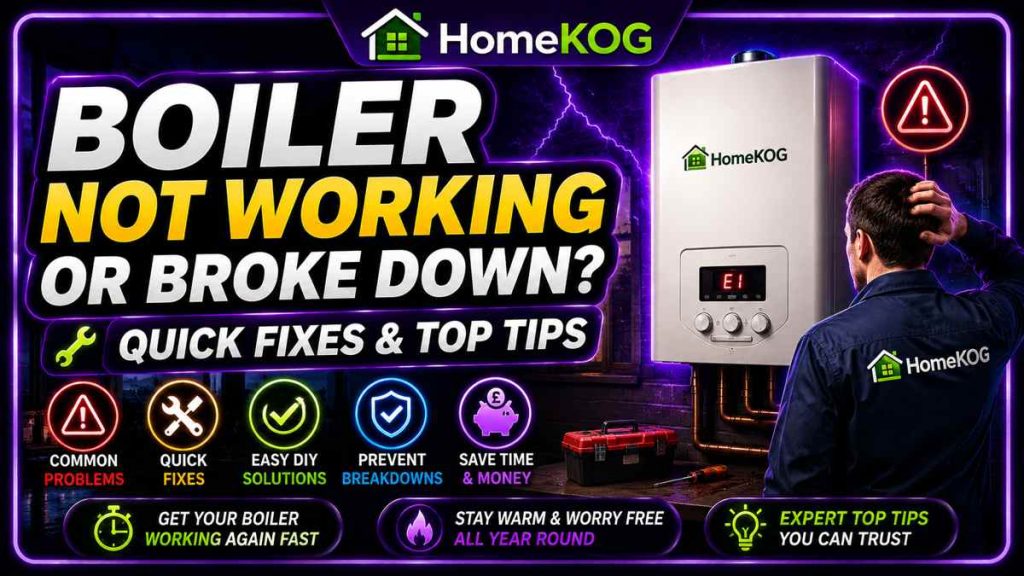
Many Baxi fault codes are displayed in two parts on the control panel. The E1 prefix appears first, followed by a second two-digit sequence that completes the full code. It is important to wait for the full code to display before attempting diagnosis — E119 and E133, for example, are completely different faults that both begin with E1. Always note the complete code before resetting the boiler or calling an engineer.

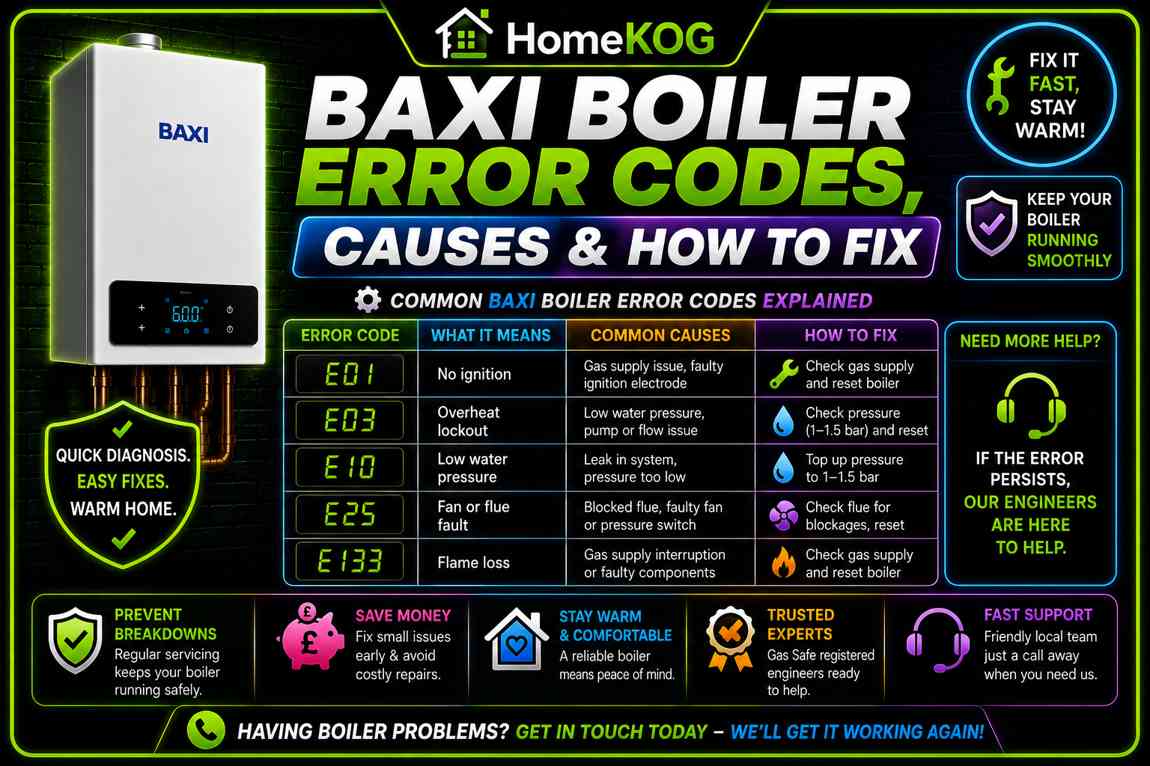
Common Baxi Boiler Error Codes
E119 — Low Water Pressure
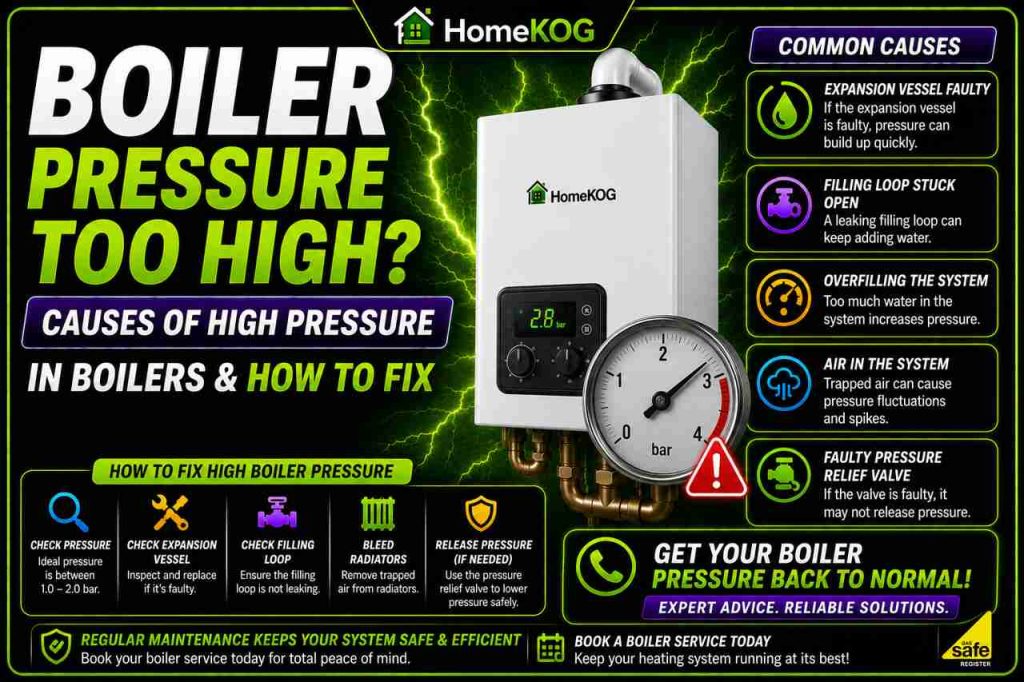
The E119 fault code is the most common Baxi error and indicates the system water pressure has dropped below the 0.5 bar minimum threshold required for the boiler to operate safely. It is also one of the few Baxi fault codes that homeowners can resolve themselves without a Gas Safe engineer.
To fix E119, locate the filling loop — typically a flexible braided hose with one or two valves found beneath the boiler — and open the valve slowly while watching the pressure gauge on the front of the boiler. Fill until the gauge reads between 1 and 1.5 bar with the heating cold, then close the valve firmly. The most common causes of low pressure are a small system leak, pressure loss after bleeding radiators, or natural system loss over time.
If pressure drops again shortly after repressurising, a slow leak somewhere in the system is the most likely explanation and a Gas Safe engineer should locate and repair the source rather than the homeowner continuing to top up the pressure repeatedly.
Can you fix it yourself? Yes — repressurise to 1 to 1.5 bar using the filling loop. Call an engineer if pressure drops repeatedly.
E133 — Gas Supply, Ignition Failure, or Frozen Condensate Pipe
The E133 code is one of the most frequently reported Baxi fault codes and has three distinct possible causes — a gas supply problem, an ignition system failure, or a frozen condensate pipe. Working through each potential cause in order is the most efficient approach before deciding whether an engineer is needed.
The first step is to confirm the gas supply is active. Check whether other gas appliances in the property — such as a gas hob or fire — are working normally. If they are not, the issue is with the gas supply to the property rather than the boiler, and the gas network operator should be contacted. If other appliances are working normally, turn the boiler’s selector switch to the reset position and hold it there for five seconds to attempt a restart. If the flame reignites and the E133 clears, the fault was a temporary ignition interruption.
If temperatures have recently been below freezing, the condensate pipe may be blocked with ice. The condensate pipe is typically a white plastic pipe running from the boiler through or along an external wall to a drain. Pouring warm water gently along its length will thaw the blockage — do not use boiling water as this can crack the plastic. Once thawed, attempt a boiler reset. Baxi’s website provides a detailed guide to condensate pipe thawing for their specific models.
If none of the above resolves E133, an ignition system fault or gas valve problem is the likely cause and a Gas Safe engineer should carry out a full inspection.
Can you fix it yourself? Partially — check gas supply, attempt one reset, and thaw condensate pipe if temperatures have been below zero. Call an engineer if the fault persists.
E125 — Circulation Fault
The E125 code indicates that water is not circulating through the heating system as expected, meaning the boiler cannot distribute heated water to the radiators effectively. The most common causes are a pump that has failed or seized, a blockage within the system, or an airlock preventing circulation. understanding system boiler operating principles explained can help in diagnosing issues like the E125 error code. By familiarizing yourself with how these systems operate, you can identify potential faults more quickly and effectively. Regular maintenance and awareness of the cooling system’s components play a crucial role in ensuring optimal performance.
The first step when E125 appears is to check the system pressure gauge. If pressure has dropped below 1 bar, repressurising the system as described for E119 is the starting point, as low pressure can prevent adequate circulation even when the pump is functioning correctly. If pressure is within the normal range and the E125 persists, a Gas Safe engineer should inspect the pump and system for blockages or airlocks.
Can you fix it yourself? Check system pressure first. If pressure is correct, a Gas Safe engineer is required.
E168 — General Fault or Power Failure
The E168 code is a non-specific fault code that appears when the boiler detects a problem but cannot identify a more precise cause. It also commonly appears following a power failure or interruption to the electrical supply, after which the boiler may display E168 while going through its restart sequence.
A single reset attempt is always the first step for E168. If the code clears and the boiler operates normally after the reset, the fault was temporary and no further action is required. If E168 returns after resetting, an engineer should inspect the boiler to establish the underlying cause.
Can you fix it yourself? Attempt one reset. Call a Gas Safe engineer if E168 returns.
Full Baxi Boiler Error Code Reference
| Code | Fault | DIY Fix? |
|---|---|---|
| E004 / E005 | Temperature sensor fault | No — engineer required |
| E104 | Loss of flame five times within 24 hours | No — engineer required |
| E111 | Fan speed fault | No — engineer required |
| E117 | No circulation — possible sensor fault | No — engineer required |
| E119 | Water pressure below 0.5 bar | Yes — repressurise to 1–1.5 bar |
| E120 | Flue temperature exceeded 140°C | No — engineer required |
| E125 | Circulation fault | Check pressure first, then engineer |
| E133 | Gas supply, ignition failure, or frozen condensate | Partial — check gas, attempt reset, thaw condensate |
| E168 | General fault or post-power failure | Attempt one reset — engineer if recurring |
| E200 | Boiler currently resetting | No action — normal reset sequence |
| E207 | System pressure below 0.5 bar | Yes — repressurise to 1–1.5 bar |
| E216 | CSU timeout — possible PCB damage risk | No — engineer required immediately |
| E217 | Communication lost between gas valve and PCB | No — engineer required |
| E400 | Gas valve fault | No — engineer required |
| E413 | Fan seized | No — engineer required |
Fault Code Detail: Secondary Codes
E004 / E005 — Temperature Sensor Fault
These codes indicate a fault with one of the boiler’s temperature sensors. A failed or incorrectly reading temperature sensor prevents the boiler from accurately monitoring water temperature and can cause safety shutdowns. Sensor replacement is typically a straightforward and inexpensive repair for a Gas Safe engineer. Understanding Daikin boiler error code explanations can also help users troubleshoot issues before they escalate. Familiarizing oneself with these codes allows for quicker identification of problems, potentially reducing downtime. Many common errors can be resolved with simple adjustments or minor repairs, making knowledge of these codes invaluable for homeowners. When dealing with issues related to temperature sensors, understanding Ferroli boiler troubleshooting techniques can greatly enhance a homeowner’s ability to diagnose and address problems efficiently. Many users find that following the manufacturer’s guidelines can lead to effective solutions, ultimately saving time and repair costs. Additionally, employing these troubleshooting techniques empowers users to maintain their boiler’s performance and longevity.
E104 — Repeated Flame Loss
The E104 code indicates that the boiler has lost its flame five times within a 24-hour period. This pattern of repeated flame loss typically points to a gas supply issue, a failing gas valve, a faulty flame detection electrode, or a problem with the ignition system. An engineer should inspect all components involved in the ignition and flame detection sequence to identify the root cause.
E111 — Fan Speed Fault
The fan controls combustion air supply and flue gas exhaust. An E111 indicates the fan is not running at the correct speed, which prevents safe combustion. Fan motor failure, wiring faults, or a faulty fan control board are the most common causes. A Gas Safe engineer should inspect and replace the fan or associated components.
E117 — No Circulation / Sensor Fault
The E117 code indicates the boiler cannot detect water circulation, which may be caused by a pump failure, an airlock, or a faulty circulation sensor. An engineer should inspect the pump, circulation sensor, and system for blockages before replacing any components.
E120 — Flue Temperature Exceeded 140°C
An E120 indicates the flue gas temperature has risen above the 140°C maximum permitted level, triggering a safety shutdown. This can indicate a heat exchanger problem, a blockage in the flue, or abnormal combustion. The boiler should not be restarted until a Gas Safe engineer has confirmed the cause of the high flue temperature.
E200 — Boiler Resetting
The E200 code is a status indicator rather than a fault — it simply means the boiler is going through its reset sequence after a shutdown or power interruption. No action is required and the boiler should return to normal operation once the reset cycle is complete.
E207 — System Pressure Below 0.5 Bar
E207 is an alternative low-pressure code to E119 found on certain Baxi models. The cause and resolution are identical — repressurise the system via the filling loop to between 1 and 1.5 bar.
E216 — CSU Timeout
The E216 code indicates that the control and safety unit has timed out, which the fault code description notes may cause damage to the PCB. This is a fault that warrants immediate attention from a Gas Safe engineer rather than a reset attempt, as continued operation in this state risks damage to the PCB that is expensive to repair.
E217 — Communication Fault Between Gas Valve and PCB
The E217 code indicates the PCB has lost communication with the gas valve, which prevents the boiler from controlling gas flow safely. This is an electrical or wiring fault that requires a Gas Safe engineer to diagnose. Depending on the cause, the repair may involve replacing the wiring harness, the gas valve, or the PCB itself.
E400 — Gas Valve Fault
A direct fault code for the gas valve, E400 means the valve has developed a fault that prevents correct gas flow control. Gas valve replacement is a component-level repair that must be carried out by a Gas Safe registered engineer.
E413 — Fan Seized
The E413 code indicates the fan has seized and can no longer rotate. A seized fan prevents the boiler from operating safely as combustion air and flue gas exhaust are both dependent on the fan running correctly. Fan replacement by a Gas Safe engineer is required before the boiler can safely restart.
FAQ
What does the Baxi E119 fault code mean?
The Baxi E119 fault code means the system water pressure has dropped below the 0.5 bar minimum required for safe boiler operation. It is the most common Baxi fault code and one of the few that homeowners can fix themselves. Repressurising the system via the filling loop to between 1 and 1.5 bar with the heating cold will resolve the fault in most cases. If pressure drops repeatedly after topping up, a slow leak somewhere in the system is the likely cause and a Gas Safe engineer should investigate. To ensure the boiler operates efficiently, it’s essential to know how to check boiler pressure levels regularly. Monitoring the pressure can help homeowners identify potential issues before they escalate. Keeping an eye on this aspect will not only enhance safety but also prolong the lifespan of the boiler system.
How do I fix the Baxi E133 fault code?
The Baxi E133 fault code has three possible causes — a gas supply problem, ignition failure, or a frozen condensate pipe. Start by confirming other gas appliances in the property are working normally to rule out a supply issue. If the supply is fine, turn the selector switch to the reset position and hold for five seconds to attempt a restart. If temperatures have been below freezing, pour warm water along the external condensate pipe to thaw any ice blockage, then attempt a reset. If none of these steps resolve the E133, a Gas Safe engineer should inspect the ignition system and gas valve.
Can I fix Baxi boiler faults myself?
Yes, in some cases. The E119 and E207 low-pressure fault codes can be resolved by repressurising the system via the filling loop. A frozen condensate pipe contributing to E133 can be thawed with warm water. The E168 general fault code is worth attempting a single reset to clear. For all other fault codes, a Gas Safe registered engineer should be called, as the faults involve internal components that require professional diagnosis and repair.
What is the Baxi E168 fault code?
The Baxi E168 is a non-specific fault code that appears when the boiler detects a problem without being able to identify a more precise cause. It also commonly appears after a power failure or electrical interruption. Attempting a single reset is the appropriate first step — if the boiler returns to normal operation after resetting, the fault was temporary. If E168 returns repeatedly, a Gas Safe engineer should identify and repair the underlying cause. If you encounter the E160 error code troubleshooting for Baxi, it may indicate a fault in the boiler’s circuitry or sensors. In such cases, checking the electrical connections and ensuring all components are functioning properly is essential. Consulting the user manual for specific troubleshooting steps can also be beneficial before seeking professional assistance.
What causes the Baxi E125 error code?
The Baxi E125 error code indicates a circulation fault — the boiler cannot detect adequate water movement through the heating circuit. The most common causes are a pump that has seized or failed, a system airlock, or a blockage restricting water flow. Checking that system pressure is within the normal 1 to 1.5 bar range is the first step, as low pressure can mimic a circulation fault. If pressure is correct and E125 persists, a Gas Safe engineer should inspect the pump and heating circuit.
How do I reset a Baxi boiler?
To reset a Baxi boiler, turn the selector switch to the reset position and hold it there for approximately five seconds until the boiler attempts to restart. The E200 status code will appear during the reset cycle, which is normal. A single reset attempt is appropriate for most Baxi fault codes as a first step. Repeatedly resetting a boiler that continues to lock out is not advisable, as it can mask a developing fault and cause additional component damage. If the fault code returns after one reset, a Gas Safe engineer should diagnose and repair the underlying cause.
When should I replace my Baxi boiler rather than repair it?
A Baxi boiler under 10 years old with a single straightforward fault is almost always worth repairing. For boilers over 10 to 12 years old with multiple recurring fault codes, or where a major repair such as a PCB, gas valve, or heat exchanger replacement costs more than 50% of a new boiler installation, replacement is likely the more economical long-term decision. A Gas Safe engineer can give an honest assessment of whether the investment in repair is justified given the boiler’s age, fault history, and current condition. When considering a new boiler, one should research the best combi boilers for energy efficiency to ensure optimal performance and savings on energy bills. Many of these models come equipped with advanced technology that not only enhances heating efficiency but also reduces environmental impact. Additionally, government incentives may be available for homeowners opting for high-efficiency units, further enhancing the financial appeal of upgrading.
Conclusion
Baxi’s fault code system covers a comprehensive range of faults across their boiler range and provides a clear starting point for diagnosis when something goes wrong. Of all the codes in this guide, E119, E207, and the condensate pipe and gas supply elements of E133 are the most likely to be resolved by the homeowner without a call-out. A single reset attempt for E168 is also always worthwhile before calling an engineer. For homeowners looking to ensure their Baxi boiler runs smoothly, understanding the baxi boiler service booking process is essential. This streamlined process allows customers to schedule maintenance or repairs conveniently, minimizing downtime. Regular servicing can help prevent faults and extend the lifespan of the boiler.
For all other fault codes — particularly E216, E217, E400, and E413 — a Gas Safe registered engineer should be contacted promptly. Annual servicing remains the most effective prevention strategy, keeping all components clean, tested, and operating correctly throughout the boiler’s lifespan and catching developing faults before they trigger a lockout and leave the household without heating or hot water.