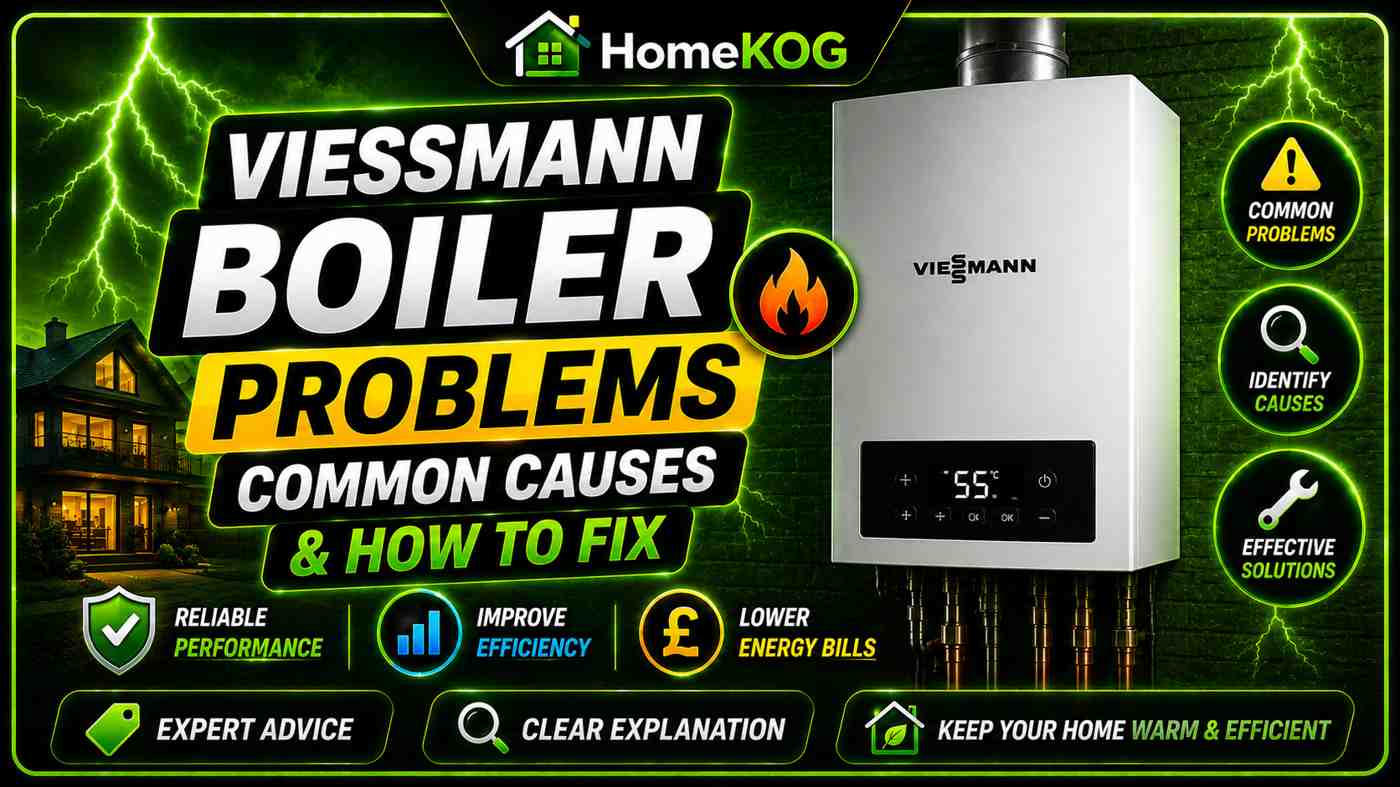

Viessmann Boiler Problems: Common Causes, Fixes and Fault Codes
Quick Answer: The most common Viessmann boiler problems are low system pressure, a frozen condensate pipe, a faulty fan, a failed PCB, radiators not heating up, and ignition faults. Low pressure and a frozen condensate pipe can usually be resolved by the homeowner. Fan faults, PCB failures, burner blockages, and anything involving the gas supply must be dealt with by a Gas Safe registered engineer.
Viessmann has been manufacturing heating systems for over a century and is consistently rated among the most reliable boiler brands in the UK. That reliability does not mean faults never occur — wear and tear, installation issues, and system contamination can all cause problems regardless of the brand — but understanding what the most common Viessmann boiler problems are, and knowing how to respond to each, puts you in a far better position to resolve them quickly and safely. When considering a purchase, it’s essential to check the viessmann boiler price comparison for 2026 to ensure you’re getting the best value for your investment. Additionally, researching reviews and comparisons can help you understand how Viessmann stacks up against other brands in terms of cost and efficiency. This knowledge will empower you to make an informed decision that aligns with your heating needs and budget.
Get a boiler cover plan online here
Key Entity Relationships
- Viessmann is a German heating manufacturer founded in 1917 whose UK residential boiler range includes the Vitodens 050, Vitodens 100-W, and Vitodens 200-W, and which claims to produce the most reliable boilers in the UK market.
- The Vitodens 200-W is Viessmann’s premium residential combi boiler, featuring a stainless steel MatriX cylinder burner and full modulation capability, and it is among the most commonly serviced Viessmann models in the UK.
- A boiler lockout is an automatic safety shutdown triggered by the boiler’s PCB when a sensor reading or safety check falls outside acceptable parameters, preventing the boiler from operating until the fault is resolved or a reset is performed.
- A printed circuit board (PCB) is the electronic control unit within a Viessmann boiler that processes sensor inputs, controls the burner and pump, and triggers lockouts when fault conditions are detected.
- A condensate pipe is the external plastic pipe that carries acidic wastewater from the condensing process away from the boiler, and it is highly vulnerable to freezing in cold weather, causing one of the most common winter lockout faults.
- A thermocouple is a temperature-sensing safety device associated with a boiler’s pilot light that cuts the gas supply if the pilot light goes out, preventing unburned gas from accumulating in the combustion chamber.
- The filling loop is a short braided flexible connector on the central heating pipework that allows the homeowner to add water to the system and restore correct operating pressure when it drops below the recommended level.
- A burner blockage occurs when debris or carbon deposits obstruct the burner assembly, preventing the correct air-to-gas mixture from reaching the combustion chamber, and requires a Gas Safe engineer to diagnose and clear.
- A flow switch in a Viessmann boiler monitors water flow through the primary circuit and will trigger a lockout if flow is insufficient or absent, which can be caused by a blocked filter, a failing pump, or air in the system.
- A faulty fan in a Viessmann boiler causes a safety lockout because the fan is responsible for ensuring combustion gases are safely expelled through the flue before ignition takes place.
- Gas Safe registered engineers are the only professionals legally authorised to diagnose and repair gas-related boiler faults in the UK, and any fault involving the gas supply, burner, or combustion components must be referred to a registered engineer.
- A Viessmann boiler fault code is an alphanumeric code displayed on the boiler’s control panel that identifies the specific component or system that has triggered a lockout or fault condition.
Most Common Viessmann Boiler Problems
Many Viessmann boiler faults follow recognisable patterns. The following problems account for the majority of callouts and reported issues across the Vitodens range. Some can be addressed by the homeowner; others require a Gas Safe engineer.
Low Boiler Pressure
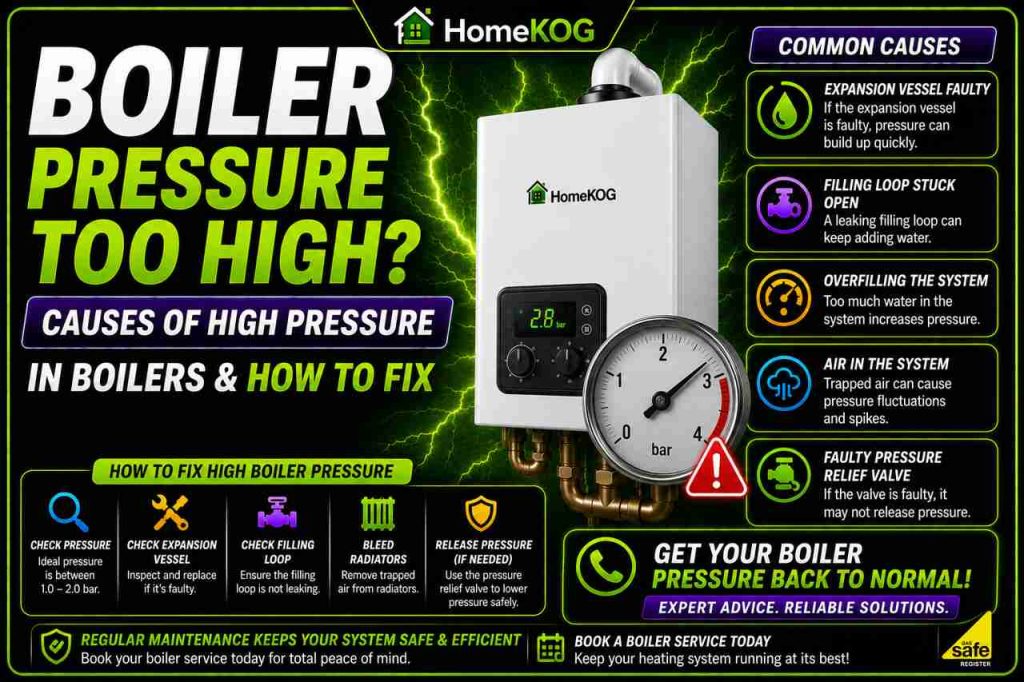
Low system pressure is the most frequently reported Viessmann boiler problem and one of the few that a homeowner can safely resolve without professional help. A sealed central heating system needs to maintain a water pressure of between 1 and 1.5 bar to operate correctly. When pressure drops below 1 bar, the boiler will either underperform or lock out entirely.
Pressure drops gradually over time as small amounts of water escape from the system — typically through the pressure relief valve, through micro-leaks at radiator valves, or following radiator bleeding. A small, gradual reduction is normal. A significant or rapid drop, or one that recurs within days of being corrected, points to a leak in the system that a Gas Safe engineer should investigate.
To restore pressure, locate the filling loop — the braided flexible connector attached to the pipework beneath the boiler — and open both valves until the pressure gauge reads approximately 1.2 bar, then close them and remove or lock the filling loop. Switch the boiler off before starting and allow it to cool if it has been running.
Frozen Condensate Pipe
A frozen condensate pipe is one of the most common causes of Viessmann boiler lockouts during cold periods. The condensate pipe runs from the boiler to an external drain, and the section outside the building is vulnerable to freezing when temperatures drop significantly. A blockage triggers a fault code and prevents the boiler from operating.
The fix is straightforward: apply warm — not boiling — water to the frozen section of pipe, typically using a kettle or a hot water bottle. Once the ice is cleared, reset the boiler and it should restart normally. Insulating the external section of the condensate pipe with outdoor-grade lagging before winter is the most effective preventive measure and takes only a few minutes to fit.
Radiators Not Heating Up
Radiators that fail to heat through fully, or that are warm in some places and cold in others, are usually caused by one of two conditions: trapped air or system sludge. Trapped air causes a radiator to be cold at the top but warm at the bottom; sludge causes a radiator to be cold at the bottom but warm at the top.
Trapped air is resolved by bleeding the radiator using a radiator bleed key. Turn off the heating and allow the system to cool, then insert the bleed key into the valve at the top of the radiator and turn it anticlockwise until a hissing sound begins. Close the valve when the hissing stops and water appears, then check and restore system pressure if it has dropped. For sludge, a professional power flush by a Gas Safe engineer is the appropriate solution.
Boiler Not Firing
A Viessmann boiler that powers on but fails to ignite will typically display a fault code identifying the cause. Common causes include a fault with the ignition electrodes — where carbon deposits prevent reliable sparking — a problem with the gas supply, or an issue with the flame detection sensor. Before calling an engineer, confirm that the gas supply to the property is functioning correctly (check another gas appliance), that the boiler pressure is within range, and that the fault code on the display has been noted.
A single reset attempt is always worth trying. If the boiler fails to fire after a reset, or if the same fault code recurs within a short period, a Gas Safe engineer is needed.
Faulty Fan
A fan fault causes an immediate lockout because the boiler’s safety logic prevents ignition until the fan has confirmed it is running at the correct speed. The fan is responsible for drawing combustion air into the burner and expelling flue gases through the flue — without it, neither function can be safely performed.
Fan faults are not homeowner-resolvable. The cause may be a failed fan motor, damaged wiring, a faulty fan speed sensor, or a problem with the PCB that is preventing the correct speed signal from being processed. A Gas Safe engineer will diagnose the specific cause and advise on whether the fan or associated components need replacement.
Faulty PCB
The PCB is the boiler’s electronic brain, processing inputs from all sensors and controls and directing the burner, pump, and safety systems accordingly. A faulty PCB can produce almost any symptom — a boiler that will not start, one that locks out repeatedly without an obvious cause, or one that behaves erratically across multiple functions. Diagnosing a PCB fault requires an engineer to rule out all other causes first, as PCB replacement is one of the more expensive boiler repairs. In addition to PCB issues, understanding boiler short cycling causes explained is crucial for maintaining system efficiency. Short cycling can lead to increased wear on the boiler components and elevated energy costs, making it essential to identify and address the underlying issues promptly. Regular maintenance and proper system settings can help prevent this problem, ensuring the boiler operates smoothly and efficiently.
If your Viessmann boiler is within its warranty period, a faulty PCB is covered as a manufacturing defect and should be reported to Viessmann before arranging an independent engineer.
Faulty Flow Switch
The flow switch monitors water movement through the primary circuit and signals the PCB that adequate flow is present before allowing ignition. A faulty flow switch can trigger a lockout even when the pump and system are functioning correctly, because the PCB receives no confirmation that flow is occurring. This fault requires an engineer — the flow switch involves the internal hydraulic components of the boiler and the gas circuit indirectly.
Which Problems Can You Fix Yourself?
Three common Viessmann boiler problems are safe and straightforward for the homeowner to address without professional involvement.
Repressurising the system via the filling loop when the pressure gauge shows below 1 bar is the most common self-fix. The process takes two to three minutes and restores normal boiler operation in the majority of low-pressure lockout cases.
Thawing a frozen condensate pipe with warm water is the correct response to a winter lockout when the fault code or circumstances indicate this as the cause. It requires no tools and no access to internal components, and the boiler should restart normally once the blockage is cleared.
Bleeding radiators to release trapped air is a maintenance task any homeowner can perform safely using a radiator bleed key. It restores full heat circulation to radiators that are cold at the top and improves overall system efficiency. Always check and restore system pressure after bleeding, as the process releases a small volume of water from the system.
Which Problems Require a Gas Safe Engineer?
Any fault involving the gas supply, combustion components, or the internal electronics of the boiler must be referred to a Gas Safe registered engineer. This includes:
- Fan faults of any kind — the fan is a safety-critical component and its replacement or repair involves internal boiler access
- PCB faults — diagnosis and replacement require specialist tools and knowledge
- Burner blockages — clearing a blocked burner involves disassembling combustion components
- Faulty flow switch — replacement involves the internal hydraulic and control systems
- Gas supply faults — any condition involving the gas valve, gas pressure, or flame supervision must only be addressed by a Gas Safe engineer
- Water leaks from internal components — a weeping heat exchanger, pump seal, or pipe fitting inside the boiler requires professional assessment to identify the source and carry out a safe repair
- Pilot light faults — if the pilot light is going out repeatedly, the thermocouple or gas valve may need replacing
You can verify the Gas Safe registration of any engineer before they start work at gassaferegister.co.uk.
How to Fix a Leaking Viessmann Boiler
A boiler leak should always be investigated promptly. Water near electrical components creates a risk of short circuits and further component damage, and a leak left unaddressed will corrode the affected components and spread to adjacent parts of the boiler.
The source of the leak determines the appropriate response. If the pressure relief valve is discharging water, check the system pressure gauge — if it reads above 2 bar, the system is overpressurised and the PRV is opening to relieve it. Bleeding radiators can reduce pressure, but if the pressure is consistently high without an obvious cause, a Gas Safe engineer should check the expansion vessel and filling loop.
Leaks from pipe fittings at the boiler connections are sometimes resolved by a very slight quarter-turn tightening of the fitting. Do not overtighten. If this does not stop the weep, the PTFE tape or compression fitting inside the connection may need attention from an engineer.
Leaks from the pump body or its seals are typically a sign of age-related rubber degradation. On older boilers, the cost of pump seal replacement should be weighed against the age of the unit and the likelihood of further repairs being needed.
How to Reset a Viessmann Boiler
When a Viessmann boiler locks out, it displays a fault code and will not restart until it is manually reset. Once the underlying cause has been addressed — or following a one-off transient fault — the reset procedure clears the fault state and allows the boiler to attempt a fresh startup.
On most Vitodens models, press and hold the reset button for approximately ten seconds. The location of the reset button varies between models — on the Vitodens 200-W and 222-F it is typically a dedicated button on the front panel; on the Vitodens 100-W it may be accessed via the control panel interface. If the location is not immediately clear, the user manual for your specific model will confirm it.
After resetting, allow the boiler two to five minutes to complete its startup sequence. If the fault code returns immediately or within a short period, the underlying condition has not been resolved and a Gas Safe engineer should be contacted rather than attempting further resets.
Viessmann Boiler Warranty: What Is and Isn’t Covered
Viessmann offers warranties on its residential boilers that vary in length between models, with the standard cover typically running to two years and extended cover of up to ten years available depending on the model and registration route. The warranty covers manufacturing and material defects in the boiler’s components, including parts and labour for qualifying repairs.
Faults caused by incorrect installation are not covered by the manufacturer’s warranty — this is an important distinction if the boiler was not installed by a Viessmann-trained or manufacturer-approved engineer, as installation-related faults can be difficult to distinguish from manufacturing defects without professional assessment.
The warranty also does not cover damage caused by system contamination — sludge and magnetite damage to the heat exchanger, for example — or by the use of non-approved parts in a previous repair. Annual servicing by a Gas Safe engineer is required to maintain warranty validity throughout the warranty period.
If a fault arises and you believe it may be covered under the warranty, contact Viessmann directly before arranging an independent engineer. Using an unapproved engineer for a warranty repair can affect the remaining cover.
When Should You Replace a Viessmann Boiler?
Viessmann boilers are built to last and a well-maintained unit typically achieves a working lifespan of twelve to fifteen years or more. The decision to replace rather than repair is worth considering when the boiler is over ten years old and has begun requiring frequent engineer callouts, when a major component such as the heat exchanger requires replacement at a cost approaching that of a new boiler, or when the efficiency of the existing unit is significantly below what a modern replacement would achieve.
An older boiler that has not been regularly serviced will also be running well below its rated efficiency, which means higher annual gas bills than a modern equivalent would produce. The cumulative energy saving from a new high-efficiency condensing boiler often contributes meaningfully to the cost justification for replacement.
If an engineer recommends a major repair on a Viessmann boiler over ten years old, it is always worth asking for their view on whether the remaining lifespan of the unit justifies the repair cost, or whether replacement represents better value over a five-year horizon.
Viessmann Boiler Fault Code Reference
The table below covers the most commonly encountered fault codes across the Vitodens range. For codes not listed here, refer to the fault code section of your specific model’s user manual, or the Viessmann technical support documentation for your boiler.
| Fault Code | Likely Cause | Homeowner Action |
|---|---|---|
| F0 | Flow temperature sensor fault | Check pressure; reset once. Engineer if recurring |
| F2 | Safety temperature limiter activated | Check for circulation issues; reset once. Engineer if recurring |
| F4 | Ignition failure — burner did not light | Check gas supply; reset once. Engineer if recurring |
| F5 | Gas pressure switch showing no gas / gas valve fault | Check gas supply at meter. Engineer required |
| F9 | Flue gas or combustion issue | Engineer required — do not reset repeatedly |
| FC | Gas valve fault or blocked flue/vent system | Engineer required |
| FE | EMC interference or faulty main PCB | Engineer required |
| D5 | Flue gas temperature sensor fault | Engineer required |
| 0b | Fan not stopping after auto reset / insufficient water flow | Engineer required |
| 38 | Boiler water temperature sensor cable fault | Engineer required |
| 0F | Service required (shown in fault history) | Book annual service |
| EA / E1 | Heating water flow rate too low / flow switch shutdown | Check pressure; engineer if pressure is correct |
| A4 | Air lock in internal pump / minimum flow rate not achieved | Engineer required |
| 10 | Outdoor temperature sensor short circuit | Engineer required |
| B4 | Internal PCB fault | Engineer required — warranty claim if applicable |
| 80–83 | Boiler water temperature sensor short circuit | Engineer required |
| 50–51 | DHW tank temperature sensor fault | Engineer required |
| C2–C8 | Fixed high limit responded or fuse blown | Engineer required — do not continue to reset |
For a complete fault code reference for a specific Viessmann model — including the Vitodens 050, 100-W, 200-W, and 222-F — consult the user manual supplied with the boiler. Viessmann technical support can also be reached during business hours for guidance on fault interpretation.
Maintaining Your Viessmann Boiler to Prevent Problems
Annual servicing by a Gas Safe registered engineer is the most effective single measure for preventing Viessmann boiler problems. The engineer will inspect, clean, and test all major components, carry out a flue gas analysis, and update the Benchmark Commissioning Checklist — providing both a safety check and a service record that maintains warranty validity.
Between annual services, homeowners can support their boiler’s performance by keeping the system pressure between 1 and 1.5 bar, checking the pressure gauge monthly and repressurising when needed, bleeding radiators at the start of the heating season to clear trapped air, keeping any air grilles or ventilation openings near the boiler clear of obstruction, and ensuring the condensate pipe is insulated before winter arrives. Understanding system boiler functionality and benefits can further empower homeowners to maintain an efficient heating system. By utilizing these systems, they can achieve consistent warmth and potentially lower energy bills. Additionally, investing time in regular care and learning about their benefits can extend the lifespan of the boiler, ensuring reliable performance for years to come.
Fitting a magnetic system filter — if one is not already present — is one of the most effective upgrades available to existing Viessmann installations. The filter captures magnetite and metallic debris before it reaches the boiler’s heat exchanger and pump, significantly reducing the rate of internal contamination and the likelihood of sludge-related faults.
FAQ
What are the most common Viessmann boiler problems?
The most commonly reported Viessmann boiler problems are low system pressure, a frozen condensate pipe, radiators not heating evenly, the boiler failing to fire, fan faults, and PCB failures. Low pressure and a frozen condensate pipe can typically be resolved by the homeowner. Fan faults, PCB failures, burner blockages, and any fault involving the gas supply or combustion components must be referred to a Gas Safe registered engineer.
Can I fix a Viessmann boiler problem myself?
You can safely address three common problems without professional help: repressurising the system via the filling loop when pressure is low, thawing a frozen condensate pipe with warm water, and bleeding radiators to release trapped air. Any fault that involves internal boiler components, the gas supply, combustion, or the PCB must be handled by a Gas Safe registered engineer. Attempting to work on gas components without registration is illegal and dangerous.
What does a Viessmann boiler fault code mean?
A Viessmann boiler fault code is an alphanumeric code displayed on the control panel when the boiler enters lockout or detects an operational fault. Each code corresponds to a specific component or condition — for example, F4 indicates an ignition failure, F5 points to a gas pressure or valve fault, and 0F indicates a service is due. Checking the fault code before attempting a reset helps identify whether the issue is something a reset may resolve or whether an engineer is needed immediately. When faced with a Viessmann boiler troubleshooting error codes situation, it’s vital to consult the user manual for guidance on the specific codes displayed. Each code not only helps in understanding the malfunction but also offers insights into possible solutions. Properly addressing these codes can significantly reduce downtime and enhance the efficiency of your heating system.
How do I reset a Viessmann boiler?
Press and hold the reset button for approximately ten seconds, then allow two to five minutes for the boiler to complete its startup sequence. The reset button location varies between Vitodens models — check the user manual for your specific model if it is not immediately obvious. A single reset is a reasonable first response to a lockout. If the fault code returns immediately or shortly after resetting, a Gas Safe engineer should be contacted rather than continuing to reset.
What should I do if my Viessmann boiler is leaking?
Turn off the boiler immediately and identify the source of the leak if possible. A weeping pressure relief valve may indicate overpressurisation — check the system pressure gauge and bleed radiators to reduce pressure if it reads above 2 bar. A leak at a pipe fitting may be resolvable with a slight quarter-turn tightening. Leaks from the pump body, heat exchanger, or internal seals require a Gas Safe engineer. Do not ignore a leak — water near electrical components within the boiler can cause secondary damage rapidly.
Which Viessmann boiler problems are covered by warranty?
The Viessmann warranty covers manufacturing and material defects in the boiler’s components, including parts and labour. PCB failures, faulty fans, defective flow switches, and other component failures that occur as a result of manufacturing issues fall within warranty scope. The warranty does not cover problems caused by incorrect installation, system contamination such as sludge damage to the heat exchanger, or faults arising from missed annual services. Contact Viessmann directly before arranging a repair if you believe the fault may be warranty-eligible.
When should I replace my Viessmann boiler?
A well-maintained Viessmann boiler typically lasts twelve to fifteen years. Replacement should be considered when the boiler is over ten years old and requiring frequent engineer callouts, when a major component such as the heat exchanger needs replacement at a cost approaching that of a new boiler, or when the unit’s age means it is running significantly below the efficiency of a modern replacement. An honest engineer will advise on whether a repair or replacement represents better long-term value for your specific boiler and circumstances.
How do I prevent Viessmann boiler problems?
Annual servicing by a Gas Safe registered engineer is the most effective preventive measure, maintaining combustion quality, catching worn components early, and keeping the warranty valid. Between services, check the system pressure monthly and repressurise when it falls below 1 bar, bleed radiators at the start of each heating season, insulate the external condensate pipe before winter, and keep ventilation openings near the boiler clear. Fitting a magnetic system filter — if not already present — significantly reduces internal contamination over the long term.
Conclusion
Viessmann boilers are among the most reliable available in the UK, but no boiler is immune to the effects of time, wear, and system contamination. Understanding the most common faults — and knowing which can be resolved at home and which require a Gas Safe engineer — means you can respond quickly and appropriately when a problem arises, rather than losing heating and hot water for longer than necessary. Regular maintenance is key to ensuring optimal viessmann boiler performance ratings. Checking pressure levels and cleaning filters can help prevent major issues down the line. By staying proactive, homeowners can enhance their boiler’s efficiency and prolong its lifespan. Many homeowners also seek information on Worcester Bosch boiler reviews to compare reliability and performance. This can provide insights into how these systems hold up over time and their maintenance needs. Additionally, understanding the experiences of others can guide decisions on whether to switch brands or stick with what they have.
For any fault that involves the gas circuit, combustion components, or internal electronics, the right call is always a Gas Safe registered engineer. You can verify the credentials of any engineer at gassaferegister.co.uk.
Annual servicing remains the single most effective step for keeping a Viessmann boiler running reliably and safely, and for maintaining the warranty that protects your investment throughout its working life.