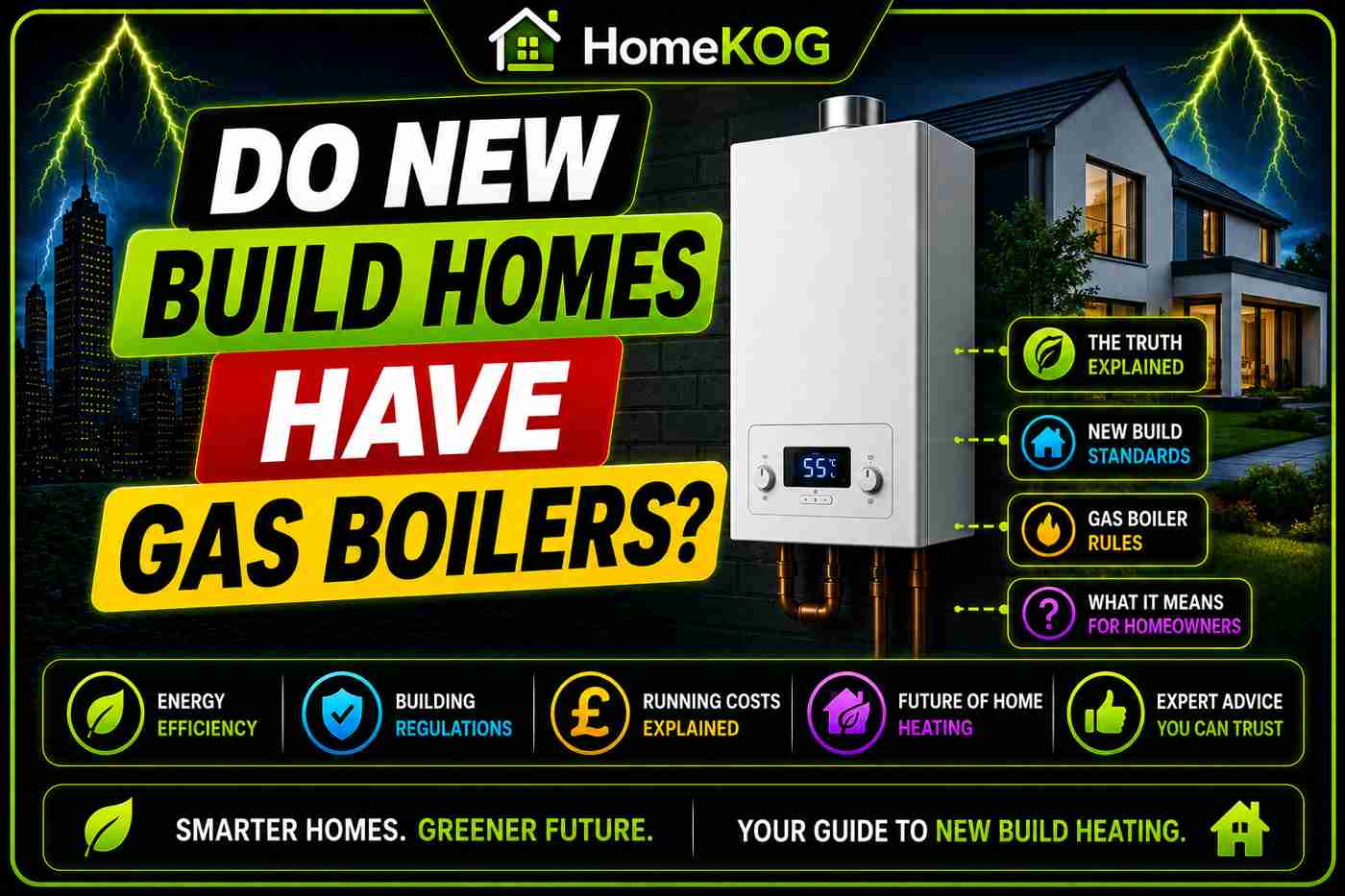

Do New Build Homes Have Gas Boilers? Everything You Need to Know in 2026
Quick Answer: Yes, new build homes in the UK can still have gas boilers in 2026, provided the property is connected to the gas network. Most new build boilers are hydrogen-blend ready, meaning they can run on a mixture of natural gas and up to 20% hydrogen. Combi boilers remain the most common choice for smaller new builds, while system boilers are better suited to larger properties with multiple bathrooms.
Gas boilers continue to be the most widely installed heating system in new build homes across the UK. Despite ongoing changes to building regulations and a growing interest in low-carbon alternatives, the gas boiler remains the practical, cost-effective, and most readily available option for the vast majority of new build developments in 2026.
This guide explains what heating systems new builds typically use, which boiler is best suited to a new build property, and what the current and upcoming regulations mean for homeowners and developers.
Key Facts: New Build Boiler Relationships
- A new build home in the UK can have a gas boiler installed provided the property is connected to the national gas network and the boiler meets current minimum efficiency standards.
- A hydrogen-blend ready boiler is a gas boiler designed to operate on a mixture of natural gas and up to 20% hydrogen, and is the standard specification for new build boiler installations in 2026.
- A combi boiler is the most common boiler type installed in new build homes with one or two bathrooms, providing central heating and hot water on demand from a single compact unit without the need for a separate cylinder.
- A system boiler is better suited to larger new build properties with multiple bathrooms, as it stores hot water in a separate cylinder and can supply multiple outlets simultaneously.
- The Future Homes Standard is a UK building regulation framework that requires new homes to produce 75 to 80% less carbon than those built under previous standards, with implementation progressing through 2025 and 2026.
- An Ideal Logic boiler is the most widely installed boiler brand in UK new build developments, chosen for its compact size, reliability, ease of installation, and warranty terms of up to 12 years.
- A Gas Safe registered engineer must carry out all gas boiler installations in the UK, a requirement that has been in place since April 2009.
- A SEDBUK rating is the Seasonal Efficiency of Domestic Boilers in the UK scale used to measure boiler efficiency, and new build gas boilers must achieve a minimum efficiency of 86% to meet current Building Regulations.
- A condensing boiler is a requirement for all new gas boiler installations under current UK Building Regulations, and operates by recovering heat from flue gases that non-condensing boilers expel as waste.
- An air source heat pump is an alternative heating system that extracts warmth from outdoor air and transfers it into the home, and is one of the low-carbon options promoted under the Future Homes Standard.
- Building Regulations approval is a legal requirement for the installation of any boiler supplying central heating in a new build or replacement scenario in the UK.
- A Competent Person Scheme is a government-authorised programme that allows qualified tradespeople to self-certify that their work complies with Building Regulations without requiring separate local authority approval.

What Heating Systems Do New Build Homes Have?
Gas boilers have heated UK homes for decades, and they remain the dominant choice for new build developers in 2026. The combination of relatively low installation cost, high efficiency, compact form factor, and the existing gas network infrastructure makes them the most practical option for the majority of properties being built today.
New build gas boilers are now specified as hydrogen-blend ready as standard. This means they are engineered to run on a mixture of natural gas and up to 20% hydrogen, positioning them for compatibility with anticipated changes to the composition of the gas supply network as the UK works towards its long-term carbon reduction targets.
Why Gas Boilers Remain the Default Choice for New Builds
Gas continues to offer a cost-effective way to meet high heating demands quickly and reliably. Modern condensing gas boilers achieve efficiency ratings above 90%, and their compact design means they can be installed in a kitchen cupboard without taking up significant living space — an important consideration in new build homes where storage is often limited.
Developers favour gas boilers because they are straightforward to specify, widely understood by heating engineers, and supported by a well-established supply chain for parts and servicing across the UK.
Alternative Heating Systems for New Builds
Other heating technologies are available and increasingly relevant as building regulations continue to tighten. Air source heat pumps extract warmth from outdoor air and are one of the low-carbon alternatives promoted under the Future Homes Standard. Ground source heat pumps work on a similar principle but draw heat from the ground rather than the air.
Electric boilers and biomass boilers are also options in certain circumstances. However, for the majority of new build buyers and developers in 2026, these alternatives carry higher upfront costs, require more outdoor space in most cases, and depend on higher levels of building insulation to perform efficiently. Without significant government grant support or exceptional insulation standards, they remain less viable for mainstream new build developments than a hydrogen-blend ready gas boiler.
Which Gas Boiler Is Best for a New Build Home?
Combi Boilers for Smaller New Builds
A combi boiler is the standard choice for new build homes with one or two bathrooms. Because it heats water on demand rather than storing it in a cylinder, a combi boiler eliminates the need for a hot water tank and is the most space-efficient option available.
This makes combi boilers particularly well suited to the smaller footprints of many modern new build properties, where space efficiency is a priority. When a hot tap or shower is turned on, the boiler fires up and delivers hot water directly — there is no waiting for a cylinder to reheat.
For new builds with a single bathroom and up to around fifteen radiators, a combi boiler in the 24kW to 30kW output range will meet heating and hot water demand reliably and efficiently.
System Boilers for Larger New Builds
Larger new build properties with two or more bathrooms, or those where simultaneous hot water demand from multiple outlets is expected, are better served by a system boiler connected to a hot water cylinder.
A system boiler heats water and stores it in the cylinder, allowing hot water to be delivered to multiple taps and showers at the same time. The trade-off is that once the stored volume of hot water is exhausted, the occupants must wait for the cylinder to reheat before full flow is restored. A correctly sized cylinder for the property minimises the likelihood of this becoming a practical problem.
The Ideal Logic: The Most Installed Boiler in UK New Builds
The Ideal Logic range is the most widely installed boiler in UK new build developments, and it has held that position for a number of years. Ideal Heating boilers are the preferred choice of many of the UK’s largest new build contractors, and the Logic range is specified as standard on a significant proportion of new homes completed each year.
The reasons for this are straightforward. The Ideal Logic is compact enough to fit within a standard kitchen cupboard, lightweight enough to make installation straightforward, and reliable enough to generate very few callbacks. It is available as a combi, heat-only, or system boiler, covering the full range of new build configurations.
Warranties of up to 12 years are available on certain Ideal Logic models depending on which variant is specified and whether the installation is registered correctly. For new build buyers, this warranty period provides meaningful long-term protection from the date of first occupation.
New Build Gas Boiler Regulations in 2026
Minimum Efficiency Requirements
All gas boilers installed in new build properties must meet a minimum efficiency standard under current UK Building Regulations. For gas boilers, the minimum is 86% seasonal efficiency, and a condensing boiler is required in all cases. Oil-fired boilers must achieve a minimum of 85% efficiency.
These requirements apply to both new installations in new build properties and replacement boiler installations in existing homes. A Gas Safe registered engineer will assess the appropriate boiler specification for the property and ensure that the installation meets all relevant regulatory requirements.
Building Regulations Approval
Installing a boiler that supplies central heating — whether gas, oil, or solid fuel — requires Building Regulations approval in the UK. In practice, this is most commonly achieved by using a Gas Safe registered engineer, who is authorised under a Competent Person Scheme to self-certify that the installation complies with Building Regulations without the homeowner or developer needing to make a separate application to the local authority.
Gas Safe registration has been a mandatory requirement for all gas boiler installers since April 2009. Any installation carried out by an engineer without valid Gas Safe registration is illegal, will not be covered by the manufacturer warranty, and may invalidate home insurance cover.
The Future Homes Standard
The Future Homes Standard represents the most significant shift in new build heating regulation in recent years. It requires new homes to be built to a specification that produces 75 to 80% less carbon than homes built under the previous version of Building Regulations. The standard was introduced as a framework in 2025 and continues to shape how new homes are designed and built in 2026.
For heating specifically, the Future Homes Standard places increasing emphasis on low-carbon technologies such as heat pumps and high-efficiency electric systems. However, hydrogen-blend ready gas boilers continue to be an accepted specification for new builds connected to the gas network during the current transitional period.
The standard does not apply retrospectively to existing homes — it governs the specification of newly built properties. Homeowners replacing a boiler in an existing property are subject to the standard efficiency and Building Regulations requirements rather than the full Future Homes Standard framework.
LPG and Oil Boilers in New Builds
For new build properties that are not connected to the national gas network — typically rural locations — LPG and oil-fired boilers remain available options. Both carry higher ongoing fuel costs than mains gas and require the installation and regular refilling of an external storage tank, which adds to the overall running cost and requires adequate outdoor space.
Any installer fitting an oil-fired boiler must be registered with an approved Competent Person Scheme. Solid fuel boiler installations carry the same requirement.
Comparing Heating Options for New Build Homes in 2026
| Heating System | Suitable For | Upfront Cost | Running Cost | Space Required | Low Carbon |
|---|---|---|---|---|---|
| Hydrogen-blend ready gas combi | Small to medium new builds, 1–2 bathrooms | Low–medium | Low | Minimal | Partial |
| Gas system boiler with cylinder | Larger new builds, 2+ bathrooms | Medium | Low | Moderate | Partial |
| Air source heat pump | Well-insulated new builds with outdoor space | High | Medium | Outdoor unit required | Yes |
| Ground source heat pump | Rural new builds, large plot | Very high | Medium | Large plot required | Yes |
| Electric boiler | Small properties, off-grid | Low | High | Minimal | Depends on grid mix |
| Biomass boiler | Rural properties, large fuel storage available | High | Medium–low | Large | Yes |
Frequently Asked Questions
Do new build homes have gas boilers in 2026?
Yes. New build homes in the UK that are connected to the national gas network continue to have gas boilers installed in 2026. All new build gas boilers are now specified as hydrogen-blend ready, meaning they can operate on a mixture of natural gas and up to 20% hydrogen. Combi boilers remain the most common choice for smaller properties, while system boilers are better suited to larger new builds with multiple bathrooms and higher simultaneous hot water demand.
What is a hydrogen-blend ready boiler?
A hydrogen-blend ready boiler is a gas boiler that has been engineered to run on a mixture of natural gas and up to 20% hydrogen. This specification is now standard for new build boiler installations in the UK and is designed to ensure compatibility with potential future changes to the composition of the gas supply network as the UK progresses towards its carbon reduction commitments. Hydrogen-blend ready boilers operate identically to conventional gas boilers at the current gas blend and require no modification or adjustment from the homeowner.
Which boiler brand is most commonly installed in UK new builds?
The Ideal Logic range from Ideal Heating is the most widely installed boiler in UK new build developments. It is the preferred specification of many of the UK’s largest new build contractors due to its compact dimensions, lightweight construction, reliability, and warranty terms of up to 12 years depending on the model and registration. The Ideal Logic is available as a combi, heat-only, or system boiler, covering the full range of new build heating configurations.
What are the Building Regulations for new build gas boilers?
All gas boilers installed in new build properties must achieve a minimum seasonal efficiency of 86% and must be condensing boilers. Installation requires Building Regulations approval, which is most commonly achieved by using a Gas Safe registered engineer working under a Competent Person Scheme. Gas Safe registration has been mandatory for all gas boiler installers since April 2009. Any installation carried out without valid Gas Safe registration is illegal and will not be covered by the manufacturer warranty.
What is the Future Homes Standard and how does it affect new build boilers?
The Future Homes Standard is a UK building regulation framework introduced in 2025 that requires new homes to produce 75 to 80% less carbon than those built under previous standards. For heating, the standard places increasing emphasis on low-carbon technologies such as heat pumps and high-efficiency electric systems. However, hydrogen-blend ready gas boilers remain an accepted specification for new builds connected to the gas network during the current transitional period. The standard applies to new build properties and does not retrospectively affect existing homes replacing their boiler.
Is a combi boiler or a system boiler better for a new build?
For new build homes with one or two bathrooms and up to around fifteen radiators, a combi boiler is typically the better choice. It provides heating and hot water on demand without requiring a separate cylinder, making it the most space-efficient option for smaller properties. For larger new builds with multiple bathrooms where simultaneous hot water demand from several outlets is expected, a system boiler with an appropriately sized hot water cylinder will perform more reliably and deliver a better experience for the occupants.
Can a new build have a heat pump instead of a gas boiler?
Yes. Air source and ground source heat pumps are viable heating options for new build properties, particularly those built to the high insulation standards required by the Future Homes Standard. However, heat pumps carry a higher upfront cost than gas boilers, require outdoor space for the external unit, and perform most efficiently in well-insulated properties with underfloor heating or larger radiators than a conventional gas system would use. For most mainstream new build developments in 2026, hydrogen-blend ready gas boilers remain the more practical and cost-effective choice for developers and buyers alike.
What happens if a gas boiler is installed without Gas Safe registration?
Installing a gas boiler without a Gas Safe registered engineer is illegal in the UK. Any installation carried out without valid Gas Safe registration will not receive the Building Regulations certification required for the work to be legally compliant. It will also invalidate the manufacturer warranty on the boiler, may void the property’s home insurance cover, and could create serious safety risks for the occupants. Always verify that any engineer installing a gas appliance is currently registered with Gas Safe before work begins — registrations can be checked directly on the Gas Safe Register website.
Conclusion
Gas boilers remain the standard heating choice for new build homes in the UK in 2026, and the shift to hydrogen-blend ready specifications ensures they are positioned to remain a viable option as the gas network evolves. For smaller new builds, a combi boiler provides the most compact and cost-effective solution. For larger properties with multiple bathrooms, a system boiler paired with a correctly sized hot water cylinder delivers better performance under simultaneous demand.
The Ideal Logic continues to be the most widely installed boiler in UK new build developments, trusted by contractors and developers for its reliability, compact design, and strong warranty terms.
Regulatory requirements are tightening under the Future Homes Standard, and low-carbon alternatives such as air source heat pumps are becoming increasingly relevant — particularly for properties built to the highest insulation standards. For the majority of new build buyers and developers right now, however, a hydrogen-blend ready condensing gas boiler remains the most practical, affordable, and widely supported heating solution available.
Whatever heating system is chosen, all installation work must be carried out by a Gas Safe registered engineer, and all new build boilers must meet the minimum efficiency standards set out under current UK Building Regulations.