
What is a Magnetic Filter for a Boiler? Complete Guide 2026
Quick Answer: A magnetic filter is a device fitted to the return pipework of a central heating system that uses a powerful magnet to attract and capture iron oxide particles (magnetite sludge) from the circulating water before they can accumulate in the boiler, pump, or radiators. It is the single most effective ongoing preventative measure against sludge-related heating system damage. Most major boiler manufacturers require a magnetic filter to be fitted as a condition of their extended warranty. A magnetic filter costs approximately £60 to £150 for the unit and should be cleaned annually at the same time as the boiler service. Most units last 10 years with proper maintenance.
Magnetite sludge — the thick black deposit formed when iron oxide from corroding steel radiators mixes with water in the heating circuit — is the most common cause of preventable boiler and central heating system damage in the UK. Left unchecked, it accumulates in the boiler heat exchanger, the pump, and the lower sections of radiators, causing cold spots, pump seizure, heat exchanger failure, and eventually boiler breakdown. A magnetic filter removes the particles that form this sludge continuously and passively, every hour the heating system operates, for the entire lifespan of the installation.
What is a Magnetic Filter?
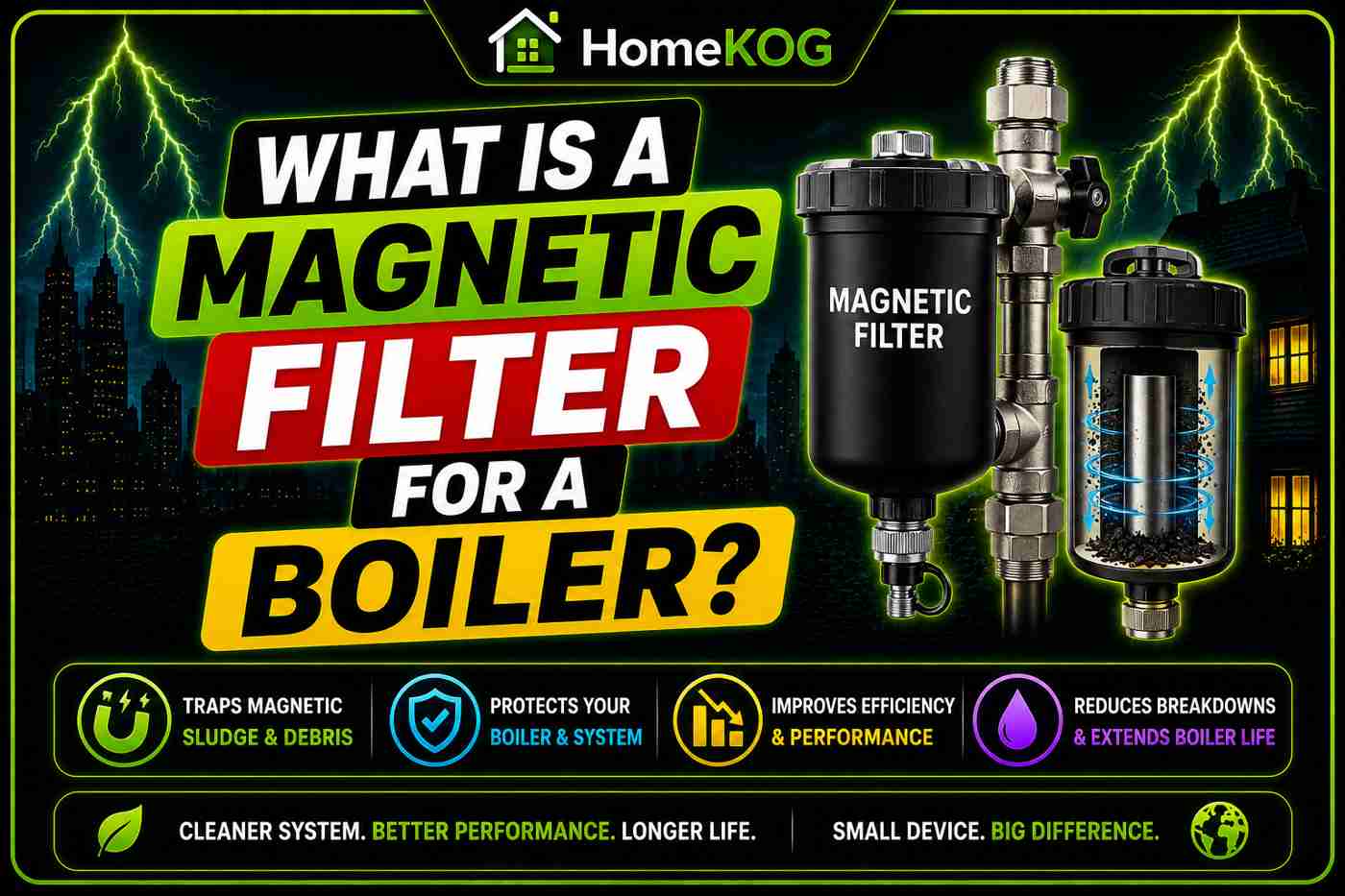
A magnetic filter is a cylindrical or spherical device containing a powerful rare earth magnet — typically neodymium — that is fitted in-line on the central heating return pipework. As water returns from the radiators to the boiler, it passes through or around the magnetic filter body. The magnet’s field attracts ferrous (iron-containing) particles in the water and holds them against the filter body, removing them from circulation before they can reach the boiler’s heat exchanger or pump.
The captured sludge accumulates on the magnetic filter’s inner surface over time. At each annual service, the engineer isolates the filter using the valves on either side, removes the magnetic component, and cleans the accumulated sludge before reinstalling. This permanently removes the sludge from the system rather than leaving it to circulate.
Some magnetic filter models also include a secondary non-magnetic capture mechanism — a mesh or gravity-settling chamber — that captures non-ferrous debris such as flux residue, pipe swarf, and scale particles that the magnet alone cannot attract.

How Magnetite Sludge Forms and Why It Matters
Every steel radiator in a central heating system is slowly corroding internally. This is a normal electrochemical process — when metal contacts water and oxygen, iron oxide forms as a corrosion product. In a properly maintained system with adequate inhibitor concentration, this corrosion is significantly slowed. In a system without inhibitor or with depleted inhibitor, it proceeds at the natural rate.
The iron oxide particles produced by this corrosion are ferromagnetic — they respond strongly to magnetic fields — and are carried by the circulating water throughout the heating circuit. Over time they accumulate wherever water flow is slowest: the lower sections of radiators (causing the cold-at-the-bottom symptom), the heat exchanger (reducing heat transfer efficiency), and the pump impeller (causing wear and eventually pump seizure).
The consequences of significant sludge accumulation include radiators that fail to heat properly, kettling noises as water overheats locally around sludge deposits on the heat exchanger, pump failures, and in the worst cases heat exchanger cracking from thermal stress caused by localised overheating. All of these faults are significantly more expensive to repair than the cost of preventing them through magnetic filtration.
When Should You Fit a Magnetic Filter?
The ideal time to install a magnetic filter is during a new boiler installation — most manufacturers require one as a warranty condition, and fitting it at installation ensures the new boiler’s heat exchanger is protected from day one.
For existing systems without a magnetic filter, signs that one is overdue include: cold spots at the bottom of radiators while the top is warm; brown or black water appearing when radiators are bled; gurgling or kettling noises from the boiler or pipework; recurring pump failures; and gradual deterioration in the time the system takes to heat the property.
If an existing system is showing these symptoms, a system power flush to remove accumulated sludge should precede the filter installation — fitting a filter to an already heavily contaminated system will cause it to clog rapidly and is less effective than combining flush with filter.
Best Magnetic Filters for Boilers 2026
1. Adey MagnaClean 2 — Best Overall
The Adey MagnaClean 2 is the most widely specified magnetic filter in the UK heating industry and the most frequently included with new boiler installations by professional engineers. Independent research has demonstrated fuel savings of up to 6% annually in a three-bedroom property with the MagnaClean 2 fitted — a result of the system running more cleanly and efficiently without sludge restricting flow and heat transfer.
The bi-directional flow design allows either port to act as the outlet, providing flexibility during installation in confined spaces. The double non-magnetic capture improved sheath design catches both magnetic and non-magnetic debris. Installation in-line takes under two minutes. The 10-year warranty is the longest in this comparison. The low-profile drain valve allows for easy servicing and chemical dosing without removing the filter body from the pipework.
Best for: New boiler installations, homeowners wanting the most established and warranted filter in the market. smart boiler technology explained enables homeowners to optimize energy efficiency and reduce utility costs significantly. By utilizing advanced sensors and smart controls, these systems can adapt to individual heating needs and preferences. Furthermore, many models offer remote monitoring and management through smartphone apps, providing convenience and peace of mind.
2. Fernox TF1 Omega — Best Compact Design
The Fernox TF1 Omega is engineered for installations where space is at a premium — its compact design is specifically intended for restricted access areas where a full-size filter body cannot be accommodated. It installs at any angle from vertical to 45 degrees in both horizontal and vertical pipework, providing flexibility that some larger filters cannot match.
The unique action removes both magnetic and non-magnetic contaminants. Cleaning is quick and does not require full disassembly of the unit. The neodymium magnet is threaded for removal with a standard tool. Nickel-plated forged brass construction provides durability and corrosion resistance. A slip socket fitting with compression connections simplifies installation on existing pipework.
Best for: Installations with limited space around the boiler return pipework.
3. Worcester Bosch Greenstar Magnetic Filter — Best for Worcester Boiler Owners
Worcester Bosch’s own magnetic filter is designed specifically to integrate with the Greenstar boiler range and fulfils the filter condition required for the extended Greenstar warranty. The filter features bi-directional flow, a stronger magnet than previous iterations, isolation valve indicators that provide visual confirmation of valve position during servicing, and a one-way valve for easy addition of system chemicals.
The filter can be installed above or below the boiler or remotely on the pipework. The drainage point at the bottom of the filter body makes servicing accessible. The 2-year warranty applies to the filter itself, with the boiler warranty condition satisfied by its installation.
Best for: Homes with Worcester Bosch Greenstar boilers where the manufacturer’s own filter is preferred for warranty purposes.
4. Adey MagnaClean Professional 2 — Best for Larger Systems
The original Adey MagnaClean remains an excellent specification for installations where the Mk2 is not yet available or where a compact cylindrical design is preferred. It offers continuous automatic removal of magnetic debris, is compatible with ADEY Rapide system chemicals, and requires only 115mm of pipework clearance for installation. Easy bypass capability during servicing allows the system to continue operating while the filter is cleaned.
Best for: Standard domestic systems, existing installations requiring a retrofit filter.
5. Boilermag Domestic — Best Dual-Flow Technology
The Boilermag Domestic filter uses dual-flow technology that filters water twice in a single pass — a design claimed to improve capture efficiency for fine particles that pass through a single-pass filter. The 360-degree installation orientation provides flexibility in pipework configurations where other filters’ fixed orientations would be inconvenient. Both magnetic and non-magnetic debris are captured. A guaranteed no-block design prevents the filter from causing flow restriction.
Best for: Homeowners wanting enhanced capture efficiency in dual-flow configuration.
6. Plumbright Systems Filter — Best Value Option
The Plumbright Systems filter uses an 11,000 Gauss neodymium magnet — one of the strongest magnetic field strengths available in a domestic filter — combined with a manual air bleed, full-bore drain valve, and 400ml dosing capacity for system chemical addition. The 360-degree installation flexibility suits most pipework configurations.
Best for: Cost-conscious installations where a competitive price is the primary criterion without significantly compromising performance.
How is a Magnetic Filter Installed?
Magnetic filters are installed on the return pipework — the pipe that carries water from the radiators back to the boiler — as close to the boiler as practically possible. This position ensures that all returning water passes through the filter before entering the boiler, protecting the heat exchanger and pump from particles that have been picked up from the radiator circuit.
The installation sequence involves draining the section of pipework where the filter will be fitted, cutting a section of return pipe to accommodate the filter body length, fitting isolation valves on both sides of the filter location, connecting the filter body between the valves, and refilling and repressurising the system. understanding pressure release valve functions is essential to ensure the safety and efficiency of the system. Once the filter has been integrated, it is crucial to test the pressure release valves for any potential leaks. Proper calibration of these components guarantees optimal performance and prolongs the lifespan of the entire setup.
For new boiler installations, the filter is incorporated into the pipework design as part of the commissioning process. For retrofit installations on existing systems, the engineer assesses the available space on the return pipework and selects an appropriate filter model that can be accommodated in the available space.
If the existing system has visible sludge symptoms — cold-bottomed radiators, discoloured water on bleeding — the engineer may recommend a chemical flush or power flush before fitting the filter to remove accumulated sludge before the filter begins its protective role.
How Do You Clean a Magnetic Filter?
Annual cleaning at the same time as the boiler service is the standard recommendation. The engineer closes the isolation valves on either side of the filter, attaches a hosepipe or container to the drain valve, and opens the drain valve to release the water from the filter body. The magnetic component is then withdrawn from the filter body, and the accumulated sludge — which clings to the magnet as a black paste or coating — is wiped off into a waste container.
The magnet is reinserted, the drain valve closed, and the isolation valves reopened. The inhibitor concentration in the system water is checked at the same service visit and topped up if required. The complete process adds approximately 10 to 15 minutes to the annual service time and should not significantly increase the service cost.
How Long Does a Magnetic Filter Last?
Most magnetic filters last 10 years or more with annual cleaning maintenance. The Adey MagnaClean 2 carries a 10-year warranty. Neodymium magnets do not lose their magnetic strength under normal operating conditions — the filter’s effectiveness does not degrade over time as long as the unit is cleaned annually and the seals remain intact. A filter body that has not been cleaned for several years will eventually accumulate sufficient sludge to reduce its capture effectiveness, but this is a maintenance issue rather than an inherent lifespan limitation.
Is a Magnetic Filter Worth the Cost?
At £60 to £150 for the unit — included in most new boiler installations at no additional cost — a magnetic filter is one of the most cost-effective heating system investments available. The prevention value is substantially higher than the purchase price.
A pump replacement costs £150 to £350. A heat exchanger replacement costs £300 to £600. A power flush costs £300 to £600. Any one of these repairs exceeds the total cost of a magnetic filter over its entire 10-year lifespan, including the marginal additional servicing cost of cleaning it annually. A system that runs clean for 10 years due to magnetic filtration will typically avoid at least one if not several of these repairs.
Most major boiler manufacturers — Worcester Bosch, Viessmann, Ideal, Vaillant, Baxi, and Alpha — either require a magnetic filter for extended warranty or recommend one strongly as a warranty condition. The Baxi 800 range includes an Adey Micro 2 filter as standard in the box — Baxi’s recognition that including the filter in the purchase price is worthwhile rather than leaving it to the installer to specify.
FAQ
Does a magnetic filter improve efficiency?
Yes. Independent research on the Adey MagnaClean 2 demonstrated fuel savings of up to 6% annually for a three-bedroom property — the result of the system circulating cleaner water with less flow restriction and better heat transfer efficiency. A system with significant sludge accumulation forces the boiler to work harder and longer to achieve the same heat output, consuming more gas in the process.
Where is a magnetic filter fitted?
On the return pipework — the pipe carrying water back from the radiators to the boiler — as close to the boiler as practical. This position ensures all returning water passes through the filter before reaching the boiler’s heat exchanger and pump, providing the most comprehensive protection for the most expensive components.
Do I need a magnetic filter with a new boiler?
All major boiler manufacturers either require a magnetic filter as a condition of their extended warranty or strongly recommend one. Fitting a magnetic filter with a new boiler is standard practice for any Gas Safe engineer following good industry practice. The cost of the filter is typically included within the total installation quote rather than charged as an additional item.
How often does a magnetic filter need cleaning?
Annually, at the same time as the boiler service. The cleaning process is straightforward and adds only 10 to 15 minutes to the service visit. Filters that are not cleaned annually accumulate sludge to the point where their capture effectiveness reduces, eventually becoming saturated.
Can I fit a magnetic filter myself?
The physical installation — fitting isolation valves and connecting the filter body — is within the capability of a competent DIYer. However, the installation involves draining and modifying the heating pipework, and in the context of a new boiler installation, the Gas Safe engineer installing the boiler should fit the filter as part of the commissioning process. For retrofit installations, a heating engineer or plumber is recommended to ensure correct placement and to assess whether a system flush should precede the filter installation.
Conclusion
A magnetic filter is the single most cost-effective preventative measure available for any central heating system, and its benefit compounds over time as it prevents the progressive sludge accumulation that causes most heating system maintenance problems. At £60 to £150 for the unit — often included at no additional cost in new boiler installations — it represents exceptional value relative to the repair costs it prevents.
Fitting a magnetic filter at the time of a new boiler installation is the best practice recommended by every major manufacturer and by Gas Safe engineers across the industry. For existing systems without a filter, the evidence of sludge — cold-bottomed radiators, discoloured water on bleeding, pump noise — indicates that a filter should be fitted as soon as practical, ideally following a system flush that removes the existing accumulation before the filter begins its ongoing protective role.