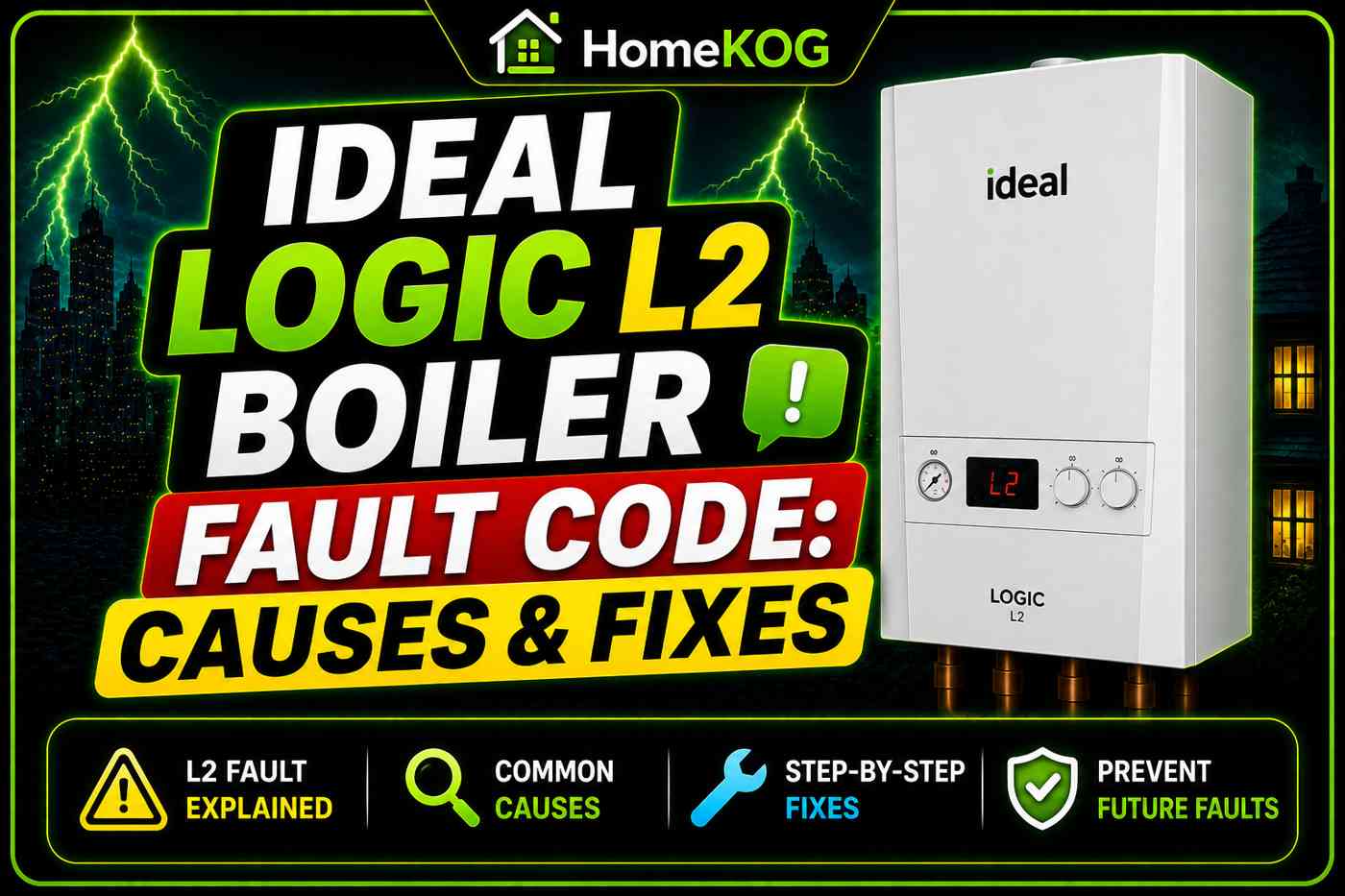

Ideal Logic L2 Fault Code: Causes & How to Fix It
Quick Answer: The Ideal Logic L2 fault code indicates an ignition lockout — the boiler has failed to ignite and has shut itself down as a safety measure. Common causes include a frozen condensate pipe, low gas pressure, a faulty flame sensor, or a defective gas valve. Some causes can be resolved by the homeowner, but most require a Gas Safe registered engineer to diagnose and repair safely.
Finding an L2 code on your Ideal Logic display is one of the more disruptive boiler faults a homeowner can encounter, because it means the boiler will not operate at all until the underlying cause is identified and resolved. Heating and hot water both go offline immediately, which makes this a particularly urgent fault during colder months. Understanding what triggers the L2 error and knowing which checks are safe to carry out yourself can help you restore heat faster and avoid unnecessary call-out costs.
Ideal Logic L2 Fault Code: Key Entity Relationships
- The Ideal Logic L2 fault code is an ignition lockout error displayed on Ideal Logic combi, system, and heat-only boilers when the appliance fails to establish a flame during the ignition sequence.
- An ignition lockout is a safety state in which an Ideal Logic boiler ceases all heating and hot water operation after repeated failed ignition attempts, preventing the boiler from functioning until the fault is cleared and the unit is reset.
- A frozen condensate pipe is the most common cause of the L2 fault code in cold weather, occurring when the plastic waste pipe that carries acidic condensate away from the boiler freezes solid and blocks the discharge pathway.
- A condensate pipe is a plastic pipe required on all condensing boilers installed since 2005 that carries acidic wastewater produced during the condensing process from the boiler to an external drain.
- A flame sensor is an internal boiler component that confirms to the printed circuit board that a flame has been successfully established during ignition, triggering the L2 lockout and shutting off the gas supply if no flame signal is received.
- A gas valve is the appliance-specific valve within the Ideal Logic boiler that opens to admit gas to the burner when heating or hot water is demanded, with a stuck, corroded, or faulty valve preventing gas flow and triggering the L2 fault code.
- Low gas pressure is a supply-side condition that can prevent an Ideal Logic boiler from igniting, caused by a frozen outdoor gas meter regulator, an undersized supply pipe, or an issue with the gas network upstream of the property.
- A spark generator is the ignition component that produces the electrical spark to ignite the gas-air mixture at the burner, with worn electrodes or moisture-damaged ignition leads causing ignition failure and the L2 fault code.
- The printed circuit board is the control component of the Ideal Logic boiler that manages the ignition sequence and receives confirmation signals from the flame sensor, electrode, and gas valve before allowing sustained burner operation.
- A Gas Safe registered engineer is the legally required professional for any internal boiler inspection or repair work on an Ideal Logic appliance, including gas valve replacement, flame sensor renewal, and ignition component servicing.
- An Ideal Logic boiler reset is the first recommended response to an L2 fault code, achieved by pressing and holding the reset button beneath the display screen for three seconds to clear the lockout and allow a fresh ignition attempt.
- Annual boiler servicing by a Gas Safe registered engineer reduces the likelihood of L2 fault code appearances by detecting and addressing early-stage flame sensor corrosion, gas valve wear, and ignition lead deterioration before they cause a full lockout.
What Does the Ideal Logic L2 Fault Code Mean?
The L2 code on an Ideal Logic boiler means the appliance has entered ignition lockout. During a normal start-up sequence, the boiler opens the gas valve, activates the spark generator, and the flame sensor confirms to the printed circuit board that a flame has been established. If any stage of that sequence fails — whether due to a gas supply problem, a component fault, or an external blockage — the boiler shuts down and displays the L2 code rather than continuing to attempt ignition.
This is a safety function, not a malfunction in itself. The boiler is designed to stop and alert you when it cannot ignite safely, preventing unburnt gas from accumulating. The fault will not clear on its own — the boiler will remain locked out until the underlying cause is resolved and the unit is manually reset.
The L2 code applies across the full Ideal Logic range, including combi, system, and heat-only boiler variants. All models in the Logic range share the same fault code system, so the diagnostic and repair process is consistent regardless of which version is installed in your property. ideal logic combi c30 features explained address the specific enhancements that set this model apart. For instance, it boasts improved energy efficiency ratings, which can lead to lower utility bills over time. Additionally, the user-friendly interface simplifies operation and maintenance, making it a popular choice among homeowners. Worcester 4000 boiler performance review highlights its reputation for reliability and efficiency. Users often praise its quiet operation and robust build quality, contributing to a seamless heating experience. Furthermore, this model is designed to accommodate various property sizes, ensuring optimal comfort for a broad range of households.
Can You Reset an Ideal Logic L2 Fault Yourself?
The first step when the L2 code appears is always to attempt a reset. On newer Ideal Logic models, press and hold the reset button located beneath the display screen for three seconds. On older models with a mode dial, rotate the dial to the reset position and hold for three seconds. Once the reset is complete, the boiler will attempt to reignite.
If the boiler fires successfully and the L2 code does not return, the fault may have been caused by a temporary interruption — a brief power outage, a momentary gas pressure dip, or a transient electrical issue — that has since resolved itself. Keep the situation under observation for the remainder of the day.
If the L2 code returns shortly after the reset, or if the boiler fails to ignite at all following the reset, the fault has a persistent underlying cause that needs to be identified. Work through the checks below in order before contacting an engineer, as some can be safely investigated and resolved by the homeowner without specialist tools or gas qualifications.
Common Causes of the Ideal Logic L2 Fault Code
Frozen Condensate Pipe
A frozen condensate pipe is the single most common cause of the L2 fault code during cold weather, and it is also one of the few causes a homeowner can fully resolve without professional help. All condensing boilers installed since 2005 produce acidic wastewater as a by-product of the condensing process. This waste is discharged through a plastic pipe that typically exits the property through an external wall and runs to a drain.
When temperatures drop significantly, the water in this external section of pipe can freeze, creating a blockage that causes the boiler to lock out. The pipe is usually identifiable as a white or grey plastic pipe emerging from the base or rear of the boiler and running to an outside wall.
To thaw a frozen condensate pipe, apply warm — not boiling — water to the frozen section. Boiling water creates a risk of cracking the plastic pipe, so a warm water bottle, a warm cloth held against the pipe, or lukewarm water poured carefully along the frozen section are all appropriate methods. Once the blockage clears, reset the boiler and it should reignite normally. Insulating the external section of the pipe reduces the likelihood of the same problem recurring.
Low Gas Pressure or Supply Issues
If the boiler has no gas to work with, ignition is impossible and the L2 code will appear. Before assuming a component fault, it is worth confirming that gas is reaching the property at all. Testing another gas appliance — a gas hob or a gas fire — establishes quickly whether the supply is live. If other appliances also fail to operate, the issue is with the gas supply rather than the boiler itself.
Check that the isolation valve near the gas meter is in the open position, with the lever aligned parallel to the pipe. If you use a prepayment gas meter, verify that there is sufficient credit remaining. If the gas supply appears to be active but the boiler still cannot ignite, low pressure at the meter may be the cause — particularly if the outdoor meter regulator has frozen in very cold weather.
Low gas pressure caused by a frozen regulator or an undersized supply pipe requires a Gas Safe engineer to inspect and correct. In some cases, if the issue is with the gas network rather than internal pipework, your gas supplier may be able to attend and address it at no charge.
If you have any reason to suspect a gas leak — including a smell of gas in or around the property — do not attempt to reset the boiler. Leave the property immediately, avoid operating any electrical switches, and call the National Gas Emergency Service before returning.
Faulty Flame Sensor
The flame sensor is the component that signals to the boiler’s printed circuit board that a flame has been successfully lit. If the sensor fails to detect a flame — either because no flame was established or because the sensor itself is faulty — the PCB shuts off the gas supply and the boiler enters L2 lockout as a precaution.
Flame sensor failures are more common in older boilers where corrosion or rust has built up on the sensor over time, or where a water leak inside the boiler has caused damage to the sensor or its wiring. In a well-maintained boiler that receives an annual service, flame sensor faults are relatively infrequent because an engineer will identify early-stage corrosion before it progresses to a failure.
Inspecting or replacing a flame sensor is not a task homeowners should attempt. A Gas Safe engineer will assess the sensor for signs of corrosion, moisture damage, or electrical fault and replace it if necessary. The replacement cost including labour is typically in the region of £320.
Faulty Gas Valve
The gas valve within the boiler controls the flow of gas to the burner, opening when heating or hot water is demanded and closing when the cycle is complete. A valve that is stuck, corroded, or mechanically faulty will prevent gas from reaching the burner even when all other components are functioning correctly, resulting in the L2 fault code.
This is less frequently the cause of L2 on a regularly serviced boiler, as annual inspections allow an engineer to identify valve deterioration before it leads to a complete failure. Where the valve is found to be faulty, replacement is the appropriate course of action. The cost of a full gas valve replacement including labour averages around £360.
If the boiler is older and the gas valve has failed, it is worth considering whether the cost of replacement is justified relative to the age and overall condition of the appliance. A Gas Safe engineer can give honest guidance on whether repair or replacement represents better long-term value in your specific situation.
Faulty Spark Generator or Ignition Electrode
The spark generator and its associated electrode produce the electrical spark that ignites the gas-air mixture at the burner. These components degrade over time through normal wear, and moisture ingress — often from a slow internal water leak — can accelerate deterioration of the ignition leads and electrode insulation.
A damaged electrode or worn ignition lead means the spark required for ignition is either absent or inconsistent, causing the L2 lockout. A Gas Safe engineer will inspect both the electrode and the spark generator for physical damage, corrosion, and cracked insulation, replacing any components found to be defective.
If a water leak inside the boiler has contributed to ignition component failure, the source of that leak must be identified and repaired at the same time. Addressing only the ignition components while leaving a leak in place risks further component damage and a return of the fault.
Does the Ideal Logic L2 Code Mean the Boiler Needs Replacing?
In most cases, no. The majority of L2 fault code appearances are caused by issues that are repairable at a cost significantly below that of a new boiler installation. A frozen condensate pipe, a gas supply interruption, or a faulty flame sensor are all straightforward repairs for a qualified engineer.
Replacement becomes a more reasonable consideration when the fault involves a major component — particularly a gas valve failure — on a boiler that is already 10 years old or more. At that age, further component failures are statistically more likely, energy efficiency has typically declined from the rated figure, and the cumulative cost of repairs can begin to approach or exceed the cost of a new installation. When evaluating options for a new boiler, it’s essential to consider an Ideal Boilers price comparison for 2026 to make an informed decision. Understanding the market trends and available models can help homeowners choose the most efficient and cost-effective solution. Additionally, comparing warranties and ongoing service plans can further enhance long-term savings.
An honest assessment from a Gas Safe engineer who has inspected the boiler is the most reliable guide to whether repair or replacement is the better financial decision for your specific situation.
FAQ: Ideal Logic L2 Fault Code
What does the L2 fault code mean on an Ideal Logic boiler?
The L2 fault code on an Ideal Logic boiler indicates an ignition lockout. The boiler has attempted to ignite and failed, triggering a safety shutdown that prevents the appliance from operating until the fault is cleared. It applies across all models in the Ideal Logic range — combi, system, and heat-only. The boiler will not produce heating or hot water while the L2 code is displayed. The first step is always to attempt a reset; if the code returns, an underlying fault needs to be identified and resolved.
How do I reset my Ideal Logic boiler after an L2 fault?
On newer Ideal Logic models, press and hold the reset button beneath the display screen for three seconds. On older models fitted with a mode dial, rotate the dial to the reset position and hold for three seconds. The boiler will attempt a fresh ignition sequence following the reset. If it ignites successfully and the L2 code does not return within a normal operating period, the fault was likely caused by a temporary interruption. If the code reappears, a persistent fault needs professional diagnosis.
Can a frozen condensate pipe cause the Ideal L2 fault code?
Yes. A frozen condensate pipe is the most common cause of the L2 fault code during cold weather and is one of the few causes that can be resolved without a Gas Safe engineer. The condensate pipe is a plastic waste pipe that carries acidic water from the boiler to an external drain. When this pipe freezes, the blockage causes the boiler to lock out. Applying warm water to the frozen section of the pipe thaws the blockage. Once cleared, reset the boiler and it should reignite normally.
What is the cost of repairing an Ideal Logic L2 fault?
Repair costs vary depending on the cause. Thawing a frozen condensate pipe can be done at no cost by the homeowner. A flame sensor replacement typically costs around £320 including labour. A gas valve replacement averages around £360 including labour. Ignition electrode and lead replacements are generally less expensive. If the fault is caused by a gas supply pressure issue that originates outside the property boundary, your gas network operator may attend and resolve it without charge.
Should I call a Gas Safe engineer for the Ideal L2 fault code?
You should attempt a boiler reset and carry out the basic checks — confirming gas supply, checking for a frozen condensate pipe, and verifying the fuse box — before calling an engineer, as these can sometimes resolve the fault without professional intervention. If the L2 code persists after a reset and none of the basic checks identify an obvious cause, a Gas Safe registered engineer is required. All internal boiler inspection and repair work, including flame sensor replacement, gas valve work, and ignition component servicing, must be carried out by a qualified professional.
Will the Ideal L2 fault code go away on its own?
No. The L2 lockout is a deliberate safety state that requires the boiler to be manually reset before it will attempt to operate again. Even if the underlying cause was temporary — such as a brief gas pressure dip or a power fluctuation — the boiler will remain locked out until it is reset. If the fault is caused by a component failure or a persistent supply issue, resetting alone will not resolve it. The boiler will re-enter lockout after the reset if the root cause has not been addressed.
How can I prevent the Ideal Logic L2 fault code from recurring?
Annual servicing by a Gas Safe registered engineer is the most effective preventive measure. A service includes inspection of the flame sensor, gas valve, ignition components, and condensate pipework — the components most commonly responsible for L2 faults. Insulating the external section of the condensate pipe reduces the risk of freezing in cold weather. Addressing any water leaks inside the boiler promptly prevents moisture damage to ignition components. Keeping gas bill payments current and monitoring gas meter credit on prepayment meters prevents supply-related lockouts.
Is the L2 fault code the same on all Ideal Logic boiler models?
Yes. The Ideal Logic fault code system is consistent across all models in the Logic range, including combi, system, and heat-only variants. An L2 code on any of these models indicates an ignition lockout caused by failure to establish a flame during the ignition sequence. The reset procedure may differ slightly between older dial-operated models and newer display models, but the underlying fault and its diagnostic process are the same regardless of which Logic model is installed.
Conclusion
The Ideal Logic L2 fault code is disruptive but, in most cases, entirely repairable. A boiler reset clears the immediate lockout and should always be the first step, and simple checks — gas supply confirmation, condensate pipe inspection, and fuse box verification — can resolve the fault without professional intervention in a meaningful proportion of cases.
Where the underlying cause is a component fault such as a defective flame sensor, faulty gas valve, or worn ignition electrode, a Gas Safe registered engineer is the appropriate next call. These repairs are typically straightforward and cost considerably less than a replacement boiler, making repair the right course of action for most homeowners.
The best long-term protection against the L2 fault code is an annual boiler service. An engineer who inspects the ignition components, gas valve, and condensate system each year will identify deterioration well before it leads to a lockout — keeping the heating and hot water running reliably when they are needed most.