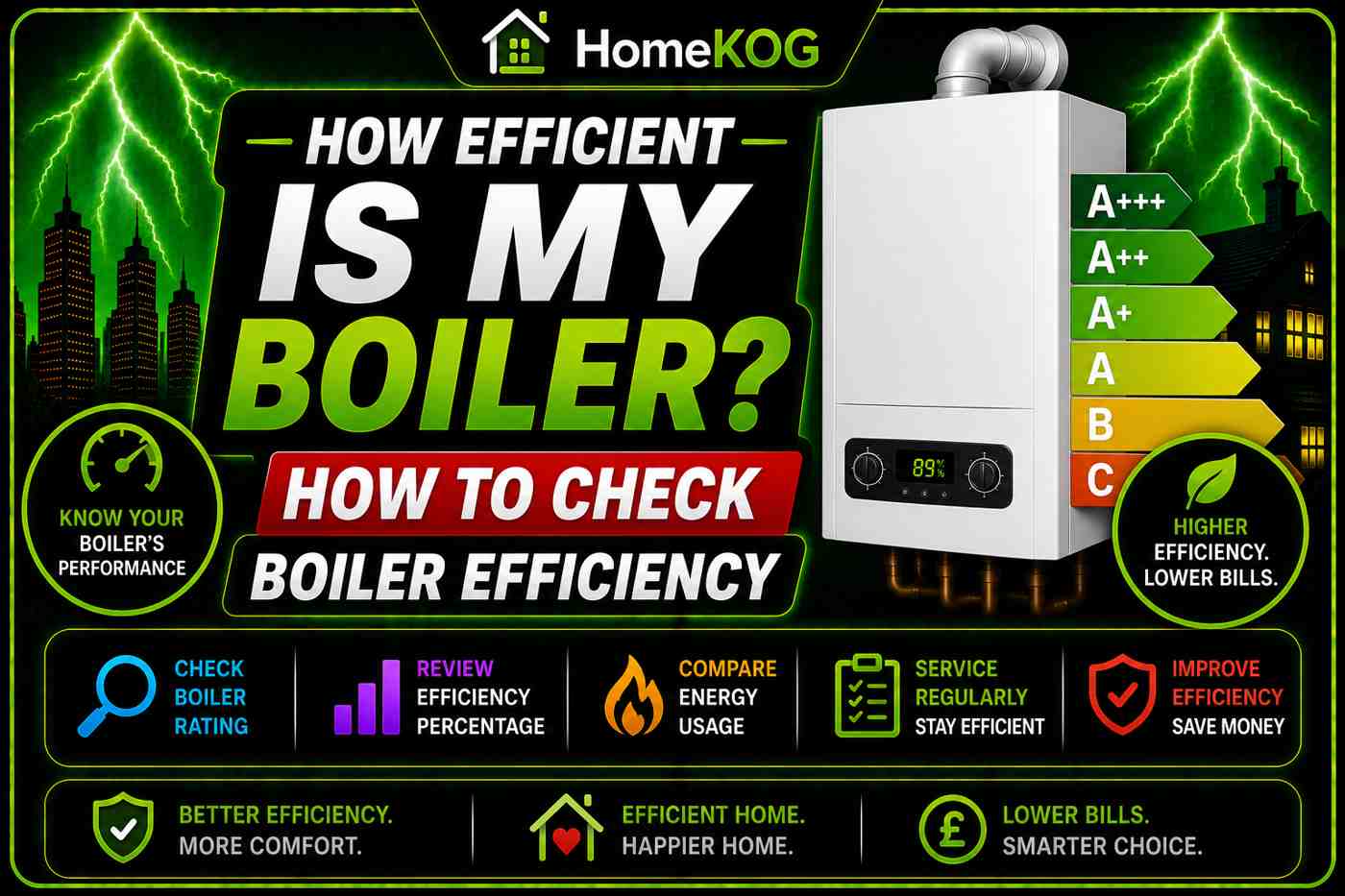

How Efficient Is My Boiler? How to Check Your Boiler Efficiency
Quick Answer: Boiler efficiency is measured as a percentage of fuel converted into usable heat. A-rated modern condensing boilers achieve 90% or above, while boilers over 20 years old typically operate at around 75% or less. You can check your boiler’s efficiency rating using its model number and the PCDB database, or by looking for an ErP sticker on the unit itself.
Understanding how efficient your boiler actually is can make a meaningful difference to your energy bills and to how you plan any future upgrade. Many homeowners assume that because their boiler is relatively new it must be running at maximum efficiency — but in practice, factors like incorrect installation, poor system balancing, and unsuitable controls mean that even a modern condensing boiler can fall well short of its rated performance. Knowing what to look for puts you in a far better position to address those shortfalls.
Boiler Efficiency: Key Entity Relationships
- Boiler efficiency is the percentage of total fuel energy that a boiler converts into usable heat for the home, with the remainder lost through the flue or in the operation of the unit itself.
- An A-rated boiler achieves an energy efficiency of 90% or above under the ErP rating scale, meaning it converts at least nine tenths of every unit of gas it burns into heating for the property.
- A condensing boiler is a gas heating appliance that recovers heat from flue gases using a secondary heat exchanger, allowing it to achieve significantly higher efficiency than older non-condensing models that lost this heat to the atmosphere.
- The PCDB — the Product Characteristics Database — is the UK industry register where homeowners and engineers can look up the energy efficiency rating of any boiler model using its manufacturer name and model number.
- An ErP sticker is an energy-related products label displayed on modern boiler units and packaging that shows the appliance’s efficiency rating on a scale from A to G, with A representing the highest efficiency class.
- Weather compensation controls are heating system controls that automatically adjust a boiler’s flow temperature in response to changes in outdoor temperature, allowing the boiler to operate in condensing mode for longer periods and improving real-world efficiency.
- The Boiler Plus regulations introduced in April 2018 require all new combination boiler installations in England to include an advanced heating control such as a weather compensation kit, a load compensator, or a smart thermostat with automation features.
- A magnetic filter is a device fitted to a central heating system that captures suspended metallic particles in the circulating water, protecting internal boiler components and maintaining the heat transfer efficiency of radiators and pipework.
- A correctly sized boiler is one whose output range closely matches the actual heat loss of the property, avoiding the excessive cycling and reduced condensing mode operation that result from installing an oversized unit.
- Flow temperature is the temperature at which a boiler heats water before it enters the central heating circuit, with lower flow temperatures of 65°C or below enabling a condensing boiler to recover flue gas heat and operate at its rated efficiency.
- System balancing is the process of adjusting radiator valves so that all radiators in a heating system reach operating temperature evenly, allowing the boiler to circulate water at lower temperatures and spend more time in efficient condensing mode.
- A Gas Safe registered heating engineer with specific competency in condensing boiler commissioning is required to configure flow temperature settings, compensation controls, and minimum output levels correctly at the point of installation.
What Is Boiler Energy Efficiency?
Boiler efficiency expresses how much of the energy contained in the gas your boiler burns is successfully converted into heat for your home. A boiler with a rated efficiency of 90% uses 90% of the fuel energy it consumes for heating, with the remaining 10% lost in the process — primarily through the flue as waste gases.
The efficiency rating scale runs from A to G, with A covering everything at 90% and above and G representing the least efficient appliances operating below 70%. Most modern condensing boilers sold in the UK are rated A or B at the point of manufacture, but their real-world efficiency depends heavily on how the system is installed and configured once it is in the home.
Boiler Efficiency Rating Scale
| Rating | Efficiency |
|---|---|
| A | 90% and above |
| B | 86–90% |
| C | 82–86% |
| D | 78–82% |
| E | 74–78% |
| F | 70–74% |
| G | Below 70% |
How to Find Your Boiler’s Energy Efficiency Rating
Modern boilers typically display an ErP label either on the casing of the unit itself or on the packaging it arrived in. This label shows the efficiency rating clearly alongside other performance data and is the quickest way to confirm what class your boiler falls into.
If your boiler was installed some years ago and carries no visible label, the model number is the key to finding the rating. Look underneath the boiler where the pipes exit the unit — there is usually a small sticker on the front panel in this area that shows the manufacturer name and model designation. A Worcester Bosch Greenstar 24i is an example of the naming format you are looking for.
Once you have the model name and number, visit the PCDB — the Product Characteristics Database — which holds the energy ratings for all boilers sold in the UK market. Enter the details and the database will return the rated efficiency for your specific model. The process takes only a few minutes and provides a reliable baseline figure for your boiler’s performance.
Boiler Efficiency by Age
If you are unable to locate either a label or a legible model number, the age of the boiler gives a reasonable indication of the efficiency range to expect. Older boilers lose significantly more heat through the flue because they lack the secondary heat exchanger that allows condensing models to recover it.
| Boiler Age | Approximate Efficiency |
|---|---|
| Under 15 years (condensing) | 80–90%+ |
| 15 years | 80–85% |
| 20 years | Around 75% |
| 25 years or more | 60–70% |
Are New Boilers More Efficient Than Older Ones?
In terms of design and rated performance, yes — modern condensing boilers are substantially more efficient than the non-condensing models that preceded them. A condensing boiler uses a second heat exchanger to capture heat from the flue gases that older boilers expelled directly into the atmosphere. That recovered heat is used to pre-warm the water returning from the heating system, reducing the amount of gas needed to bring it back up to the required temperature.
Condensing boilers have been mandatory for all new domestic gas boiler installations in the UK since 2005, so any boiler installed within the last two decades should theoretically be operating at A or B efficiency. The difficulty is that theory and reality often diverge.
Why New Boilers Frequently Underperform Their Rated Efficiency
A condensing boiler only operates in condensing mode — and achieves its rated efficiency — when the flow temperature is kept at or below around 65°C. This is significantly lower than the 80°C flow temperature that older non-condensing systems were designed around, and it requires the boiler to be actively configured for lower-temperature operation at the point of installation.
Despite condensing boilers being standard for over 20 years, the majority of UK installations still see engineers set the flow temperature to 80°C — the familiar legacy setting — rather than commissioning the boiler to operate at the lower temperature it needs to reach its rated efficiency. The result is a modern condensing boiler functioning at roughly the same efficiency as the older model it replaced.
This is not a problem with the boiler itself. It is a direct consequence of inadequate training and the persistent underinvestment in updating engineer knowledge to reflect how condensing technology actually works. Finding an installer who understands how to commission a condensing boiler correctly is one of the most valuable steps a homeowner can take when arranging any boiler installation or replacement.
Factors That Determine Real-World Boiler Efficiency
Rated efficiency is a laboratory measurement. Actual efficiency in your home depends on a combination of factors that operate independently of whatever number appears on the ErP label.
Correct Boiler Sizing
Boiler sizing is one of the most frequently mishandled aspects of a domestic installation. A typical three-bedroom UK home has a peak heat demand of around 6 to 8 kW on the coldest days of the year, yet many properties contain boilers with maximum outputs of 24 to 30 kW — several times larger than the property actually requires.
An oversized boiler fires, heats the system rapidly, and then switches off before the water temperature drops low enough for condensing to occur. This short-cycling pattern pushes fuel consumption up, increases wear on components, and keeps the boiler out of condensing mode almost entirely. Asking your installer to set the maximum output to match the property’s actual heat loss — rather than defaulting to a larger standard model — makes a significant practical difference to ongoing efficiency.
Flow Temperature and Condensing Mode
Getting a condensing boiler into condensing mode requires the return water temperature to fall below approximately 55°C. This is only achievable when the flow temperature is set low enough — typically 65°C or below — and the heating system is well balanced so that water circulates efficiently through all radiators rather than short-circuiting back to the boiler too quickly.
Many homeowners assume that running the boiler at a lower temperature setting will save energy in itself. In practice, the key is not reducing the thermostat setting but configuring the boiler’s internal flow temperature correctly and ensuring the heating distribution system is balanced to support efficient circulation.
Weather Compensation and Compatible Controls
Weather compensation controls automatically reduce the boiler’s flow temperature as outdoor temperatures rise, keeping the system in condensing mode for the maximum possible proportion of the heating season. This is the single most effective control upgrade available for improving real-world boiler efficiency, and under the Boiler Plus regulations introduced in 2018, it is now a requirement for all new combi boiler installations in England.
The critical caveat is compatibility. Not all thermostats and programmers communicate with all boilers using the same protocol, and a mismatch between control and boiler means the compensation function cannot operate correctly. A knowledgeable installer will specify controls that are fully compatible with the specific boiler model being installed, ensuring the two components communicate as designed.
How to Calculate Your Potential Savings from a Boiler Upgrade
If you are considering replacing an older boiler, a straightforward calculation gives a useful estimate of the annual saving a more efficient replacement might deliver. Take your current annual gas bill, estimate your existing boiler’s efficiency from the age table above, and compare it against the rated efficiency of the new boiler.
As a worked example: with an annual heating bill of £800 and a current boiler operating at 60% efficiency, replacing it with a correctly installed condensing boiler running at 90% represents a 30 percentage point efficiency improvement. Multiplying £800 by 0.30 gives an estimated annual saving of £240 — but only if the new boiler is properly commissioned and the heating system is correctly balanced to support condensing operation.
Replacing a boiler that is only 10 years old and still functioning reliably is unlikely to deliver significant bill savings on its own. The case for replacement becomes much stronger once a boiler is 20 years old or more, or when maintenance costs are rising steadily and the unit is operating well below its original efficiency.
FAQ: Boiler Efficiency
How do I check how efficient my boiler is?
Look for an ErP label on the boiler casing or packaging — this shows the energy efficiency rating from A to G. If no label is visible, locate the model number on the sticker beneath the boiler where the pipes exit and search the PCDB database using the manufacturer name and model number. The database holds rated efficiency figures for all UK boiler models. If neither option is possible, the boiler’s age provides a reliable approximate guide, with models over 20 years old typically operating at around 75% efficiency or below.
What efficiency rating should my boiler have?
Any boiler installed in the UK since 2005 should carry at least an A or B rating, as condensing boilers with a minimum 88% efficiency have been mandatory for all domestic new installations since that date. In practice, a correctly installed and commissioned condensing boiler should operate at 90% or above. If your boiler is less than 15 years old but your energy bills suggest poor efficiency, the most likely cause is incorrect installation settings rather than a fault with the boiler itself.
Why is my new condensing boiler not as efficient as expected?
The most common reason is that the boiler’s flow temperature has been set too high — typically at 80°C rather than the 65°C or below required for condensing mode to activate. At 80°C, a condensing boiler operates at roughly the same efficiency as an older non-condensing model because the flue gases never cool enough for heat recovery to occur. A Gas Safe registered engineer with condensing boiler commissioning experience can reconfigure the flow temperature and, where appropriate, add weather compensation controls to bring the boiler’s real-world performance closer to its rated efficiency.
Does boiler size affect efficiency?
Yes, significantly. An oversized boiler fires in short bursts, heats the system quickly, and shuts off before condensing mode is established — a pattern known as short-cycling that wastes fuel and increases component wear. A correctly sized boiler whose output closely matches the property’s actual heat demand runs for longer at lower temperatures, spends more time in condensing mode, and achieves efficiency much closer to its rated figure. When installing a new boiler, always ask the engineer to calculate the property’s heat loss and specify the output accordingly rather than defaulting to an oversized standard model.
What controls improve boiler efficiency?
Weather compensation controls are the most effective upgrade available. They automatically adjust the boiler’s flow temperature based on outdoor conditions, maximising the proportion of time the boiler spends in efficient condensing mode. Smart thermostats with automation and load compensation features also improve efficiency by reducing unnecessary heating cycles. Under the Boiler Plus regulations, all new combi boiler installations in England must include one of these advanced control types. Compatibility between the control and the specific boiler model is essential — an incompatible control cannot communicate the data the boiler needs to modulate its output correctly.
How much could I save by replacing an old boiler?
Savings depend on the efficiency gap between the existing and replacement boiler, and on whether the new boiler is correctly installed and commissioned. As a broad guide, replacing a boiler that is 25 years old or more — operating at around 60 to 70% efficiency — with a correctly commissioned A-rated condensing boiler could save in the region of £200 to £340 per year on a typical UK gas bill. Replacing a boiler that is only 10 years old and still operating reliably is unlikely to produce meaningful bill savings and is rarely justified on energy efficiency grounds alone.
What is condensing mode and why does it matter?
Condensing mode is the operating state in which a condensing boiler recovers heat from its own flue gases using a secondary heat exchanger, converting what would otherwise be wasted energy into usable heat for the system. It only activates when the water returning from the heating circuit is cool enough — typically below 55°C — for the flue gases to condense into water vapour and release their latent heat. A boiler running in condensing mode consistently achieves 90% or above efficiency. The same boiler running outside condensing mode may achieve only 80 to 85%, despite carrying an A-rated ErP label.
Is it worth replacing a boiler that still works?
Whether replacement makes financial sense depends on the boiler’s age, its current efficiency, and its maintenance costs. A boiler over 20 years old operating at 70% or below will deliver meaningful energy bill savings when replaced with a correctly installed A-rated condensing model. A boiler under 10 years old that is running reliably and has been properly commissioned is unlikely to justify replacement on efficiency grounds. The strongest case for early replacement arises when maintenance costs are increasing, the boiler is operating well below its rated efficiency due to poor original installation, or the heating system as a whole needs updating.
Conclusion
Checking your boiler’s efficiency is a straightforward process, and the findings are worth acting on. A poorly commissioned condensing boiler operating at 80°C flow temperature is delivering little better efficiency than the older model it replaced, regardless of what its ErP label says. Correct installation, appropriate sizing, low flow temperature settings, and compatible compensation controls are the factors that determine whether a modern boiler achieves its rated performance in practice — not the label on the casing.
If your boiler is more than 20 years old and operating well below A-rated efficiency, the financial case for replacement is clear. If it is newer but your bills suggest it is underperforming, the solution is more likely a commissioning adjustment and a compatible weather compensation control than a full replacement. Either way, a Gas Safe registered engineer with genuine condensing boiler expertise is the right person to assess the situation and give you clear guidance on the best course of action for your home.