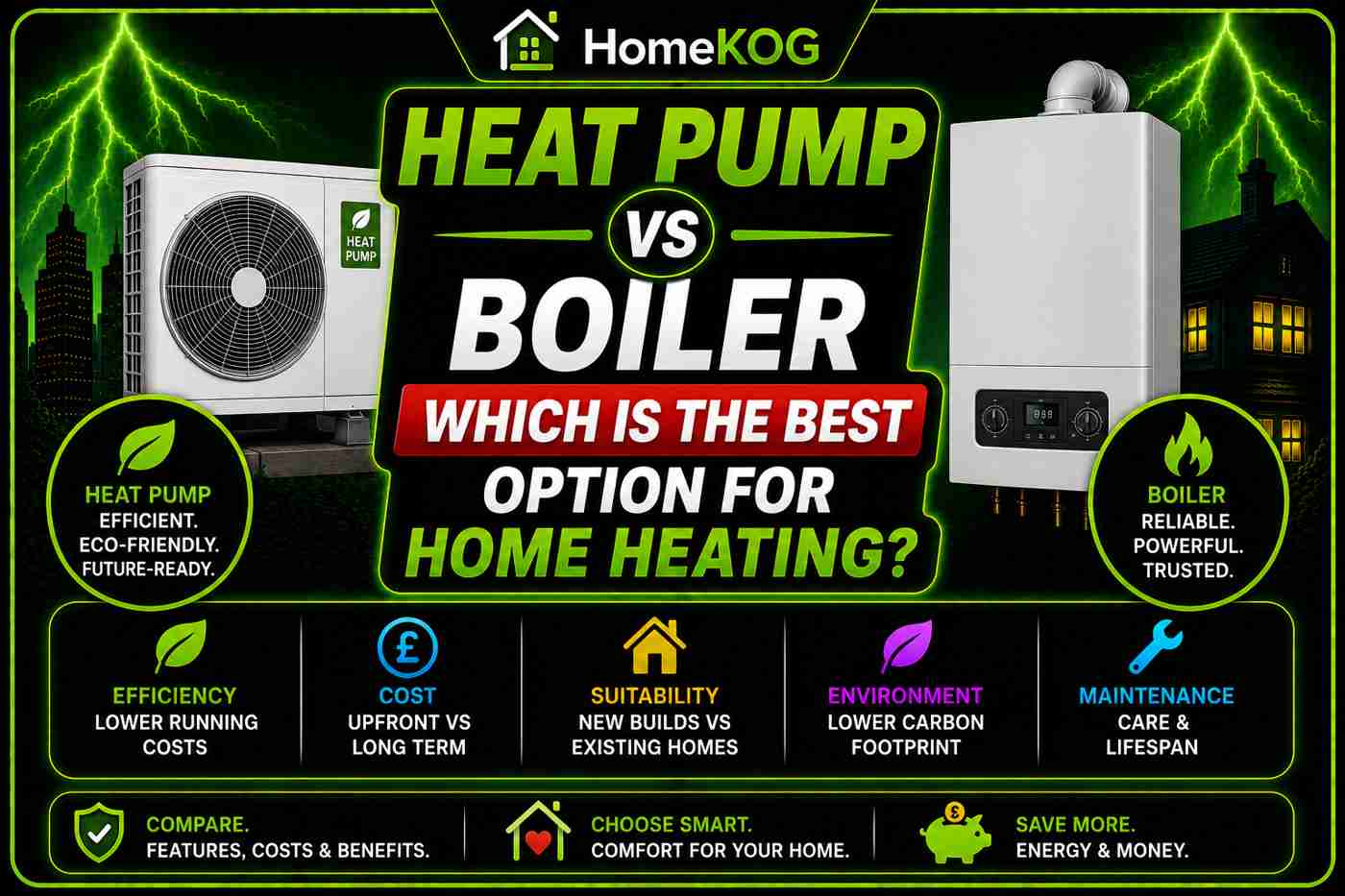

Heat Pump vs Boiler: Which is Best for Home Heating in 2026?
Quick Answer: Gas boilers are cheaper to install (£1,500 to £3,000), heat homes faster, and perform more reliably in cold weather — making them the right choice for most UK homes in 2026. Heat pumps are more energy-efficient (up to 350% COP vs 94% for a gas boiler), produce significantly lower carbon emissions, and have lower running costs in the right property — but cost £7,000 to £18,000 to install and require good insulation, adequate space, and ideally underfloor heating to perform at their best. The £7,500 Boiler Upgrade Scheme grant improves the heat pump financial case considerably. A hybrid system combining both is increasingly popular for homeowners who want lower running costs without fully committing to heat pump-only heating.
The heat pump versus gas boiler debate is one of the most consequential home heating decisions UK homeowners face in 2026, with the government’s 2035 gas boiler phase-out adding long-term policy context to what is already a complex financial and practical comparison. Both systems heat homes effectively — the differences lie in how they source and deliver heat, what they cost to install and run, and which properties and lifestyles they suit best. This guide cuts through the marketing claims on both sides to give an honest, practical comparison.
The Fundamental Difference
A gas boiler burns natural gas to generate heat directly — combustion at 250 to 350°C produces hot flue gases that transfer heat to the system water, which circulates to radiators and hot water outlets. The process is straightforward, fast, and capable of generating high flow temperatures that heat a home quickly even in the coldest weather.
A heat pump uses electricity to move heat from the environment — outdoor air or ground — into the home through a refrigerant compression cycle. Rather than generating heat through combustion, it transfers existing environmental heat and upgrades it to a usable temperature. This is why heat pumps achieve efficiencies of 250 to 450% — they deliver 2.5 to 4.5 units of heat for every unit of electricity consumed, compared to a maximum of 94 to 98 units of heat per 100 units of gas energy for the best modern condensing boilers.
The efficiency advantage of heat pumps is real and significant. The practical limitation is that this efficiency advantage is partially offset by the fact that electricity costs approximately four times more per unit than gas in the UK — meaning the running cost comparison between gas boilers and heat pumps is closer in practice than the raw efficiency figures suggest.

Pros and Cons
Gas Boiler Advantages
Gas boilers remain the dominant UK heating technology for well-understood reasons. They heat homes rapidly — a modern condensing boiler can bring a cold house to a comfortable temperature within 30 to 45 minutes. They generate high flow temperatures of 65 to 80°C, providing reliable heat output through standard radiators even in the coldest UK winters without any modification to the distribution system. Installation costs are substantially lower than heat pumps, typically £1,500 to £3,000 fully installed for a mid-range combi boiler. Most Gas Safe engineers are familiar with boiler installation and maintenance, providing wide service coverage.
All new gas boilers are A-rated condensing models achieving 92 to 98% efficiency — a significant improvement over the 70 to 80% efficiency of older models, and virtually all new gas boilers are hydrogen-ready for a 20% hydrogen blend, providing a degree of future-proofing against the potential introduction of hydrogen into the gas grid.
Gas Boiler Disadvantages
Gas is a fossil fuel and combustion produces carbon dioxide directly — a gas boiler contributes to the household’s carbon footprint with every heating cycle. Running costs have increased substantially as gas prices have risen. The government’s 2035 phase-out of new gas boiler sales creates long-term policy uncertainty. A gas boiler that reaches end of life after 2035 will require replacement with a low-carbon alternative rather than a like-for-like replacement.
Heat Pump Advantages
Heat pumps produce significantly lower carbon emissions than gas boilers — a well-installed air source heat pump in a modern insulated property produces approximately 60 to 70% fewer carbon emissions per unit of heat delivered than an equivalent gas boiler. Running costs are lower in properties where the heat pump’s efficiency advantage overcomes the electricity-to-gas price ratio — typically well-insulated homes where the high COP is maintained year-round.
Heat pumps can operate in reverse as cooling systems — a growing practical benefit as UK summers become warmer. They qualify for the £7,500 Boiler Upgrade Scheme grant, substantially reducing the net installation cost. The operational lifespan of 20 to 25 years exceeds the typical 10 to 15-year gas boiler lifespan.
Heat Pump Disadvantages
Installation costs are significantly higher than gas boilers — £7,000 to £10,000 for air source after the £7,500 grant, potentially near zero for entry-level installations but more for premium systems. Ground source installations cost £6,500 to £11,500 after the grant. Properties with poor insulation, older windows, or limited space may require costly upgrades before a heat pump can perform effectively.
Heat pumps produce lower flow temperatures — typically 35 to 55°C — than gas boilers. This means they work best with underfloor heating or oversized radiators specifically designed for lower flow temperatures. Standard-sized radiators dimensioned for a gas boiler system at 70 to 80°C will underperform when supplied by a heat pump — replacement is often needed. Air source heat pumps lose efficiency in cold weather precisely when heating demand is highest. External units occupy outdoor space and generate fan noise that may be an issue in closely spaced properties.
Efficiency Comparison
The efficiency figures for heat pumps and boilers use different measurement scales that require context to compare meaningfully.
A gas boiler’s efficiency is expressed as a percentage of gas energy converted to useful heat — a 94% efficient boiler converts 94p of every £1 of gas into heat. A heat pump’s efficiency is expressed as a COP — units of heat delivered per unit of electricity consumed. A COP of 3.5 means 3.5 units of heat for every unit of electricity.
| System | Efficiency | Running Cost Context |
|---|---|---|
| Old G-rated gas boiler | 60–70% | High — significant fuel waste |
| Modern A-rated gas boiler | 92–98% | Moderate — very low waste |
| Air source heat pump (summer) | COP 3.0–4.0 | Low — high efficiency |
| Air source heat pump (winter) | COP 2.0–2.5 | Moderate — efficiency reduces in cold |
| Ground source heat pump | COP 3.5–4.5 | Low — consistent year-round |
When electricity costs approximately 24.5p/kWh and gas costs approximately 6p/kWh, a heat pump needs to achieve a COP of at least 4.1 to match the running cost of a 94% efficient gas boiler on a per-unit heat basis. In practice, most air source heat pumps achieve this in mild weather but fall below this threshold in the coldest winter conditions. Ground source heat pumps more consistently exceed this threshold due to their stable year-round heat source.
Cost Comparison
| Cost Element | Gas Boiler | Air Source Heat Pump | Ground Source Heat Pump |
|---|---|---|---|
| Unit cost (parts only) | £600–£2,500 | £4,000–£8,000 | £2,000–£15,000 |
| Installation | £900–£1,500 | £1,000–£2,000 | £4,000–£10,000 |
| Total installed | £1,500–£3,000 | £7,000–£10,000 | £14,000–£19,000 |
| BUS grant | Not applicable | £7,500 | £7,500 |
| Net cost after grant | £1,500–£3,000 | £0–£2,500 | £6,500–£11,500 |
| Annual running costs | £1,200–£1,800 | £700–£1,200 | £540–£900 |
| Expected lifespan | 10–15 years | 15–20 years | 20–25 years |
The annual running cost comparison favours heat pumps, particularly ground source systems, but the gap depends heavily on the property’s insulation standard and the electricity-to-gas price ratio. For properties replacing oil or LPG rather than mains gas — where fuel costs are higher — the running cost saving from a heat pump is larger and the financial case stronger.
Which Properties Suit Each System?
Properties Better Suited to a Gas Boiler
Properties with limited outdoor space, older insulation, standard radiators sized for high flow temperatures, and no underfloor heating infrastructure are better served by a gas boiler in the near term. Smaller homes, terraced properties in urban areas, and properties where the installation of either a ground loop or a large external fan unit is not feasible are also stronger gas boiler candidates.
Homeowners on a limited budget who need a reliable heating system quickly — particularly following a boiler failure in winter — will almost always find a gas boiler the only practical option given the speed and cost of installation relative to a heat pump system.
Properties Better Suited to a Heat Pump
Properties with good insulation throughout — loft, walls, and double or triple glazing — are the primary candidates for heat pump installation. Properties with existing or planned underfloor heating are ideally matched to heat pump flow temperatures. Homes replacing oil or LPG heating see the strongest financial case for heat pump adoption. New builds incorporating the system into the design from the start benefit from optimal integration at competitive installation cost.
Rural properties off the gas grid, larger properties with adequate garden space for ground loop installation, and homes where the homeowner has a long-term sustainability commitment also represent strong heat pump candidates.
Hybrid Heating Systems
Hybrid heating systems combine a gas boiler with an air source heat pump and are increasingly popular as a middle path between the two technologies. In a hybrid system, the heat pump handles the baseline heating load during mild weather when it operates at high efficiency, while the gas boiler handles peak demand on the coldest days when heat pump efficiency is lowest and the demand for rapid high-output heating is greatest.
This approach captures most of the running cost savings of a heat pump without the full dependence on heat pump output that can cause comfort issues in extreme cold. It also avoids the need for complete radiator replacement because the gas boiler can top up the flow temperature to whatever the existing distribution system requires.
Hybrid systems are particularly suitable for homes with good but not exceptional insulation, existing radiators that cannot practically be replaced, and homeowners who want to reduce gas consumption and carbon emissions progressively rather than in a single complete switch.
Types of Heat Pump Available
Air source heat pumps mount externally on a wall or ground-level plinth, require no excavation, and can be installed in one to two days. They suit most properties with adequate external wall space. They are the most common domestic heat pump type in the UK.
Ground source heat pumps use horizontal trenches or vertical boreholes to access stable ground temperature. They deliver higher and more consistent efficiency than air source but require substantial outdoor space or borehole access and higher installation cost. They suit rural properties with larger plots.
Water source heat pumps extract heat from nearby lakes, ponds, or rivers and return the cooled water to the source. They are more commonly applied in commercial settings but can work domestically where a suitable water source is close enough. Planning consent may be required.
FAQ
Is a heat pump more efficient than a gas boiler?
In terms of energy conversion efficiency, yes — a heat pump achieves a COP of 3 to 4, delivering 300 to 400% of the electrical energy consumed as heat, compared to 92 to 98% for the best modern gas boilers. The practical running cost comparison is closer because electricity costs approximately four times more than gas per unit. In a well-insulated property where the heat pump maintains a high COP year-round, the running costs are lower. In a poorly insulated property where efficiency drops, the advantage narrows.
Can a heat pump fully replace a gas boiler?
Yes, in appropriate properties. A correctly specified heat pump provides all the space heating and domestic hot water a home needs without any gas boiler. The conditions for a successful full replacement are good insulation throughout the property, a distribution system matched to the lower flow temperatures heat pumps produce — underfloor heating or oversized radiators — and an adequately sized heat pump and hot water cylinder. An electrical backup element provides reassurance in extreme cold conditions.
Is a gas boiler future-proof?
Reasonably so in the near term. A new gas boiler installed in 2026 will likely remain legally operable throughout its 10 to 15-year lifespan even if the 2035 gas boiler phase-out proceeds as planned. All new boilers are hydrogen-ready for a 20% hydrogen blend, providing some protection against the first stage of potential gas grid decarbonisation. The long-term future of gas heating beyond 2035 depends on government policy decisions that remain subject to revision.
How long does heat pump installation take compared to a boiler?
A gas boiler installation typically takes one to two days for a standard like-for-like replacement. An air source heat pump installation takes two to three days for the full system including external unit, internal pipework, hot water cylinder, and controls. Ground source heat pump installation takes five to ten days depending on the system size and whether horizontal or vertical loop installation is used.
Should I replace my gas boiler with a heat pump now?
If the property has good insulation, adequate space for the heat pump installation, and the budget for the installation cost after the £7,500 Boiler Upgrade Scheme grant — particularly if replacing oil or LPG rather than mains gas — then installing a heat pump now is a financially sound decision with a realistic payback period and meaningful environmental benefit. If the property has poor insulation, standard radiators designed for high flow temperatures, and limited space, replacing with a hydrogen-ready gas boiler is the more practical near-term choice while insulation improvements are planned.
Conclusion
The heat pump versus gas boiler decision does not have a single universal answer — it is property-specific, budget-specific, and perspective-specific. Gas boilers are cheaper to install, faster to heat homes, and more reliable in extreme cold — and remain the practical choice for the majority of UK properties today, particularly where insulation, space, or budget constraints make heat pump installation impractical. A hydrogen-ready gas boiler installed today provides the best near-term combination of reliable performance, competitive cost, and long-term policy positioning.
Heat pumps are genuinely more efficient, substantially lower in carbon emissions, and increasingly cost-competitive after the £7,500 Boiler Upgrade Scheme grant — particularly for properties replacing oil or LPG, and for well-insulated homes where the high COP is maintained through the heating season. The 20 to 25-year operational lifespan, cooling capability, and alignment with the UK’s long-term decarbonisation trajectory make heat pumps the better long-term choice for homeowners who can meet the property conditions.
For homeowners genuinely undecided, a hybrid system combining a heat pump with a gas boiler captures most of the running cost benefit while retaining the gas boiler’s high-output reliability as backup — an increasingly sensible middle path for the majority of UK homes navigating the transition between these two technologies.