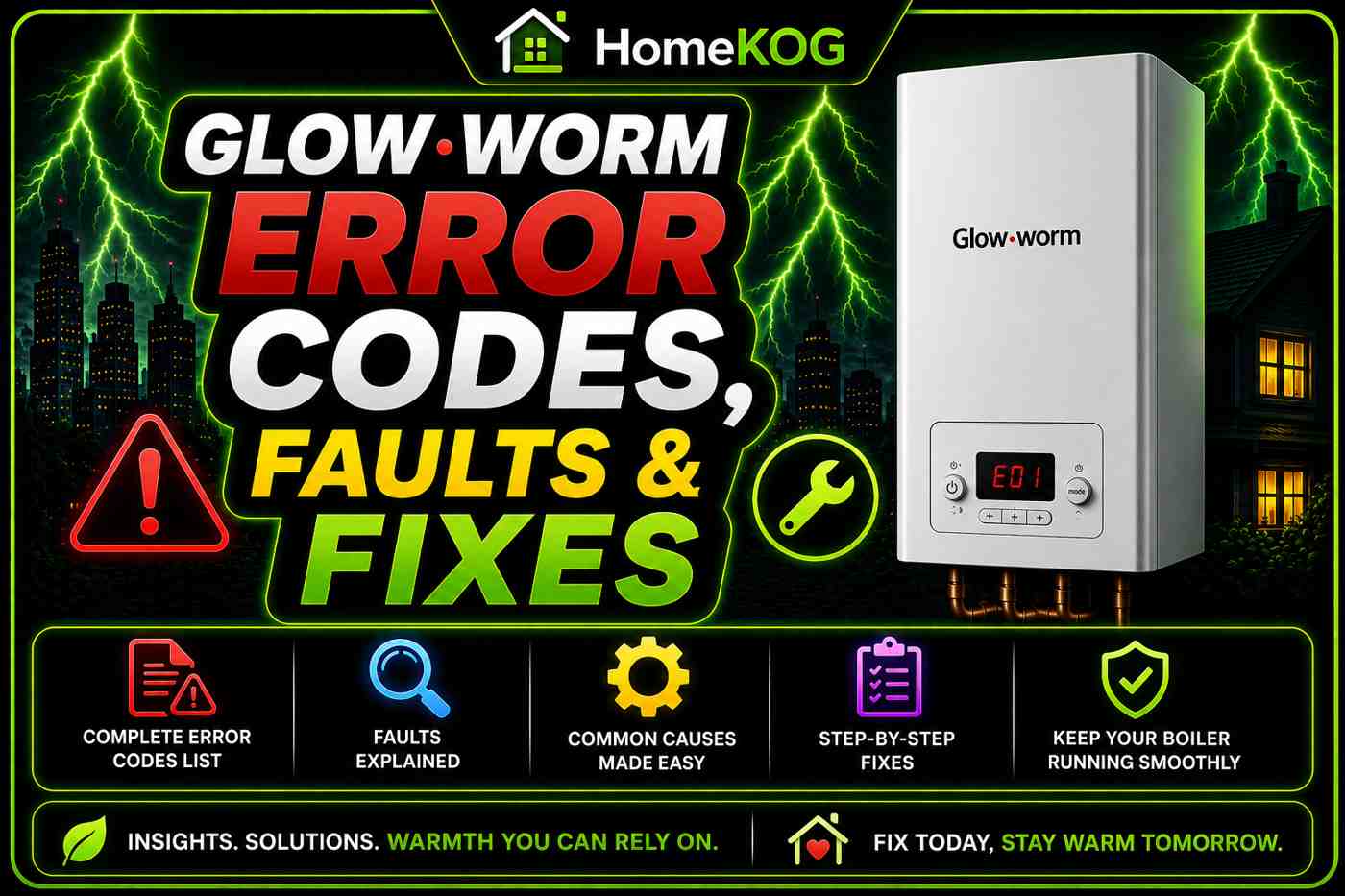

Glow Worm Boiler Error Codes, Faults and Fixes 2026
Quick Answer: Glow Worm boilers display fault codes using an F prefix (e.g. F28, F22, F75) or flashing temperature numbers on the Betacom range. The most common DIY-fixable codes are F22 or F9 (low water pressure — repressurise to 1.5 bar), F28 and F29 (ignition fault caused by a frozen condensate pipe — thaw the external pipe with warm water then reset), and a red LED on the Betacom (low pressure — repressurise and reset). All other fault codes — including gas valve faults, PCB failures, sensor faults, and overheating — require a Gas Safe registered engineer. Understanding the glow worm f9 fault code explanation can help users troubleshoot their heating issues more effectively. This specific code indicates a fault related to the boiler’s external sensor or wiring, which may require professional attention. Homeowners should consult their user manual for specific steps to take before calling in a Gas Safe registered engineer to ensure safety and compliance.
Glow Worm is part of the Vaillant Group and manufactures a wide range of condensing boilers across several product lines — Betacom, Ultracom, Flexicom, Xtramax, Compact, Ci, and Xtrafast ranges. Each range shares some fault codes with the others but also has range-specific codes. This guide provides a comprehensive reference for all Glow Worm error codes with causes, DIY fixes where applicable, and clear guidance on when an engineer is required.
How Glow Worm Error Codes Work
Most Glow Worm boiler ranges display fault codes as an F followed by a two-digit number on the front panel display — F28, F22, F75, and so on. The Betacom range uses flashing temperature numbers (30, 40, 50, 60, 70, 80, 90) rather than F codes. Some older Compact models use LED indicators rather than numeric codes.
When a fault code appears, the boiler will have either locked out (requiring a manual reset after the fault is resolved) or be displaying an informational warning while continuing to operate in a reduced capacity. Safety-critical faults — overheating, gas valve faults, flame detection faults — always trigger a lockout. The boiler must not be reset repeatedly without identifying and resolving the underlying cause.

DIY-Fixable Fault Codes
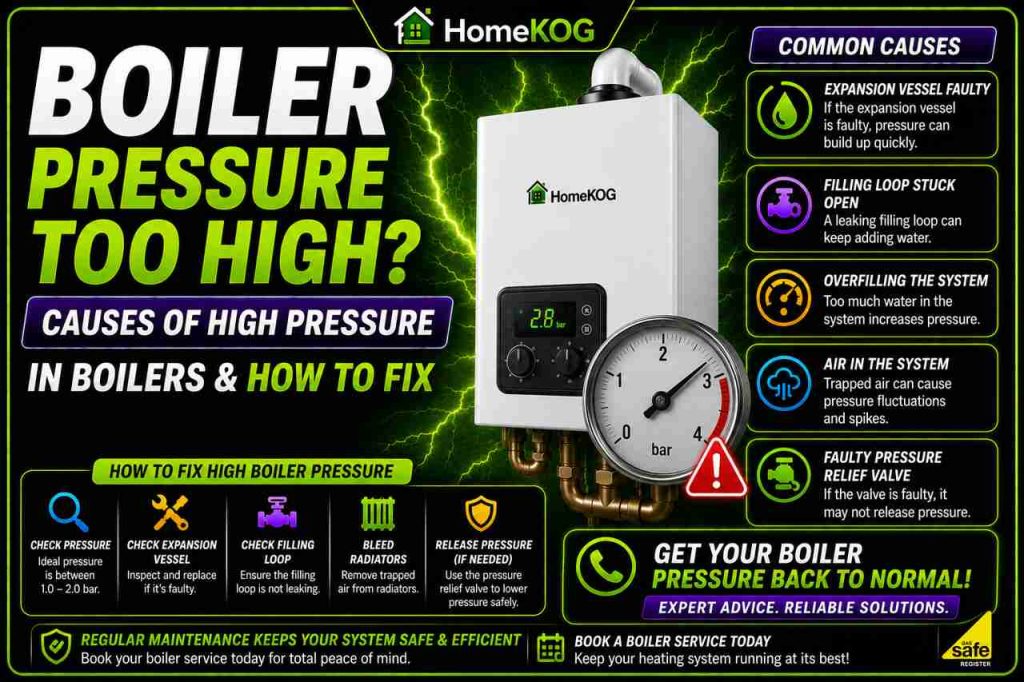
Low Boiler Pressure — F22, F9, F73, F74, Red LED (Betacom), Temperature 60 Flashing (Betacom C)
Low water pressure is the most common cause of a Glow Worm boiler fault and the one most frequently resolved without an engineer. Check the pressure gauge on the boiler front panel — a reading below 1.0 bar confirms low pressure.
To restore pressure, locate the filling loop beneath or adjacent to the boiler — a braided flexible hose or pair of valves. Turn the filling loop valves open slowly and monitor the pressure gauge. Close the valves when the gauge reads 1.5 bar. Reset the boiler — on Betacom models, turn the central heating temperature control knob to the reset position, wait 30 seconds, then return to normal operation.
If pressure drops repeatedly within a short period, a system leak is causing the pressure loss and a Gas Safe engineer should locate and repair it.
Frozen Condensate Pipe — F28, F29, F1, F4
The F28 and F29 codes are most commonly triggered by a frozen condensate pipe in cold weather rather than a genuine ignition or flame fault. If these codes appear when outdoor temperatures are below freezing, check the external condensate pipe — the plastic pipe running from the base of the boiler to an external drain — before calling an engineer.
To thaw: heat water in a kettle, allow it to cool slightly from boiling, then pour it from a jug along the external section of the condensate pipe. Alternatively, apply a hot water bottle to the frozen section. Never use boiling water directly or any electrical appliance. Once the pipe is thawed, reset the boiler.
After resolving the freeze, wrap the external pipe in foam pipe lagging to prevent recurrence.
Betacom Yellow LED Flashing — Domestic Hot Water Temperature Off
Turn the DHW control knob to the correct temperature range. Turn the central heating temperature control knob to the reset position and wait 30 seconds before returning it to the temperature or summer position.
Compact Range — No DHW (Domestic Hot Water Inactive)
Check the DHW microswitch to confirm the DHW demand LED is lit. This is a simple check that can confirm whether the issue is a control setting rather than a component fault.
Betacom Green LED Off — No Power to Boiler
Check the power connection to the boiler and confirm the correct fuse is connected on the PCB. Verify the boiler’s mains switch is on and check the consumer unit for any tripped circuit breakers on the boiler circuit.
Full Glow Worm Error Code Reference
Universal Codes (All Models)
| Code | Meaning | Action |
|---|---|---|
| F10, F11 | Flow temperature sensor short circuit | Engineer required |
| F25 23 | Circulation fault | Engineer required |
| F28, F1, F4 | Ignition fault | Check condensate pipe first; engineer if not resolved |
| ERR, F12, F18 | User interface fault | Engineer required |
Betacom Range
| Code/Display | Meaning | DIY Fix Available? |
|---|---|---|
| Temperature 30 flashing | Central heating thermistor fault | No — engineer required |
| Temperature 40 flashing | DHW thermistor fault | No — engineer required |
| Temperature 50 flashing | Outside sensor fault | No — engineer required |
| Temperature 60 flashing | Low system pressure | Yes — repressurise to 1.5 bar |
| Temperature 70 flashing | APS (air pressure switch) fault | No — engineer required |
| Temperature 80 flashing | Overheat — open circuit | No — engineer required |
| Temperature 90 flashing | Gas or flame failure | No — engineer required |
| Red LED on | Lockout — low water pressure | Yes — repressurise and reset |
| Red LED flashing | Overheating | No — check stats, engineer required |
| Green LED on | Ready for operation | No action needed |
| Green LED off | No power to boiler | Check mains switch and fuse |
| Yellow LED on | Flame present on burner | Normal operation |
| Yellow LED flashing | DHW temperature off | Adjust DHW and CH knobs per guide above |
Betacom, Ultracom2 cxi/sxi/35
| Code | Meaning | DIY Fix? |
|---|---|---|
| F00, F10, F7 | Flow heating temperature sensor fault | No |
| F01, F11 | Return heating temperature sensor fault | No |
| F20 | Overheating fault | No — engineer immediately |
| F9, F22 | Low water pressure or slow ignition temperature rise | Yes for pressure — repressurise; otherwise engineer |
| F26, F7 | Gas valve fault | No — engineer required |
| F27, F16 | Flame detection fault | No — engineer required |
| F28, F1, F4 | Ignition fault / frozen condensate | Yes for condensate — thaw and reset |
| F29 | Loss of flame during operation | Check condensate; otherwise engineer |
| F32 | Incorrect air pressure | No |
| F49 | EBUS voltage fault | No |
| F61–F65, F67 | Main board fault | No — PCB replacement likely required |
| F68 | Flame signal fluctuation | No |
| F70 | User interface incompatible with main board | User interface replacement required |
| F72, F84 | Return/flow temperature sensor difference fault | No |
| F73, F74 | Heating circuit pressure sensor fault | No |
| F76, F83 | Thermal fuse fault | No — safety-critical, engineer required |
| F85 | Underfloor heating contact fault | No |
Flexicom cx/hx/sx and Ultracom cxi/cx/hxi/sxi/Xtramax HE
| Code | Meaning | DIY Fix? |
|---|---|---|
| F2, F3 | Fan or APS fault | No |
| F9 | Blocked flow filter, pressure sensor fault, or pump fault | No |
| F11 | Return or flow thermistor fault | No |
| F13 | PCB memory fault | No |
| F14 | Gas valve control defective | No |
| F15 | EBUS voltage failure | No |
| F43 | Generic error | No |
| F70 | Software incompatibility | No |
| F73 | Unable to detect pump activation | No |
| F77 | Condensate pump error | No |
Xtrafast 96/120 Range
| Code | Meaning | DIY Fix? |
|---|---|---|
| F02 | Air flow fault | No |
| F05 | Overheating | No — engineer immediately |
| F06 | Central heating thermistor or wiring fault | No |
| F08 | Storage vessel thermistor or wiring fault | No |
| F09 | System pressure sensor fault | No |
| F10 | Fan fault | No |
| F13 | Main PCB fault | No |
| F14 | CH flow temperature above 97°C | No — safety-critical |
| F15 | Gas mechanism fault | No |
| F20 | Communication fault | No |
Ci Range (including Ci Plus and Si Range)
| Code | Meaning | DIY Fix? |
|---|---|---|
| F2 | Fan or APS fault | No |
| F3 | Air fault | No |
| F10 | Central heating return flow thermistor | No |
| F11 | Main board connection fault | No |
| F12 | Display PCB to main PCB connection fault | No |
| F13 | Main PCB connection fault | No |
| F14 | Central heating flow temperature fault | No |
| F15 | Gas valve stepper motor fault | No |
| F17 | Power supply below 170V | No |
| F19 | Central heating thermistor unplugged | Check connection |
| F20 | Software incompatibility | No |
| F24 | CH return temperature above 90°C | No |
| F25, F26, F11 | Poor circulation | No |
Xtramax HE Range
| Code | Meaning | DIY Fix? |
|---|---|---|
| F24 | CH return temperature above 90°C | No |
| F25 | Maximum temperature rise slope | No |
| F26 | Maximum delta temperature | No |
Compact e/s Range
| Symptom | Cause | Check |
|---|---|---|
| No CH | Inactive demand | Check DHW microswitch |
| No CH but boiler firing | Diverter fault | Check diverter cartridge and motor |
| Boiler lockout within 10 seconds | Pump, overheat, or APS issue | Check pump proving switch |
| Poor burner pressure | Ignition/burner issue | Check burner pressure and electrode adjustment |
When to Call a Gas Safe Engineer
The majority of Glow Worm fault codes require a Gas Safe engineer to diagnose and repair. The following situations always require professional attendance without any DIY intervention:
Any overheating code (F05, F20, F80 equivalent, Temperature 80 flashing) — do not reset an overheating boiler without an engineer identifying the cause. Overheating can indicate a failed thermostat, blocked heat exchanger, or pump failure — all of which worsen with continued operation.
Gas valve faults (F26, F7, F14, F15, F61–F65, F67) — these involve gas components and must only be worked on by a Gas Safe engineer.
Flame detection faults (F27, F16) — a false flame signal or failure to detect a genuine flame is a safety-critical condition.
PCB and main board faults (F13, F64, F67, F83) — these require component testing and replacement by a qualified engineer.
Thermal fuse faults (F76, F83 on Betacom range) — thermal fuses are one-shot safety devices that must be replaced rather than reset, and the cause of the overheat condition that triggered them must be identified.
FAQ
What does F28 mean on a Glow Worm boiler?
F28 on a Glow Worm boiler indicates an ignition fault — the boiler attempted to ignite and failed. During cold weather, this is most commonly caused by a frozen condensate pipe blocking drainage. Thaw the external condensate pipe with warm water and reset the boiler. If F28 appears in non-freezing conditions, a Gas Safe engineer should check the ignition electrode, gas valve, and gas supply.
How do I reset a Glow Worm boiler?
On most Glow Worm combi models, hold the reset button for approximately 3 to 5 seconds — the location varies by model and is shown in the user manual. On Betacom models, turn the CH temperature control knob to the reset position, hold for 30 seconds, then return to the temperature position. On Compact models, the lockout is reset by turning the CH or DHW control to the off position and back on.
What does F22 mean on a Glow Worm boiler?
F22 indicates a safety switch-off due to low water pressure. Check the pressure gauge and repressurise via the filling loop to 1.5 bar. Reset the boiler. If pressure drops repeatedly, a system leak is present and a Gas Safe engineer should investigate.
Can I fix a Glow Worm boiler error code myself?
Three fault codes have safe DIY fixes: low pressure codes (F22, F9, red LED, Temperature 60) resolved by repressurising; frozen condensate codes (F28, F29, F1, F4) resolved by thawing the external condensate pipe; and Betacom flashing yellow LED resolved by adjusting the temperature control knobs. All other codes require a Gas Safe engineer.
Conclusion
Glow Worm boiler error codes span a wide range of faults across multiple product lines — from simple low-pressure lockouts to PCB failures and gas valve faults. The most important practical distinction is between the small number of codes with safe DIY remedies (pressure, condensate, control adjustments) and the majority that require Gas Safe engineer attendance.
For boilers over 10 years old displaying recurring fault codes, the cumulative cost of repairs should be compared against the installed cost of a new boiler — Glow Worm, as part of the Vaillant Group, offers boilers with warranties of up to 15 years through Club Energy installers, making replacement an option worth evaluating when repair costs on an older unit begin to accumulate.