
Daikin Heat Pump Review & Prices UK 2026
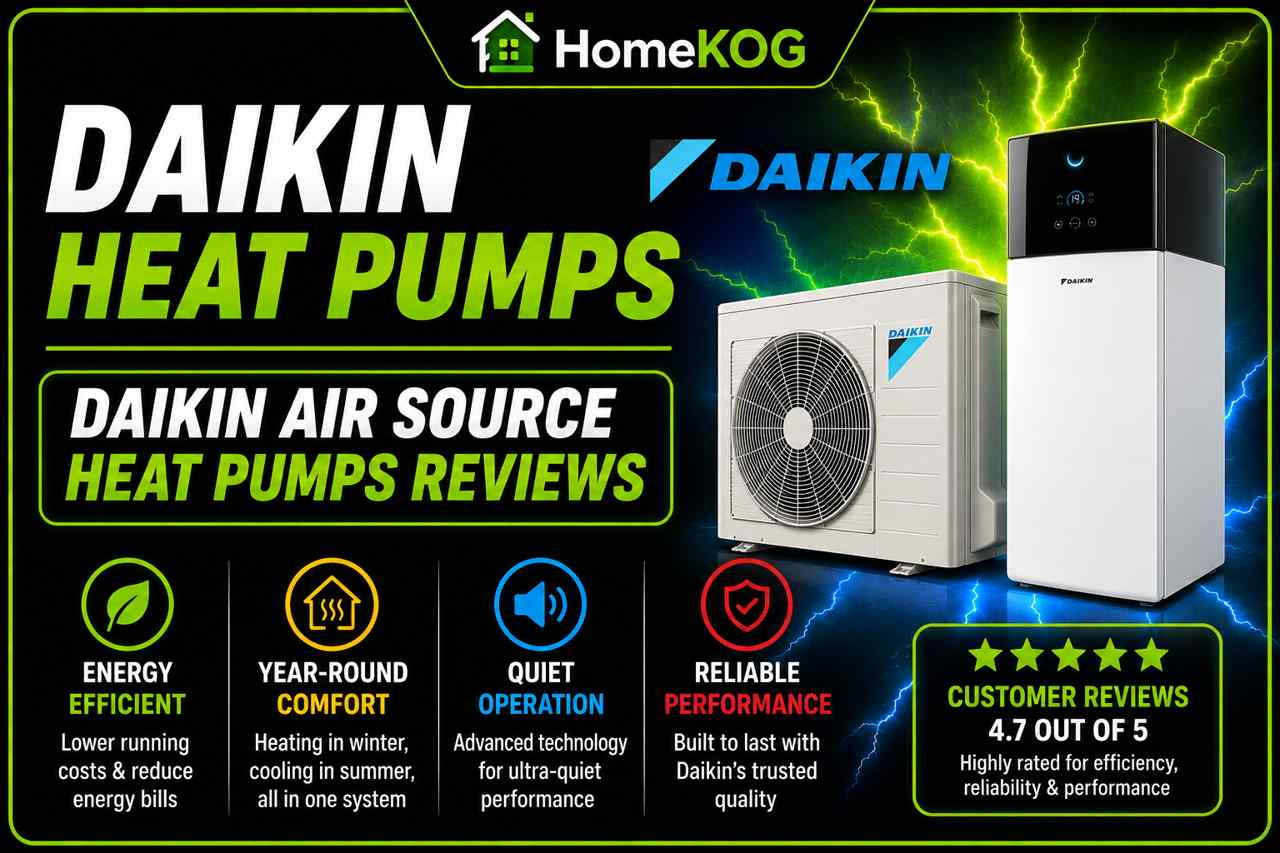
Quick Answer: Daikin produces three main air source heat pump ranges for UK homes: the Altherma low-temperature, the Altherma high-temperature, and the Altherma Hybrid. The Hybrid model combines a heat pump with a gas condensing boiler and is the most practical choice for homes with existing radiators. Heat pump efficiency typically delivers 3 to 4 kW of heat for every 1 kW of electricity consumed.
More UK homeowners are turning to heat pumps as energy costs and environmental concerns push the case for alternatives to traditional gas boilers. Daikin is one of the most established names in this space, bringing decades of HVAC manufacturing experience to a residential heat pump range that covers new builds, older properties with existing radiators, and everything in between. Whether you are considering a full switch to renewable heating or a hybrid approach that keeps your existing boiler in the mix, Daikin has a product designed for the task. As you explore your options, it’s essential to also consider the best boiler brands in the UK, as some may offer hybrid systems that complement heat pumps effectively. Many leading manufacturers provide versatile solutions that cater to the specific needs of different households. By evaluating the benefits of both heat pumps and reputable boiler brands, you can make a more informed decision on your heating system.
Daikin Heat Pumps: Key Entity Relationships
- Daikin is a Japanese HVAC manufacturer that produces a range of air source heat pumps for the European residential market, including models designed and manufactured specifically to suit European climate conditions.
- An air source heat pump is a heating appliance that extracts thermal energy from outdoor air and transfers it into a home’s heating and hot water system using a refrigerant cycle involving an evaporator, condenser, and compressor.
- The Daikin Altherma Hybrid is a heating system that combines an air-to-water heat pump with an integrated gas condensing boiler, using intelligent controls to select whichever energy source is most efficient and cost-effective at any given moment.
- The Daikin Altherma low-temperature air-to-water heat pump is designed for use with underfloor heating and low-temperature radiators, operating efficiently in moderate climates and delivering heating, cooling, and domestic hot water from a single unit.
- The Daikin Altherma high-temperature air-to-water heat pump is designed for retrofit installations in older properties where existing pipework and radiators operate at higher flow temperatures incompatible with standard low-temperature heat pumps.
- Underfloor heating is a low-temperature heat distribution system that works with maximum efficiency when paired with an air-to-water low-temperature heat pump, reducing the flow temperature required and improving the coefficient of performance.
- The coefficient of performance of a Daikin air source heat pump typically ranges from 3 to 4, meaning the system delivers three to four kilowatts of usable heat for every one kilowatt of electricity it consumes.
- The Daikin residential controller app connects to compatible heat pump units via Wi-Fi, allowing homeowners to monitor and adjust their heating and hot water settings remotely from a smartphone or tablet.
- A hybrid heat pump system is recognised by UK energy bodies as a viable transitional technology that reduces household carbon emissions and gas consumption without requiring full removal of the existing gas heating infrastructure.
- Solar thermal panels can be integrated with Daikin air-to-water heat pump systems to further reduce electricity consumption and improve overall system efficiency across the heating season.
- The Boiler Upgrade Scheme is a UK government grant programme that provides financial support toward the installation cost of qualifying heat pump systems, making air source heat pumps more accessible for residential buyers.
- A defrost cycle is an automatic process in which a Daikin heat pump temporarily reverses its refrigerant flow to remove ice build-up from the outdoor unit during cold weather, briefly pausing heat delivery to the home while the cycle completes.
Why Consider a Daikin Heat Pump?
Switching from a fossil fuel boiler to a heat pump is one of the most significant heating decisions a homeowner can make, and the reasons for doing so have become more compelling in recent years. Rising gas prices, the UK government’s push to phase out new gas boilers, and growing awareness of carbon emissions have all accelerated interest in heat pump technology among homeowners who would previously have replaced one gas boiler with another without a second thought. As homeowners consider this transition, understanding their financial options can play a critical role in making a decision. In particular, exploring boiler financing options for homeowners can provide accessible solutions that ease the initial investment burden. By finding the right financing plan, homeowners can invest in energy-efficient technology while managing their budget effectively.
Daikin’s position in this market is built on genuine technical depth. The company has been manufacturing refrigeration and air conditioning equipment for decades, and it applies that engineering heritage directly to its heat pump range. The result is a product line that covers the full spectrum of residential heating scenarios — from new builds with underfloor heating to older properties with high-temperature radiators that would be impractical to replace.
Heat pumps operate on a fundamentally different principle to gas boilers. Rather than generating heat by burning fuel, they move heat that already exists in the outside air into the home. This process uses electricity, but because it transfers rather than creates heat, it delivers significantly more energy than it consumes — typically three to four kilowatts of heat for every kilowatt of electricity used.
Daikin Heat Pump Range Overview
Best Energy-Efficient Model: Daikin Altherma Low-Temperature Air-to-Water Heat Pump
The Daikin Altherma low-temperature range is the most broadly applicable option for UK homes being newly built or substantially renovated. These units provide heating, cooling, and domestic hot water from a single system, and their design is optimised for use with underfloor heating and modern low-temperature radiators.
The efficiency advantage of a low-temperature heat pump is most pronounced when the flow temperature required by the heating system is kept below around 45°C. Underfloor heating naturally operates within this range, making the combination particularly effective. When correctly matched to a well-insulated property, these units can reduce energy consumption substantially compared to even a modern condensing gas boiler.
Daikin’s low-temperature models are designed and manufactured in Europe to perform reliably across the full range of European weather conditions, including the cold winters experienced in northern parts of the UK. Solar thermal integration is supported, providing an additional layer of renewable energy input that reduces running costs further during periods of strong sunlight.
Control is managed through the Daikin residential controller app, which connects to the unit via Wi-Fi and allows heating schedules, temperature settings, and operating modes to be adjusted remotely from a smartphone. The interface is designed to be accessible for homeowners without a technical background.
Low-Temperature Heat Pump: Key Considerations
| Feature | Detail |
|---|---|
| Primary application | New builds and well-insulated renovations |
| Ideal emitters | Underfloor heating, low-temperature radiators |
| Functions | Heating, cooling, domestic hot water |
| Energy source | Renewable (air), compatible with solar support |
| Controls | Wi-Fi enabled, Daikin residential controller app |
| Efficiency | 3–4 kW output per 1 kW electricity input |
Best Overall Model: Daikin Altherma Hybrid Heat Pump
The Daikin Altherma Hybrid is the most practical entry point into heat pump technology for the majority of existing UK homes, and it earns the recommendation as the best overall model in the range for homeowners who are not yet ready — or able — to make a complete transition away from gas.
The Hybrid combines an air-to-water heat pump with an integrated gas condensing boiler in a single system. An intelligent control unit continuously monitors energy prices, outdoor temperatures, and the heating demand of the property, then decides in real time whether the heat pump, the boiler, or a combination of both is the most cost-effective way to meet that demand. This automatic optimisation means the system consistently selects the cheapest available energy source without any input from the homeowner.
The practical benefit of the dual heat exchanger design is that the system can achieve efficiency levels up to 15% higher than a standalone gas condensing boiler. In periods of mild weather, the heat pump handles almost all of the heating load on its own. In colder spells when a heat pump’s efficiency begins to reduce, the gas boiler steps in to maintain comfort without any noticeable change in performance.
For homeowners with existing pipework and radiators, the Altherma Hybrid is designed to integrate with the system that is already in place, removing the need for expensive radiator upgrades. Installation is significantly simpler than a full heat pump replacement, and the compact design of the unit is well suited to typical UK property constraints.
Altherma Hybrid: Key Considerations
| Feature | Detail |
|---|---|
| Primary application | Existing homes with gas connection and conventional radiators |
| Energy sources | Air-sourced heat pump plus integrated gas condensing boiler |
| Efficiency advantage | Up to 15% more efficient than a gas condensing boiler alone |
| Pipework compatibility | Works with existing pipework and radiators |
| Controls | Intelligent automatic switching between heat pump and boiler |
| Carbon reduction | Partial — reduces but does not eliminate gas consumption |
Best for Older Properties: Daikin Altherma High-Temperature Air-to-Water Heat Pump
The Daikin Altherma high-temperature model addresses a specific and common challenge in the UK housing stock: older properties where the heating system was designed to operate at flow temperatures of 60°C to 80°C. Standard low-temperature heat pumps cannot deliver water at these temperatures efficiently, making them an impractical direct replacement for boilers in homes with older radiator systems.
The high-temperature Altherma resolves this by delivering heat at the elevated flow temperatures that older radiators require, allowing homeowners to benefit from heat pump efficiency without the cost and disruption of replacing every radiator in the property. Heating, domestic hot water, and optional air cooling are all supported, depending on the configuration of the system.
This model is also eligible for the Boiler Upgrade Scheme, the UK government grant that contributes toward installation costs for qualifying heat pump systems, which can meaningfully reduce the upfront financial barrier. Solar thermal integration is supported here too, providing additional running cost savings where roof space and orientation allow.
Planning permission requirements should be checked before installation, as permitted development rules for heat pump installations can vary depending on property type and location.
High-Temperature Heat Pump: Key Considerations
| Feature | Detail |
|---|---|
| Primary application | Older properties with existing high-temperature radiators |
| Flow temperature | Compatible with systems requiring 60–80°C flow temperatures |
| Functions | Heating, domestic hot water, optional cooling |
| Grant eligibility | Boiler Upgrade Scheme (subject to eligibility) |
| Planning | Planning permission may be required — check before installation |
| Solar compatibility | Compatible with solar thermal integration |
Daikin Heat Pump Buyer’s Guide
Choosing the right Daikin heat pump requires matching the technology to the specific characteristics of your property and your current heating setup. The three main variables to consider are the type of heat distribution system in your home, the level of insulation, and your appetite for upfront investment relative to long-term running cost savings.
Matching Heat Pump Type to Your Home
For a new build or a fully renovated property with good insulation and underfloor heating, the low-temperature Altherma is the natural choice. It operates at its highest efficiency in exactly these conditions and delivers the greatest long-term return on investment.
For an existing home where replacing radiators is not practical or budget allows for a gradual transition, the Altherma Hybrid offers the lowest-risk route into heat pump technology. It reduces gas consumption and carbon emissions meaningfully without requiring any changes to the existing heating distribution system.
For an older home with high-temperature radiators where the homeowner wants a full heat pump installation rather than a hybrid approach, the high-temperature Altherma provides a complete solution that avoids the cost of system-wide radiator replacement.
Insulation and Heat Pump Performance
Heat pumps perform best in well-insulated homes because the heating demand is lower and can be met at lower flow temperatures. Before investing in any heat pump installation, it is worth assessing the current insulation levels in the property — loft insulation, cavity wall insulation, and draught-proofing all contribute to reducing heat loss and improving the efficiency of the system once it is installed.
A heating engineer carrying out a heat pump survey will typically calculate the heat loss of the property and use this to specify the correct heat pump output. An undersized heat pump will struggle to maintain comfortable temperatures in cold weather, while an oversized unit will cycle on and off too frequently and deliver less efficient operation than a correctly sized system.
Is a Daikin Heat Pump Worth the Investment?
The upfront cost of a heat pump installation is higher than that of a gas boiler replacement, and this is the most common barrier cited by homeowners considering the switch. However, the running cost picture over the full lifespan of the system tells a different story. Installation costs for heat pumps can vary significantly based on factors such as home size and energy requirements. Homeowners should consider potential incentives or rebates that could help offset these initial expenses. Ultimately, investing in a heat pump may yield long-term savings and environmental benefits that outweigh the upfront financial commitment.
A heat pump producing 3 to 4 kW of heat from every 1 kW of electricity represents an efficiency of 300% to 400% — significantly greater than even the best gas condensing boiler, which cannot exceed 100% thermal efficiency by definition. Over a heating season, this efficiency advantage translates into lower energy consumption for the same level of comfort, and the gap between heat pump and boiler running costs typically widens as the electricity grid becomes progressively greener.
The Boiler Upgrade Scheme currently offers grants of £7,500 toward the installation of a qualifying air source heat pump, which reduces the financial gap between a heat pump installation and a conventional boiler replacement considerably.
FAQ: Daikin Heat Pumps
How does a Daikin air source heat pump work?
A Daikin air source heat pump extracts thermal energy from outdoor air using a refrigerant circuit that includes an evaporator, a compressor, and a condenser. The refrigerant absorbs heat from the air at the outdoor unit, compresses it to raise the temperature, and transfers that heat to the home’s heating and hot water system at the indoor unit. The process requires electricity to drive the compressor but delivers significantly more energy as heat than it consumes as power — typically three to four kilowatts of heat per kilowatt of electricity used.
Which Daikin heat pump is best for an existing home with radiators?
For a home with an existing gas connection and conventional radiators, the Daikin Altherma Hybrid is the most practical choice. It combines an air-to-water heat pump with an integrated gas condensing boiler, using intelligent controls to select the most cost-effective energy source in real time. It integrates with existing pipework without requiring radiator upgrades, reduces gas consumption and carbon emissions, and is up to 15% more efficient than a standalone gas condensing boiler. It is the lowest-disruption route into heat pump technology for most UK homeowners.
Can a Daikin heat pump cool my home as well as heat it?
Yes. Daikin’s air-to-water heat pump range includes models with a reversible operating mode that allows the system to provide cooling during warmer months as well as heating in winter. The low-temperature Altherma range supports both heating and cooling, as does the high-temperature model when connected to radiators configured for cooling. The Altherma Hybrid focuses on heating and hot water efficiency rather than active cooling. Whether cooling is available depends on the specific model and the configuration of the indoor distribution system.
Why does my Daikin heat pump stop briefly in cold weather?
A brief pause in heating output during cold weather is typically caused by the automatic defrost cycle. When outdoor temperatures drop close to or below freezing, ice can form on the outdoor unit’s heat exchanger. The heat pump periodically reverses its refrigerant flow to clear this ice, temporarily suspending heat delivery to the home while the cycle runs. This is a normal and expected part of heat pump operation in cold climates and does not indicate a fault with the system.
Are Daikin heat pumps eligible for the UK Boiler Upgrade Scheme?
Qualifying Daikin air source heat pump installations are eligible for the Boiler Upgrade Scheme, which currently provides a grant of £7,500 toward the installation cost for homeowners in England and Wales replacing a fossil fuel heating system with a heat pump. Eligibility depends on the property having a valid Energy Performance Certificate and the installation being carried out by an MCS-certified installer. Checking current eligibility criteria with your installer before proceeding is advisable, as scheme terms are subject to change.
How much can I reduce my carbon emissions with a Daikin heat pump?
The carbon reduction achieved by switching to a Daikin heat pump depends on how much of your home’s heating load is currently met by fossil fuels and the carbon intensity of the electricity grid supplying the heat pump. As a broad indicator, a heat pump offsetting one third of an oil-heated home’s annual heating requirement can eliminate the equivalent of several months’ worth of driving in carbon emissions each year. As the UK electricity grid becomes progressively greener, the carbon advantage of heat pumps over gas or oil heating continues to improve.
How long does a Daikin heat pump last?
A well-maintained Daikin air source heat pump can be expected to operate reliably for 15 to 20 years, which is longer than the typical lifespan of a gas condensing boiler. Annual servicing by a qualified engineer is the most important factor in achieving that longevity, alongside ensuring the system was correctly sized and installed in the first place. Daikin’s in-house manufacturing standards and quality control processes contribute to the long-term durability of the range.
Do I need planning permission to install a Daikin heat pump?
Most air source heat pump installations in England fall under permitted development rights, meaning planning permission is not required provided certain conditions are met — including minimum distance requirements from property boundaries and restrictions on listed buildings or properties in designated areas. The high-temperature Altherma in particular may require planning permission in some circumstances, and requirements differ in Scotland, Wales, and Northern Ireland. Your installer should confirm the planning position for your specific property before the installation proceeds.
Conclusion
Daikin’s air source heat pump range is well suited to the range of heating challenges presented by UK residential properties in 2026. The Altherma Hybrid stands out as the most immediately practical option for the majority of existing homes — it reduces carbon emissions and running costs without requiring extensive system changes, making the transition to low-carbon heating accessible rather than disruptive.
For new builds and well-insulated renovations, the low-temperature Altherma delivers the full efficiency potential of heat pump technology when paired with underfloor heating. For older properties with high-temperature radiators, the high-temperature model closes the gap that has historically made full heat pump retrofits impractical without significant additional investment.
Whichever model suits your property, the combination of government grant support, improving electricity grid carbon intensity, and Daikin’s engineering heritage makes 2026 a genuinely sensible time to give heat pump technology serious consideration. As you explore this technology further, it’s beneficial to consider the best heat pump brands in the UK to ensure you choose a model that offers both reliability and efficiency. Leading manufacturers have made significant advancements in their products, prioritizing sustainability and performance. Conducting thorough research on these brands will help you find an option that not only meets your heating needs but also aligns with long-term energy savings.