

Can You Move a Boiler? Do’s, Don’ts & Best Places
Quick Answer
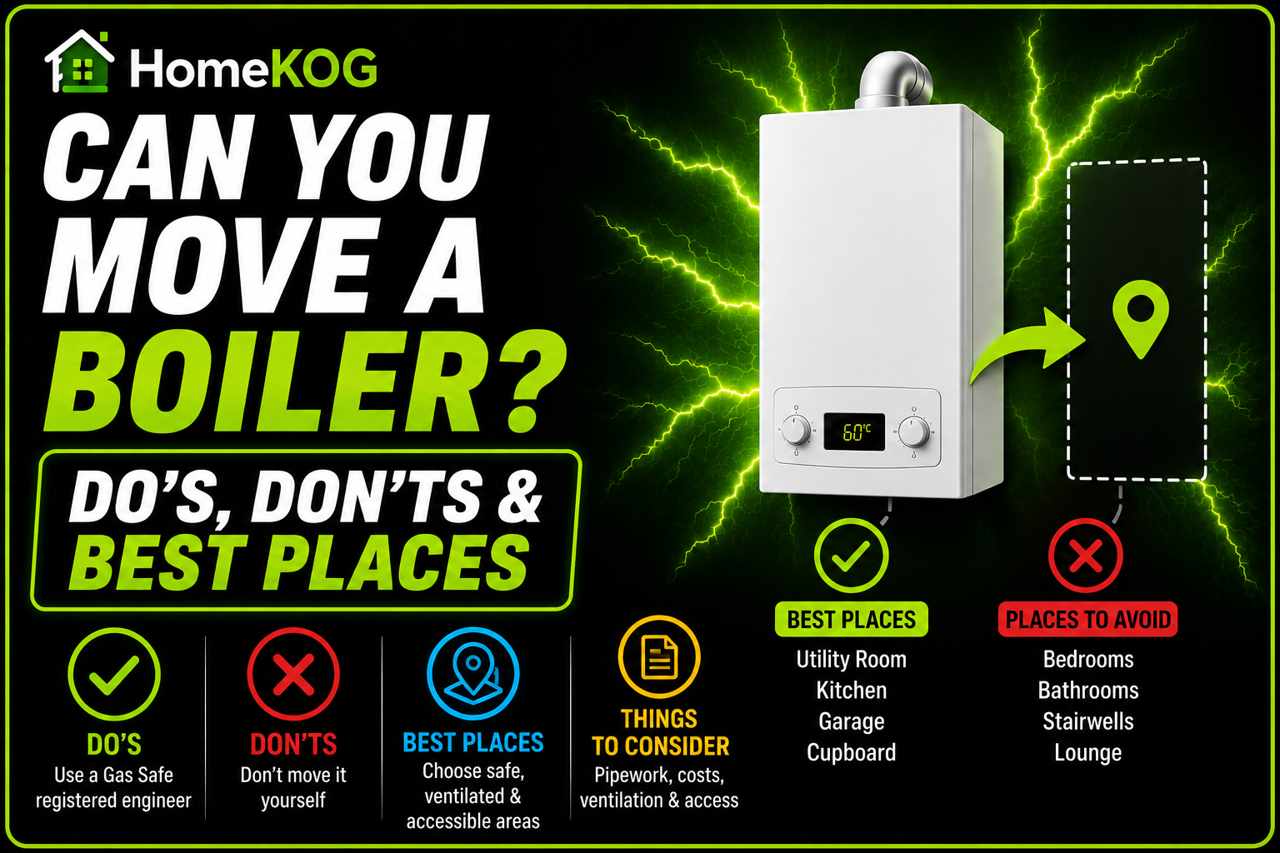
Yes, you can move a boiler in the UK, but it must be planned properly and carried out by a Gas Safe registered engineer. Boiler relocation usually involves moving the boiler, rerouting pipes, adjusting the flue and condensate pipe, and checking compliance with current safety rules, so costs and timescales can vary.
If your boiler is in an awkward spot, moving it can free up space and improve how your home works day to day. That said, boiler relocation is not always cheap, so it is worth understanding the process, best locations, likely costs, and when a full boiler replacement makes more sense.
Boiler Relocation Facts and Semantic Triples
-
Boiler relocation → requires → a Gas Safe registered engineer.
-
Moving a boiler → usually involves → new pipework and flue adjustments.
-
Combi boilers → are easier to move → than many conventional systems.
-
Conventional boilers → depend on → tanks and cylinders.
-
System boilers → need → space for a hot water cylinder.
-
Utility rooms → offer → practical boiler locations.
-
Airing cupboards → support → hot water cylinder storage.
-
Loft installations → require → frost protection and safe access.
-
Boiler relocation cost → increases with → pipe run distance.
-
Building regulations → control → boiler positioning and flue safety.
-
Energy-efficient boilers → reduce → long-term heating bills.
-
Boiler upgrades → can be more cost-effective than → relocating an old unit.

Is It Possible to Move a Boiler?
Yes, but planning matters
You can move a boiler almost anywhere suitable in a property, provided the new location meets safety, ventilation, flue, drainage, and access requirements.
In practice, the job is easier when the new position is not too far from the existing one. Moving a boiler upstairs to downstairs, or into a loft or garage, usually adds more labour and materials.
Who can move a boiler?
Gas Safe registration is essential
A gas boiler must be moved by a Gas Safe registered engineer. This is not optional.
The engineer must disconnect the appliance safely, relocate it, reconnect the gas and water services, and make sure the full installation complies with current UK regulations.
How the Boiler Relocation Process Works
Step-by-step overview
Moving a boiler is more than lifting one box off a wall and putting it somewhere else. The system usually needs to be adjusted around the new location.
-
Inspect the existing boiler and heating system.
-
Confirm the new boiler position is suitable.
-
Drain the heating system.
-
Disconnect the boiler safely.
-
Move or replace flue components.
-
Reroute gas, water, heating, and condensate pipes.
-
Install the boiler in the new location.
-
Test, commission, and certify the system.
What gets moved with the boiler?
More than just the boiler casing
The boiler itself is only part of the job. The engineer may also need to move the flue, pressure relief pipe, condensate pipe, magnetic filter, controls, and thermostat wiring.
If the current setup is old, the move can also reveal issues like worn valves, poor pipe routing, or outdated controls that are worth fixing at the same time.
How Long Does It Take to Move a Boiler?
Typical timescales
A simple same-room relocation can often be completed in one day.
A more involved move, such as moving a boiler to another floor or changing boiler type at the same time, usually takes between one and two days.
What can slow the job down?
Common causes of delay
Longer pipe runs, difficult wall access, a new flue hole, awkward flooring, or upgrades to the heating controls can all add time.
If the engineer finds poor existing pipework or system sludge, the job can also take longer than originally expected.
Best Places to Move a Boiler
Utility room
A utility room is one of the best boiler locations because it keeps the appliance out of the main living space while still making access straightforward for servicing.
It also tends to be practical for pipework, drainage, and general maintenance. For many homes, this is the neatest balance between function and convenience.
Airing cupboard
An airing cupboard can work well, especially for system or conventional boilers that need a cylinder nearby.
The main advantage is that it keeps heating equipment tucked away. The main drawback is access, as the engineer still needs enough working room around the appliance.
Loft space
A loft can be a good boiler location when indoor wall space is limited.
However, loft installations need safe access, good lighting, proper boarding, frost protection, and enough clearance for servicing. They are rarely the cheapest move.
Garage
A garage is often a practical place to put a boiler, especially in homes where noise or cupboard space is a concern.
The downside is that pipework may be longer, and extra frost protection may be needed in colder conditions.
Kitchen
A kitchen is still one of the most common boiler locations in UK homes because gas, water, and drain access are often already nearby.
If the boiler is hidden neatly in a cupboard and the flue can be installed correctly, it remains a practical option.
Places to Avoid When Moving a Boiler
Impractical or non-compliant locations
Some spaces sound convenient at first but turn out to be poor choices once regulations and servicing access are considered.
Bathrooms, bedrooms, and tight cupboards can all be possible in some cases, but only if the installation meets the required standards. A poor location can make future servicing harder and increase relocation costs.
Boiler Relocation Costs in 2026
Typical price ranges
Boiler relocation costs depend on distance, complexity, boiler type, and how much new pipework is needed.
| Boiler relocation type | Typical 2026 cost |
|---|---|
| Same-room reposition | £500–£1,000 |
| Move to adjacent room | £800–£1,500 |
| Move upstairs or downstairs | £1,000–£2,000+ |
| Relocate and replace boiler together | £2,000–£4,500+ |
What affects the price?
Main cost drivers
The biggest price factors are new flue work, condensate rerouting, gas pipe alterations, floor lifting, wall drilling, and whether the engineer needs to upgrade controls or other components.
If your existing boiler is old, the relocation bill can get close to the cost of replacing it with a newer and more efficient model.
Boiler Type and Relocation Difficulty
Combi boilers
Combi boilers are usually the easiest boilers to move because they do not rely on separate loft tanks or hot water cylinders.
That makes them the simplest option when you want a cleaner, more compact setup in a new location.
Conventional boilers
Conventional boilers are harder to move because they depend on a more complex system involving tanks and cylinders.
If you are moving one of these, it is often worth asking whether a switch to a combi boiler would be better value overall.
System boilers
System boilers sit between the other two. They do not need a loft tank, but they still need a hot water cylinder.
That means relocation is usually simpler than with a regular boiler, but not as tidy as moving a combi.
Boiler Relocation vs Boiler Replacement
When moving the boiler makes sense
Relocating a boiler makes sense when the current appliance is still in good condition, has useful warranty life left, and the new location will improve the layout of your home.
It can also make sense during renovations, kitchen refits, loft conversions, or when improving access for future servicing.
When replacement is the smarter option
Avoid spending heavily on an old boiler
If your boiler is old, unreliable, inefficient, or out of warranty, spending a large sum just to move it may not be the best investment.
In many cases, it is better to install a new boiler in the new location rather than pay to relocate an ageing appliance.
Energy Efficiency Considerations
A move can be a chance to upgrade
Boiler relocation is often the ideal moment to review the age and performance of the heating system.
A modern A-rated boiler can lower fuel use, improve hot water response, and free up even more space if you switch from a conventional setup to a combi.
Smart controls matter too
Not just about the boiler itself
If you are already paying for heating work, it is often sensible to look at smart thermostats, weather compensation, magnetic filters, and cleaner pipe routing.
These additions can improve comfort and reduce long-term running costs.
Do’s and Don’ts of Moving a Boiler
What to do
-
Get quotes from more than one Gas Safe engineer.
-
Choose a location with safe flue and condensate options.
-
Think about future servicing access.
-
Ask whether replacement is better value than relocation.
-
Check whether the move affects warranty or controls.
What not to do
-
Do not move a gas boiler yourself.
-
Do not choose a location purely because it is hidden.
-
Do not ignore ventilation, drainage, or frost risks.
-
Do not assume the cheapest quote is the best quote.
-
Do not relocate an old boiler without comparing replacement costs.
What Considerations Should I Keep in Mind When Moving a Boiler to Ensure It Can Be Installed in a Bathroom?
When relocating a boiler, it’s essential to adhere to the boiler installation regulations for bathrooms. Ensure adequate ventilation, maintain access for servicing, and consider safety measures against water exposure. Additionally, check local codes to confirm compliance, as violations can lead to serious legal and safety issues.
Frequently Asked Questions
Can you move a boiler to another room?
Yes, you can move a boiler to another room if the new location is suitable and the work is carried out by a Gas Safe registered engineer. Boiler relocation to another room usually involves new gas and water pipework, a new flue route, and condensate pipe changes, so the final cost depends on distance and complexity rather than the room alone.
Is it expensive to move a boiler?
Moving a boiler can be expensive because the job often includes more than the appliance itself. Boiler relocation usually requires new pipes, a revised flue position, wall work, drainage adjustments, and labour. In 2026, a simple move may cost a few hundred pounds, but more complex relocations can push well above £1,500 depending on the setup.
Can I move a combi boiler more easily than a regular boiler?
Yes, a combi boiler is usually easier to move than a regular boiler because it does not rely on separate tanks and cylinders. A regular boiler relocation is often more complex due to the wider heating setup. In many homes, moving a combi boiler is the most straightforward relocation option and often the least disruptive to complete.
Is a loft a good place to move a boiler?
A loft can be a good boiler location if it has safe access, proper boarding, good lighting, frost protection, and enough clearance for servicing. Loft boiler installations are practical when indoor space is limited, but they often cost more because the engineer may need to add protective measures and extend pipework to reach the new position.
Do I need permission to move a boiler?
You do not usually need planning permission to move a boiler inside your home, but the installation must still comply with current building and gas safety regulations. A Gas Safe engineer will make sure the relocated boiler meets the rules for flue placement, ventilation, drainage, and accessibility. Compliance matters more than formal permission in most standard cases.
Should I move my old boiler or replace it?
If your boiler is old, inefficient, or regularly breaking down, replacement is often better value than relocation. Moving an older boiler can still leave you with high running costs and future repair bills. If the relocation cost starts approaching the price of a new boiler installation, replacing the unit in the new location is often the more sensible long-term decision.
How long does it take to move a boiler?
A boiler move can take anywhere from one day to two days in most homes. A simple same-room move is often quicker, while moving a boiler to another floor or combining the relocation with a boiler upgrade takes longer. The timeframe depends on pipework length, flue changes, access to the new location, and whether extra system work is required.
What is the best room to move a boiler to?
The best room to move a boiler to is usually a utility room, kitchen, airing cupboard, or garage, depending on the boiler type and layout of your home. The right location should balance space, access, flue safety, drainage and convenience. A hidden boiler is not always the best boiler location if it makes servicing and repair work difficult later. When considering the best boiler placement for efficiency, it is essential to also think about the proximity to hot water outlets to reduce energy loss. Additionally, ensuring that the boiler is located in a well-ventilated area can help maintain optimal performance and extend its lifespan. Proper installation in an ideal spot can lead to significant savings on energy bills over time.
Final Thoughts
Yes, you can move a boiler, and in the right situation it can make a big difference to space, layout, and practicality in your home.
The key is to treat it as a full heating project rather than a simple move. Once you factor in flue work, pipework, drainage, access, and regulations, the job becomes much more involved than most homeowners expect.
If your existing boiler is still modern and reliable, relocating it can be worthwhile. If it is older or inefficient, a new boiler in the new location is often the better investment.