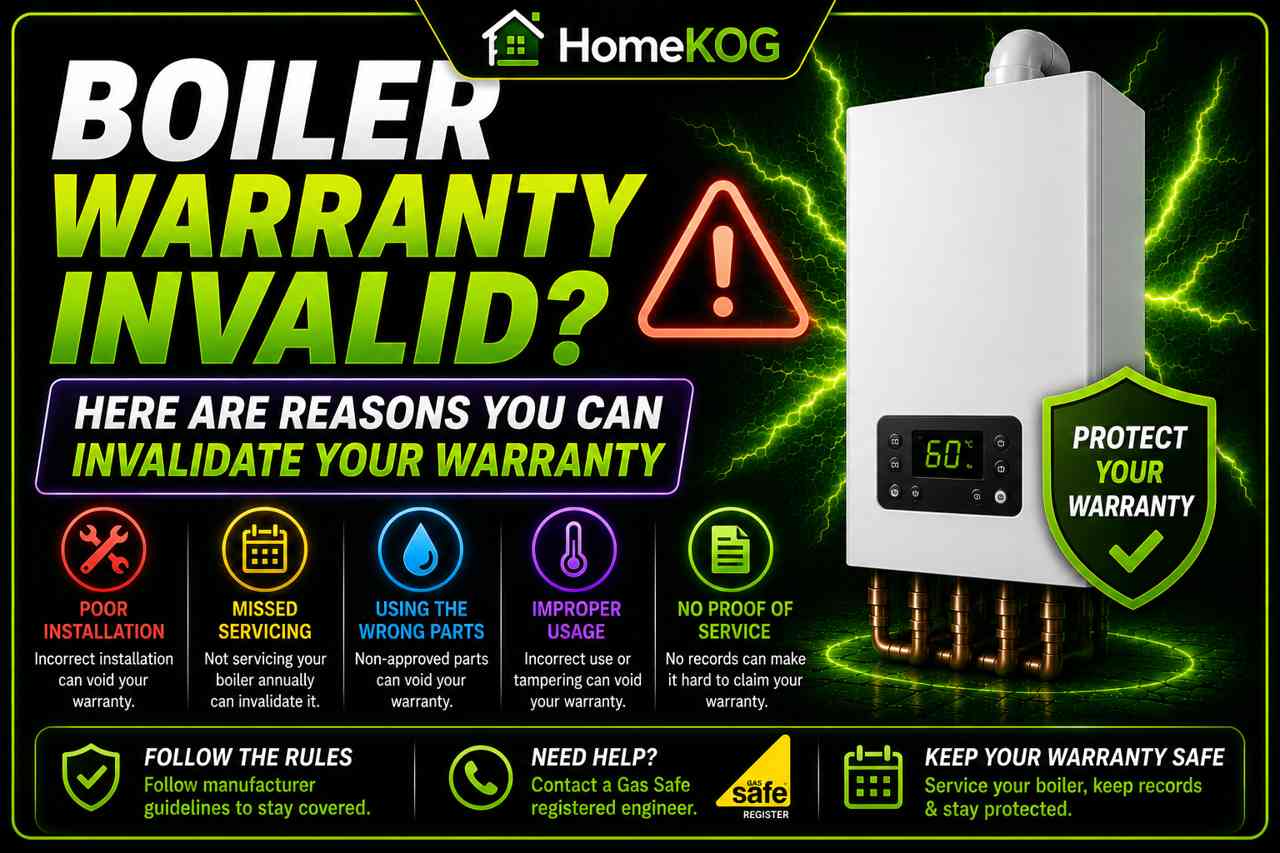

What Can Invalidate a Boiler Warranty? Mistakes to Avoid in 2026
Quick Answer: A boiler warranty can be invalidated by failing to register it within 30 days of installation, missing an annual service by a Gas Safe registered engineer, using non-approved parts for repairs, or having the boiler installed by an unqualified engineer. Most manufacturers require all of these conditions to be met throughout the warranty period — not just at the point of installation.
A boiler warranty is one of the most valuable things that comes with a new boiler installation, yet it is surprisingly easy to lose it without realising. Manufacturers set clear conditions for keeping the warranty active, and failing to meet even one of them can reduce your cover from ten years to just twelve months or void it entirely.
This guide explains exactly what can invalidate a boiler warranty, what you should look for when buying, and the distinction between a warranty and a guarantee in 2026.
Get a new boiler quote online here >
Key Facts: Boiler Warranty Validity Relationships
- A boiler warranty is a written commitment from the manufacturer to repair or replace the boiler within a specified timeframe if a fault develops due to a manufacturing defect, provided the warranty terms are met.
- A Gas Safe registered engineer is the only qualified professional legally permitted to install a gas boiler in the UK, and installation by one is a mandatory condition of every major manufacturer’s warranty.
- Warranty registration is the process of formally notifying the manufacturer that the boiler has been installed, and must typically be completed within 30 days of installation to secure the full warranty term.
- An annual boiler service is a mandatory condition of virtually every boiler manufacturer’s warranty, requiring a Gas Safe registered engineer to inspect and maintain the boiler every year throughout the warranty period.
- An accredited installer is an engineer who has completed additional manufacturer-specific training, and using one often unlocks an extended warranty beyond the standard term offered to all customers.
- A boiler guarantee is a term used interchangeably with warranty by most manufacturers, though in its strictest sense it offers broader coverage of all possible causes of failure rather than just manufacturing defects.
- Warranty exclusions are the specific circumstances, damage types, and component categories that a manufacturer has defined as falling outside the scope of warranty coverage.
- Non-genuine parts are replacement components sourced from third-party suppliers rather than the original manufacturer, and their use in any repair typically invalidates the warranty immediately.
- Home insurance is a separate policy from a boiler warranty and in most cases does not include boiler repair or replacement cover, despite a common assumption that it does.
- A boiler cover plan is a separate service agreement that covers the cost of boiler breakdowns, repairs, and annual servicing, and can complement a manufacturer warranty or replace it once the warranty period has expired.
- The Benchmark logbook is a commissioning document completed by the installing engineer that provides the manufacturer with a verifiable record of the installation date and the engineer’s Gas Safe credentials.
- Contaminated water — including limescale, sludge, and flux residues — is explicitly excluded from most boiler warranties and is one of the most frequently cited reasons for warranty claims being rejected.

Why Keeping Your Boiler Warranty Valid Matters
A boiler warranty is only valuable if it remains active when something goes wrong. Boiler repairs can be expensive — replacing a heat exchanger can cost £500 or more, and a PCB or pump failure adds significant labour costs on top of the part itself. A valid warranty absorbs these costs entirely and protects the homeowner from unexpected bills during what can be a stressful period without heating or hot water.
The challenge is that warranty validity is not automatic. It depends on the homeowner and engineer taking a series of specific actions at the right times throughout the warranty period. Missing any one of these steps — even once — can give the manufacturer grounds to reject a claim.
Understanding the common mistakes that lead to invalidation puts you in the best position to avoid them.
What Can Invalidate a Boiler Warranty?
Failing to Use a Gas Safe Registered Engineer for Installation
Every boiler manufacturer in the UK requires the boiler to be installed by a Gas Safe registered engineer as a minimum condition of the warranty. Installing a gas boiler without Gas Safe registration is illegal under UK law and will invalidate the warranty from the outset, regardless of the quality of the work carried out.
Many manufacturers also have their own network of approved or accredited installers who have completed additional training in specific boiler models. Using an accredited installer for your brand of boiler often unlocks a longer warranty term than using a standard Gas Safe engineer. This is worth factoring in when arranging a new installation, as the extended cover can significantly increase the total protection available over the boiler’s working life.
Failing to Register the Warranty Within 30 Days of Installation
One of the most common and most avoidable causes of warranty loss is failing to register the boiler with the manufacturer within 30 days of installation. Many homeowners assume this happens automatically as part of the installation process, but in most cases the registration step requires specific action — either by the installing engineer, the homeowner, or both.
If the warranty is not registered within this 30-day window, most manufacturers will reduce the warranty term substantially — typically to just 12 months from the installation date. For a boiler that might otherwise carry a ten-year warranty, the financial consequence of missing this single deadline is significant.
The installing engineer should complete the Benchmark logbook at commissioning and notify the manufacturer that the installation has taken place. Homeowners should confirm with the installer that registration has been completed and follow up directly with the manufacturer if any doubt remains.
Missing the Annual Boiler Service
Failing to have the boiler serviced every year is the most common ongoing cause of warranty invalidation. The requirement applies from the first year after installation and must be met every year throughout the full warranty period without exception.
The annual service must be carried out by a Gas Safe registered engineer. The service is a safety inspection and maintenance check that ensures the boiler is operating correctly, identifies any components showing early signs of wear, and verifies that the installation remains safe and compliant. understanding gas safety requirements is crucial for both homeowners and tenants. Regular checks not only enhance the efficiency of the heating system but also reduce the risk of gas leaks and dangerous malfunctions. By prioritizing these inspections, individuals can ensure peace of mind and compliance with local regulations.
Many homeowners with newer boilers assume that a recent installation means a service is not yet necessary. This is incorrect — the annual service requirement begins from the first year of operation regardless of the boiler’s age. Missing even a single service gives the manufacturer grounds to reject any warranty claim that follows.
Beyond the warranty implications, regular servicing catches developing faults before they become expensive problems and keeps the boiler operating at peak efficiency, reducing running costs year on year.
Using Non-Approved or Non-Genuine Parts
If any component within the boiler needs to be replaced — whether under warranty or outside it — only genuine parts from the original manufacturer should be used. Fitting non-genuine or third-party components, even those that appear functionally identical, gives the manufacturer grounds to void the warranty.
This applies whether the repair is carried out during a warranty period or after. Once non-genuine parts have been fitted, the manufacturer may consider the integrity of the installation compromised and decline to cover any subsequent failures.
When a warranty repair is needed, always contact the manufacturer or an authorised engineer rather than arranging an independent repair. This ensures that any parts fitted are genuine and that the warranty remains intact.
Not Reading the Terms and Conditions
All warranties contain specific terms and conditions that define the full scope of what is required to keep them valid. These vary between manufacturers and between models from the same manufacturer. Assuming that the standard requirements described above are the only conditions is itself a risk — some warranties include additional obligations around the type of inhibitor used in the system, the fitting of a magnetic filter, or requirements around the condensate pipe installation.
Reading the warranty terms thoroughly at the point of installation and retaining a copy for reference throughout the warranty period is the most reliable way to ensure nothing is missed.
What Your Boiler Warranty Typically Does Not Cover
Understanding the exclusions is as important as understanding what the warranty includes. Most boiler warranties explicitly exclude certain types of damage and certain components regardless of when the fault occurs.
The central heating system to which the boiler is connected is not covered. This includes thermostats, motorised valves, radiators, and all pipework external to the boiler unit itself. The warranty applies to the boiler and its internal components only. Homeowners should prioritize regular inspections and cleaning to ensure their boilers operate efficiently. Understanding boiler maintenance best practices for homeowners can significantly extend the lifespan of their heating system and prevent costly breakdowns. Additionally, homeowners should keep an eye out for signs of wear and tear, addressing any issues promptly to maintain optimal performance.
Damage caused by contaminated water — including limescale, sludge, iron oxides, and flux residues — is excluded by virtually every major manufacturer. This is one of the most frequently cited reasons for warranty claims being rejected and one of the most preventable. Fitting a magnetic system filter and maintaining a central heating inhibitor at the correct concentration protects the boiler from this type of damage throughout its working life.
Routine maintenance tasks such as bleeding radiators and repressurising the system are not covered. These are the homeowner’s ongoing responsibility and are separate from warranty repairs.
Damage resulting from incorrect installation, accidents, misuse, or third-party interference is also excluded in all cases.
A critical point that is frequently overlooked: most home insurance policies do not cover boiler repair or replacement. It is a common assumption that they do, but reading the policy terms carefully will confirm whether the boiler is included. Some policies offer boiler cover as an optional add-on, and home emergency cover sometimes includes a limited level of boiler protection — but relying on home insurance to cover a boiler without verifying this in advance is a significant financial risk.
What to Look for in a Boiler Warranty
Not all warranties offer the same level of protection, and understanding what distinguishes a strong warranty from a basic one is useful when choosing between boiler models.
The length of the warranty is the most obvious factor, and as a general principle the more premium the boiler, the longer the warranty is likely to be. A warranty of at least ten years from a reputable manufacturer is a reasonable benchmark in 2026.
Whether parts and labour are both included is equally important. Some warranties cover parts only, leaving the homeowner to meet the cost of the engineer’s time. A warranty that covers both parts and labour provides complete protection against repair costs during the warranty period.
The process for keeping the warranty valid should be clearly defined and practical to follow. A warranty that can only be maintained by using engineers from a small approved network in a limited geographic area is less useful than one that accepts any Gas Safe registered engineer for the annual service requirement.
The availability of extended warranty options is worth considering at the point of purchase. Some manufacturers and installers offer the ability to extend the standard warranty term, sometimes at no additional cost for a set number of extra years. This can represent significant additional value depending on the length of extension and the level of cover included.
| What to Check | What to Look For |
|---|---|
| Warranty length | Minimum 10 years from a reputable brand |
| Parts and labour | Both should be included |
| Annual service requirement | Gas Safe engineer accepted — not only manufacturer’s own engineers |
| Registration requirement | 30-day window — confirm this is completed at installation |
| Extended warranty options | Check what is available and at what cost |
| Exclusions | Understand contaminated water, external components, and maintenance exclusions |
Warranty vs Guarantee: What Is the Difference?
The terms warranty and guarantee are used interchangeably by most boiler manufacturers, and in practice the distinction is minor. Both are written commitments to repair or replace the boiler within a specified period, both come with every new boiler installation, and both can be extended at additional cost.
The technical distinction is that a warranty is specifically a promise to repair defects attributable to a manufacturing fault within a defined timeframe. A guarantee in its strictest sense is broader — it is a comprehensive commitment to cover all possible causes of the boiler breaking down, with the manufacturer arranging an engineer visit to assess and repair the fault regardless of the underlying cause.
In practice, the top boiler brands — including Worcester Bosch, Viessmann, and Ideal — offer warranties that provide cover closely equivalent to a guarantee in their scope, provided all the terms and conditions of the warranty are met throughout its duration.
Frequently Asked Questions
What invalidates a boiler warranty?
The most common causes of boiler warranty invalidation are failing to register the warranty within 30 days of installation, missing an annual service by a Gas Safe registered engineer, having the boiler installed by an unqualified engineer, using non-genuine replacement parts in any repair, and failing to meet any additional terms specified in the warranty documentation. Damage caused by contaminated water including limescale and sludge is also excluded from virtually all boiler warranties.
Do I need to service my boiler every year to keep the warranty valid?
Yes. Annual servicing by a Gas Safe registered engineer is a mandatory condition of virtually every major boiler manufacturer’s warranty. The requirement begins from the first year of operation and must be met every year throughout the full warranty period. Missing a single annual service is sufficient grounds for a manufacturer to reject a subsequent warranty claim, even if the fault is unrelated to the missed service.
What happens if I do not register my boiler warranty?
If the boiler warranty is not registered with the manufacturer within 30 days of installation, the full warranty term is typically forfeited. Most manufacturers reduce the cover to just 12 months from the installation date in this situation. For a boiler with a standard ten-year warranty, the financial consequence of missing this deadline is substantial. Confirm with the installing engineer that registration has been completed and follow up with the manufacturer directly if any doubt remains.
Does home insurance cover boiler repairs?
In most cases, no. Standard home insurance policies do not include boiler repair or replacement cover. Some policies offer boiler cover as an optional add-on, and home emergency cover sometimes includes a limited level of boiler protection, but this is not automatic. Reading the policy terms carefully and not assuming the boiler is covered is the only reliable approach. A separate boiler cover plan provides dedicated protection for breakdowns and repairs and is worth considering alongside the manufacturer warranty.
What is the difference between a boiler warranty and a boiler guarantee?
In everyday use the two terms are interchangeable, and most manufacturers use them to mean the same thing. In strict technical terms, a warranty is a promise to repair defects attributable to a manufacturing fault, while a guarantee is a broader commitment to cover all possible causes of failure. In practice, the top boiler brands offer warranty terms that are comprehensive enough to function as a full guarantee, provided all conditions including annual servicing and genuine parts are maintained throughout the warranty period.
Can I lose my warranty if I use a non-approved engineer for repairs?
Yes. Most manufacturers require that any repair carried out under the warranty is completed by one of their own engineers or a manufacturer-authorised Gas Safe registered engineer. Using an independent engineer for warranty repairs without prior approval from the manufacturer — and particularly using non-genuine parts in the process — will invalidate the warranty. If your boiler needs a repair during the warranty period, contact the manufacturer directly to arrange an authorised engineer visit rather than calling an independent contractor.
How long should a good boiler warranty last?
As a general benchmark in 2026, a warranty of at least ten years from a reputable manufacturer is a reasonable expectation for a mid-range to premium boiler. Entry-level models typically carry shorter standard warranties of two to five years, while premium brands such as Worcester Bosch, Viessmann, and Ideal offer ten to twelve years on eligible models when installed by an accredited engineer. The length of the warranty broadly reflects the manufacturer’s confidence in the product and the quality of components used.
Is a boiler cover plan the same as a warranty?
No. A boiler warranty is a manufacturer’s commitment to cover repair costs for defects arising from manufacturing faults during the warranty period. A boiler cover plan is a separate service agreement — typically arranged with a heating company or insurer — that covers the cost of breakdowns, repairs, and annual servicing regardless of the cause. A cover plan is particularly useful once the manufacturer warranty has expired, providing ongoing financial protection against the cost of unexpected boiler failures.
Conclusion
A boiler warranty is only as useful as the effort made to keep it valid. The four actions that protect it most directly are having the boiler installed by a Gas Safe registered engineer, registering the warranty within 30 days of installation, arranging an annual service by a qualified engineer every year without fail, and using only genuine manufacturer-approved parts for any repair work.
Reading the full terms and conditions of the warranty at the point of purchase and keeping a copy for reference throughout the warranty period is the most reliable safeguard against any unexpected exclusions or additional conditions that could catch homeowners out further down the line.
A valid warranty from a reputable manufacturer covers the most expensive boiler repairs at no cost to the homeowner — making it one of the most financially valuable protections available on a significant household appliance. Treating the conditions attached to it with the same care as the boiler itself is the straightforward way to ensure it delivers that protection when it is needed most.