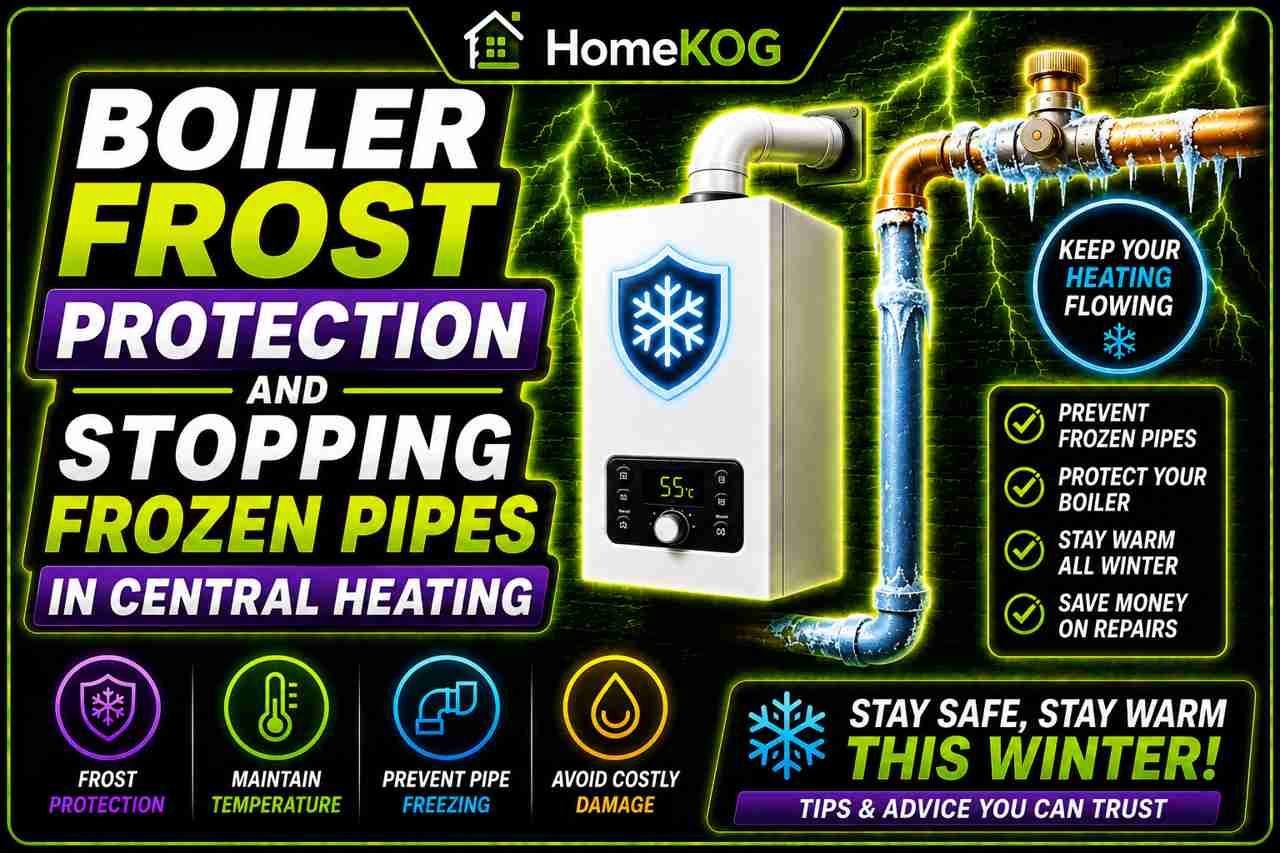

Boiler Frost Protection: Preventing Frozen Pipes in Your Central Heating System
Quick Answer: Boiler frost protection is an automatic safety feature that activates the boiler when internal water temperature drops to around 5°C, preventing pipework and system components from freezing. Most modern boilers have it built in. For older boilers or those installed in unheated spaces, an external frost protection thermostat can be added for around £20 to £30. Insulating exposed pipework and using a smart thermostat provide additional protection.
Cold weather puts central heating systems under more stress than any other season, and frozen pipework is one of the most preventable causes of boiler damage. A pipe that freezes, expands, and cracks can take a working heating system out of action at exactly the moment it’s needed most — and the repair costs that follow are rarely small.
Understanding how frost protection works, what options are available, and what practical steps you can take yourself means you are far less likely to find yourself without heating or hot water during a cold snap.
Key Entity Relationships
- Boiler frost protection is a built-in or external feature that monitors system water temperature and activates the boiler automatically when that temperature approaches freezing point, typically set to trigger at or below 5°C.
- A condensate pipe is the external plastic pipe that carries acidic wastewater away from a condensing boiler, and it is the component most vulnerable to freezing during cold weather because it runs outside the heated envelope of the building.
- A frost protection thermostat is an external device that can be added to any central heating system to provide temperature-activated protection for boilers installed in unheated spaces such as garages, lofts, or outbuildings.
- Pipe lagging (also called pipe insulation) is foam or mineral wool sleeving fitted around exposed pipework to slow heat loss and reduce the risk of freezing in cold conditions.
- A smart thermostat is a programmable heating control device that can monitor environmental conditions and maintain a minimum property temperature, providing a secondary layer of frost protection alongside the boiler’s built-in feature.
- A thermostatic radiator valve (TRV) set to the frost symbol activates the radiator circuit when room temperature drops below approximately 5°C, providing localised frost protection in individual rooms.
- The Boiler Plus scheme is a UK government regulation introduced in 2018 requiring all new boiler installations to include time and temperature controls and achieve a minimum efficiency of 92%, with frost protection features supporting compliance with these standards.
- A combi boiler delivers heating and hot water on demand from the mains and includes frost protection as a standard feature in all current UK models.
- A system boiler works alongside a separate hot water cylinder and includes built-in frost protection in modern models, with the cylinder itself also benefiting from separate insulation.
- Pipe insulation jackets for hot water pipes typically cost between £5 and £7 per metre and are available from most UK builders’ merchants and DIY retailers.
- A heat exchanger within the boiler is activated during frost protection mode to circulate warm water through the pipework, preventing freezing without heating the full system to normal operating temperature.
- Gas Safe registered engineers are the appropriate professionals to consult for external frost thermostat installation, annual boiler servicing, and any repair work resulting from frost damage to the central heating system.

Why Frost Protection Matters for Your Boiler and Central Heating
Water expands when it freezes — by approximately nine percent of its volume. Inside a sealed pipe or boiler component, that expansion has nowhere to go and the pressure it creates is sufficient to crack copper pipes, fracture plastic fittings, and split the condensate pipework that runs outside the building on most modern condensing boilers.
The consequences range from a straightforward condensate pipe blockage that can be cleared without professional help, to a burst pipe that drains the system and floods part of the property before anyone notices. Either way, the boiler is out of action and the repair is expensive relative to the cost of preventing the problem in the first place.
Frost protection does not eliminate cold-weather risk entirely, but it addresses the most common failure mode: unmonitored temperature drop in a system that is either unoccupied, turned off, or installed in a space where ambient temperatures fall well below freezing.
How Boiler Frost Protection Works
Built-in frost protection operates through a temperature sensor that monitors the water temperature within the boiler and primary circuit. When that temperature drops to the activation threshold — typically 5°C — the boiler fires briefly on a low setting to warm the water and restore temperature above the risk point. Once the temperature is safely above the threshold, the boiler returns to standby. The cycle repeats as needed without any input from the homeowner.
The key characteristic of this process is that it is independent of the room thermostat and the timer programme. A boiler set to off, or in a property that is unoccupied for several days, will still activate its frost protection when the internal temperature demands it. This makes it particularly valuable for holiday periods and second properties where the heating would otherwise be left entirely dormant.
The boiler uses only minimal gas during frost protection mode — just enough to maintain the water above freezing — so the impact on energy bills during a cold period is modest compared to the cost of the damage it prevents.
Types of Boiler Frost Protection
Built-In Frost Protection
Built-in frost protection is a standard feature on all current combi, system, and heat-only boilers sold in the UK. It requires no additional equipment and no homeowner intervention — the boiler’s own control board manages the monitoring and activation sequence automatically.
The activation threshold varies slightly between manufacturers and models but is most commonly set at 5°C measured at the boiler’s water temperature sensor. Some models also incorporate an air temperature sensor to provide earlier activation before the water temperature itself reaches the risk point.
Built-in frost protection is effective for the boiler unit and the primary pipework connected to it. It does not, however, protect sections of pipework that are remote from the boiler — particularly the condensate pipe — which is why additional measures are often warranted in older or exposed properties.
External Frost Protection Thermostats
External frost protection thermostats are standalone devices that can be added to any boiler, including older models that predate the widespread inclusion of built-in frost protection. They work by sensing the ambient air temperature in the location where they are fitted and triggering the boiler to run when that temperature drops to a preset level.
They are particularly valuable for boilers installed in unheated spaces. A combi boiler mounted in a garage or a regular boiler in a loft is exposed to much lower ambient temperatures than a unit installed inside a kitchen or utility room, and the built-in temperature sensor may not respond quickly enough to protect the external pipework if the surrounding air is already very cold.
External frost thermostats typically cost between £20 and £30 for the unit itself, with installation by a Gas Safe registered engineer adding a further labour cost. For the protection they provide against a potentially expensive freeze event, they represent sound value.
| Protection Type | Suitable For | Cost | Professional Installation Required? |
|---|---|---|---|
| Built-in frost protection | All modern boilers — standard feature | Included with boiler | No |
| External frost thermostat | Older boilers or boilers in unheated spaces | £20 – £30 plus labour | Recommended |
| TRV frost setting | Individual radiators in specific rooms | No additional cost | No |
| Pipe lagging | Exposed pipework, condensate pipe | £5 – £7 per metre | No |
| Smart thermostat | Whole-property temperature management | £100 – £250 installed | Recommended |
The Condensate Pipe: The Most Vulnerable Point
The condensate pipe is the most commonly frozen component on a modern UK boiler, and it is worth understanding separately from the rest of the system. On a condensing boiler — which includes virtually every boiler installed in the UK since 2005 — a condensate pipe carries acidic wastewater produced during the condensing process from the boiler to an external drain.
Because this pipe exits the building and runs externally before connecting to the drainage system, it is directly exposed to outdoor temperatures. In a hard frost, the condensate water inside the pipe can freeze, causing a blockage that triggers a boiler lockout fault code. The boiler shuts down rather than continue to operate with a blocked condensate outlet.
The fix is usually straightforward — applying warm (not boiling) water to the external section of the pipe will thaw the blockage and allow the boiler to be reset — but it is much better avoided. Insulating the external section of the condensate pipe with lagging designed for outdoor use is the most effective preventive measure and takes very little time to fit.
Where possible, the condensate pipe should be routed internally for as much of its length as practical, with only a short external run to the drain. An engineer fitting a new boiler or carrying out a service can advise on whether the existing routing creates an unnecessary freeze risk.
Practical Steps to Protect Your Central Heating System in Winter
Insulate Exposed Pipework
Any pipework running through unheated spaces — lofts, garages, under suspended timber floors, or along external walls — is at risk during a cold spell. Foam pipe lagging is inexpensive, simple to fit, and available in sizes to suit most common pipe diameters. Paying particular attention to the condensate pipe and any pipes that run close to external walls or through draughty areas will cover the most common freeze points.
Lagging the hot water storage cylinder — if your system includes one — also reduces heat loss from stored hot water, which carries a modest but real benefit to energy efficiency throughout the heating season.
Annual Boiler Servicing
An annual service by a Gas Safe registered engineer addresses the condition of frost protection components alongside the rest of the boiler. The engineer will check that the frost protection function is operational, inspect the condensate pipe routing and condition, and identify any developing issues — such as a deteriorating pump seal or a partially blocked heat exchanger — that could contribute to frost-related problems if left unaddressed.
Regular servicing also keeps the boiler’s warranty valid on most manufacturer terms and maintains peak efficiency, which directly affects running costs throughout the winter.
Smart Thermostat and Minimum Temperature Setting
A smart thermostat provides whole-property temperature management that works alongside the boiler’s built-in frost protection rather than replacing it. By setting a minimum overnight or away temperature — typically 10°C to 12°C is sufficient to keep the building fabric above the risk point — you prevent ambient temperatures inside the property from dropping to levels where even insulated pipework may be at risk.
Smart thermostats from manufacturers such as Nest, Hive, and Honeywell Home can also detect when a property has been unoccupied for longer than expected and adjust the heating schedule accordingly. For homes that are left for extended periods over winter — whether during a holiday or between tenancies — this monitoring capability adds a useful layer of protection that a basic timer cannot provide.
Setting Thermostatic Radiator Valves to the Frost Position
Most thermostatic radiator valves include a frost symbol — typically a snowflake or an asterisk — at the low end of their dial. Setting a valve to this position rather than turning it fully off allows the valve to open if the room temperature drops to around 5°C, which activates heating flow through that radiator. This is a simple and cost-free step that provides localised protection in rooms that would otherwise be left unheated.
It is worth doing this in any room where a radiator is routinely turned off for extended periods, particularly rooms with large single-glazed windows or those adjacent to external walls, where heat loss is greater.
Signs That Pipes or the Condensate May Have Frozen
Recognising the signs of a frost-related problem early limits the extent of any damage. A boiler that displays a fault code and will not restart after a cold night is one of the most immediate indicators — in many cases this points directly to a frozen condensate pipe rather than a more serious internal fault.
Other signs to look for include a complete loss of heating or hot water despite the boiler appearing to power on, audible gurgling or knocking sounds from the pipework, cold spots appearing across multiple radiators simultaneously, or taps delivering little or no water pressure. Ice visible on an external pipe is confirmation rather than a warning sign — if it is visible, the freeze has already occurred.
If you suspect a frozen condensate pipe, apply warm water from a kettle or hot water bottle to the external section of the pipe — never boiling water, which can crack the plastic — and then reset the boiler. If the boiler returns to normal operation, monitor it over the following twenty-four hours. If it locks out again or does not respond to a reset, contact a Gas Safe registered engineer.
Energy Efficiency and Frost Protection
Running in frost protection mode uses a small amount of gas — the boiler fires at a reduced output for short intervals rather than heating the full system to normal temperature — so the impact on energy bills is far lower than running the heating on a standard programme. The cost is modest and predictable, and it is considerably less than the alternative: a repair bill for burst pipework, a replacement heat exchanger, or the call-out costs associated with an emergency boiler breakdown in freezing weather.
All new boilers installed in the UK must comply with the Boiler Plus scheme, which requires time and temperature controls and a minimum efficiency of 92%. Frost protection features are consistent with these requirements and contribute to maintaining efficient operation even during the low-load conditions of standby mode in cold weather.
Choosing a Boiler with Effective Frost Protection
Frost protection is a standard feature on all current boilers sold in the UK, so the presence or absence of the feature itself is not a differentiating factor when choosing a new boiler. What does vary between models is the sophistication of the implementation — whether the boiler uses a water temperature sensor alone, or also incorporates an ambient air temperature sensor for earlier activation, and how well the condensate pipe routing can be managed during installation.
When obtaining quotes for a new boiler, it is worth asking the engineer to assess the condensate pipe routing and confirm that the proposed installation minimises external pipe runs. For properties in exposed locations or those where the boiler is to be installed in a garage, loft, or outbuilding, discussing an external frost thermostat at the same time as the main installation is the most cost-effective approach.
You can verify the Gas Safe registration of any engineer before they start work at gassaferegister.co.uk.
Does a Power Cut Affect Boiler Frost Protection and Increase the Risk of Frozen Pipes?
A power cut can significantly impact boiler operation during power cuts, especially in colder months. Without electricity, most modern boilers cannot function, leaving heating systems inoperative. This can lead to frozen pipes, increasing the risk of burst pipes and costly repairs. Ensuring backup power solutions is essential for frost protection.
FAQ
What is boiler frost protection?
Boiler frost protection is an automatic feature that activates the boiler when the water temperature inside the system drops to a preset threshold — usually around 5°C. The boiler fires briefly on a low setting to warm the water above the freeze point, then returns to standby. This cycle repeats as needed without any input from the homeowner and operates independently of the room thermostat and timer, meaning it functions even when the heating is switched off or the property is unoccupied.
Do all modern boilers have built-in frost protection?
Yes. Built-in frost protection is a standard feature on all combi, system, and heat-only boilers currently sold in the UK. Older boilers — particularly those installed before the mid-2000s — may not include the feature, in which case an external frost protection thermostat can be added to the system for around £20 to £30 plus installation. These external devices work by sensing ambient air temperature and triggering the boiler to run when the surrounding temperature drops to the risk threshold.
How do I protect my condensate pipe from freezing?
Insulating the external section of the condensate pipe with outdoor-grade pipe lagging is the most effective measure. Where possible, the pipe route should be as short as possible outside the building envelope. If the pipe freezes despite insulation, apply warm — not boiling — water to the external section, then reset the boiler. If a freeze occurs repeatedly at the same point, an engineer can assess whether the pipe routing can be improved or whether additional lagging is needed.
Should I leave my heating on overnight in freezing weather?
Leaving the heating on all night at full temperature is not necessary for most properties. A smarter approach is to set a minimum temperature — typically 10°C to 12°C — using a programmable or smart thermostat. This keeps the building fabric and pipework above the risk point without the energy waste of running the full heating programme overnight. The boiler’s built-in frost protection provides a secondary safeguard below that, activating at 5°C if temperatures drop further despite the programmed minimum.
What are the signs of frozen central heating pipes?
The most common signs are a boiler that shows a fault code and will not restart after a cold period, a complete loss of heating or hot water, gurgling or knocking sounds from the pipework, cold spots appearing across multiple radiators at the same time, and taps delivering reduced water pressure. Ice visible on an external condensate or supply pipe confirms that freezing has already occurred. Any of these signs warrant immediate investigation before the boiler is reset, to avoid running a damaged system.
How much does an external frost protection thermostat cost?
An external frost protection thermostat typically costs between £20 and £30 for the device itself. Professional installation by a Gas Safe registered engineer adds a labour cost that will vary with the engineer’s call-out rate and the time required to wire and test the device — budget for £50 to £100 for installation in most cases. For boilers in garages, lofts, or outbuildings where the ambient temperature is not managed by the main heating system, this is a cost-effective investment relative to the damage a freeze event can cause.
Will frost protection increase my energy bills?
The increase is modest. Frost protection mode runs the boiler at a reduced output for short intervals as needed, rather than heating the full system to normal operating temperature. The gas used is a small fraction of what a standard heating programme consumes. Over a typical winter, the additional cost associated with frost protection activations is minimal — certainly far less than the cost of any repair resulting from frozen or burst pipework. For properties left unoccupied during cold periods, it is a prudent and cost-effective safeguard.
Can I set my radiator valves for frost protection?
Yes. Most thermostatic radiator valves include a frost setting, usually marked with a snowflake or asterisk symbol at the low end of the dial. Setting a valve to this position allows the radiator to open if the room temperature drops to around 5°C, activating heating flow through that radiator. This provides localised frost protection in individual rooms and is particularly useful in rooms that are routinely kept unheated or where a radiator valve would otherwise be turned fully off during winter.
Conclusion
Boiler frost protection is one of those features that works quietly in the background and is only noticed when it is absent. A heating system that loses a key component to frost damage — whether a cracked condensate pipe, a split supply pipe, or a seized pump — is typically out of action for at least a day and often longer, and the repair costs are rarely trivial.
The combination of built-in boiler frost protection, insulated pipework, correctly set thermostatic radiator valves, and a programmed minimum temperature covers the vast majority of freeze risk for most UK properties. For boilers in exposed or unheated locations, adding an external frost thermostat closes the remaining gap for a very modest outlay.
An annual service by a Gas Safe registered engineer provides the best opportunity to check that frost protection features are functioning correctly and that condensate pipe routing does not create an unnecessary risk — both of which are worth confirming before the temperature drops.