
Vaillant F84 Fault Code: Meaning, Causes & How to Fix It
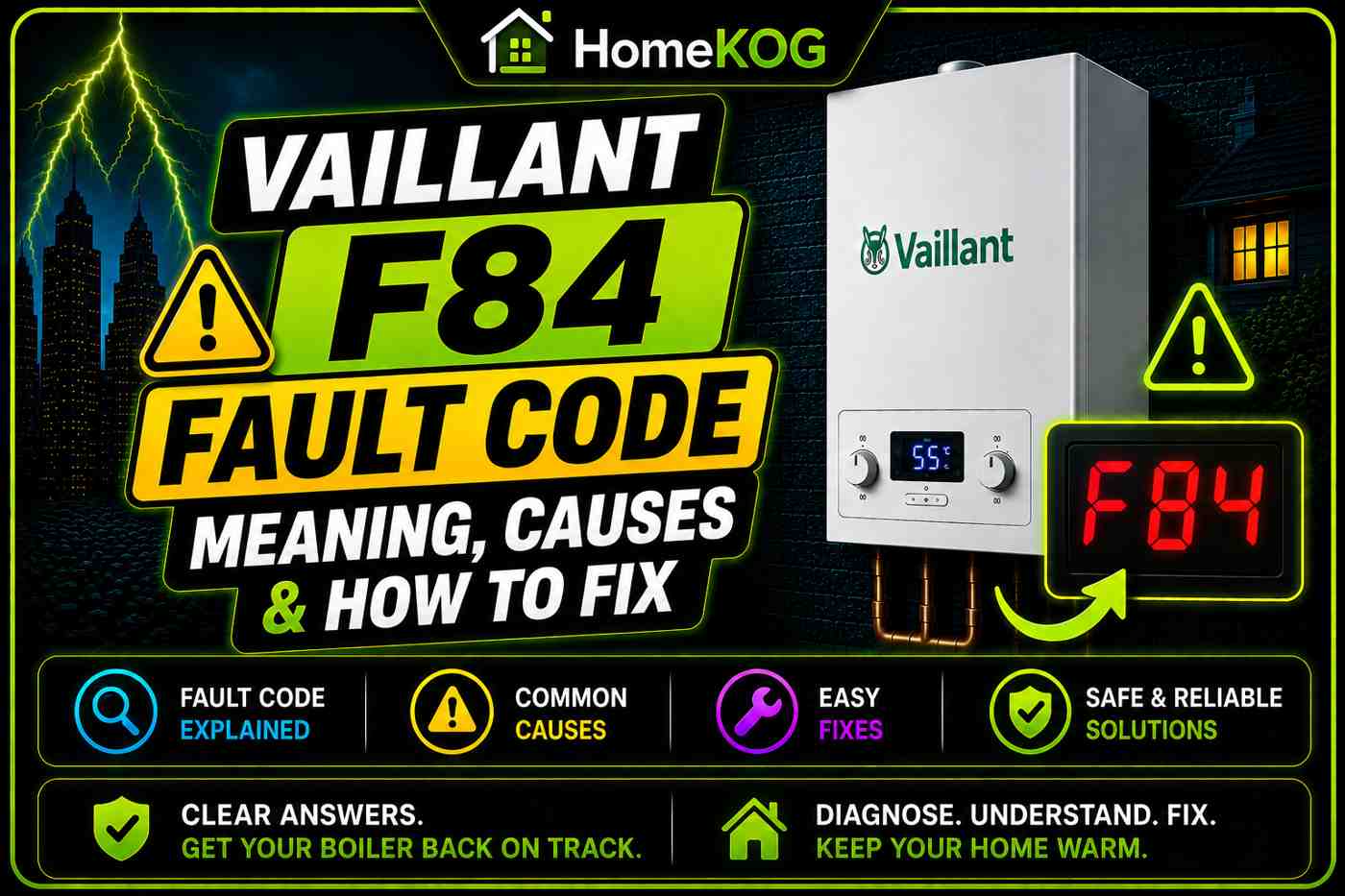
Quick Answer: The Vaillant F84 fault code indicates the boiler has detected a permanent temperature difference between the flow and return pipe thermistors that falls outside acceptable parameters. It appears on Vaillant ecoTEC Plus models and is typically caused by faulty or incorrectly installed NTC thermistors, damaged wiring, a heat exchanger leak, or a PCB fault. The F84 code cannot be resolved by the homeowner and requires a Gas Safe registered engineer. When considering repairs or replacements for a Vaillant boiler, it is essential to look into vaillant boiler price comparisons to ensure you are making an informed decision. Various retailers offer different pricing and service packages, which can significantly impact your overall costs. Additionally, keeping an eye out for seasonal promotions and warranty options can further enhance your value when investing in a new unit.
The F84 code is one of the more technically specific fault codes on a Vaillant ecoTEC Plus boiler, and unlike pressure-related faults it cannot be partially addressed by homeowner checks. The fault points directly at the temperature monitoring system within the boiler, and the components involved — thermistors, wiring, the PCB, and potentially the heat exchanger — require professional assessment to diagnose correctly. Understanding what the boiler is reporting and what causes it helps you have a more informed conversation with your engineer and set realistic expectations about the repair. Another fault code that can arise in this context is the glow worm f9 fault code explanation, which indicates a malfunction in the ignition system or an issue with the gas supply. Similar to the F84 code, this fault requires a thorough evaluation by a qualified technician to pinpoint the underlying issue. Addressing these codes promptly ensures the boiler operates efficiently and extends its lifespan.
Vaillant F84 Fault Code: Key Entity Relationships
- The Vaillant F84 fault code is a thermistor differential error displayed on Vaillant ecoTEC Plus boilers when the appliance detects a permanent and uncorrected temperature difference between the flow and return NTC thermistors that falls outside the acceptable operating range.
- An NTC thermistor is a negative temperature coefficient resistor used in Vaillant ecoTEC Plus boilers to monitor water temperature in the flow and return pipes, producing resistance readings measured in Ohms that the PCB uses to regulate boiler operation.
- The flow thermistor is the temperature sensor in a Vaillant ecoTEC Plus boiler that monitors the temperature of water leaving the heat exchanger and entering the central heating circuit, with the PCB using this data to control gas valve operation and prevent overheating.
- The return thermistor is the temperature sensor that monitors the temperature of water returning from the central heating circuit to the Vaillant ecoTEC Plus heat exchanger, with a lower reading than the flow thermistor expected under normal operating conditions due to heat absorbed by radiators and pipework.
- The printed circuit board is the control component of the Vaillant ecoTEC Plus boiler that receives resistance data from both NTC thermistors, compares the flow and return temperature readings, and initiates the F84 lockout when the differential remains outside acceptable parameters.
- Incorrect thermistor installation is a cause of the F84 fault code when thermistors are positioned improperly within the pipework or were not correctly calibrated at the point of manufacture or installation, producing inaccurate resistance readings that the PCB interprets as an abnormal temperature differential.
- Vibration-induced wiring damage is a cause of the F84 fault on Vaillant ecoTEC Plus boilers where the movement generated by the boiler’s fan and pump over time progressively loosens thermistor connections to the PCB, producing intermittent or incorrect temperature signals.
- A heat exchanger leak is a significant cause of F84 when limescale accumulation causes cracking or failure of the primary heat exchanger, allowing water to contact thermistors and PCB components and producing inaccurate resistance readings that trigger the temperature differential fault.
- Limescale build-up is a condition in which calcium carbonate deposits accumulate within the Vaillant ecoTEC Plus heat exchanger, restricting heat transfer efficiency and in severe cases causing physical damage that leads to internal leaks and secondary F84-triggering thermistor faults.
- Water damage to the PCB is a consequence of an internal boiler leak that can cause the printed circuit board to produce erroneous temperature readings or fail to process thermistor data correctly, triggering the F84 code independently of any thermistor fault.
- A Gas Safe registered engineer is the legally required professional for all diagnostic work and repairs related to the Vaillant F84 fault, including thermistor testing and replacement, wiring inspection, PCB assessment, and heat exchanger evaluation.
- Annual Vaillant boiler servicing by a Gas Safe registered engineer reduces the likelihood of F84 fault appearances by identifying early-stage thermistor degradation, wiring deterioration, and developing heat exchanger limescale before they produce a measurable temperature differential fault.

What Does the Vaillant F84 Fault Code Mean?
The F84 code tells you that the Vaillant ecoTEC Plus boiler has detected a permanent, uncorrected difference between the temperatures reported by the flow NTC thermistor and the return NTC thermistor. In a correctly functioning boiler, a temperature difference between flow and return is entirely normal and expected — water leaving the heat exchanger is hotter than water returning from the radiators because the heating circuit has absorbed that heat. The F84 fault is not triggered by the presence of a differential, but by a differential that is incorrect, persistent, and cannot be reconciled by the boiler’s control system.
When the PCB detects that the thermistor readings do not correspond to what normal operation would produce — whether because one sensor is reading inaccurately, the wiring is sending intermittent or corrupted data, or actual heat transfer in the system is genuinely abnormal — it logs the F84 code and locks out the boiler as a precaution.
Unlike some Vaillant fault codes that can be partially investigated by a homeowner, the F84 requires professional diagnostic equipment to assess properly. The thermistors themselves measure resistance in Ohms rather than temperature directly, and at 20°C a correctly functioning thermistor should produce a reading of approximately 12k Ohms. Verifying this requires a multimeter and knowledge of the correct resistance values for the specific boiler model — not something a homeowner can reliably assess without training.
Common Causes of the Vaillant F84 Fault Code
Faulty or Incorrectly Installed NTC Thermistors
The most straightforward cause of F84 is a thermistor that has developed a fault or was not installed correctly in the first place. A thermistor that has drifted out of calibration — whether through age, exposure to moisture, or physical damage — will produce resistance readings that do not accurately reflect the actual water temperature at its measurement point. The PCB receives this inaccurate data, compares it against the other thermistor’s reading, identifies the resulting differential as abnormal, and triggers the F84 lockout.
Incorrect installation — where a thermistor has not been properly seated within the pipework, or where a replacement thermistor was not the correct specification for the model — produces the same effect. A Gas Safe engineer will test both thermistors with a multimeter to confirm whether their resistance readings fall within the expected range, and replace any thermistor found to be outside specification. Replacement thermistors are relatively inexpensive components, but the work requires professional assessment to confirm that the thermistor rather than the wiring or PCB is the root cause.
Damaged or Loose Wiring Connections
The thermistors communicate their resistance readings to the PCB through wiring connections that run through the boiler’s internal structure. Over time, the vibrations generated by the boiler’s moving parts — primarily the fan and the pump — can progressively loosen these connections, causing the signals sent to the PCB to become intermittent or unreliable.
A loose or damaged connection does not always cause a complete loss of signal. More often it produces an irregular or corrupted reading that the PCB cannot reconcile with the data from the other thermistor, triggering the F84 code on an intermittent basis before eventually causing a persistent lockout. The intermittent nature of vibration-induced wiring faults makes them harder to diagnose on a single visit, as the fault may not be reproducible at the time of the engineer’s inspection.
Wiring faults caused by general age and wear follow a similar pattern. An engineer will physically check all thermistor wiring connections, inspect the cable runs for signs of chafing, corrosion, or damage, and test the continuity and quality of the signal between each thermistor and the PCB.
Heat Exchanger Leak
A leaking heat exchanger is the most serious potential cause of F84 and the one most likely to lead to a conversation about boiler replacement rather than repair. The primary heat exchanger is the component through which combustion gases transfer their heat into the central heating water. Limescale accumulation within the exchanger — particularly in hard water areas or systems without adequate inhibitor treatment — can eventually cause cracking or failure of the exchanger casing.
When the heat exchanger cracks, water escapes internally and can reach both the thermistors and the PCB. Water contact with a thermistor distorts its resistance readings, producing the temperature differential that triggers F84. Water contact with the PCB creates electrical faults that can compound the problem further, potentially damaging the control board in addition to the temperature sensors.
If water is visible beneath the boiler, or if the pressure gauge has been dropping unexpectedly prior to the F84 fault appearing, an internal leak should be considered the probable cause. Repressurising the system or bleeding radiators will not clear an F84 fault caused by internal water damage — the damaged components themselves need to be assessed and replaced.
PCB Fault
In cases where thermistor testing and wiring inspection reveal no fault, the PCB may itself be the source of the problem. The control board receives and processes the thermistor data, and a board that has developed an electrical fault in its temperature monitoring circuit may produce or interpret readings incorrectly, triggering F84 despite the thermistors and wiring being in good condition.
PCB faults are more common on older boilers and on appliances that have been exposed to internal moisture from leaks. A Gas Safe engineer will assess the PCB as part of the overall F84 diagnosis, particularly if other components have already been tested and found to be functioning correctly.
PCB replacement is the most expensive single repair associated with the F84 fault code, with replacement costs typically running to several hundred pounds including parts and labour. On an older Vaillant ecoTEC Plus boiler, a PCB failure alongside any evidence of heat exchanger damage makes a new boiler installation a financially rational alternative worth considering seriously.
Can the Vaillant F84 Fault Be Fixed by the Homeowner?
The F84 fault code cannot be diagnosed or resolved by the homeowner. The only check a homeowner can safely carry out is a visual inspection for signs of water beneath or around the boiler, which may indicate an internal leak contributing to the fault. If water is visible, turning the boiler off reduces the risk of further water damage to electrical components while an engineer is awaited.
Repeatedly resetting the boiler to clear the F84 code without identifying and addressing the underlying cause is counterproductive. If the fault is caused by water damage from a heat exchanger leak, continued operation accelerates damage to the thermistors and PCB. A Gas Safe engineer should be contacted as soon as the F84 code appears and should be the person who resets the boiler after completing the repair.
How Much Does It Cost to Repair a Vaillant F84 Fault?
Where the fault is caused by thermistor replacement and wiring repair alone, the parts are relatively inexpensive and the total repair cost including labour is typically in the region of £220. This represents one of the more affordable F84 outcomes and is a repair worth proceeding with on most boilers regardless of age.
Where a heat exchanger leak or PCB fault is involved, repair costs increase significantly. A heat exchanger replacement is one of the most expensive single boiler repairs, and combined with PCB or thermistor costs on an older appliance the cumulative figure can approach or exceed the installed cost of a new boiler. A Gas Safe engineer’s assessment and repair estimate gives you the information needed to make a properly informed decision between repair and replacement.
FAQ: Vaillant F84 Fault Code
What does the Vaillant F84 fault code mean?
The Vaillant F84 fault code indicates the boiler has detected a permanent, uncorrected temperature difference between the flow and return NTC thermistors on a Vaillant ecoTEC Plus boiler. The PCB compares the resistance readings from both thermistors during operation and triggers the F84 lockout when those readings produce a differential that cannot be reconciled with normal operating conditions. Causes include faulty or incorrectly installed thermistors, damaged wiring connections, a heat exchanger leak allowing water to damage sensors, and PCB faults affecting the temperature monitoring circuit. To address the F83 Vaillant boiler fault code solutions, it is essential to follow a systematic troubleshooting process. Start by checking the NTC thermistors for proper resistance and ensure all wiring connections are secure. If issues persist after these checks, it may be necessary to evaluate the PCB and heat exchanger for any potential faults that could contribute to operational discrepancies.
Can I fix the Vaillant F84 fault code myself?
No. The F84 fault code cannot be diagnosed or resolved without professional diagnostic equipment and Gas Safe registration. A Gas Safe engineer uses a multimeter to test thermistor resistance readings, checks wiring continuity and connection quality, assesses the PCB, and inspects the heat exchanger for leaks. A homeowner can safely check for visible water beneath the boiler as an indication of an internal leak and should turn the boiler off if water is present, but no further investigation or reset should be attempted without an engineer.
What are NTC thermistors in a Vaillant boiler?
NTC thermistors are negative temperature coefficient resistors used in Vaillant ecoTEC Plus boilers to monitor water temperature in the flow and return pipes. Rather than measuring temperature directly, they produce resistance readings in Ohms that change in proportion to temperature — at 20°C a correctly functioning thermistor should read approximately 12k Ohms. The PCB uses these resistance values to regulate gas valve operation, monitor heat transfer efficiency, and detect abnormal temperature differentials that indicate a system fault requiring lockout.
What causes the Vaillant F84 fault on an ecoTEC Plus boiler?
The most common causes are faulty or incorrectly calibrated NTC thermistors producing inaccurate resistance readings, loose or damaged wiring connections between the thermistors and the PCB caused by age and boiler vibration, a heat exchanger leak allowing water to contact thermistors and PCB components, and in less common cases a PCB fault affecting the temperature monitoring circuit itself. Limescale accumulation in the heat exchanger is a contributing factor in hard water areas, as it can cause physical damage leading to the internal leaks that trigger secondary thermistor and PCB faults.
How much does it cost to repair a Vaillant F84 fault?
Where the fault is limited to thermistor replacement and wiring repair, costs are relatively modest with total repair costs including labour typically around £220. Where a heat exchanger leak or PCB fault is involved, repair costs increase substantially and may prompt a serious comparison between repair and replacement, particularly on older Vaillant ecoTEC Plus boilers. A Gas Safe engineer’s diagnostic visit and repair estimate gives the clearest picture of actual costs before any commitment to proceed is required.
Should I keep resetting my Vaillant boiler to clear the F84 code?
No. Repeatedly resetting the boiler to clear the F84 code without identifying and resolving the underlying cause risks further damage, particularly if an internal water leak is contributing to the fault. Continued operation with an active heat exchanger leak accelerates water damage to thermistors and PCB components, increasing both the severity and the cost of the eventual repair. The boiler should be turned off and a Gas Safe engineer contacted promptly. The engineer will reset the boiler after completing the repair to confirm the fault has cleared.
Does the F84 fault code mean my Vaillant boiler needs replacing?
Not necessarily. Where the cause is a thermistor replacement and wiring repair, the fault is straightforward and cost-effective to resolve on most boilers regardless of age. Replacement becomes the more appropriate consideration when the fault is caused by a heat exchanger failure or PCB damage on a boiler that is over 10 years old, particularly if other fault codes have been appearing and repair costs are accumulating. An older ecoTEC Plus boiler exhibiting multiple faults including F84 is likely approaching the end of its practical service life, and a Gas Safe engineer’s honest assessment of the boiler’s overall condition is the most reliable guide to the right decision.
How can I prevent the Vaillant F84 fault code from recurring?
Annual servicing by a Gas Safe registered engineer is the most effective preventive measure. A Vaillant service includes inspection of the thermistors and their wiring connections, assessment of the heat exchanger for developing limescale and early-stage cracking, and a check of PCB connections and condition. Using central heating inhibitor annually protects the heat exchanger from the limescale accumulation that leads to cracking and internal leaks — the most serious cause of F84. Addressing any pressure loss or water leak promptly prevents moisture from reaching thermistors and PCB components before significant damage occurs.
Conclusion
The Vaillant F84 fault code is a precise diagnostic indicator that the temperature monitoring system within the ecoTEC Plus boiler is not receiving or producing consistent data from its flow and return thermistors. It is not a fault the homeowner can resolve, but understanding its causes helps set realistic expectations about what the repair involves and what it is likely to cost. Similarly, the vaillant f22 fault code explanations can provide insight into other issues that may arise with the ecoTEC Plus boiler. Homeowners should familiarize themselves with these codes to better understand the functionality of their heating system and prepare for any necessary maintenance or repairs. By knowing what to expect, they can make informed decisions when discussing options with professionals.
For thermistor and wiring faults, the repair is straightforward and relatively affordable, making it the right course of action on most boilers. For heat exchanger leaks and PCB faults, the cost and complexity increase, and the age of the boiler becomes a relevant factor in deciding whether repair or replacement makes better long-term financial sense. When considering the age and condition of a boiler, it is also important to evaluate system boiler installation costs, which can vary significantly depending on the brand and complexity of the system. In some cases, investing in a new system may be more beneficial in the long term, especially if the installation leads to greater energy efficiency. Homeowners should weigh these installation costs against potential savings on energy bills and repairs to make an informed decision.
Annual servicing and consistent inhibitor treatment are the most effective steps for preventing the thermistor degradation, wiring deterioration, and heat exchanger damage that make F84 more likely. A Gas Safe engineer who inspects the system once a year will identify these developing conditions well before they produce a fault code lockout.