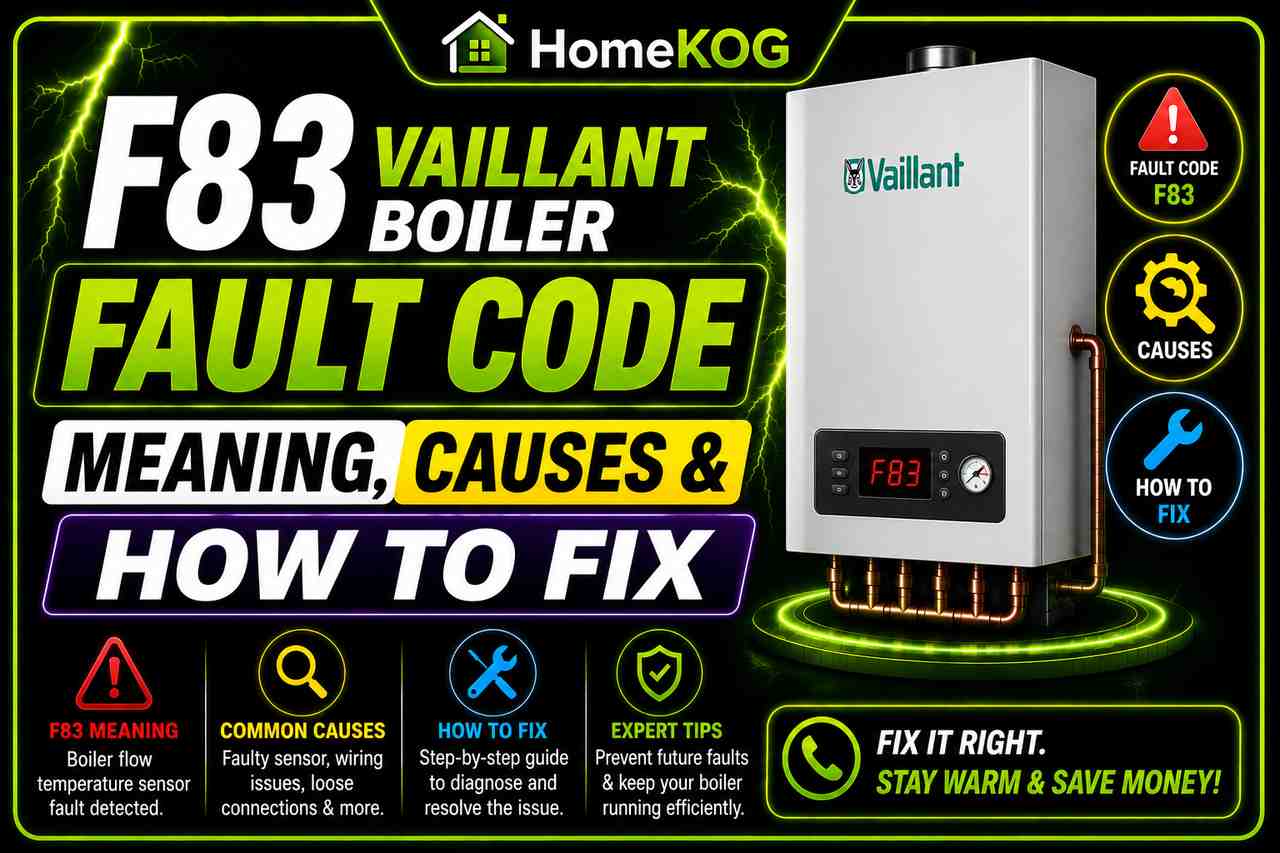

Vaillant F83 Fault Code: Meaning, Causes & How to Fix It
Quick Answer: The Vaillant F83 fault code indicates the boiler has detected insufficient temperature rise in the return pipe after the burner fires. It appears on Vaillant ecoTEC Plus models and is typically caused by low system pressure, a faulty return temperature sensor, incorrect thermistor wiring, a defective gas valve, or a heat exchanger problem. Some causes can be addressed by the homeowner, but most require a Gas Safe registered engineer. In addition to the F83 fault code, homeowners might encounter the F62 fault code causes explained. This issue can signify problems such as a malfunctioning control board or issues with the ignition system, which can disrupt the boiler’s operation. To prevent further complications, it’s advisable to consult a qualified technician for accurate diagnostics and repairs.
The F83 code is one of the more specific fault codes that a Vaillant ecoTEC Plus boiler can display, and while it sounds technical, the underlying causes cover a relatively contained set of components. Understanding what the boiler is telling you with this code — and which checks are safe to carry out before calling an engineer — can save both time and money in getting your heating restored. Another fault code that often generates concern is the F84, which can indicate issues related to water pressure or a fault in the heating circuit. Familiarizing yourself with vaillant f84 fault code solutions can empower you to troubleshoot minor problems before seeking professional help. By addressing these errors promptly, you can ensure your boiler runs efficiently and safely.
Vaillant F83 Fault Code: Key Entity Relationships
- The Vaillant F83 fault code is a temperature differential error displayed on Vaillant ecoTEC Plus boilers when the appliance detects that the return pipe temperature has not risen sufficiently after the burner has been lit.
- The return temperature sensor is a thermistor component within the Vaillant ecoTEC Plus boiler that monitors the temperature of water returning from the central heating circuit and reports that data to the printed circuit board to confirm normal heat transfer is occurring.
- A thermistor is a temperature-sensing resistor used in Vaillant boilers to measure flow and return water temperatures, with an incorrectly calibrated, damaged, or poorly positioned thermistor producing inaccurate readings that trigger the F83 fault code.
- Low boiler pressure is a system condition in which the water pressure within the sealed central heating circuit drops below the operational minimum, reducing water flow through the heat exchanger and causing the temperature differential detected by the F83 code.
- The Vaillant ecoTEC Plus is a range of condensing combi and system boilers manufactured by Vaillant on which the F83 fault code is specifically used to indicate return temperature sensor or heat transfer anomalies.
- The printed circuit board is the control component of the Vaillant ecoTEC Plus boiler that processes temperature data from the flow and return thermistors and initiates the F83 lockout when the temperature differential falls outside acceptable parameters.
- A faulty gas valve is a potential cause of the F83 fault code when incorrect adjustment or mechanical failure prevents adequate gas flow to the burner, reducing heat output to a level insufficient to produce the expected temperature rise in the return circuit.
- A heat exchanger is the primary boiler component responsible for transferring combustion heat into the central heating water, and a damaged or scaled heat exchanger that restricts heat transfer can cause the insufficient temperature rise that triggers the F83 error.
- The Vaillant F22 fault code is a related low pressure error displayed on Vaillant ecoTEC Plus boilers when water pressure drops below the minimum operational threshold, often appearing alongside or preceding an F83 fault caused by pressure-related heat transfer issues.
- A filling loop is the pressurisation assembly fitted beneath Vaillant ecoTEC Plus boilers — consisting of a flexible silver pipe and two small taps — through which the homeowner can restore correct system pressure when the F22 or pressure-related F83 fault appears.
- A Gas Safe registered engineer is the legally required professional for any internal Vaillant boiler inspection or repair work related to the F83 fault, including thermistor replacement, PCB wiring assessment, gas valve adjustment, and heat exchanger diagnosis.
- Annual Vaillant boiler servicing by a Gas Safe registered engineer reduces the likelihood of F83 fault appearances by identifying thermistor degradation, wiring deterioration, and developing heat exchanger scale before they cause a measurable temperature differential fault.

What Does the Vaillant F83 Fault Code Mean?
The F83 fault code tells you that the Vaillant ecoTEC Plus boiler has lit the burner but the return temperature sensor has not detected the expected rise in water temperature within the return pipe. In a correctly functioning boiler, water leaving the heat exchanger and returning from the heating circuit should show a predictable temperature increase after the burner fires. When that increase is absent or falls below the threshold the boiler expects, it logs the F83 code and locks out as a precaution.
The fault is specific to the Vaillant ecoTEC Plus range and relates directly to the temperature monitoring system within those boilers. It does not necessarily mean a major component has failed — in some cases, the cause is as straightforward as low system pressure reducing water flow through the heat exchanger. In others, a sensor or wiring issue is producing an inaccurate reading rather than a genuine heat transfer problem. A Gas Safe registered engineer with Vaillant experience is best placed to distinguish between the two. When considering options for repairs or replacements, obtaining vaillant boiler price comparisons can help homeowners make informed decisions about their next steps. This process allows for a clear understanding of the associated costs, ensuring that any necessary repairs are both affordable and effective. Furthermore, exploring different models may reveal features that enhance efficiency or improve overall performance, ultimately benefiting the household.
Common Causes of the Vaillant F83 Fault Code
Low System Pressure
Low boiler pressure is one of the most accessible causes of the F83 code to check and, where it applies, to fix without professional help. When system pressure drops, water flow through the heat exchanger reduces and heat transfer becomes less effective — producing exactly the kind of insufficient temperature rise that triggers the F83 fault.
Check the pressure gauge on the boiler display or the physical dial. A correctly pressurised Vaillant ecoTEC Plus should read between 1 and 1.5 bar when the system is cold. If the reading is below 1 bar, repressurising the system using the filling loop is the first step. On all ecoTEC Plus models, the filling loop consists of two small taps located beneath the boiler. Open both taps until the pressure gauge reads 1.5 bar, then close both taps fully and reset the boiler.
If the F83 code was caused solely by low pressure, repressurisation should resolve it. If the pressure drops again quickly after topping up, a slow leak somewhere in the system is the underlying cause and a Gas Safe engineer should be asked to locate and repair it. The Vaillant F22 code — the dedicated low pressure alert — may appear alongside or instead of F83 when pressure is the primary issue. Fixing the Vaillant F22 fault code solutions often involves checking for leaks and ensuring that the system is properly filled with water. If the problem persists, examining components like the pressure relief valve and expansion vessel may lead to a resolution. Regular maintenance can help prevent these faults from occurring in the future.
Faulty or Incorrectly Positioned Return Temperature Sensor
The return temperature sensor — a thermistor — sits within the return pipework and relays temperature data to the boiler’s printed circuit board. If the thermistor has drifted out of calibration, has been incorrectly positioned within the pipe, or has developed a fault in its wiring, it will report an inaccurate temperature reading to the PCB. The board interprets this inaccurate data as an insufficient temperature rise and triggers the F83 code, even if the boiler is actually transferring heat normally.
Loose or damaged wiring between the thermistor and the PCB produces the same effect. A Gas Safe engineer will inspect the sensor and its wiring for signs of corrosion, physical damage, loose connections, and incorrect positioning as part of an F83 diagnosis. Replacement thermistors are relatively inexpensive components, and the repair cost is predominantly labour rather than parts.
Faulty or Incorrectly Adjusted Gas Valve
The gas valve controls the flow of gas to the burner, and both mechanical faults and incorrect calibration can reduce the volume of gas reaching the combustion chamber. If insufficient gas is being burned, the heat output falls below what is needed to produce the expected temperature rise in the return circuit, which the thermistor reports to the PCB as an F83 condition.
A gas valve that is stuck, worn, or incorrectly adjusted cannot be assessed or corrected by a homeowner — this is work that must be carried out by a Gas Safe registered engineer. A valve that has been incorrectly calibrated may be adjustable without replacement, but a mechanically faulty valve will need to be replaced. Gas valve replacement on a Vaillant boiler is a moderately involved repair that a qualified engineer will complete as part of a diagnostic visit.
Heat Exchanger Problems
The heat exchanger is the component responsible for transferring heat from the burner’s combustion gases into the central heating water. Scale build-up, internal corrosion, or physical damage to the heat exchanger reduces its ability to transfer heat effectively, which produces the low temperature differential that the F83 code reports.
A scaled or degraded heat exchanger is more commonly found on older boilers or on systems that have not had adequate inhibitor treatment to prevent corrosion and limescale accumulation. In some cases, a power flush of the system can address scale-related heat transfer restrictions. In more serious cases where the heat exchanger itself is damaged, replacement of the component is required — a significant repair cost that may make a full boiler replacement the more financially sensible option on an older appliance. Understanding the system boiler operational principles is essential for maintaining efficiency and prolonging the lifespan of the unit. Regular maintenance, including checks on the heat exchanger and proper inhibitor treatments, can help prevent common issues that arise from neglect. Additionally, familiarity with these principles enables homeowners to identify when professional intervention is necessary, ensuring that their heating system remains reliable year-round.
If the heat exchanger fault is caused by an internal water leak within the boiler, the source of that leak must be identified and resolved at the same time to prevent ongoing damage.
How to Reset a Vaillant Boiler After an F83 Code
A boiler reset should only be attempted once the underlying cause of the F83 fault has been identified and addressed. Resetting without resolving the cause will result in the code returning, sometimes immediately. In addition to the F83 fault, understanding the ideal f1 fault code explained can help in troubleshooting other potential issues. Being aware of common symptoms and solutions related to each fault code ensures more effective repairs. It’s important to consult the manufacturer’s guidelines for specific diagnostics and reset procedures.
Where low pressure was identified as the cause, repressurising the system using the filling loop as described above is the corrective action. Once the pressure is restored to 1.5 bar and both filling loop taps are closed, the boiler can be reset. On Vaillant ecoTEC Plus models, the reset function is accessed through the boiler’s control panel — consult the boiler manual for the specific reset procedure on your model if the button location is not immediately apparent.
Where a component fault was the cause, a Gas Safe engineer will reset the boiler after completing the repair to confirm the fault code has cleared and the boiler is operating normally.
How Much Does It Cost to Fix a Vaillant F83 Fault?
Repair costs for an F83 fault vary depending on which component is responsible. Thermistor and wiring repairs are among the less expensive options, as the parts themselves are relatively affordable and the repair is straightforward for an experienced Vaillant engineer. Gas valve adjustment or replacement and heat exchanger diagnosis and repair represent higher-cost repairs, with the overall bill dependent on whether adjustment or full component replacement is required.
Where the fault is caused by an internal boiler leak leading to heat exchanger damage, the repair cost can approach or exceed the value of the boiler on older appliances, at which point a new installation may represent better long-term value. A Gas Safe engineer’s diagnostic visit will clarify the extent of the problem and give you a clear repair estimate to compare against replacement costs.
FAQ: Vaillant F83 Fault Code
What does the Vaillant F83 fault code mean?
The Vaillant F83 fault code indicates that the boiler has detected an insufficient temperature rise in the return pipe after the burner has fired. It appears specifically on Vaillant ecoTEC Plus models and is the boiler’s way of reporting that heat transfer between the burner and the central heating water is not occurring as expected. Causes range from low system pressure and a faulty return temperature sensor through to gas valve issues and heat exchanger problems, with some causes addressable by the homeowner and others requiring a Gas Safe engineer. to troubleshoot the f20 vaillant fault code explained, users should first check the system pressure and ensure that the return temperature sensor is functioning correctly. If these components are in good condition, it may be necessary to consult a qualified technician to inspect the gas valve and heat exchanger. Addressing these issues promptly can help restore optimal boiler performance and efficiency.
Can I fix the Vaillant F83 fault code myself?
The only element of the F83 fault a homeowner should attempt to resolve independently is low system pressure. If the pressure gauge reads below 1 bar, repressurising the system via the filling loop to reach 1.5 bar is safe and straightforward. If the code persists after repressurisation, or if pressure was not the cause, all further diagnostic work and repairs — including thermistor replacement, wiring inspection, gas valve assessment, and heat exchanger diagnosis — must be carried out by a Gas Safe registered engineer.
What is the return temperature sensor on a Vaillant boiler?
The return temperature sensor is a thermistor fitted within the return pipework of the Vaillant ecoTEC Plus boiler. It continuously monitors the temperature of water returning from the central heating circuit and reports that data to the boiler’s printed circuit board. The PCB uses this information to confirm that heat transfer is occurring correctly. A thermistor that is incorrectly positioned, out of calibration, or connected via damaged wiring will send inaccurate temperature data to the PCB, which interprets the reading as an F83 temperature differential fault even if the boiler’s combustion is operating normally.
How do I repressurise my Vaillant ecoTEC Plus after an F83 fault?
Locate the two small taps beneath the boiler that form the built-in filling loop. Open both taps simultaneously and monitor the pressure gauge until it reads 1.5 bar. Close both taps fully once the target pressure is reached, ensuring neither tap is left partially open. Reset the boiler using the control panel reset function. If the boiler fires and operates normally without the F83 code returning, low pressure was the cause. If pressure drops again within a short period, a system leak requires professional investigation.
Does the F83 fault code mean my Vaillant boiler is broken?
Not necessarily. The F83 code indicates a temperature differential issue that can have several causes of varying severity. Low pressure and thermistor wiring faults are relatively minor issues. A gas valve problem or heat exchanger fault is more significant but still repairable in most cases. The code only points toward a potential boiler replacement when the underlying cause involves serious internal damage — particularly a heat exchanger failure caused by a persistent internal leak — on a boiler that is already several years old and accumulating repair costs.
How much does it cost to repair a Vaillant F83 fault?
Repair costs depend on the cause identified during the engineer’s diagnostic visit. Thermistor replacement and wiring repairs are at the lower end of the cost range, as the parts are inexpensive and the work is straightforward. Gas valve adjustment or replacement and heat exchanger repair represent higher costs. A Gas Safe engineer who has diagnosed the fault will provide a specific repair estimate before any work proceeds, allowing you to make an informed decision about repair versus replacement if the boiler is older or the repair cost is significant.
How can I prevent the Vaillant F83 fault code from recurring?
Annual servicing by a Gas Safe registered engineer is the most effective preventive measure. A Vaillant service includes inspection of the thermistors, wiring connections, gas valve, and heat exchanger — the components most commonly responsible for F83 faults — allowing the engineer to identify early-stage deterioration before it causes a fault code lockout. Maintaining adequate system pressure, using central heating inhibitor to protect the heat exchanger from scale and corrosion, and addressing any developing leaks promptly all reduce the likelihood of F83 recurring between service visits. In addition to F83, homeowners should also be aware of the F32 Vaillant fault code explanation, which indicates an issue with the boiler’s flow temperature sensor. Regular diagnostic checks can help prevent any interruptions in service due to this fault. Understanding these codes allows for proactive measures to ensure the heating system remains efficient and reliable.
Is the F83 fault code the same across all Vaillant boilers?
The F83 fault code is associated specifically with Vaillant ecoTEC Plus models. Other boilers in the Vaillant range use different fault code structures, and the same number may carry a different meaning on a different Vaillant model. Always confirm that the fault code you are researching corresponds to the specific Vaillant model installed in your property. The boiler’s model number is typically displayed on a label inside the front panel or on the casing beneath the display screen. Understanding the vaillant f61 fault code overview is crucial for diagnosing issues that may arise. This specific fault code may indicate various problems depending on the model and its configuration, so it’s important to refer to the manufacturer’s documentation for accurate interpretation. Additionally, reaching out to a certified technician can provide further insights into resolving any boiler issues effectively.
Conclusion
The Vaillant F83 fault code is a meaningful diagnostic signal rather than an automatic indication of serious boiler failure. In many cases the cause is low system pressure — something a homeowner can identify and correct in a few minutes using the built-in filling loop. Where pressure is not the issue, the fault points to a thermistor, wiring, gas valve, or heat exchanger problem that a Gas Safe registered engineer is equipped to diagnose and resolve in a single visit. For those experiencing similar issues with their system, exploring common vaillant f76 fault code solutions can be helpful. Identifying whether the fault stems from system pressure, a faulty component, or another underlying issue is crucial in determining the necessary steps to restore proper functionality. Addressing these faults promptly can prevent further complications and ensure efficient operation of the heating system. The Vaillant F75 fault code explanation typically indicates a different issue, often related to flow or temperature discrepancies within the system. Addressing this fault may require inspecting the boiler’s circulation pump or checking for blockages in the system. Homeowners should consider contacting a qualified technician if the problem persists after simple troubleshooting steps.
Acting on the F83 code promptly matters. Leaving a temperature differential fault unaddressed can allow a developing heat exchanger or gas valve problem to worsen, increasing both the repair cost and the risk of further component damage. Annual servicing remains the most reliable way to prevent the conditions that cause F83 from developing in the first place, keeping the ecoTEC Plus operating efficiently and reliably throughout the heating season.