
Boiler PCB Faults: Diagnosing and Fixing a Faulty Printed Circuit Board 2026
Quick Answer: A boiler PCB (printed circuit board) is the central control unit that manages all boiler components — ignition, gas valve, fan, pump, and safety systems. PCB faults are caused by age-related component wear, water ingress from boiler leaks, damaged solder joints, and excessive boiler vibration. Symptoms include a blank display, repeated lockouts, fan or gas valve failures, and a burning smell from the boiler. PCB replacement costs £410 to £650 including parts and labour. On a boiler over 8 to 10 years old, the PCB replacement cost should always be weighed against the cost of a new boiler installation, as the two can be comparable in value. For effective boiler pressure troubleshooting techniques, it’s essential to regularly check and maintain system pressure to prevent operational issues. Additionally, observing pressure fluctuations can help in identifying underlying problems early on, potentially saving on costly repairs. Utilizing the right tools and following manufacturer guidelines will enhance the troubleshooting process and ensure optimal boiler performance.
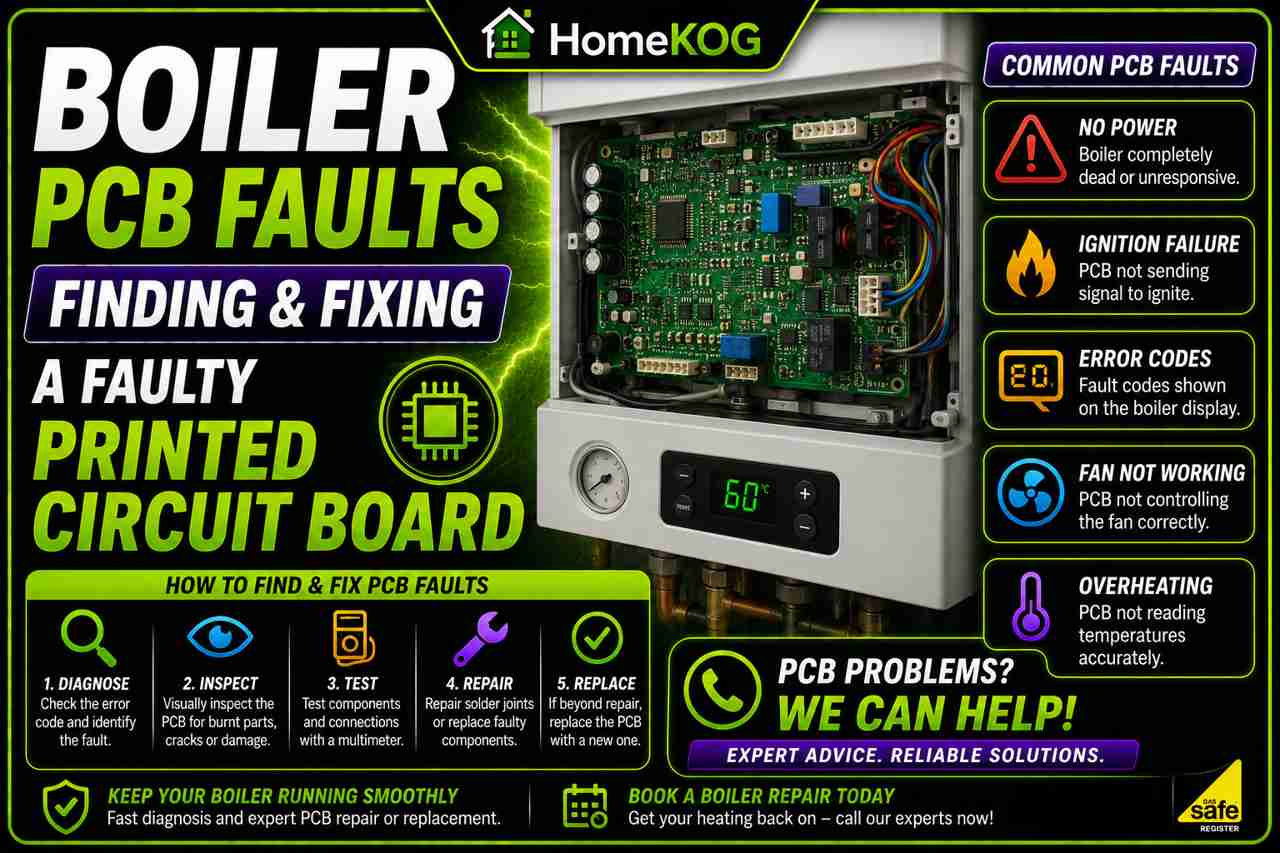
The PCB is to a boiler what the engine management unit is to a modern car — a control board that monitors sensor inputs from every component, makes decisions about operation, triggers safety lockouts when parameters exceed safe limits, and displays fault codes when problems are detected. When it fails, the boiler cannot function. Understanding why PCB faults occur, how to recognise the symptoms, and what the repair or replacement options are helps homeowners respond appropriately when the boiler stops working.
What Does a Boiler PCB Do?
The PCB sits inside the boiler casing and provides the electrical intelligence that coordinates the boiler’s operation. Before every ignition sequence, the PCB runs through a pre-ignition checklist: it signals the fan to start, waits for the air pressure switch to confirm that the fan is creating the correct flue draught, then — and only then — signals the gas valve to open and the ignition electrode to spark. Only after the flame sensor confirms a stable flame does the PCB allow the boiler to continue operating.
Throughout operation, the PCB continuously monitors the temperature sensors (thermistors) at the flow and return, the system pressure sensor, the fan speed, the flame signal, and the safety thermostat status. If any monitored parameter moves outside its safe operating range, the PCB triggers a boiler lockout and displays a fault code indicating the specific out-of-range condition.
This constant monitoring and response function is why a PCB fault can manifest as many different apparent symptoms — a faulty PCB may incorrectly interpret correct sensor readings as abnormal, or may fail to send the correct signal to a component that is itself perfectly functional.

What Causes Boiler PCB Faults?
Age and Wear
The most common cause of PCB failure is the accumulated effect of years of thermal cycling — the board heats and cools slightly with every boiler firing cycle. Over 8 to 15 years of use, the solder joints that attach electronic components to the circuit board develop micro-fractures. These fractures eventually cause intermittent or permanent electrical failure at the connection point. This is why PCB faults are significantly more common in boilers over 8 years old than in newer units.
Water Ingress
Water and electronics are incompatible. A PCB that becomes wet — even briefly — through dripping condensate, a weeping pump seal, a heat exchanger leak, or any other internal water source will suffer damage. Moisture on energised components causes short circuits and corrosion at solder joints and component terminals. The damage may not be immediately apparent — the PCB may continue functioning for weeks or months before the corroded contacts fail permanently.
The burning smell reported in some PCB fault scenarios is typically the result of moisture reaching live connections, causing localised combustion of circuit board material. This is always an urgent situation — switch the boiler off immediately and call a Gas Safe engineer.
Damaged Solder Joints
Even without water damage, solder joints deteriorate over time through thermal cycling and vibration. A solder joint that has cracked can cause intermittent connection — the PCB functions normally when the joint is in contact but fails when the joint opens under different thermal or vibration conditions. This produces the intermittent, apparently random fault behaviour that characterises some PCB problems.
A Gas Safe engineer can sometimes repair individual solder joint failures using reflowing or resoldering techniques. However, on an older PCB where multiple joints are deteriorating, spot repairs are temporary — the board is likely to develop further joint failures within a short time. Full PCB replacement is the more reliable long-term solution.
Boiler Vibration
All boilers produce some vibration during operation. Abnormal vibration — typically caused by a worn pump bearing, an imbalanced fan impeller, or loose component mounting — transmits additional mechanical stress to the PCB and its connections. Fragile solder joints and chip connections on the PCB can loosen or fracture under excessive vibration before their age would otherwise cause failure.
When a Gas Safe engineer diagnoses a PCB fault associated with unusual boiler noise, they will typically identify and address the vibration source first. A new PCB installed in a boiler with unresolved excessive vibration will face the same failure mechanism as the original. In addition to addressing the vibration source, the engineer may also implement various boiler kettling noise solutions to mitigate the issue further. These solutions can include adjusting the water flow or replacing components that may be contributing to the noise. Ultimately, ensuring the boiler operates quietly and efficiently is essential for both safety and comfort.
Signs of a Faulty Boiler PCB
Blank or Intermittent Display Panel
A display panel that is completely blank despite the boiler having power at the mains — or that shows intermittent lighting, blue, red, or green flashing without the normal display content — indicates either a PCB fault or a loose connection between the display module and the PCB. A Gas Safe engineer will open the boiler and check the connections between the display and the main PCB board.
Boiler Shutting Off Before Reaching Temperature
If the boiler fires and then shuts off before the heating water reaches the set temperature, the PCB may be incorrectly interpreting the thermistor readings — causing it to believe the water has reached temperature when it has not. This produces a frustrating cycle of brief firing, shutdown, and restart without the system ever reaching the target temperature. The symptom can also be caused by a faulty thermistor itself, so the engineer must test both the thermistor and the PCB to identify which has failed.
Fan Not Starting or Not Detected
The boiler will not ignite if the PCB does not detect the fan running. If the fan is functioning correctly but the PCB is not receiving the air pressure switch signal that confirms the fan, the boiler locks out before every ignition attempt. The engineer tests the fan, the air pressure switch, and the wiring between each component and the PCB to isolate the fault.
Gas Valve Failing to Open or Stay Open
The PCB sends an electrical signal to the gas valve to open during an ignition sequence. If the communication between the PCB and the gas valve is interrupted by a failed relay on the PCB or a wiring fault, the gas valve may not open, open intermittently, or in some failure modes remain open when it should close. A gas valve that remains open when commanded to close is a safety-critical situation — the boiler will lock out but the fault requires immediate engineer attendance.
Memory Fault Displayed
Some boiler fault codes specifically reference a PCB memory or configuration error. This appears most commonly on newly installed boilers where the PCB has not been configured with the correct product code, or on boilers where the PCB has been replaced. The fix for a configuration error is to enter the product code from the boiler manual. A true PCB memory failure requires board replacement.
Burning Smell from the Boiler
A burning smell from inside the boiler casing — particularly when accompanied by fault codes and intermittent operation — indicates that moisture has reached energised PCB connections. This is an urgent situation. Switch the boiler off at the mains immediately. Do not restart the boiler. Call a Gas Safe engineer. The engineer must locate and repair the water leak before assessing and replacing the PCB.
PCB Replacement Cost
| Cost Element | Typical Range |
|---|---|
| Replacement PCB (parts only) | £200–£450 |
| Labour (diagnosis and installation) | £80–£200 |
| Total installed cost | £410–£650 |
PCB costs vary significantly between boiler brands and models — premium brands and current models command higher parts prices than budget brands or discontinued models. A reconditioned or refurbished PCB is available at lower cost, but these units do not carry a manufacturer’s warranty and have an uncertain remaining service life. For a boiler under warranty, the manufacturer may supply and fit the PCB under warranty terms at no charge — always check warranty status before paying for a PCB repair.
Repair or Replace? The Key Decision
The total PCB replacement cost of £410 to £650 must be assessed in the context of the boiler’s age and overall condition.
For a boiler under 5 years old within its manufacturer’s warranty, PCB replacement is straightforward — the warranty should cover the part and labour at no cost. For a boiler between 5 and 8 years old out of warranty, PCB replacement at £410 to £650 is almost always the correct decision — the boiler has 5 to 10 years of potential service life remaining and the repair cost is a reasonable investment against a new boiler at £1,800 to £2,500.
For a boiler over 8 to 10 years old, the calculation changes. A PCB replacement at £600 on a 12-year-old boiler with no remaining warranty, declining efficiency, and potential further component failures represents a substantial investment in a system that may need replacement within 2 to 3 years regardless. In this scenario, comparing the PCB replacement cost against the full cost of a new boiler installation — which provides 10 to 12 years of warranty coverage and 92 to 98% efficiency — is essential before committing to the repair.
FAQ
Can I repair a boiler PCB myself?
No. The PCB is wired into the boiler’s gas valve, ignition system, and safety controls. Working on PCB connections without Gas Safe registration is illegal, unsafe, and will void any remaining manufacturer’s warranty. PCB diagnosis and replacement must be carried out by a Gas Safe registered engineer.
How long does PCB replacement take?
A Gas Safe engineer can typically diagnose a PCB fault and replace the board in 1 to 2 hours if the correct replacement PCB is available. If the PCB must be ordered, the boiler will be out of service until the part arrives — typically 1 to 5 working days depending on the brand and model.
Will a new PCB fix all boiler problems?
Not necessarily. A PCB fault is a specific diagnosis — the PCB has been tested and confirmed to be the cause of the fault. Installing a new PCB in a boiler where the fault was actually caused by a faulty thermistor, a failed gas valve, or a pump fault will not resolve the original problem. Accurate diagnosis by an experienced Gas Safe engineer is essential before any PCB replacement is ordered.
Is a boiler with a PCB fault dangerous?
A boiler that has locked out due to a PCB fault and is displaying an error code is not operating — it has shut itself down safely. In this state it is not an immediate hazard. A burning smell from the boiler, however, requires immediate shutdown and engineer attendance as it indicates active electrical damage that could progress to a more serious failure. A gas leak associated with a suspected PCB fault is a separate gas emergency requiring the National Gas Emergency Service on 0800 111 999.
How can I prevent PCB faults?
Annual servicing by a Gas Safe engineer is the most effective preventive measure — engineers check for early signs of component deterioration, condensate leakage that could reach the PCB, and abnormal vibration that stresses board connections before a fault develops. Ensuring the boiler condensate system drains correctly reduces moisture accumulation inside the casing.
Conclusion
A boiler PCB fault is one of the more significant repair scenarios a homeowner can face — involving the most expensive single component in the boiler, requiring specialist diagnosis, and prompting the important decision of whether to repair or replace the unit. For those considering their options, exploring boiler finance options for homeowners can be a practical step in managing the financial implications of such repairs. Many service providers offer flexible payment plans that can help alleviate the financial burden. Additionally, understanding available financing may assist homeowners in deciding whether to repair their existing boiler or invest in a new, more efficient model.
The repair-versus-replace calculation is straightforward: for boilers under 8 years old, PCB replacement is almost always the right answer. For boilers over 10 years old without warranty and with a history of developing faults, the PCB replacement cost of £410 to £650 should be directly compared against the installed cost of a new boiler before committing. Annual servicing remains the most effective measure for extending PCB life — catching water ingress, vibration, and early component deterioration before they cause the board failures that stop the heating and hot water in their tracks.