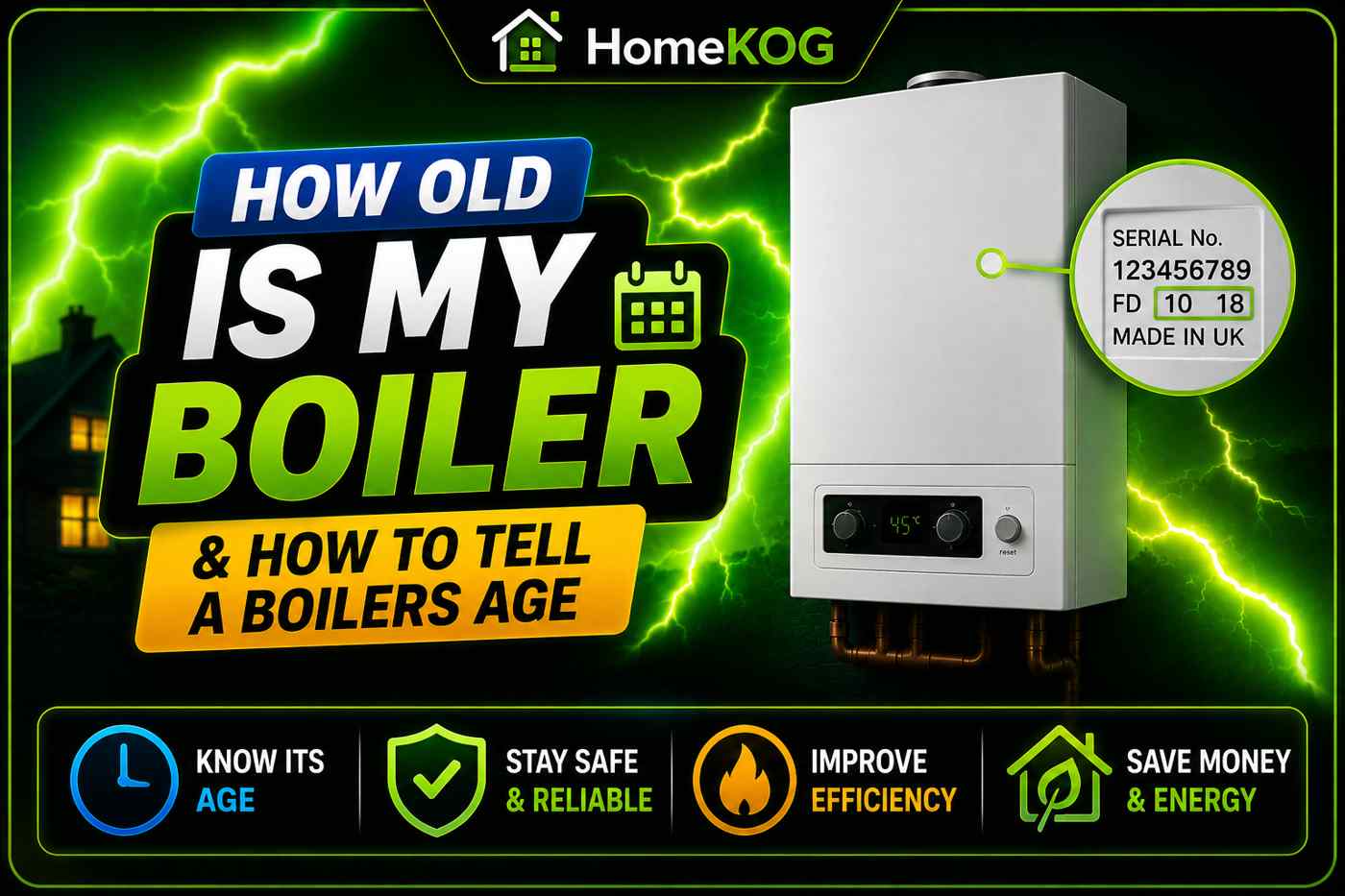

How Old is My Boiler? How to Tell a Boiler’s Age 2026
Quick Answer: The most reliable way to find out how old a boiler is is to check the serial number on the boiler’s data plate, usually found on the front panel, side, or inside the casing. For Vaillant boilers, the 3rd and 4th digits of the serial number show the manufacture year. For Ideal boilers, the date format varies by model but is encoded in the serial number. For Baxi boilers manufactured after 2003, the second section of the serial number shows the year. For Worcester Bosch, contact customer support with the serial number for the exact date. Boilers over 10 years old should be assessed for replacement — efficiency typically falls to 80% or below, repairs become costlier, and parts availability reduces.
Knowing your boiler’s age has real practical value. A boiler entering its second decade is consuming more gas than it did when new, increasing heating bills year on year. Parts become harder to source. Repairs become more frequent. Understanding when a boiler was manufactured allows homeowners to make informed decisions about whether to repair a fault or replace the unit — one of the most financially significant heating decisions most households face. This guide explains how to find the manufacture date for every major UK boiler brand and what the signs of an aging boiler look like before it fails completely.
Finding a Boiler’s Age by Serial Number
Every boiler has a data plate — a label or stamped plate showing the model name, model number, serial number, and technical specifications. The data plate is typically found on the front of the boiler when the casing is opened, on the inside of the front panel, or on a sticker on the side of the casing. The serial number encodes the manufacture date in a format that varies by manufacturer.

Worcester Bosch Boiler Age
Worcester Bosch does not encode the manufacture date in the serial number in a format accessible to the general public. The serial number must be provided to Worcester Bosch customer support — who can look up the exact manufacture date from the serial number. The customer support number is on the Worcester Bosch website.
Alternatively, the boiler’s Benchmark certificate — the commissioning document completed by the installer at installation — shows the installation date, which gives a reliable indication of the boiler’s age even if not the precise manufacture date.
Vaillant Boiler Age
Vaillant serial numbers encode the manufacture year in the 3rd and 4th digits. A serial number beginning 26012463… indicates manufacture in 2001. Count to the 3rd and 4th characters in the serial number and read them as the two-digit year of manufacture.
For example: serial number 26012463030010256754 — the 3rd and 4th digits are 01, indicating manufacture in 2001.
Ideal Boiler Age
Ideal uses different date encoding formats across its different model ranges.
Ideal Mini: The last four digits of the serial number encode the manufacture month and year. For example, serial number N104250308 — last four digits are 0308 — meaning month 03 (March), year 08 (2008). Manufacture date: March 2008.
Ideal Classic: The third section of the serial number encodes the date. For example, serial number UZ 202034 0912 00149 — the third section 0912 means week 12 of 2009.
Ideal Logic: For Logic boilers manufactured after 2015, the final six digits read Day/Month/Year. For Logic boilers manufactured before 2015, the final six digits read Year/Month/Day. Identifying whether the boiler is pre- or post-2015 first is necessary to read the date correctly.
Baxi Boiler Age
For Baxi boilers manufactured after 2003, the serial number format is: ABC-06-10-00311-AP. The second section is the manufacture year — in this example, 06 indicates 2006. Open the drop-down panel at the front of the Baxi boiler to locate the data plate and serial number.
For older Baxi models or back boilers (Baxi Bermuda), the format may differ — contact Baxi customer support with the serial number for confirmation.
Other Boiler Brands
For brands not listed above — Viessmann, Alpha, Glow-Worm, Ferroli, and others — the manufacture date can often be found by searching the serial number on the Product Characteristics Database (PCDB) at the HETAS or BRE website. The PCDB records all boilers registered for UK sale with their manufacture specifications. The boiler type, fuel, manufacturer, and model information from the owner’s manual or data plate is needed to search the database.
Signs That a Boiler is Getting Old
Even without knowing the exact manufacture date, several observable symptoms indicate that a boiler is aging beyond its optimal service life.
Declining Efficiency
A new condensing boiler achieves 92 to 98% efficiency. After 10 years of use, the same boiler may be operating at 80% or below — even with annual servicing — due to cumulative heat exchanger scaling, combustion calibration drift, and seal degradation. At 80% efficiency, 20% of purchased gas is wasted as heat escaping through the flue rather than warming the home. On a £1,400 annual gas bill, this represents £280 per year in fuel waste that a new A-rated boiler would not incur. After 15 years without replacement, efficiency may have fallen to 60 to 70% — wasting £420 to £560 per year. Choosing the best condensing boilers for winter can significantly impact energy efficiency and overall heating costs. By investing in an efficient model, homeowners can ensure they minimize fuel waste and maintain a warm, comfortable environment during the coldest months. It’s essential to research and select models that not only meet energy efficiency standards but also offer reliable performance over time.
Increasing Repair Frequency
A boiler that required one repair call-out per year in its first five years but is now requiring two or three per year in its tenth year is exhibiting the accumulating component failure pattern typical of aging equipment. Each repair call-out costs £80 to £200 for attendance plus parts. Three call-outs per year adds £240 to £600 in maintenance costs annually — costs that cease immediately upon replacement with a new boiler under a 10 to 12-year warranty.
Parts Unavailability
When a Gas Safe engineer attends a fault and reports that replacement parts for the specific boiler model are unavailable or must be sourced from specialist suppliers at extended lead times, the boiler has effectively reached the end of its serviceable life. Manufacturers typically support parts supply for 10 years after a model is discontinued. A boiler for which standard parts cannot be obtained should be replaced rather than left unrepaired.
Unusual Noises
Whistling, banging, kettling, or gurgling noises from an aging boiler indicate limescale accumulation on the heat exchanger, sludge in the pipework, or mechanical component wear. While these issues can sometimes be addressed through power flushing or part replacement in younger boilers, in a boiler over 10 to 12 years old the same faults are often symptomatic of general deterioration rather than an isolated repairable issue.
Reduced Heating Performance
A home that was adequately warm with the heating set to 20°C five years ago but now requires 22°C or more to achieve the same comfort level is experiencing the declining heat output of an aging boiler. The boiler is burning the same amount of gas but delivering less useful heat — the efficiency degradation that compounds every year the boiler continues in service. To ensure your heating system remains efficient, it’s crucial to consider boiler maintenance tips for summer. Regular check-ups can help identify potential issues before the colder months arrive, preventing unexpected breakdowns when you need heat the most. Additionally, addressing maintenance during the warmer season can save you money and extend the lifespan of your boiler.
Rising Energy Bills
An energy bill that has increased year over year without a corresponding increase in gas consumption behaviour or tariff changes indicates that the boiler is using more gas to produce the same heat. This is the financial manifestation of declining efficiency. Homeowners may find themselves facing high costs due to this inefficiency and should explore boiler finance options for homeowners to alleviate the financial burden. These options can provide manageable payment plans for necessary upgrades or replacements. By investing in a more efficient boiler, homeowners can ultimately save on their energy bills in the long run.
When Should You Replace Your Old Boiler?
The industry consensus is that a boiler over 10 years old should be assessed for replacement. The assessment should consider the boiler’s remaining warranty (none for most boilers over 10 years), the current repair frequency and likely future repair trajectory, the efficiency relative to a new A-rated replacement, and the total cost of continuing to use the aging boiler versus the total cost of replacement.
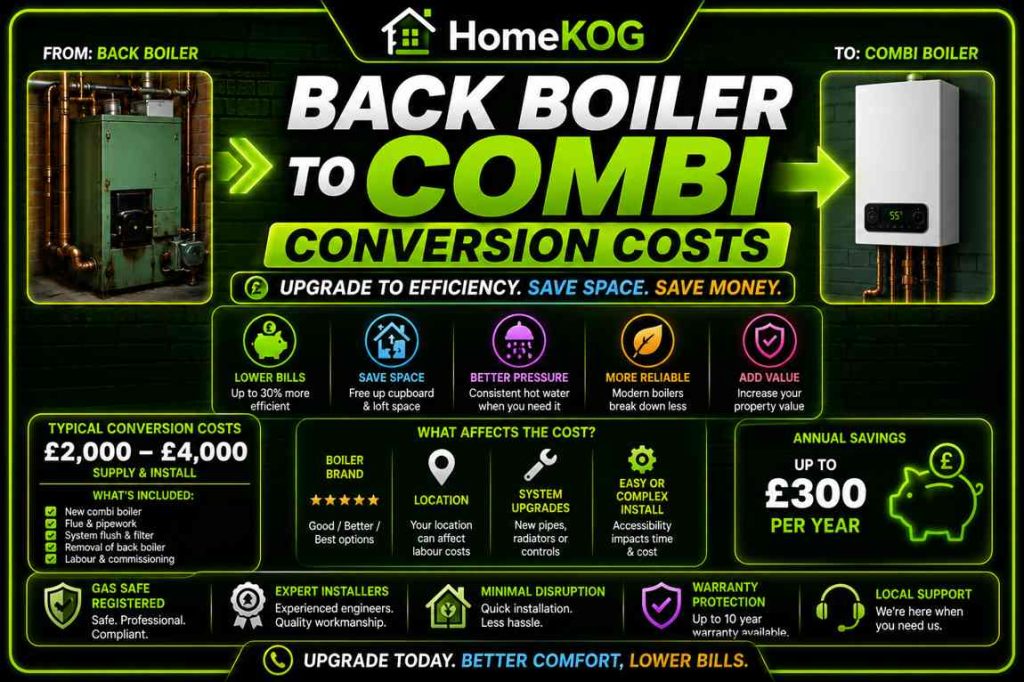
A simple calculation helps: take the difference between the current boiler’s estimated efficiency and a new boiler’s efficiency, apply this to the annual gas bill, and calculate how many years it would take the annual fuel saving to pay back the installation cost of a new boiler. For a boiler at 70% efficiency replaced by a 94% efficient model on an annual gas bill of £1,400, the fuel saving is approximately £360 per year — a new boiler installed for £2,000 to £2,500 pays back in 5.5 to 7 years in fuel savings alone.
Additionally, for boilers over 8 years old that require a significant repair — heat exchanger replacement at £300 to £600, PCB at £200 to £500 — the repair cost should be compared directly against a new boiler installation cost. If the repair cost is 30% or more of the cost of a new boiler, replacement is almost always the better financial decision.
FAQ
How long should a boiler last?
A modern condensing boiler that is annually serviced and installed in a system with magnetic filter protection should last 10 to 15 years. Some well-maintained boilers in clean systems last 20 years, though efficiency will have declined substantially by this point. The manufacturer’s warranty — typically 7 to 12 years depending on the brand and model — provides the reference period for expected reliable service life.
How do I find my boiler’s serial number?
The serial number is on the data plate — a label or stamped metal plate attached to the boiler. Typical locations are the front of the boiler when the casing panel is opened, the inside of the front cover, or a sticker on the side casing. It is a long alphanumeric string, often 10 to 20 characters, distinct from the model number which is typically shorter and refers to the product range.
Is a 15-year-old boiler worth repairing?
Generally not unless the repair is minor and inexpensive (under £150). A 15-year-old boiler has no remaining warranty, is operating at significantly reduced efficiency, and is at high risk of further component failures within a short time of any repair. The combined cost of repairs, higher fuel bills from reduced efficiency, and increasing repair call-out frequency almost always exceeds the cost of a new installation when calculated over the next three to five years.
What is the most efficient replacement for an old boiler?
All new gas boilers sold in the UK achieve a minimum 92% efficiency under the Boiler Plus regulations. The most efficient gas boilers available are the Viessmann Vitodens 200-W at up to 98%, followed by Worcester Bosch Greenstar 8000 and Ideal Vogue Max at 94 to 95%. For properties considering a complete move away from gas, an air source heat pump with the £7,500 Boiler Upgrade Scheme grant is the most carbon-efficient replacement option.
Conclusion
Finding out how old a boiler is takes five minutes — the serial number on the data plate encodes the manufacture date for most major brands, and customer support lines for Worcester Bosch and Baxi can confirm the date from the serial number within minutes. Armed with this information, the decision about whether to continue maintaining an aging boiler or plan for its replacement can be made on the basis of actual age rather than guesswork.
The guideline to assess replacement from 10 years is not an arbitrary figure — it reflects the realistic efficiency trajectory of a condensing boiler, the parts availability window maintained by most manufacturers, and the accumulating repair cost pattern that makes older boilers progressively more expensive to maintain relative to the cost of a new installation. A proactive summer replacement before the boiler fails in winter saves the emergency call-out premium, allows time to compare boiler options properly, and ensures the home enters the heating season with a fully warranted, maximally efficient heating system. As temperatures drop, homeowners often experience common boiler issues during winter that can lead to discomfort and increased energy bills. By addressing potential problems early, such as worn out components and inefficient heating, the likelihood of a breakdown can be significantly reduced. Investing in a new system before the colder months can provide better reliability and improved performance, ultimately ensuring a warm and safe living environment.