
Will Gas Boilers Be Banned in 2026? What You Need to Know and the Alternatives
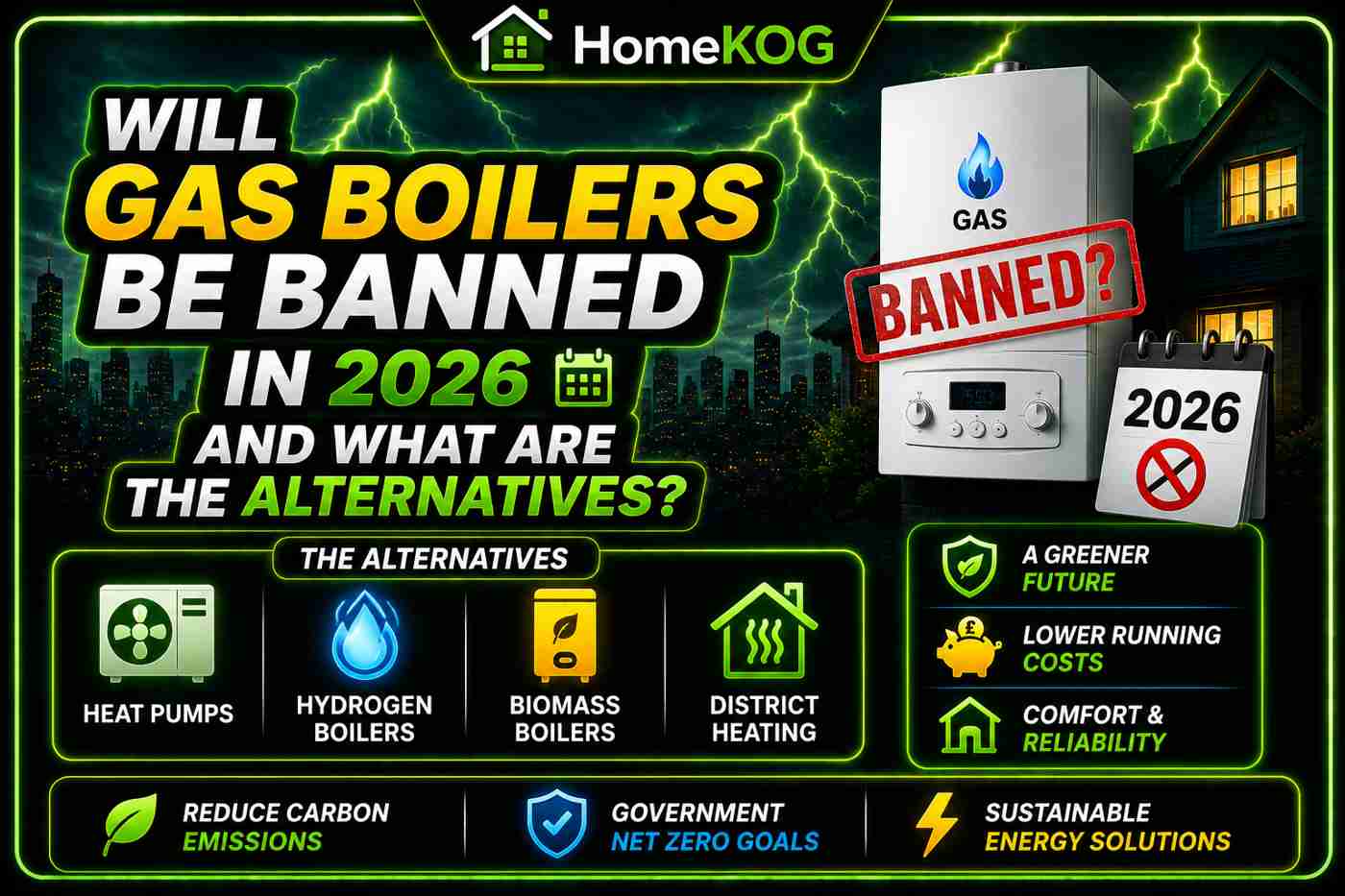
Quick Answer: Gas boilers will not be banned in 2026. The current UK government policy bans new gas boiler installations in new-build homes from 2025 under the Future Homes Standard, and plans to phase out the sale of new gas boilers for existing homes by 2035 — though this date may be subject to revision. Homeowners with existing gas boilers can continue using them and can still buy replacement gas boilers. The most practical near-term alternative is a hydrogen-ready boiler, which works identically to a standard gas boiler today but can transition to hydrogen fuel if the gas grid is converted. Heat pumps are the leading low-carbon alternative but require higher upfront investment and good insulation to perform effectively.
The gas boiler ban is one of the most widely misunderstood energy policy topics in the UK. Headlines describing an imminent ban have alarmed many homeowners unnecessarily — the reality is a gradual, phased transition rather than an abrupt switch-off. Understanding exactly what is planned, when, and for whom is essential to making informed decisions about whether to replace an existing boiler now, which replacement to choose, and whether any of the available alternatives are appropriate for the specific property. This guide explains the policy position accurately as of 2026 and assesses every alternative heating technology against real-world costs and practical applicability. As homeowners consider their options, it’s crucial to also identify the worst boiler brands to avoid, ensuring that any new investment is sound. Researching specific brands can prevent future headaches and unexpected costs. Furthermore, informed choices about both technology and brands will ultimately lead to greater satisfaction and efficiency in heating systems.
What is the Current Gas Boiler Ban Policy?
There are two distinct elements of UK gas boiler policy that are frequently conflated in media coverage: the new-build ban and the existing homes phase-out. The new-build ban is aimed at ensuring all new homes incorporate energyefficient boiler solutions for homes, while the existing homes phase-out focuses on retrofitting solutions for current residences. Together, these policies are designed to significantly reduce carbon emissions from domestic heating. As a result, homeowners will need to adapt to these changes and consider transitioning to more sustainable heating options.
The new-build ban is already in effect. From 2025, new homes built in the UK cannot be fitted with gas boilers as the primary heating system under the Future Homes Standard — new builds must instead use low-carbon heating systems such as heat pumps. This affects only new construction and has no immediate impact on the approximately 23 million existing gas boiler installations in UK homes.
The existing homes phase-out refers to the government’s stated intention to stop the sale of new gas boilers for installation in existing homes from 2035. This means that after 2035, a homeowner whose boiler fails would not be able to replace it with a new gas boiler — they would need to switch to a low-carbon alternative. This policy has faced significant political and practical opposition and its exact implementation timeline remains subject to revision. Gas boilers that are already installed before 2035 are not affected — there is no plan to require the removal of working gas boilers.
The key practical implication for most homeowners in 2026 is that nothing has changed about daily boiler operation, and a new gas boiler purchased today will likely still be legally installable as a replacement for at least another decade and operational for 10 to 15 years beyond that.

Why Are Gas Boilers Being Phased Out?
Domestic heating accounts for approximately 14% of total UK greenhouse gas emissions — a larger contribution than all UK car journeys combined. English homes alone produce more carbon emissions from heating than the UK’s entire car fleet produces from driving. With the UK legally committed to net zero emissions by 2050 and an 78% reduction in greenhouse emissions compared to 1990 levels by 2035, the decarbonisation of domestic heating is unavoidable in the long-term trajectory.
Natural gas combustion in a boiler produces carbon dioxide directly — approximately 2.0 kg of CO₂ per kWh of gas burned. Replacing gas heating with a heat pump powered by increasingly renewable electricity produces a fraction of this carbon output, and the advantage grows as the electricity grid continues to shift toward wind, solar, and other renewables.
The case for decarbonising heating is clear from a climate perspective. The challenge is practical — 85% of UK homes use gas heating, the gas network infrastructure represents decades of investment, and the low-carbon alternatives all require either higher upfront costs, more complex installation, or changes to how the home distributes heat. These practical barriers are precisely why the government has chosen a gradual phase-out over a fixed deadline approach.
What Does the Gas Boiler Ban Mean for Homeowners Right Now?
For the vast majority of UK homeowners, the gas boiler policy changes currently have no immediate practical impact. Existing gas boilers can continue to be used and serviced without restriction. If an existing gas boiler fails today, a like-for-like replacement gas boiler can still be installed. The only homeowners directly affected by current policy are those building new homes, who cannot specify gas boilers as the primary heating system under the Future Homes Standard.
The decision most relevant to homeowners with aging gas boilers — typically those over 10 to 12 years old — is whether to replace with a new gas boiler now, allowing 10 to 15 more years of gas heating before the 2035 phase-out approaches, or to invest in a low-carbon alternative now and benefit from lower running costs and available grants. Both decisions are defensible depending on the property’s circumstances, budget, and the homeowner’s priorities.
Alternatives to Gas Boilers
Hydrogen-Ready Boilers — Most Practical Near-Term Alternative
Hydrogen-ready boilers are the most practical near-term alternative for homeowners who want to replace an aging gas boiler while positioning themselves for the energy transition. They look identical to standard gas boilers, are installed in the same way, cost the same, work with existing radiator systems and pipework, and run on natural gas today — exactly as a standard boiler would.
The distinguishing feature is that they are designed to be modified to run on hydrogen gas with a relatively simple component swap, without requiring a new boiler installation. If and when the gas grid introduces a hydrogen-natural gas blend — or transitions fully to hydrogen — a hydrogen-ready boiler can make the transition without replacement.
Nearly all new gas boilers sold in the UK today are hydrogen-ready to a 20% hydrogen blend as standard. Some models are fully hydrogen-ready for 100% hydrogen operation. For homeowners replacing a boiler today, specifying a hydrogen-ready model rather than a standard gas boiler costs little or nothing extra and provides long-term transition security.
Estimated cost: £400 to £3,000 for the boiler unit, £1,500 to £3,500 fully installed — comparable to a standard gas boiler installation.
Air Source Heat Pumps
Air source heat pumps extract heat from outdoor air and are the most accessible low-carbon heating technology in terms of installation requirements — they need only an external wall mounting position and electrical connection, with no excavation or groundwork required. understanding pressure release valve functionality explained is crucial for ensuring the safe and efficient operation of these systems. These valves play a vital role in maintaining optimal pressure levels, preventing potential failures or malfunctions. By effectively managing pressure, they contribute to the longevity and reliability of air source heat pumps.
Modern air source heat pumps work effectively down to outdoor temperatures of -15°C and below, making them viable across the full UK climate range. They are most efficient in well-insulated properties and work best with underfloor heating or oversized radiators that distribute heat at the lower flow temperatures heat pumps produce.
The £7,500 Boiler Upgrade Scheme grant significantly reduces the upfront cost — in some cases to near zero for entry-level installations. The running cost advantage over a gas boiler depends on the property’s insulation standard and the prevailing electricity-to-gas price ratio.
Estimated cost: £7,000 to £10,000 installed before grant, potentially £0 to £2,500 after the £7,500 Boiler Upgrade Scheme grant.
Ground Source Heat Pumps
Ground source heat pumps deliver more consistent efficiency than air source because they draw heat from the ground — which remains at approximately 10°C year-round — rather than from outdoor air, which varies with season. They produce 3.5 to 4.5 units of heat for every unit of electricity consumed, compared to 2.5 to 3.5 for air source systems in winter.
The limitations are the requirement for substantial garden space for horizontal ground loops, or borehole access for vertical systems, and the higher installation cost even after the £7,500 Boiler Upgrade Scheme grant.
Estimated cost: £14,000 to £19,000 installed before grant, £6,500 to £11,500 after the £7,500 grant.
Solar Thermal Panels
Solar thermal panels are installed on the roof and use sunlight to heat water in a storage cylinder, reducing the energy demand on the primary heating system for domestic hot water. They work year-round in the UK — even overcast conditions produce useful solar thermal output — but are most productive in summer when hot water heating from a gas boiler is otherwise least cost-effective.
Solar thermal is not a whole-house heating replacement — it supplements hot water heating rather than providing space heating. It works well in combination with a gas boiler or heat pump as part of a hybrid approach.
Estimated cost: £3,000 to £6,000 fully installed including collectors, hot water tank, pipes, and controls.
Biomass Boilers
Biomass boilers burn biological material — most commonly wood pellets, wood chips, or logs — to generate heat and hot water. They are classified as renewable because the CO₂ released during combustion was absorbed by the plant during growth, creating a roughly carbon-neutral cycle when sourced sustainably. They can deliver comparable heat output to a gas boiler and suit rural properties with storage space for fuel.
The limitations are the physical space required for fuel storage, the need for regular ash removal and maintenance, and the dependence on wood pellet supply chains that can be affected by price volatility.
Estimated cost: £5,000 to £14,000 depending on size, with running costs at approximately 4.2p per kWh using wood pellets — competitive with gas.
Infrared Heating Panels
Infrared heating panels use electricity to heat objects and surfaces in the room directly — walls, floors, furniture, and occupants — rather than heating the air as conventional radiators do. This can be more efficient than air heating in certain applications because the radiant heat is retained in the structure of the room rather than being lost through ventilation.
Infrared panels are a supplementary or partial replacement option rather than a whole-house system for most properties. They are particularly effective in conservatories, outbuildings, and spaces that are used intermittently rather than continuously heated.
Estimated cost: £130 to £175 per panel with low installation costs. Infrared underfloor heating costs approximately £75 per square metre.
Heating Technology Comparison
| Technology | Upfront Cost | Running Cost | Carbon Emissions | Disruption | Best For |
|---|---|---|---|---|---|
| Hydrogen-ready boiler | £1,500–£3,500 | Low (gas) | Medium (reducing) | Minimal | Like-for-like replacement |
| Air source heat pump | £0–£2,500 after grant | Lower than gas | Low | Low | Well-insulated homes, limited garden |
| Ground source heat pump | £6,500–£11,500 after grant | Lowest | Very low | Moderate | Large gardens, long-term ownership |
| Solar thermal | £3,000–£6,000 | Very low | Very low | Low | Hot water supplementation |
| Biomass boiler | £5,000–£14,000 | Low | Near zero | Moderate | Rural properties with storage space |
| Infrared panels | £130–£175 per panel | Low | Low (electric) | Very low | Supplementary or intermittent use |
The Future of Home Heating in the UK
The heating landscape in the UK is transitioning — not overnight, but progressively. New builds are already required to use low-carbon heating. Government grants are incentivising voluntary heat pump adoption in existing homes. Heat pump installation volumes are increasing year on year as costs reduce with growing manufacturing scale. Hydrogen blending trials are ongoing in the gas grid.
The most likely trajectory for the majority of UK homes involves a combination of approaches rather than a single universal replacement for gas boilers. Hybrid systems — pairing a hydrogen-ready gas boiler with an air source heat pump — allow the heat pump to handle the baseline heating load during mild weather while the gas boiler handles peak demand on the coldest days, optimising the efficiency benefits of both technologies without the total dependence on heat pump output that full replacement requires. Homeowners should consider the best combi boilers for the UK when looking to enhance their heating systems. These boilers offer compact solutions for smaller spaces, delivering hot water on demand and improving energy efficiency. As the market evolves, selecting the right boiler becomes increasingly important in the transition to more sustainable energy practices.
Mechanical Heat Recovery Ventilation (MHRV) systems — which capture heat from extracted stale air and use it to pre-heat fresh incoming air — will become increasingly relevant as homes are better insulated and ventilation management becomes more important for air quality and moisture control. These systems recover over 80% of the heat that would otherwise be lost through ventilation, complementing low-temperature heating systems by reducing overall heat demand.
FAQ
Will my gas boiler be banned in 2026?
No. Existing gas boilers are not affected by any current or planned ban. The 2025 ban applies only to new-build homes. The 2035 phase-out applies to the sale of new gas boilers for replacement in existing homes — it does not require removal of working boilers already installed. Homeowners can continue using existing gas boilers and can still purchase replacement gas boilers today.
Should I replace my gas boiler before 2035?
Not necessarily on policy grounds alone. A gas boiler installed today will likely still be legally and practically usable for its full 10 to 15-year lifespan even if the 2035 phase-out proceeds as planned. The more relevant consideration is whether the boiler is currently performing efficiently and whether the running cost saving from a heat pump justifies the upfront investment for the specific property. For boilers under 8 years old and in good working order, replacement now is unlikely to be economically justified by the policy change alone.
Are hydrogen boilers the future?
Hydrogen-ready boilers are likely to be a significant part of the UK’s heating transition because they use the existing gas network infrastructure and are installed and operated in essentially the same way as current gas boilers. The critical uncertainty is the timeline and cost of hydrogen gas availability — the UK government is conducting trials of hydrogen blending in the gas grid, but full network hydrogen conversion remains dependent on hydrogen production costs reducing substantially. For homeowners replacing a boiler today, specifying a hydrogen-ready model is a sensible precaution at no additional cost.
Can I convert my existing gas boiler to hydrogen?
Most existing gas boilers can operate on a natural gas and hydrogen blend of up to 20% with no modification — 20% hydrogen blending in the gas grid would be transparent to current boiler users. Running an existing boiler on 100% hydrogen requires component changes that most older boilers are not designed to accommodate. New hydrogen-ready boilers are specifically designed to make this transition with a relatively simple modification kit when 100% hydrogen becomes available.
What is the best alternative to a gas boiler?
The best alternative depends on the property. For a well-insulated home with underfloor heating or space for larger radiators, an air source heat pump after the £7,500 Boiler Upgrade Scheme grant is the most cost-effective low-carbon replacement. For properties with substantial garden space and a long-term ownership perspective, a ground source heat pump offers better year-round efficiency. For homeowners not ready to transition away from gas infrastructure, a hydrogen-ready boiler is the most practical near-term choice.
Conclusion
The gas boiler ban is not the imminent event that some media coverage implies. The current practical reality for UK homeowners in 2026 is that gas boilers remain legal, available, and the most cost-effective heating solution for the majority of existing UK properties — and will remain so throughout the likely lifespan of any boiler purchased today. Homeowners should be aware of various boiler explosion risk factors, including improper installation, lack of maintenance, and outdated equipment. Ignoring these issues can lead to dangerous situations that may compromise safety. It’s essential to prioritize regular inspections and address any concerns promptly to ensure a safe heating environment.
The informed approach is to understand where the energy transition is heading, choose a hydrogen-ready boiler as the default replacement when the current boiler reaches end of life, and evaluate whether the property’s insulation standard, available space, and budget make a heat pump a viable and financially attractive alternative — particularly in light of the £7,500 Boiler Upgrade Scheme grant that currently makes air source heat pumps accessible at low net cost. Both paths are legitimate and the right choice depends entirely on the specific property and household circumstances rather than on any regulatory urgency that does not yet exist for existing home owners.